eBook - ePub
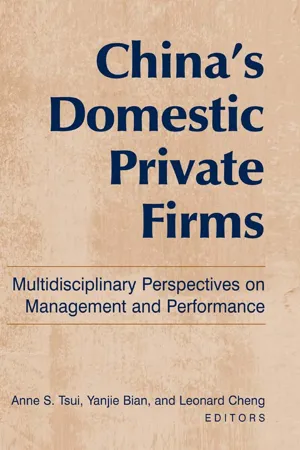
China's Domestic Private Firms:
Multidisciplinary Perspectives on Management and Performance
- 336 pages
- English
- ePUB (mobile friendly)
- Available on iOS & Android
eBook - ePub
China's Domestic Private Firms:
Multidisciplinary Perspectives on Management and Performance
About this book
One of the most important outcomes of market reforms in China over the past 20 years has been the emergence of a significant domestic private sector, which now accounts for almost a third of China's GDP and is by far the country's most important source of employment growth. This book is the first in-depth analysis of the management and operation of these domestic private firms, which are defined as companies or organizations created by PRC citizens, including township enterprises and collectives. The book provides a comprehensive and multidisciplinary perspective on the factors important to the successful operation and growth of these firms. It begins with a review of the literature on the topic in three different disciplines - economics, sociology, and management - each followed by several chapters covering recent developments in these areas. Featuring contributions by distinguished scholars and China experts, the work concludes with an insightful chapter on the future of China's public sector in the global economy.
1
____________________________________
____________________________________
EXPLAINING THE GROWTH AND DEVELOPMENT OF THE CHINESE DOMESTIC PRIVATE SECTOR
ANNE S. TSUI, YANJIE BIAN, AND LEONARD CHENG
China has captured the imagination of people with an interest in world affairs. Virtually every day there are stories about China in newspapers such as the Wall Street Journal, the New York Times, the International Herald Tribune, and the Financial Times. China also commands frequent appearances in journals like Time, BusinessWeek, and the Economist. There is no disputing the cliché that “China is hot these days.” The facts seem to warrant this popular attention. China now leads the world in foreign direct investment (FDI). In 2003, its inward FDI of US$53.5 billion topped figures for both France (US$47 billion) and the United States (US$29.8), the second and third largest recipients of FDI during the same period (UNCTAD, 2004, Annex table B.1).1 In 2002, China’s total merchandise trade (exports plus imports) stood at US$620.7 billion and ranked fourth in the world, if the European Union (EU) was treated as a single entity. In 2004, China’s total merchandise trade shot up to US$1 trillion, making it the third largest trader in the world, after only the EU and the United States.
Chinese exports are no longer limited to garments, textiles, toys, and plastics. They now may also be information and telecommunication products and consumer electronics, some of which are beginning to compete head-on with the world’s leading brands. Between 1978 and 2004 the Chinese economy grew at an average of 9.4 percent per year (Wong 2004). While Japan and the four “Asian tigers” (Taiwan, Korea, Singapore, and Hong Kong) have experienced comparable growth rates, such growth for China was particularly impressive and particularly important in the history of the world economy, given China’s diversity and size.
Even more amazing is that China’s rise as a major economic power in the world has been accomplished in less than twenty-five years. It began in 1979, when China embarked on economic reform and opened its doors to international trade and foreign investments. The phenomenal growth of the Chinese economy is not only a force for the world’s business and political leaders to reckon with, but also an intellectual puzzle for economists, sociologists, political scientists, and management scholars.
Scholarly debates abound as to what has accounted for this phenomenal growth and how long it can be sustained. To most economists, there is not much difference between China’s experience and those of the East Asian economies, except for the fact that China has had to face an additional hurdle: the hurdle of switching from central planning to a market economy and of creating the new institutions required for a market economy to work. Furthermore, both policymakers and economic analysts agree that the annual growth rate will slow down, perhaps to 7 percent in the next decade, and to even lower rates in the subsequent decades. That is to say, one would be truly naïve to think that the Chinese economy will continue to grow at its past high rates forever, given that Japan and the Asian tigers slowed down after the early phase of learning and imitation was exhausted. Others are even more pessimistic, predicting that the growth is itself a bubble waiting to burst in the near future. Chang (2001) is one member of a cottage industry predicting China’s collapse. A recent book by Huang (2003) argues that the vast amount of FDI into China is detrimental to that nation because it favors foreign firms over domestic firms and makes China less competitive in the global market in the long term.
Despite controversy about the future, there seems to be a broad consensus that China’s economic success in the past twenty-five years has been less a result of reviving state-owned enterprises (SOEs) than a consequence of creating an increasingly market-oriented environment in which non-state-owned firms have been able to survive and flourish. The private sector, also known as the nonstate sector, takes many forms, as we shall see below—but collectively it has become China’s most important engine of growth. As a result of the nonstate sector’s rapid growth, SOEs’ share of industrial output fell from almost 100 percent at the start of the economic reform in 1978 to 54.6 percent in 1990 and to less than 33 percent in 2003 (see chapter 8 in this volume, Table 8.1). The share of GDP contributed by state-owned firms fell to less than 50 percent in 1990 and to 33.3 percent in 2000 (Wu 2005, Table 2).
Without a doubt, the foreign-invested firms and domestic private firms are major contributors to China’s economic growth. But, the importance of the private sector to China is not limited to the economic sphere alone, as it may also be a key driver of China’s political and social processes. China’s development path reflects complex interactions between entrepreneurs, whose primary objective is to create wealth, and local government officials, whose objectives include both wealth creation and social order. This interaction embodies the friction between an authoritarian political regime and an increasingly competitive market economy. In this book, we aim to contribute to the discourse on what may account for China’s success in economic growth by analyzing the growth, development, current position, and future prospects of firms in its emerging domestic private sector.
Each of the core disciplines of economics, sociology, and management can contribute to the understanding of different aspects of the intellectual puzzle mentioned above. These are the three social science disciplines in which most research on China’s private-sector firms has been conducted, and, with support from the Hong Kong University of Science and Technology (HKUST) provided through its High Impact Area, an initiative for China’s business and management, we have sought to achieve an interdisciplinary perspective by juxtaposing contributions of scholars from these core disciplines. This book is organized into three sections, each containing four to six chapters. The first section consists of six chapters presenting the sociological perspective (chapters 2–7). The second section, with four chapters (chapters 8–11), represents the economic perspective. The third section presents the management perspective, in five chapters (chapters 12–16). Each section starts with a chapter that reviews the literature on the private sector in the relevant discipline, continues with two to four empirical studies, and then concludes with a chapter that offers original ideas that go well beyond commentary on the previous chapters by suggesting new perspectives and avenues for future research. The final chapter (chapter 17), by Andrew Walder, provides a global perspective by comparing the different development paths of the private sector in different regions of the world and offering a unique account for the path taken by China.
In this introduction, we first attempt to define the term “domestic private sector,” drawing on “work in progress,” because the sector is continuously evolving and its boundary is rapidly changing. As we shall see, the domestic private sector comprises traditional private firms, household businesses (small family businesses), village-and-township enterprises, and privatized state-owned firms and their spin-offs. Following the delineation of the private sector, we summarize the findings of the three reviews of the sociological, economic, and management literatures contained herein. We then present some highlights of the nine empirical chapters. These are original works that study different business and management issues faced by firms in the amorphous Chinese private sector. Finally, synthesizing the research directions suggested by the authors of the final chapters of each of the three sections in this book (Tom Gold, Yijiang Wang, and Claudia B. Schoonhoven) and the insights of Andrew Walder in the final chapter, we highlight some key research directions that would be useful in advancing knowledge about these firms as well as contributing to global management knowledge about firms in different economic, political, and social-cultural contexts.
DEFINING CHINA’S DOMESTIC PRIVATE SECTOR
What is China’s domestic private sector? To offer a clear definition of this term as it exists in China today is a daunting task. As will be seen in some of the chapters in this book, some private firms hide their real status by “attaching” (“hanging” or gua) themselves to state-owned firms in order to avoid discrimination or to gain privileges. Others register as township or village enterprises to gain protection or seek support from local governments. The above are examples of private firms masquerading as nonprivate firms by wearing “red hats”—that is, by donning the garb of politically correct status. Since the reverse is unlikely to be true—except as an intermediate step of converting state-owned assets into privately controlled and eventually privately owned firms—the actual number of private firms may far exceed the official figures. For the purpose of this book, we define the domestic private sector in China as including all firms that are not exclusively owned by the state (i.e., the central government in Beijing and its ministries): (a) urban and rural township-and-village enterprises (TVEs); (b) urban and rural small-scale household enterprises or family businesses (getihu, with fewer than eight employees); (c) privately owned firms (siren qiye, with eight or more employees); (d) spin-offs of state-owned enterprises; and (e) publicly listed joint stock companies (including formerly state-owned enterprises).
This definition excludes firms that are wholly owned by investors from Hong Kong, Macau, and Taiwan, and joint ventures formed by these investors with their Chinese partners. The joint ventures may take the form of joint exploration and development, contractual joint ventures, and equity joint ventures. Also excluded are firms classified as “foreign-invested or managed” in the form of international joint ventures or wholly foreign-owned subsidiaries of multinational corporations.
In general, the domestic private sector in China is made up of several subsectors. Some authors (e.g., Li, chapter 8 in this volume) refer to all of these as the “nonstate sector.” The focus of this book is on the true domestic private firms—that is, firms with primary state ownership and with foreign investments are excluded from this analysis. It is a sector that is evolving, dynamic, minimally researched (relative to the state-owned and foreign-invested firms), and most deserving of systematic scholarly attention.
Another complication in defining the private sector is that a firm in one sector may become a firm in another sector. For instance, when the political environment was unfavorable to privately owned firms, some of them sought political protection by becoming collectively owned enterprises; later, when conditions became favorable to the formation and operation of new forms of firms, some transformed back into private enterprises, such as joint stock companies or firms owned by employees or employee associations. Another example is provided by individual (family) businesses that grow in size and are reclassified as private enterprises. The fluidity of firm status and ownership category not only makes it hard to correctly identify private firms, but also creates difficulty in tracking their development over time and comparing them with other types of firms in the same period.
The discrepancy between the official and real identities of firms creates a serious problem for correctly measuring the size of the private sector, whether in terms of employment or output. Researchers have little choice but to rely on figures provided in recent issues of the Almanac of China’s Economy (State Council Development Research Council 2002, 2003) and other, related, sources. In 2002, it was estimated that there were about 300,000 urban collectives and 1.88 million rural TVEs, employing 11 million and 133 million workers, respectively; the employment figures for 2003 were 10 million and 136 million, respectively. In 2003, there were 3 million private firms and 23.5 million small individual and family businesses, employing 43 million people and 46 million people (owners plus employees), respectively. In 2003, there were also 300,000 foreign-invested enterprises, employing a total of 8.6 million workers. That is to say, in 2003 the above private subsectors together employed 243.6 million people, representing 32.7 percent of China’s total employment.2 In 2003, the state sector; the collective sector; and the sector of private enterprises, individual businesses, and foreign-invested enterprises each contributed about one-third to China’s GDP.3 Even though findings about the split between the collective subsector and the rest of the nonstate sector vary, the total share of the broadly defined private sector remains more or less the same: it accounts for two-thirds of China’s GDP.4
To put the above numbers in p...
Table of contents
- Cover
- Half Title
- Title Page
- Copyright Page
- Table of Contents
- Preface and Acknowledgments
- List of Abbreviations
- 1. Explaining the Growth and Development of the Chinese Domestic Private Sector
- 2. Explaining China’s Emerging Private Economy: Sociological Perspectives
- 3. Family Businesses in China, 1978–96: Entry and Performance
- 4. Transnational or Social Capital? Returnees versus Local Entrepreneurs
- 5. The Sweatshop and Beyond: Authority Relations in Domestic Private Enterprises
- 6. Property Rights Regimes and Firm Behavior: Theory versus Evidence
- 7. Observing Private Business in China
- 8. A Survey of the Economics Literature on China’s Nonstate Enterprises
- 9. Decentralization and the Structure of Chinese Corporate Boards: Do Politicians Jeopardize Board Professionalism and Firm Performance?
- 10. Firm Behavior in a Mixed Market: The Case of China
- 11. In Marketplace and Boardroom: What Do We Know and Not Know about China’s Nonstate Enterprises?
- 12. China’s Domestic Private Firms: A Literature Review and Directions for Future Research
- 13. Authority and Benevolence: Employees’ Responses to Paternalistic Leadership in China
- 14. The Commitment-Focused HRM System: Adoption and Performance Implications in Domestic Private Firms
- 15. Lenovo’s Pursuit of Dynamic Strategic Fit
- 16. The Emergence of China’s Private-Sector Firms: Theory Development in the Midst of Evolving Institutional and Industrial Conditions
- 17. China’s Private Sector: A Global Perspective
- About the Editors and Contributors
- Index
Trusted by 375,005 students
Access to over 1.5 million titles for a fair monthly price.
Study more efficiently using our study tools.
Frequently asked questions
Yes, you can cancel anytime from the Subscription tab in your account settings on the Perlego website. Your subscription will stay active until the end of your current billing period. Learn how to cancel your subscription
No, books cannot be downloaded as external files, such as PDFs, for use outside of Perlego. However, you can download books within the Perlego app for offline reading on mobile or tablet. Learn how to download books offline
Perlego offers two plans: Essential and Complete
- Essential is ideal for learners and professionals who enjoy exploring a wide range of subjects. Access the Essential Library with 800,000+ trusted titles and best-sellers across business, personal growth, and the humanities. Includes unlimited reading time and Standard Read Aloud voice.
- Complete: Perfect for advanced learners and researchers needing full, unrestricted access. Unlock 1.5M+ books across hundreds of subjects, including academic and specialized titles. The Complete Plan also includes advanced features like Premium Read Aloud and Research Assistant.
We are an online textbook subscription service, where you can get access to an entire online library for less than the price of a single book per month. With over 1.5 million books across 990+ topics, we’ve got you covered! Learn about our mission
Look out for the read-aloud symbol on your next book to see if you can listen to it. The read-aloud tool reads text aloud for you, highlighting the text as it is being read. You can pause it, speed it up and slow it down. Learn more about Read Aloud
Yes! You can use the Perlego app on both iOS and Android devices to read anytime, anywhere — even offline. Perfect for commutes or when you’re on the go.
Please note we cannot support devices running on iOS 13 and Android 7 or earlier. Learn more about using the app
Please note we cannot support devices running on iOS 13 and Android 7 or earlier. Learn more about using the app
Yes, you can access China's Domestic Private Firms: by Anne S. Tsui,Yanjie Bian in PDF and/or ePUB format, as well as other popular books in Business & Business General. We have over 1.5 million books available in our catalogue for you to explore.