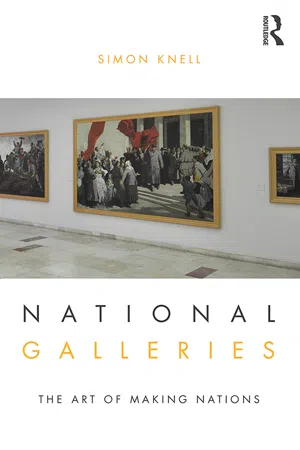
Are national galleries different from other kinds of art gallery or museum? What value is there for the nation in a collection of international masterpieces? How are national galleries involved in the construction national art?
National Galleries is the first book to undertake a panoramic view of a type of national institution – which are sometimes called national museums of fine art – that is now found in almost every nation on earth. Adopting a richly illustrated, globally inclusive, comparative view, Simon Knell argues that national galleries should not be understood as 'great galleries' but as peculiar sites where art is made to perform in acts of nation building. A book that fundamentally rewrites the history of these institutions and encourages the reader to dispense with elitist views of their worth, Knell reveals an unseen geography and a rich complexity of performance. He considers the ways the national galleries entangle art and nation, and the differing trajectories and purposes of international and national art. Exploring galleries, artists and artworks from around the world, National Galleries is an argument about how we think about and study these institutions. Privileging the situatedness of each national gallery performance, and valuing localism over universalism, Knell looks particularly at how national art is constructed and represented. He ends with examples that show the mutability of national art and by questioning the necessity of art nationalism.
On 2 January 2012, Viktor Orbán, the Hungarian Prime Minister, opened a temporary exhibition at the Hungarian National Gallery (Magyar Nemzeti Galéria) entitled Heroes, Kings, and Saints: Images and Documents from the History of Hungary (Plate 1). A rearrangement of some of the great patriotic works of nineteenth-century Hungarian history painting, this show at first sight appeared uncontroversial despite the government directive that had brought it into being. This was not, however, just a rehang and the paintings were no longer to be understood simply as pinnacles in the history of Hungarian art. Now art was political illustration, and the visitor’s gaze was directed away from the artistic achievement and towards the paintings’ subject matter as a form of historical testament. At the very heart of these paintings was a narrative of national struggle; a political idea the Orbán government had used to win support. Hungary, so long a part of the Austrian Habsburg Empire, had endured many pains in its fight to exist as an independent nation. Like every nation in this part of Europe it had found its territory challenged by larger and more powerful nations, particularly Austria and the other German-speaking territories, Russia and Turkey. Each at some point imposed its will on this country. Its golden age of nation building began in the aftermath of its failed revolution of 1848 and culminated in the millennial national celebrations of 1896. This moment however was short-lived. On losing the First World War, Austria-Hungary was dissolved with the Treaty of Trianon of 1920, leaving Hungary at last an independent nation-state but reduced in size by two thirds. Its neighbours benefited as a result: Romania was extended, Czechoslovakia invented, and the northern Balkans gained independence. Like Austria, Hungary now found itself a small, disempowered nation. For nationalists this would forever be resented, but every country in this part of Europe could claim these kinds of injustice.
Plate 1 Viktor Orbán opens Heroes, Kings, Saints, 2012. Photo: Lajos Soos, EPA
Resurgent Hungarian nationalism was, however, only part of the political backdrop to this exhibition. Orbán’s Fidesz government had risen to power with a sizeable majority, sufficient to change the national constitution, the Basic Law of Hungary, and to attempt to move the state away from the liberal democracy it had struggled to become after the fall of communism in 1989. Orbán now recognised China, Russia and Turkey as offering preferred models of state governance. The streets of Budapest filled with pro-democracy demonstrations in response, followed by counter-demonstrations by the government’s supporters. The new constitution was published in a huge, lavish volume illustrated using the great history paintings possessed by, and on display in, the Hungarian National Gallery. It made a direct connection between the politics of the present day and Heroes, Kings, and Saints, which opened on the day it came into force. Indeed, copies of the new Basic Law could be read in the gallery.
The scene, then, was rather more extraordinary than it might at first appear. Everything in this exhibition had been transformed. Behind Orbán, as he gave his address, was Gyula Benczúr’s The Recapture of Buda Castle in 1686, completed for the millennial celebrations of 1896.1 Based upon an exhibition of artefacts that had been on show ten years earlier at the bicentenary of the siege that saw the Ottoman Turks finally driven out of the country, the painting spoke of national triumph. It seemed to embody the very essence of the national anthem, the Himnusz (The Hymn), which refers to the Turkish yoke, though the painting lacks the pain and sorrow – so central to Hungarian nationalism – that accompany that song’s triumphalism. The words and sentiments of this anthem together with its alternative, the Szózat (The Appeal), had been printed in large letters on the walls of the new exhibition and were used to guide the arrangement of the works. To Orbán’s left were historic paintings recalling the nation’s struggle to exist: ‘This is the ground on which so many times your fathers’ blood flowed.’ To his right, they depicted national construction and the centrality of Christianity, values important to the present regime’s conception of Hungary: ‘Mind, might, and so holy a will.’ And these things together were all the more powerful for being displayed in the Hungarian National Gallery situated as it was in Buda Castle itself, the site of this defining moment in the nation’s history and the subject of Benczúr’s masterpiece. This massive castle, which is rather more of a palace, is situated high above the city. From here one looks out over the near mythological Danube and the fairy tale parliament building, and beyond them to the flatlands of Pest (Figure 1.1). Viewing the most scenic and dramatic setting of any national gallery in the world, from here a patriot might feel a sense of possession over all that he or she sees. The Recapture of Buda Castle is living testament to the achievement of nationhood. As the gallery’s own guide points out, the present castle is built on the ruins of the ‘residence of the medieval Hungarian rulers’. Visitors are left in no doubt that this site lies at the very heart of Hungarian identity and the ‘Árpád Dynasty’.
Figure1.1 The Hungarian National Gallery in Buda Castle, Budapest. Photo: Simon Knell
In a room beyond this large opening gallery space, original documents, including treaties and the national anthem, as well as a replica of the iconic Crown of St Stephen, added to the patriotic historicism that had called this exhibition into existence. The culmination, however, was Mihály Munkáscy’s vast painting, The Hungarian Conquest.2 Completed in 1893, it had been commissioned to hang behind the presidential pulpit in Imre Steindl’s beautiful Neo-Gothic parliament building that was at the time being erected. Like many of the great painters of patriotic historical works, Munkáscy lived abroad, at this time in Paris. He was commissioned to depict that foundational moment when Árpád, chief of the Hungarian tribes, on a white horse, arrived in the Carpathian Basin in AD 896. The painting’s political message was carefully modelled for the task in hand: ‘Árpád should be depicted not as a devastating conqueror but a dignified chief, who gained a homeland for his people and wanted to live in peace with the inhabitants already living in the invaded territory … The painting also reflects the popular historical conception of the so-called double conquest according to which in reality Árpád found no strangers but only Hungarians in the new homeland … descendants of Huns living here under the domination of Attila the Hun.’3 At the time of its construction, the painting met with resistance on account of its scale and rising ethnic tensions, though it did eventually find a place in the parliament building. In this exhibition, it was accompanied by the words, ‘By you was won a beautiful homeland’. Munkáscy’s Árpád was no longer a carefully conceived political construct; one could believe this was the man and this was the reality of the conquest. The painting was not to be understood as a history painting but as history itself (though the gallery’s staff had inserted a large interpretive panel to prevent so literal a reading).
Many of the paintings in the exhibition had been permanently on display. Those works produced after 1850 constituted ‘the nation’s passion’ and represented that post-revolutionary moment when the fate of the nation was in the balance.4 In 2012, however, they were loaded with additional political meaning. As images, they depicted and romanticised historic and mythic moments in the nation’s past, created by artists of great technical proficiency who extracted every potent ounce of emotion out of their subjects by judicious exploitation of the stylistic conventions of history painting: metaphor, allegory and symbolism, chocolate-box realism and sentimentality, and theatrical melodrama. History, myth and poetry were by these means impossibly entangled, but that barely mattered if these paintings were simply to be considered art. These works were, however, never simply art. Their subject matter ensured that they held political potential, which was further enhanced by the suffering, exile and heroism of those artists who painted them, for they belonged to the generation which fought for independence.
And now, in this exhibition, the Orbán government had added yet another political layer, mobilising these works and the history they ‘record’ for contemporary political ends. They seemed to evidence the historical conditions and contemporary anxieties that led to the birth and continue to challenge the survival of Hungary. This idea, that the nation was never a cold fact, had long been central to Hungarian nationalism. It appealed as much to the heart as the head and thus was as much indebted to artists, poets and authors, as it was to conquest, or economic or military might. Some have argued that Central Europe is imprisoned by the past.5 One visitor to the exhibition observed, ‘History is the opiate of Central European people. It is not a hobby-horse but an addiction. As if it were something that could compensate for all of our losses. That explains the exhibition in the National Gallery’.6 Here, memories of occupation, denied freedoms, the loss of territory and so on, remain on the surface, ready to be reawakened, whether in political rhetoric, street protests or gallery poetics. But such thinking soon gets out of control. Inevitably it essentialises the very characteristics of the nation; it defines who belongs and who does not, and now these things became the subject of conversation. One politician from the far-right Jobbik party at this time called for ‘Jews to be registered on lists as threats to national security’.7 Was the government’s rhetoric of fear merely a means to gain support or did it reflect a Central European reality the liberal West could not imagine? Early in 2014, Russia annexed Crimea from Ukraine. A few months later, Orbán was re-elected with almost the same majority. One in five Hungarians had voted for the Jobbik party.
On show for the whole of 2012, Rubicon Historical Magazine dedicated an issue to the exhibition. Packed with full colour illustrations of the paintings, together with maps and other documents, its cover headline read ‘MAGYARORSZÁG A MÉRLEGEN’ (HUNGARY IN THE BALANCE). The government-supporting daily newspaper, Magyar Nemzet, said the exhibition was a shield against the cynicism of the political left. Elsewhere in the building, installed by the government but without the participation of the gallery’s curators, around $100,000 of much ridiculed political art was also on display. It had been specially commissioned to illustrate the Basic Law. One curator remarked that it was ‘cheap, weak, dull and didactic’.8 At the Berlin Academy of Fine Arts, architect and dissident, László Rajk, mounted a protest exhibition entitled Missing Paragraphs which spelled out what had been removed from the constitution, though this too was criticised by Hungarian commentators keen to see it merely as propaganda of the left. There was also another protest, in the Hungarian National Gallery itself: on 31 December 2011, the day before the constitution (and exhibition) came into being, the director resigned.
Embarking on a New Journey
These events in Hungary reveal, perhaps surprisingly, that a national gallery is a potentially powerful resource for nation building. This book argues, perhaps even more surprisingly, that this is so of all national galleries and not just those that find themselves in a period of reignited nationalism. In many respects this will appear an odd perspective, for national galleries are known by most visitors, perhaps most of the time, as places in which to find aesthetic, intellectual, emotional, cultural, social and educational fulfilment. Experienced visitors, who possess some knowledge of art and who find the art gallery a familiar and comfortable environment, may also adopt a distanced, universal, view of art that serves to further diminish the politics and national significance of the works on display. Curators, too, invariably act to depoliticise art, perhaps facilitating a purely aesthetic or social reading. Few would consider that they are engaged in nation making. As a result of these curatorial actions visitors might be able to ignore the extraordinary, and sometimes flamboyant, nationalistic architectural setting and make the art itself the subject of their attentions. And yet, there is no denying that a national gallery is a rare and exceptional thing. Are visitors not implicitly and subtly imbibing aspects of their national being in these institutions? Might not the English visitor to Tate Britain, for example, sense a certain Englishness in a Paul Nash painting? Might they not feel some degree of British conceit at the National Gallery’s possession of such treasures as Jan van Eyck’s Arnolfini Portrait (1434) or Hans Holbein the Younger’s The Ambassadors (1533)? These galleries may not assert nationhood or national identity in the manner of the exhibition at the Hungarian National Gallery, but nevertheless a sense of nation can be observed in them both by national citizens and foreign visitors.
Those who have written about national galleries have tended to ignore this political aspect, preferring only to consider these institutions as great – rather than national – galleries. Deprived of this perspective, art historians have tended to impose on national galleries that lens invented to distinguish and rank great art. The result has been the veneration of a handful of national galleries of Old Master paintings in London, Paris, Vienna, Berlin, Madrid, Amsterdam, Florence, Budapest, St Petersburg and Washington. All others have against this standard been considered too poor or immature to warrant consideration, or as mere derivatives of this grand order.9 It is no coincidence that most of these great galleries were formed by old and powerful nations; the same nations that produced, edited, and disseminated the geographically restricted universalism that has traditionally shaped perspectives in the history of art. While it is certainly true that these particular galleries provide a rich resource for understanding the agency of the national gallery more generally,10 it would be wrong to consider them as typical of what has become a diverse and peculiar global phenomenon. Today, only in small island nations, such as in the Caribbean and Pacific, and in parts of the Middle East and Africa, are national galleries absent. To understand these institutions it is necessary to dispense with old and discriminatory systems of value. It is also necessary to look beyond those characteristics – interior design, objects and so on – that they share and consider what makes them different. We need to know relatively little of Albania, Argentina, Algeria, Afghanistan and Australia, to believe that each offers entirely different political, cultural, historical, geographical and economic contexts within which to build such a gallery.
A way to look past the obvious similarities is to adopt a comparative approach and use one national gallery as a lens through which to look at another. It is as though a national gallery camouflages itself so as to create the appearance of similitude when in reality it might be entirely different in terms of its values, ambitions, contributions to the nation, relationship to art production, levels of self-interest and corruption and so on. National galleries have been invented and deployed by liberal democracies, by Marxist revolutionaries and communist governments, by imperialists and right-wing dictators, in colonial and post-colonial settings, in nations old, new, large and small; sometimes ideologically different regimes have exploited national galleries in very similar ways, other times they have not. ‘Throughout the nineteenth century, monarchs and governments in power took care not to neglect so efficacious a means to influence public opinion.’11
More difficult, though no less necessary and a direct extension of this argument, is to dispense with a notion still prevalent in art history and criticism, and ...
Table of contents
Cover Page
Half Title Page
Title Page
Copyright Page
Contents
List of figures
Preface
PART I Introduction
PART II Art Nation Gallery
PART III Histories Geographies
PART IV Architecture Curation
PART V National Galleries, National Art
Notes
Index
Trusted by 375,005 students
Access to over 1.5 million titles for a fair monthly price.
Study more efficiently using our study tools.
Frequently asked questions
Yes, you can cancel anytime from the Subscription tab in your account settings on the Perlego website. Your subscription will stay active until the end of your current billing period. Learn how to cancel your subscription
No, books cannot be downloaded as external files, such as PDFs, for use outside of Perlego. However, you can download books within the Perlego app for offline reading on mobile or tablet. Learn how to download books offline
Perlego offers two plans: Essential and Complete
Essential is ideal for learners and professionals who enjoy exploring a wide range of subjects. Access the Essential Library with 800,000+ trusted titles and best-sellers across business, personal growth, and the humanities. Includes unlimited reading time and Standard Read Aloud voice.
Complete: Perfect for advanced learners and researchers needing full, unrestricted access. Unlock 1.5M+ books across hundreds of subjects, including academic and specialized titles. The Complete Plan also includes advanced features like Premium Read Aloud and Research Assistant.
Both plans are available with monthly, semester, or annual billing cycles.
We are an online textbook subscription service, where you can get access to an entire online library for less than the price of a single book per month. With over 1.5 million books across 990+ topics, we’ve got you covered! Learn about our mission
Look out for the read-aloud symbol on your next book to see if you can listen to it. The read-aloud tool reads text aloud for you, highlighting the text as it is being read. You can pause it, speed it up and slow it down. Learn more about Read Aloud
Yes! You can use the Perlego app on both iOS and Android devices to read anytime, anywhere — even offline. Perfect for commutes or when you’re on the go. Please note we cannot support devices running on iOS 13 and Android 7 or earlier. Learn more about using the app
Yes, you can access National Galleries by Simon Knell in PDF and/or ePUB format, as well as other popular books in Art & Art General. We have over 1.5 million books available in our catalogue for you to explore.