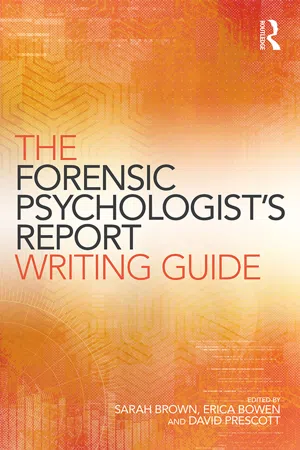
The Forensic Psychologist's Reporting Writing Guide is the first book to provide both student trainees and practitioners with best practice guidance for one of the core skills of their role.
Written and edited by an international range of experts from the UK, North America and Australasia, it provides clear advice on a range of assessments, from psychometric tests to personality functioning, and includes real-life examples to illustrate key points. Uniquely, the book also offers guidance on the range of different client groups that forensic psychologists work with across both civil and legal contexts, including juveniles, female clients, couples and those with cognitive impairments. From core principles to writing style to key issues, each chapter also includes a checklist of advice and further reading.
Comprehensive and practical, The Forensic Psychologist's Reporting Writing Guide is a user-friendly companion to this critical and often overlooked skill, and will be essential reading for both neophyte and experienced forensic psychologists alike.
General issues of reporting across different types of assessments
Introduction to Section 1
Forensic populations present numerous challenges for new evaluators. This receives succinct attention in Chapter 1, where the authors state:
The majority of offenders in prison will be motivated to progress towards release, but will not necessarily engage in the assessment process in an entirely honest manner. Previous experience of testing may have resulted in them having ‘learned’ a strategy for completing tests. This can present itself in a particular response style that may indicate dishonesty, or perhaps an aspect of their psychopathology.
While these written words can appear straightforward in meaning, their nuanced application in conducting assessments, including the use of even seemingly simple measures, can be complicated. Far from simple test administration, forensic evaluators will wish to consider their interactions with clients and the context in which the assessment takes place. Each can influence the process of the assessment and the findings themselves.
Chapter 2 calls attention to areas that many who conduct forensic evaluations may miss. For example, approximately 10 to 15 per cent of assessment clients may experience intellectual or other cognitive limitations requiring specialised knowledge and skills. Professionals evaluating these clients can easily overlook problematic areas of functioning in cases where the client has spent his or her entire life portraying themselves as more functional than they actually are. Comprehensive assessment is a vital first step in understanding the possible influence of these limitations on the treatment and supervision of clients. These issues also become important once clients enter the legal domain, where issues of competence and fitness to stand trial may become pertinent.
Indeed, as noted in Chapter 3, unstructured clinical judgements made by professionals trying to predict future behavior are so notoriously inaccurate that they cannot properly be termed ‘professional’. Humans are often very good at making social judgements (including treatment decisions), but a good measure is far more likely to be predictive of future events than a good professional. In the end, professionals are at their best using large amounts of information in the service of comprehensive assessment and treatment, but not at prediction. As this section shows, even the manner in which we convey risk assessment findings can influence those who read reports.
Fortunately, the authors in Chapter 4 and 5 provide ways forward. These ways forward include structuring information and reports in such a way that professionals can move beyond simple prediction to communicating how risk might best be formulated, managed and communicated to others. The authors emphasise the importance of structure and offer helpful suggestions for doing so.
Chapter 6 addresses the assessment of personality disorders, which are very common amongst people who repeatedly break the law. As the author notes, in addition to more common considerations, personality dysfunction is relevant to forensic practitioners in that it is often most problematic in times of crisis or despair. It is therefore an aggravating factor in the presence of conflict or frustration and can therefore be crucial in considering, formulating and managing future risks.
The final chapter in this section deals with a topic that has received scant attention in many quarters: the actual assessment of change. This can be a controversial topic at the front lines of practice. The author notes that there are two factors that can influence assessors and the public at large. These include the importance of recidivism from a policy perspective and the belief that offenders can and do fake change. These factors can combine to form a high level of cynicism among the public and even within professionals themselves.
Putting these pieces together, it can be particularly helpful for professionals to keep in mind the principles of effective correctional rehabilitation, which receive some attention in these chapters. The risk principle holds that the most intensive interventions should be reserved for those who pose the highest risk. To that end, professionals will wish to consider strongly their formulations and recommendations for managing risk. The need principle holds that effective programmes establish individualised treatment goals that are directly related to criminal recidivism processes (i.e. criminogenic needs). Finally, the responsivity principle holds that effective programmes tailor services to the characteristics of each client. This can include motivation, mode of intervention and even concerns related to scheduling. This last principle can apply to forensic evaluators in ways that can be difficult to predict, such as in interview processes (noted in Chapter 1).
1
REPORTING PSYCHOMETRIC TESTS
Glenda Liell and Martin Fisher
Introduction
Psychometric assessments are designed to be reliable and unbiased measures of psychological constructs that describe thinking, emotional and behavioural processes. Psychometric testing has been used in the following ways:
• To assist in diagnosis.
• To assist in the formulation of psychological and identification of areas of stress and conflict.
• To determine the nature of the deficits that are present (i.e. cognitive functioning).
• To assess severity of psychopathology and response to treatment.
• To assess general characteristics (i.e. personality).
• To assess risk in various criminal justice settings.
Knowing how a service user performs on a test is of no value unless we know how well other people from the same population are able to perform on the same test. Simply knowing the relative outcome is only one part of the process: scoring, interpretation and reporting complete the psychometric assessment process. The latter parts require particular competences and understanding (e.g. British Psychological Society Testing Committee, PTC, 2015) in order that the outcome is rendered meaningful and useful in assessment. The proper and appropriate reporting of results is often an overlooked aspect of the cycle but is vital, in that without effective communication of the psychometric testing results to the service user, and those requiring insight and understanding to inform their decision making and taking (Muir-Gray, 2001), the purpose is lost.
Psychometric tests can be judged and characterised by a series of measures concerning their relative merits. These can be summarised thus, and the test user needs to be familiar with these in order to select and assure the use of tests in their practice.
Reliability – this can be described in three particular ways.
1Internal consistency – the extent to which items in a scale are correlated with one another; that is, the extent to which they measure the same thing. This is often measured using Cronbach’s (alpha) (Kline, 2000).
2Inter-rater reliability – agreement amongst raters – in effect the extent to which different raters score and interpret the test in the same way.
3Test-retest reliability – a correlational measure between scores on two administrations of a test to the same subjects. A high correlation indicates high reliability.
Validity – this can be described across six measures and needs to be allied with considerations of reliability.
1Concurrent validity – a way of determining the validity of a measure by seeing how well it correlates with some other measure the test designer believes is valid.
2Content validity – a measure can be described as having this when its item accurately represents the thing that is being measured. It is a matter of expert judgement.
3Construct validity – the extent to which variables accurately measure the constructs of interest. This is used to describe a scale, index or other measure of a variable that correlates with measures of other variables in ways that are predicted by, or make sense according to, a theory of how the variables are related.
1Convergent validity – the overlap between different tests that are presumed to measure the same construct.
2Discriminant validity – a measure of the validity of a construct that when it is high the construct fails to correlate with the other, theoretically distinct, constructs: a mirror of convergence.
3Criterion-related validity – the ability of a test to make accurate predictions. Also called predictive validity.
In selecting a test to use, all of these features need to be considered to ensure that the intent and requirement of the testing process can be satisfactorily met. In the forensic context there is a need to ensure that the validation sample is relevant to the test taker’s representative population. Similarly, there is a need for clarity in the relationship between the hypothesis being considered through the use of testing and the intent of the test itself in terms of the content validity: the WAIS IV does not require forensic context-specific norms, for example, because the construct (‘intelligence’) is common to all people, not just those being assessed in a forensic context. The aim of this chapter is to outline best practice when using and reporting the outcomes and interpretations of psychometric tests.
Best practice
How do you decide whether to use a psychometric test?
Psychometric tests are one of many methods available in the collation of information during the assessment process. The principle of using information from a range of sources applies to most settings – not just forensic ones. The process of Triangulating Information (see Figure 1.1) is arguably the most a crucial aspect of the assessment process. This involves collating information from a broad range of sources.
A thorough review of all the available documentation about an individual should normally be undertaken as the starting point of an assessment. In an ideal world, information that includes an individual’s background and childhood is invaluable although not always available or complete if available. If someone has been in the care system or in secure hospitals for part of his/her life, this information may be held in medical records which may be accessed by a non-medical clinician only with consent. It is a clinician’s responsibility to consider where else information could be held. This may involve contacting individuals who are involved in managing the case in question. Clients do not have to give consent for communication to take place between relevant and appropriate parties involved in managing their cases. However, consent may need to be sought if the information being gathered involves contacting family members. The aim of an assessment is always to gain as broad an understanding as possible of the day-to-day as well as past behaviour.
Have psychometric tests been used already?
Psychological reports are likely to be found in the files of forensic clients. Whilst the conclusion(s) drawn in these reports will be of interest, attention should also be paid to the method(s) used and the current validity of the results/interpretations. The rationale for this should be clear. Assessments of characteristics that can change will have a ‘shelf-life’ and the findings of ‘dated’ tests may no longer be relevant.
Figure 1.1 Triangulation of information to inform assessment
Score sheets for psychometric tests with no accompanying interpretations may be present. It is possible to refer to this test having been administered in an assessment report if it could be useful to the assessment in question. However, it will not be known whether best practice has been employed during administration and scoring and whether the reliability of the scores has been affected. A carefully thought out and justified caveat should therefore be included if the test is going to be used.
What if you disagree with the outcome of the assessment?
No clinician is infallible, and it is possible that one could come across a test that has been scored incorrectly. It may be a straightforward error in calculation, or perhaps the test taker missed an item(s). In this type of scenario, the test could be rescored, but that depends on the test.
If it is possible to rescore the test and increase its reliability, then this must be documented. The reasons why this has been done must also be documented. However, it is important to be wary of criticising the person who initially reported the inaccurate results.
Is there value in retesting using the same measure?
Repeating psychometric tests is generally not advisable – even if errors in the scoring have been uncovered. Choosing to do so carries with it a range of implications. The same psychometric test can be used over a specific period of time as part of a measure of change following treatment. If retesting is not about measuring change, what is the value of readministering the test? Is there another reason why the test outcomes could be different such that it would aid the assessment process? An example of this might be that it was clear that the client was suffering from mental health problems which may have affected how they responded.
If retesting is considered appropriate, an insufficient period of time between testing sessions can lead to test questions being answered in the same way. The questions or types of questions may be clearly remembered by the test taker. However, they could also be answered very differently for the same reason. With some tests the issue of practice effects has the potential to invalidate outcomes, particularly for ...
Table of contents
Cover
Half Title
Title Page
Copyright Page
Table of Contents
List of Illustrations
About the Authors
Introduction
SECTION 1: General issues of reporting across different types of assessments
SECTION 2: Considerations when reporting on specific client groups
SECTION 3: Considerations when reporting in specific contexts
Appendix 1: Example report 1
Appendix 2: Example report 2
Appendix 3: Example report 3
Index
Trusted by 375,005 students
Access to over 1.5 million titles for a fair monthly price.
Study more efficiently using our study tools.
Frequently asked questions
Yes, you can cancel anytime from the Subscription tab in your account settings on the Perlego website. Your subscription will stay active until the end of your current billing period. Learn how to cancel your subscription
No, books cannot be downloaded as external files, such as PDFs, for use outside of Perlego. However, you can download books within the Perlego app for offline reading on mobile or tablet. Learn how to download books offline
We are an online textbook subscription service, where you can get access to an entire online library for less than the price of a single book per month. With over 1.5 million books across 990+ topics, we’ve got you covered! Learn about our mission
Look out for the read-aloud symbol on your next book to see if you can listen to it. The read-aloud tool reads text aloud for you, highlighting the text as it is being read. You can pause it, speed it up and slow it down. Learn more about Read Aloud
Yes! You can use the Perlego app on both iOS and Android devices to read anytime, anywhere — even offline. Perfect for commutes or when you’re on the go. Please note we cannot support devices running on iOS 13 and Android 7 or earlier. Learn more about using the app
Yes, you can access The Forensic Psychologist's Report Writing Guide by Sarah Brown, Erica Bowen, David Prescott, Sarah Brown,Erica Bowen,David Prescott in PDF and/or ePUB format, as well as other popular books in Psychology & Applied Psychology. We have over 1.5 million books available in our catalogue for you to explore.