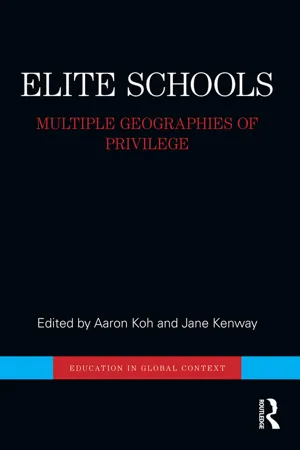
Geography matters to elite schools — to how they function and flourish, to how they locate themselves and their Others. Like their privileged clientele they use geography as a resource to elevate themselves. They mark, and market, place. This collection, as a whole, reads elite schools through a spatial lens. It offers fresh lines of inquiry to the 'new sociology of elite schools.' Collectively the authors examine elite schools and systems in different parts of the world. They highlight the ways that these schools, and their clients, operate within diverse local, national, regional, and global contexts in order to shape their own and their clients' privilege and prestige. The collection also points to the uses of the transnational as a resource via the International Baccalaureate, study tours, and the discourses of global citizenship. Building on research about social class, meritocracy, privilege, and power in education, it offers inventive critical lenses and insights particularly from the 'Global South.' As such it is an intervention in global power/knowledge geographies.
- 248 pages
- English
- ePUB (mobile friendly)
- Available on iOS & Android
eBook - ePub
About this book
Information
1
Becoming the Man
Redefining Asian Masculinity in an Elite Boarding School
“I never saw our school as an elite school or one of those ‘preppy’ schools. To me, it is a home where I lived and hung out with my friends during those years. It never once crossed my mind that the school is considered elite. In fact, I only realised how much the school shaped me until much later on,” Zach revealed during a conversation we had two years ago. Our paths first crossed when he was a final year student at St Andrew’s School, an elite private boys’ boarding school, where I conducted fieldwork as part of my Doctoral dissertation in 2007. Six years on, Zach had since graduated from university and just started working in the family business when we caught up again.
Zach’s oblivion on his alma mater being considered elite is not entirely surprising given the myriad definitions and confusing representations (Walford, 1991). While elite boarding schools have been discussed in various works and defined in disparate ways, Gaztambide-Fernández (2009a) suggests five constitutive traits that make an elite boarding school: They must be typologically, scholastically, historically, demographically, and geographically elite. When seen in light of these traits, St Andrew’s School, a private boarding school for boys in Perth, Western Australia, should be regarded as elite. In the public eye, the school was renowned for not only being consistently among the top performing schools in the state tertiary entrance exams, their students also excelled in non-academic fields such as sport and debating. Geographically, the school has been located along the river in a premium residential suburb in Perth since it was founded in the early 1900s. These characteristics, Gaztambide-Fernández (2009b) would argue, contribute to the process by which students “construct elite identification and internalise their privilege” (p. 28). Hence, elite boarding school, with its all-inclusive routine and holistic regulation of the lives of its occupants, acts as a social system for the acceptance of new cultural values. Living and participating in activities within such close proximity of each other helped to construct and reinforce traits shared by most members of the group. These qualities could be observed through embodied practices, vital for creating and maintaining a sense of being in the presence of other groups in the school community (Koh & Kenway, 2012). This approach is apparent in Allan and Charles’ (2014) study of feminine identity in a private girls’ school. They explored how ‘classed feminism’, an intrinsic part of the students’ identity, was produced and articulated against the backdrop of a long-established and privileged context. This study, like others who examined gender identities, put forward schools as key social sites where these contestations and representations could be explored. From Willis’ (1977) study on the cultures and sub-cultures of working class ‘lads’ to Renolds’ (2004) account of boys who shaped their masculinities against the ideal categories perpetuated by the school, these studies often emphasised the plurality and hierarchical nature of masculinities (Connell, 1989). Such studies traced the collective and dynamic character of masculinity through immersive research methods. Similarly, this chapter situates the discussion of masculine identity in the boarding school but through the perceptions and expressions of Asian boarders in St Andrew’s School.
Such discussions remain relevant as schools evolve their social purposes in a rapidly globalised landscape (Kenway & Fahey, 2014). These changes can be seen as responses and adaptations to new cultural discourses which result in new definitions and expressions of gender identities. Rapid globalisation can also be witnessed in the changing dynamics within the elite boarding school community. International students are now mainstays in many Australian private schools. Recent data from Australian Education International (AEI, 2014) revealed more than 500,000 international students have studied in Australian schools since 2008.
Australian Education International or AEI uses ‘international students’ as an umbrella term to include all foreign-born students who are studying in Australia on a student visa regardless of their country of birth. Australian citizens and permanent residents are excluded from this group. In most cases, international students are not eligible for Australian Government subsidies and have to pay full fees. In St Andrew’s School the term ‘overseas students’ was used broadly to refer to students who did not hold an Australian passport or did not have permanent residency. This group of students included three Anglo-Saxon boarders who were born in Europe and Canada, but the overwhelming majority were from Southeast Asia. In St Andrew’s School, staff members commonly used the term ‘Asian boarders’ to describe students who came from Asia and had the appearance of an ‘Asian’. Zach and 43 other students came under this banner when they were boarding in St Andrew’s School during 2007.
Drawing on the experiences of the Asian boarders, this chapter sets out to illustrate how this group of boys shaped and positioned their masculine identity as they resided in an elite boarding school setting. The first section of the chapter explores the ideal notions of masculinity portrayed and projected by the boarding school staff members through the school’s publicity materials. The remainder of the chapter examines the creative extent to which the Asian boarders managed to negotiate and maintain alternative masculinities. Central to this discussion is their privileged background and unique position as the minority. My analysis recognises that the Asian boarders were active in their resistance and conformity to hegemonic masculinity. Through these processes, they gained clearer definitions of their Asian identity.
Hegemonic Masculinity: The St Andrew’s School Man
Masculinity does not exist as an ontological given, but comes into existence through deliberate construction and constant reinforcing. Hence, schools are often seen as sites where masculine identities are shaped and articulated (Connell, 1989; Gilbert & Gilbert, 1998; Greene, 2007). This section examines idealised forms of masculinity upheld by the school as embodied in the ‘St Andrew’s School Man’ through staff members. This model is then contrasted with the Asian boarders’ perception of ‘Asian masculinity’.
In St Andrew’s School, most of the boarding staff were males. Their ascribed role was to look after the residential welfare of all boys in their respective year level and formally supervise the boys throughout the week and on weekends, as well as help with excursions and other activities within the community. Another additional obligation that might not be entirely apparent was that they were put forward as the model of masculinity upheld by St Andrew’s School.
Cookson and Persell (1985) noted that the key element their researched school sought when hiring new boarding staff was “balance”, where successful applicants were required to have “academic skills, sports skills, artistic skills, as well as personal characteristics as gender, experience, morality, and last but by no means least, enthusiasm” (p. 90). While every school’s conception of balance may vary, staff members were certainly promoted to the public as well-rounded individuals who not only had the academic qualifications to carry out their duties; they also possessed other qualities that epitomised the school’s ideology of masculinity. Analysis of the publicity materials and school website offers insight into the definition and certain essential qualities that the St Andrew’s Man must possess. Students in the boarding community therefore do not need to look far to find examples of the masculinity to which they should aspire. The staffing patterns and structure within the boarding community also served as examples of the expected conduct of the St Andrew’s Man.
In a typical school publication, they began by detailing the role and responsibilities of that particular staff member:
Matt is the Year 10 Coordinator and is the primary contact for all our Year 10 boarding parents. He is responsible for the leadership, pastoral care, spirit and morale, security, supervision and discipline of all boarders, in such a way as to promote their growth and well-being. He is charged with the task of ensuring that the residential experience of a St Andrew’s School boarder is an engaging and rewarding one. The aim is to empower boarders to take charge of their own lives by developing them to be confident and capable young men in an atmosphere of warmth, support and care.
One could comment that most aspects of the job were difficult to measure but what these terms mapped out was the social learning and atmosphere the boarding community could provide for the boarders. By reiterating lofty qualities such as ‘leadership’, ‘spirit and morale’, and ‘empowering’, the school presented what Connell (1990) calls an ‘ideological framework’ which embodies key traits that all conceptions need to align with.
The description would go on to present the credentials of the staff member, beginning with their educational background, followed by their relevant experiences as a teacher:
Matt graduated from the University of Queensland with a Bachelor’s degree in Arts with Honours. After relocating to Perth, he attained a Graduate Diploma in Education from the University of Western Australia.
At the start of his teaching career, Matt spent nine years working at agricultural schools around Western Australia as a teacher of Social Science and English, he taught at Pasture School in rural Kalgoorlie. Matt joined the St Andrew’s School in 1995 as a teacher of English and Social Science. Last year, he joined the boarding house as a Year Coordinator.
From this description, we can infer that the first element crucial in the St Andrew’s School concept of masculinity was that a man should possess academic ability and intellect. This emphasis was stated as one of the school’s aims “to enable boys to grow in knowledge, skills and understanding”. The boys were inculcated in the values of working hard to develop and refine their intellectual ability. They must also value and take responsibility for their educational endeavours.
Having established intellectual ability as the most important quality, the introduction went on to highlight other qualities the institution perceived as required from young men of the school:
An accomplished hockey player, Matt competed in State level competitions. In the co-curricular domain, Matt has coached hockey and tennis. He is currently the Teacher in Charge of Hockey.
In another example, talent of a different nature is described:
Having a keen interest in music, Stephen teaches piano lessons on the weekends, plays in a jazz ensemble once a week and plays the piano recreationally.
The above description resonates with Cookson and Persell’s (1985) observation that the ideal staff member and student should have balance. Therefore, by including the other interests or as the school termed it, “special talents” of the staff members, the school upheld the ideal of a balanced man with multiple skills, particularly in sports or music. The school positively encouraged these interactions and hoped that through them a set of practices that construct models, ideas, activities and relations to promote particular forms of masculinity could be imparted (Gilbert & Gilbert, 1998, p. 114). Through increased contact with staff members, the boarders could perceive the staff members as not only teachers but as individuals endowed with additional abilities. It was common to see staff members join the boarders in an impromptu game of soccer or basketball after school. Qualified staff members willingly offered pointers to the boarders on how to improve aspects of their game. Interactions such as these added to the respect the boarders had for the staff members. Furthermore, boarding staff members often had to volunteer as coaches in the various sports teams. Hence, training sessions and games provided opportunities for interaction. Staff members had many opportunities to establish more personal and open relationships with boarders than the formal classroom might allow. Such shared experiences between student–teacher led to ‘deep bonding’ (Gaztambide-Fernández, 2009b, p. 142), consequential for reinforcing institutional ideologies.
The final aspect often featured in the introduction to the school was personal information on a staff member, especially those regarding his family:
He lives with his wife Mary and two boys Peter and Jonathan in the boarding House, which is attached to the accommodation for the boarders.
The inclusion of this information is interesting because of the various connotations, both overt and veiled, conveyed through this short description. These discourses conveyed undertones of masculinity implying that a man’s responsibilities are to his family and with that the mandate to be the provider, leader and protector. Mac an Ghaill (1996) suggests that if schools are perceived as active agents in the cultural production of masculinities, a teacher’s role should be identified as being important to this notion since teachers ‘actively produce a range of masculinities’ and femininities that are made available for students collectively to negotiate and occupy (p. 385). In other words, the efforts of the school in presenting the boarding staff members as family men endorsed and provided a conceptual map to begin to explore the range of masculine formations required of students.
Summarising the qualities essential for the quintessential St Andrew’s School man, he must be accomplished in three main areas: intellect, physical abilities, and character. All three qualities contribute to what Honey (1977) terms as “an air of self-confidence in knowing that he can accomplish greatness” (p. 43). Various investigations into traditional boarding school ideology reveal similar emphasis on individuals being “well-adjusted” and possessing “prep poise” (Cookson and Persell, 1985, p. 54). According to research in gender studies, the variation of meanings could be attributed to how masculinity is historically and socially constructed (Atkins, 2005; Connell, 2000). These qualities are certainly embodied in the school’s depiction of staff members. However, it is necessary to consider how masculine identities are constituted in relation to other identities. For instance, cultural background could ascribe different meaning to status, virtues, and expectations. Connell and Messerschmidt (2005), in their discussion of ‘hegemonic masculinity’, noted that masculinity could be expressed and experienced differently by diverse cultural groups. Connell (1990) defines hegemonic masculinity as ‘the culturally idealised form of masculine character’ which is characterised by male heterosexuality and physical, social, and economic power. Connell (1990) argues that idealised forms of masculinity become hegemonic when it is widely accepted in a context and when that acceptance reinforces the dominant gender ideology of the context. Connell (1996) asserts that although the hegemonic form of masculinity may be what many males aspire to achieve, alternate forms of masculinity could vary according to cultural setting. Hence, she suggested that two diametric processes are likely to be taking place; first, the promotion of one’s own form of masculinity and secondly, the active defence against the competing form. Similarly, the Asian boarders actively reinforced notions of masculinity from their home countries as they were confronted with the different cultural forms of masculinity present in a boys’ school in Australia. These previous notions of masculinity inevitably shaped ...
Table of contents
- Cover
- Title
- Copyright
- CONTENTS
- Series Editor’s Overview
- Acknowledgements
- Introduction: Reading the Dynamics of Educational Privilege Through a Spatial Lens
- 1 Becoming the Man: Redefining Asian Masculinity in an Elite Boarding School
- 2 Capitalising on Well-Roundedness: Chinese Students’ Cultural Mediations in an Elite Australian School
- 3 The Emergence of Elite International Baccalaureate Diploma Programme Schools in China: A ‘Skyboxification’ Perspective
- 4 Elite Schoolboys Becoming Global Citizens: Examining the Practice of Habitus
- 5 The Joy of Privilege: Elite Private School Online Promotions and the Promise of Happiness
- 6 Old Boy Networks: The Relationship Between Elite Schooling, Social Capital, and Positions of Power in British Society
- 7 Exclusive Consumers: The Discourse of Privilege in Elite Indian School Websites
- 8 The Insiders: Changing Forms of Reproduction in Education
- 9 Can Geographies of Privilege and Oppression Combine?: Elite Education in Northern Portugal
- 10 “We Are Not Elite Schools”: Studying the Symbolic Capital of Swiss Boarding Schools
- 11 Tourism, Educational Travel, and Transnational Capital: From the Grand Tour to the ‘Year Abroad’ among Sciences Po-Paris Students
- 12 Schools and Families: School Choice and Formation of Elites in Present-Day Argentina
- 13 The Economy of Eliteness: Consuming Educational Advantage
- Contributors
- Index
Trusted by 375,005 students
Access to over 1.5 million titles for a fair monthly price.
Study more efficiently using our study tools.
Frequently asked questions
Yes, you can cancel anytime from the Subscription tab in your account settings on the Perlego website. Your subscription will stay active until the end of your current billing period. Learn how to cancel your subscription
No, books cannot be downloaded as external files, such as PDFs, for use outside of Perlego. However, you can download books within the Perlego app for offline reading on mobile or tablet. Learn how to download books offline
Perlego offers two plans: Essential and Complete
- Essential is ideal for learners and professionals who enjoy exploring a wide range of subjects. Access the Essential Library with 800,000+ trusted titles and best-sellers across business, personal growth, and the humanities. Includes unlimited reading time and Standard Read Aloud voice.
- Complete: Perfect for advanced learners and researchers needing full, unrestricted access. Unlock 1.5M+ books across hundreds of subjects, including academic and specialized titles. The Complete Plan also includes advanced features like Premium Read Aloud and Research Assistant.
We are an online textbook subscription service, where you can get access to an entire online library for less than the price of a single book per month. With over 1.5 million books across 990+ topics, we’ve got you covered! Learn about our mission
Look out for the read-aloud symbol on your next book to see if you can listen to it. The read-aloud tool reads text aloud for you, highlighting the text as it is being read. You can pause it, speed it up and slow it down. Learn more about Read Aloud
Yes! You can use the Perlego app on both iOS and Android devices to read anytime, anywhere — even offline. Perfect for commutes or when you’re on the go.
Please note we cannot support devices running on iOS 13 and Android 7 or earlier. Learn more about using the app
Please note we cannot support devices running on iOS 13 and Android 7 or earlier. Learn more about using the app
Yes, you can access Elite Schools by Aaron Koh,Jane Kenway in PDF and/or ePUB format, as well as other popular books in Education & Education General. We have over 1.5 million books available in our catalogue for you to explore.