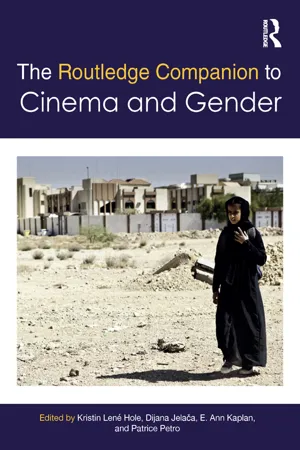
Comprised of 43 innovative contributions, this companion is both an overview of, and intervention into the field of cinema and gender. The essays included here address a variety of geographical contexts, from an analysis of cinema. Islam and women and television under Eastern European socialism, to female audience reception in Nigeria, to changing class and race norms in Bollywood dance sequences. A special focus is on women directors in a global context that includes films and filmmakers from Asia, Africa, Australia, Europe, North and South America. The collection also offers a solid overview of feminist contributions to thinking on genre from the "chick flick" to the action or Western film, to film noir and the slasher. Readers will find contributions on a variety of approaches to spectatorship, reception studies and fandom, as well as transnational approaches to star studies and essays addressing the relationship between feminist film theory and new media. Other topics include queer and trans* cinema, eco-cinema and the post-human. Finally, readers interested in the history of film will find essays addressing the methodological dimensions of feminist film history, essays on silent and studio era women in film, and histories of female filmmakers in a variety of non-Western contexts.
eBook - ePub
The Routledge Companion to Cinema & Gender
- 492 pages
- English
- ePUB (mobile friendly)
- Available on iOS & Android
eBook - ePub
The Routledge Companion to Cinema & Gender
About this book
Trusted by 375,005 students
Access to over 1.5 million titles for a fair monthly price.
Study more efficiently using our study tools.
Information
Subtopic
Feminism & Feminist TheoryPART I
What is [feminist] cinema?
In this section, we interrogate the question of what [feminist] cinema is within a range of political, historical, geographical, and cultural contexts. Patrice Petro’s opening essay situates the history of feminist film studies with respect to the ongoing scholarly contestations over its impact and relevance. She examines the tension between theory and practice, and between activism and academia. Sandra Ponzanesi and Sumita Chakravarty turn to postcolonial and transnational frameworks in order to chart current and emerging directions of the field. Ponzanesi highlights filmmakers such as Shirin Neshat and Gurinder Chadha, and situates postcolonial theoretical interventions as pivotal for rethinking the concept of cultural difference. Chakravarty focuses on the cinema of migration and particularly on US films such as Gran Torino and Frozen River, which stage a white protagonist’s encounter with (im)migrant Others. Lucy Fischer highlights the work of Mai Zetterling as a way to explore the links between women’s cinema and feminist forms of address. Kathleen Vernon and Sally Chivers illuminate some critical, but frequently overlooked, aspects of feminist film inquiry—sound (Vernon) and age and disability (Chivers). Lingzhen Wang and Anikó Imre examine film and feminism in different socialist contexts that may, on closer inspection, offer important counter-examples to Western-centric understandings of both cinema and gender alike, while Amy Borden returns to the radical aspects of queer cinema and queer theory in order to examine them as a practice that disrupts some of the identity-based tendencies of LGBT+ cinema.
Although not meant as a comprehensive overview of feminist cinema, this group of essays aims to give the reader insight into the breadth of the field of feminist film studies, as well as provide an introduction to the concerns that inform the field’s past, present, and future trajectories.
1
CLASSICAL FEMINIST FILM THEORY
Then and (mostly) now
In an April 2015 interview, University of Groningen student Daniel O’Neill asked Laura Mulvey about what we might now call “classical” feminist film theory—that is, feminist film theory of the 1970s. Specifically, he asks, what has changed since the publication of “Visual Pleasure and Narrative Cinema” in 1975? Mulvey responded by explaining that her now infamous essay was a political intervention and not an academic one. She stated,
One absolutely crucial change is that feminist film theory is now an academic subject to be studied and taught. “Visual Pleasure and Narrative Cinema” was a political intervention, primarily influenced by the Women’s Liberation Movement and, in my specific case, a Women’s Liberation study group, in which we read Freud and realised the usefulness of psychoanalytic theory for a feminist project. In addition to this feminist context, the essay could be seen as experimental, within the cultural context of the 1970s avant-garde: its writing, its films, and its ideas.1
Indeed, as Mandy Merck has recently described it, “Visual Pleasure” was a manifesto, a call to arms, and part of a larger history of feminist polemics and manifestos, stretching from “Mary Wollstonecraft’s Vindication of the Rights of Women to Emma Goldman’s ‘The Tragedy of Women’s Emancipation’ to Shulamith Firestone’s The Dialectic of Sex to Mary Daly’s Gyn/Ecology” (Merck 2007:7).
As Merck points out, “Visual Pleasure” may be (overly) familiar to film and media scholars, but is still less well known within feminist theory more generally. Similarly, Claire Johnston’s early writings, including “Women’s Cinema as Counter-Cinema” (1973) and “Feminist Politics and Film History” (1975) were likewise written in the mode of the polemic and the manifesto and are even less known today than the ubiquitous “Visual Pleasure” essay, which has been expansively reprinted although repeatedly criticized for its lack of scholarly and theoretical rigor (as a direct result of its engagement with psychoanalysis, not to mention its lack of features traditionally found in scholarly essays, such as footnotes).
In this essay, I explore the standing and status of “classical” feminist film theory in the past and today. I reflect on recent writings and scholarship that trace the history of film studies, especially the history of film theory and its “academic turn” in the 1980s and beyond. Finally, I offer an intervention into the status of feminist film theory within larger accounts of our field.
So to begin. At the 2012 Society for Cinema and Media conference, held in Boston, I attended a workshop entitled “Where is Film Theory Today?” In the course of the discussion, I was surprised to learn that many of the participants believed that film theory “died” in the mid-1990s after a prolonged critique by those who were uneasy about what they saw as its undue influence on the field. David Bordwell, for example, famously coined the phrase “S.L.A.B.” theory to describe film theory in the 1970s and 1980s—that is, the theories of Saussure, Lacan, Althusser, and Barthes, and/or Baudrillard—to capture what he believed was a detrimental orthodoxy in the vast majority of scholarship, perhaps especially feminist film scholarship.
Admittedly, I was not only surprised to learn that film theory had been dead for more than fifteen years—I was also perplexed by the funereal tone surrounding discussions of film theory. To be sure, I had read David Rodowick’s 2007 essay (although not his book, which was not yet published) entitled “An Elegy for Theory.” Here, Rodowick challenges Bordwell’s critique of the field and, more specifically, what he sees as Bordwell’s attempt to establish film studies as a discipline modeled on cognitivist science and historical poetics, along the lines of the ideals of the natural sciences (2007: 91–109). Rodowick’s “elegy,” however, is not exactly a lament for film theory’s or even the cinema’s death (and, tellingly, in the 2007 essay, he has absolutely nothing to say about feminist theory or feminist theorists). Instead, it is more of a reflection on what should constitute a philosophy of the humanities today, and in Rodowick’s view, this entails a return to the work of Stanley Cavell and Gilles Deleuze.
In his book that followed, Elegy for Theory, published in 2014, Rodowick does mention feminist film theory but mostly relegates it in his account to identity politics and cultural studies. His first mention of feminism in relation to theory, moreover, occurs on page 201 in a book of 265 pages; and here, it is included as part of a longer list, including “formalism, myth criticism, Marxist criticism, psychoanalysis, feminism, queer theory, critical race theory, postcolonial theory, new historicism, cultural studies, media studies, and so on” (2014: 201–2). Even Cavell himself, writing in 1990, emphasized the centrality of feminist film theory to film studies when he wrote: “So since it seems to me generally recognized, and incontestable, that feminist theory is, as a body of work, the most influential in the field of film study, its most powerful force” (1990: 239).2 How is it, then, that some twenty-five years later, feminist theory is nearly absent from Rodowick’s history of film theory and his philosophy of the humanities? What is at stake in this voluntary forgetting of feminist film theory’s centrality to film theory more generally?
To be sure, it is not just Rodowick who has sidelined feminist film theory in his account of the field. Indeed, many criticisms have been leveled against feminist film theory specifically in the writings of feminist film scholars, who denounce feminist film theory, not on epistemological grounds but because of its opacity and abstraction, its propensity towards jargon and cliché, and its aloofness from activism and political engagement.3 In her 1998 book Chick Flicks, for example, B. Ruby Rich, characterizes academic film feminism in disparaging terms, claiming that in place of the broad coalitions and contradictory communities that so defined feminist work in the 1970s, feminist film theory in the 1980s and beyond devolved into an academically hierarchical, heterosexist, party-line feminist film theory, with its own conferences, journals, and its own “professionalized, parochial, self-absorbed, and deracinated writing” (1998: 6). As she explained: “What sprang up in the seventies and was institutionalized in the eighties has been stagnating in the nineties, its vigor bypassed by queer culture, on the one hand, multiculturalism on the other, and cultural studies in general” (ibid. 5). There are, of course, a number of unexamined tensions here: between theory and practice as well as between activism and academia. Mulvey herself claims that her “Visual Pleasure” essay was written for polemical, political purposes, and yet it was also, and from the very beginning, central to academic debates, to the institutionalization of film studies, and to the work of many who were at once activists and scholars alike.
More recently, in a 2012 interview to promote her book on New Queer Cinema, Rich nevertheless makes the point that gender discrimination in the industry remains rampant and, one assumes, that feminist analysis remains as relevant as ever. When asked why the New Queer Cinema is dominated by male filmmakers, for instance, she explains,
Why? Because gay men are still men, whereas lesbians are still women. The run up to the Oscars this year resulted for some reason in the “discovery” of how few women have been nominated for the award and how low the numbers of women in the industry [are]—even the independent world. Lesbians though are in even worse positions than heterosexual women in the film biz, since they aren’t seen as available bedmates (well, mostly) and since the craft guilds are still so gender-bound. Editing is the great exception because it’s close work in dark rooms dedicated to helping the guy look good—a fit job for a woman.4
Thus, Rich points out a significant fact: that regardless of a seemingly greater prominence (or cultural recognition) of minority filmmakers and themes, such prominence remains delineated along gender lines.
In view of these remarks, it is important to return to the political and historical context of the 1980s, not because I believe that feminist film theory declined after this date, but because the eighties more broadly figure as a rhetorical turning point in the writings of many critics and theorists who seek to chart historical change. For some theorists, the 1980s were a watershed, especially when considered in relation to technological, cultural, and political change. Indeed, it is now something of commonplace for scholars to locate 1989 as a major historical pivot point, marking the fall of the Berlin Wall, the end of the Cold War, and the acceleration of major technological innovations in communication technologies that have fundamentally altered our relationship to the world. As Siva Vaidhyanathan puts in his book, The Googlization of Everything: And Why We Should Worry:
In 1989, as a young man of twenty-three, I could not have been more optimistic about the prospects for justice and democracy in my country and the rest of the world. … To a naïve young American like me, fascinated by new technology and devoted to the belief that free speech can be deeply and positively transformative, this simple connection between a new technology and stunning historical events was irresistible. Such a techno-optimistic story accorded well with the other views I held at that time: that the Reformation and the Enlightenment were driven, or made necessary, but the emergence of the printing-press in fifteenth-century Europe, and that mass-market pamphlets such as Thomas Paine’s Common Sense were essential factors in the birth of the American republic. Of course, this view was far too simple an explanation for the sudden (and in many places, temporary) spread of democracy and free speech. Historians of both politics and technology knew the story was more complex.(2011: 122)
The story is indeed more complex, and when we look to the field of cinema and media studies to trace the recent history of feminist film theory over the last four decades, this techno-optimistic narrative gives way to a different account of a loss of utopian aspirations and transformation. As Mulvey herself has pointed out (in her contribution to a roundtable on feminist film theory, published in 2004 in the feminist journal Signs, of which I will have more to say momentarily):
During the 1980s, events on a world scale marked the point at which the traditions of progressive politics could no longer struggle against the changing balance between left and right. The success of neoliberal economics, the collapse of communism, the globalization of capitalism, the export of industry to nonunionized developing economies, the impoverishment of Africa, and an increase in racism both in Europe and other parts of the world definitively changed the political spectrum. During this period, not only was it impossible to maintain the progressive optimism of the 1970s, it was also hard to privilege the problems of women (especially those of developed economies) and the priorities of film feminism while left politics failed in postcolonial and third-world countries.(2004: 1288)
Mulvey does not locate 1989 as the watershed moment that moved us beyond ideologies and into an era of social justice and democracy; instead, for her, the 1980s were the tipping point of a new era, defined by the expansion of neoliberal economics and the expansion of capitalism on a global scale.
Nevertheless, like Vaidhyanathan, Mulvey also takes up the question of technology and historical change, but in her case, by reflecting on the history of cinema and the emergence of digital forms. “The cinema’s one-hundredth birthday in 1995,” she explains,
may have been a temporal marker of purely symbolic importance, but this symbolism coincided with objective, material changes in its conditions of production, distribution, and consumption. The arrival of video and then, more significantly, digital technologies marked a definite end of an era for the way in which celluloid had functioned within the sphere of mass entertainment and within that of radical or avant-garde aesthetics during the greater part of the twentieth century.(Mulvey 2004: 1287)
The relationship between film and feminism came at the very end of that era, Mulvey further explains; moreover, feminist film theory and practice had close links with an even longer tradition of cinephilia. “It was a last wave,” she says,
following the great Third Cinema movements, above all in Latin America, and the European and North American avant-gardes of the 1960s. For these movements, cinema was of central importance as a symptom and symbol of utopian political teleology. Not only could cinema articulate the desire for a better world, its complex way of interpreting and representing could also produce both critique and new ways of seeing. For feminism, this was particularly the case: the cinema doubled as a major means of w...
Table of contents
- Cover
- Half Title
- Title Page
- Copyright Page
- Table of Contents
- List of figures
- List of contributors
- Acknowledgments
- Introduction
- Part I What is [feminist] cinema?
- Part II Genres, modes, stars
- Part III Making movies
- Part IV Spectatorship, reception, projecting identities
- Part V Thinking cinema’s future
- Index
Frequently asked questions
Yes, you can cancel anytime from the Subscription tab in your account settings on the Perlego website. Your subscription will stay active until the end of your current billing period. Learn how to cancel your subscription
No, books cannot be downloaded as external files, such as PDFs, for use outside of Perlego. However, you can download books within the Perlego app for offline reading on mobile or tablet. Learn how to download books offline
Perlego offers two plans: Essential and Complete
- Essential is ideal for learners and professionals who enjoy exploring a wide range of subjects. Access the Essential Library with 800,000+ trusted titles and best-sellers across business, personal growth, and the humanities. Includes unlimited reading time and Standard Read Aloud voice.
- Complete: Perfect for advanced learners and researchers needing full, unrestricted access. Unlock 1.5M+ books across hundreds of subjects, including academic and specialized titles. The Complete Plan also includes advanced features like Premium Read Aloud and Research Assistant.
We are an online textbook subscription service, where you can get access to an entire online library for less than the price of a single book per month. With over 1.5 million books across 990+ topics, we’ve got you covered! Learn about our mission
Look out for the read-aloud symbol on your next book to see if you can listen to it. The read-aloud tool reads text aloud for you, highlighting the text as it is being read. You can pause it, speed it up and slow it down. Learn more about Read Aloud
Yes! You can use the Perlego app on both iOS and Android devices to read anytime, anywhere — even offline. Perfect for commutes or when you’re on the go.
Please note we cannot support devices running on iOS 13 and Android 7 or earlier. Learn more about using the app
Please note we cannot support devices running on iOS 13 and Android 7 or earlier. Learn more about using the app
Yes, you can access The Routledge Companion to Cinema & Gender by Kristin Hole, Dijana Jelača, E. Kaplan, Patrice Petro, Kristin Hole,E. Kaplan,Patrice Petro,Kristin Lené Hole,Dijana Jelača,E. Ann Kaplan, Kristin Lené Hole, Dijana Jelača, E. Ann Kaplan, Patrice Petro in PDF and/or ePUB format, as well as other popular books in Media & Performing Arts & Feminism & Feminist Theory. We have over 1.5 million books available in our catalogue for you to explore.