- 288 pages
- English
- ePUB (mobile friendly)
- Available on iOS & Android
eBook - ePub
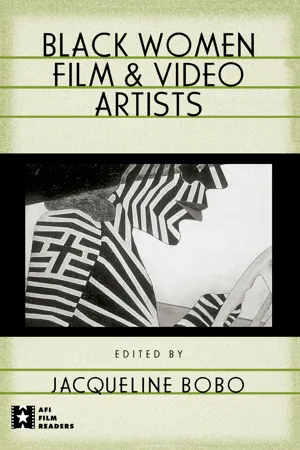
Black Women Film and Video Artists
About this book
Black women film and video makers have been producing shorts, documentaries and films since the early part of this century. Unfortunately, not only has their work been overlooked by distributors, but critical reviews have been few and far between. Conceived to redress that omission, Black Women Film and Video Artists is the first comprehensive history and analysis of this genre. Gathered here are noted scholars and critics, as well as the film/video makers themselves who offer insight into the work of underexplored artists. The discussions range from pioneering to contemporary film makers and include artists such as Madeline Anderson, Monica Freeman, Jacqueline Shearer, Kathleen Collins, Julie Dash, Camille Billops, Zeinabu irene Davis, and Michelle Parkerson, among others. Contributors include: Jacqueline Bobo, Carmen Coustaut, Gloria J. Gibson, C.A. Griffith, Monique Guillory, Carol Munday Lawrence, O. Funmilayo Makarah, Ntongela Maselila, Jacqueline Shearer, P. Jane Splawn.
Information
| critical | |
| part one | perspectives |
black | |
| one | |
genesis of a tradition |
My earliest introduction to the work of Black women makers occurred at several venues–an insightful paper given by Gloria Gibson at the 1989 Society for Cinema Studies Conference and, next, during Zeinabu irene Davis's challenging advocacy at the Twelfth Annual Ohio University Film Conference in 1990. These presentations stimulated my interest in and confirmed the need for more information about this vital aspect of Black women's creative contributions. Not only had these papers whetted the research appetite of those at the conferences, but also Gloria and Zeinabu had continued a tradition of insuring that the work of Black women makers would be given their deserved critical attention.1 Archivist and programmer Pearl Bowser had previously presented the work of Black women in a retrospective of Black American Independent Cinema 1920–1980 at a festival in Paris in 1980. Fortuitously, the event was preserved through the publication of a very useful document of the same title which is available through Third World Newsreel.2
Other events showcasing the films and videos of Black women kept the work in public view. Pearl Bowser was involved in yet another research endeavor critical for outlining the history of not only Black women makers, but, as the title confers, In Color: Sixty Years of Images of Minority Women in the Media.3 Groundbreaking essays included in the publication were written by Kathleen Collins, Christine Choy, Renee Tajima, Ada Gay Griffin, and Toni Cade Bambara, among others. Throughout the early 1980s, articles were written about Black women filmmakers in publications such as Heresies, Jump Cut, Black Film Review, and elsewhere.4 In 1987, Valerie Smith curated a showing of Black women's films, “The Black Woman Independent: Representing Race and Gender,” at the Whitney Museum of American Art in New York City. Later, Smith published an overview and analysis of Black women's work in Callaloo.5
I was fortunate to meet several of the makers in the summer of 1992 at a conference exploring ways to effectively distribute the product of Black independent film/videomakers.6 I made contact with O.Funmilayo Makarah, Linda Gibson, Cheryl Fabio Bradford, and Jacqueline Shearer, and reconnected with Pearl Bowser and Zeinabu irene Davis. An earlier chance encounter with filmmaker, programmer, and later marketer Michelle Materre proved to be a godsend for my research on Daughters of the Dust (1991). I was a participant in the Black Popular Culture Conference7 in New York City in December 1991 and decided to take advantage of the time there to preview Black women's films at the independent distribution organization Women Make Movies. Fortunately, Michelle, who worked there at the time, approached me about having a look at a video copy of Daughters of the Dust. I was impressed with the sheer power of Julie Dash's film. From Michelle I obtained a preview videotape copy of the film to show to groups of Black women I was interviewing for my book Black Women as Cultural Readers (1995). The women in my research group were even more taken with the film than I, incredible as that may have seemed at the time, for the earliest reviews posited that Daughters of the Dust would test the patience and comprehension of untutored audiences. Michelle also introduced me to Julie Dash, setting up an interview in Los Angeles that proved pivotal in my analysis of the film.
By this time Black women scholars and artists were teaching courses about Black female makers at several universities in the country: Claire Andrade Watkins at Wellesley College, Carmen Coustaut at Howard University and later at the University of Maryland, College Park; Gloria Gibson at Indiana University, and Michelle Parkerson was keeping the topic vibrant at Temple, Northwestern, Howard, and in early articles detailing the artists' history and significance.8
I started teaching courses on Black women filmmakers about five years ago, and have continued to do so at three universities: the University of California, Santa Cruz; the University of North Carolina at Chapel Hill; and at my present location, the University of California, Santa Barbara. I encountered the same impediments that others faced, regardless of whether they taught courses devoted exclusively to the topic or incorporated the films with complementary subject matter within other courses. I considered these obstacles to be challenges rather than problems, but I also understood how those less involved in the subject would be intimidated by the lack of accessible background information about the films' production history and the relative absence of material about the filmmakers themselves. Also, many of the later films, and especially the videos and interactive media, were experimental works, in which some form of background material would enhance students' understanding.
To redress the issue in my courses, I began to invite many of the makers–Cheryl Fabio Bradford, Cauleen Smith, Aarin Burch, Linda Gibson, O.Funmilayo Makarah, Yvonne Welbon, Crystal Griffith, and programmer Margaret Daniel–to speak about their works in my classes. The students were enormously impressed with the women's knowledge, skill, and training. The women not only provided astute analyses of Black women's films and videos but also contextualized the works within the broader spectrum of film and video production and criticism. I was reminded of the three days at the independent distribution conference, when, even in a casual setting, O.Funmilayo Makarah and Zeinabu Davis expertly explicated the works shown to the participants.
These events made me acutely aware that further information about the history of Black women film and videomakers would fill an egregious void within cinema scholarship. This was reaffirmed in Jacqueline Shearer's keynote address at the independent distributor's conference. Shearer's documentary The Massachusetts 54th Colored Infantry (1991) had just recently aired on public broadcasting as part of the prestigious American Experience series. Although she recognized the valuable opportunity for such a national presentation, Shearer reminded us that more work needed to be done to insure greater opportunities for more exhibition of the works of Black independent makers. She detailed her experiences with distribution, including her first production, A Minor Altercation (1977). Shearer was at that time a founding member of the Boston Newsreel Collective, which operated with a political intent: that media could augment people's understanding of the social matrices in which they were involved. The collective held community screenings, which led to discussions and interactions with audiences, and brought the images that people viewed into perspective with their daily lives. Shearer related that
it became clear to me that a film had no political merit gathering dust on the shelf. It was only in interaction with an audience that it had power. This is a very simpleminded truth but one that is still stunning to me in its significance and consequences. So a longstanding cornerstone of my understanding about media is that the production of a piece is not finished until and unless it plays to its audience.9
Despite the tremendous success of A Minor Altercation (which dealt with the desegregation conflicts in Boston in the early 1970s) through the grassroots efforts of the Boston Collective, the film was rejected by distributors. The early incarnation of Women Make Movies dismissed the film as not being feminist, even though the makers were women and the protagonists in the story were two teenage girls and their working-class mothers. Other organizations considered the film not polished enough, asserting that it lacked sophisticated production aesthetics. A Minor Altercation has since gone on to be distributed by the present Women Make Movies and is regarded as a classic early Black feminist work.
There is a substantial body of work created by Black women film/videomakers, extending back to the early part of this century. Unfortunately, the work is overlooked not only by many distributors, but also by critical reviews and scholarly analyses, with the notable exception of those by Black women scholars, have been few and far between. The recent success of filmmaker Julie Dash's Daughters of the Dust (1991), due in large measure to the fervent support of Black female audiences, underscores the critical role of Black women's films within this far-reaching creative tradition. Through the aid of other women filmmakers and an independent publicity campaign, Daughters of the Dust circumvented traditional venues to be placed before receptive audiences hungry for depictions of their history long missing from mainstream white productions. The film chronicles a loving, though complicated, multigenerational Black family at the turn of the century. They struggle, yet eventually triumph over the oppressive legacies of forced removal from their homeland and the tortuous regimens of enslavement. Dash's piece is historic; it proved, yet again, that there was a large untapped market for creative work that seriously examined Black women's experiences.
The demonstrated interest in Daughters of the Dust notwithstanding, widespread recognition of Black women film and video artists lags behind their extensive history. Documentation exists of Black women producing and directing films during the prolific interim of Black film production from 1910 through the 1920s. Archivist and film scholar Pearl Bowser notes that Black women worked behind the camera on numerous films during this time on what were known as “race” films, that is, independent films produced by Black filmmakers, rather than white-controlled films about Black life.10
Historical records show that two women were especially noteworthy in filmmaking during this period. Madame C. J. Walker, one of the first Black millionaires, made her fortune manufacturing and distributing cosmetics and hair-care products for Black women. In addition to her retail business, Walker owned the Walker Theater in Indianapolis, and produced training and promotional films about her cosmetics factory. These films, Bowser declares, “offered a visual record of women's work history” and the “development of cottage industries.”11 Bowser also points to the importance of Madam Toussaint Welcome, Booker T. Washington's personal photographer, who produced at least one film about Black soldiers who fought in World War I.
Film scholar Gloria J. Gibson-Hudson provides further evidence of Black women's production background. Gibson-Hudson's research fills out important details on earlier Black women filmmakers, but she also works to restore, in conjunction with the Library of Congress, the films of Eloyce Gist. Gist was a traveling evangelist, who toured the country in the 1920s with her religious folk dramas, exhibiting them in churches to Black audiences.12 Her two known films, Hell Bound Train and Verdict Not Guilty are considered to be as rich and provocative as those of her more studied contemporaries such as Oscar Micheaux and the brothers Noble and George Johnson.
Other pioneer Black female filmmakers examined in Gibson-Hudson's study include folklorist Zora Neale Hurston, who made ethnographic films in the 1930s. Hurston earned an MA in Cultural Anthropology, working with Franz Boas at Columbia University. Currently, several reels of Hurston's film footage are available for viewing at the Library of Congress. Similarly, footage exists of the films shot by Eslanda Goode Robeson (whose husband was Paul Robeson), but its fragile condition renders it inaccessible for public screening. Robeson, who held a Ph.D. in Anthropology, made ethnographic films in the 1940s. Alice B. Russell, another key person, worked with and was perhaps the driving force behind many of the films of Oscar Micheaux.13
Confronted with the dearth of scholarship about early Black female filmmakers, these activist researchers–Bowser, Gibson-Hudson, and others–retrieved the history of a long-neglected body of films that dealt substantively with important issues. The works addressed an array of matters crucial to understanding various facets of Black life and culture, including the role of religion in Black people's lives, the contributions of Black soldiers fighting for a country that afforded them little honor, and Black women's work and business history. Certainly, an even more bountiful cache will surface once scholars begin to uncover the largely obscured output of Black women filmmakers from the 1950s and early 1960s. Pearl Bowser is currently compiling information about Black female photographers who were involved in filmmaking at that time.
That Black women filmmakers were active in every decade of this century is not insignificant. The newly discovered films increase the opportunities to advance an understanding of Black women's cultural history and the social determinants molding Black women's lives. Furthermore, these texts demonstrate the ways in which filmmakers within the social group present stories that have an effect on altering these conditions for the better.
Concomitantly, exposure of their existence links the present to the past, outlining the expansive contours of a fertile lineage of creativity. We can now enlarge the process of assessing commonalities, pervasive themes, and preoccupations, as w...
Table of contents
- Cover Page
- Half Title Page
- Title Page
- Copyright Page
- Contents
- list of contributors
- preface
- part one: critical perspectives
- part two: critical practice
- part three: in their own words
- Suggested Course Design: Black Women Film and Video Artists
- Selected Video/Filmography: Black Women Video / Filmmakers
- Directory of Distributors
- Selected Bibliography
Trusted by 375,005 students
Access to over 1.5 million titles for a fair monthly price.
Study more efficiently using our study tools.
Frequently asked questions
Yes, you can cancel anytime from the Subscription tab in your account settings on the Perlego website. Your subscription will stay active until the end of your current billing period. Learn how to cancel your subscription
No, books cannot be downloaded as external files, such as PDFs, for use outside of Perlego. However, you can download books within the Perlego app for offline reading on mobile or tablet. Learn how to download books offline
Perlego offers two plans: Essential and Complete
- Essential is ideal for learners and professionals who enjoy exploring a wide range of subjects. Access the Essential Library with 800,000+ trusted titles and best-sellers across business, personal growth, and the humanities. Includes unlimited reading time and Standard Read Aloud voice.
- Complete: Perfect for advanced learners and researchers needing full, unrestricted access. Unlock 1.5M+ books across hundreds of subjects, including academic and specialized titles. The Complete Plan also includes advanced features like Premium Read Aloud and Research Assistant.
We are an online textbook subscription service, where you can get access to an entire online library for less than the price of a single book per month. With over 1.5 million books across 990+ topics, we’ve got you covered! Learn about our mission
Look out for the read-aloud symbol on your next book to see if you can listen to it. The read-aloud tool reads text aloud for you, highlighting the text as it is being read. You can pause it, speed it up and slow it down. Learn more about Read Aloud
Yes! You can use the Perlego app on both iOS and Android devices to read anytime, anywhere — even offline. Perfect for commutes or when you’re on the go.
Please note we cannot support devices running on iOS 13 and Android 7 or earlier. Learn more about using the app
Please note we cannot support devices running on iOS 13 and Android 7 or earlier. Learn more about using the app
Yes, you can access Black Women Film and Video Artists by Jacqueline Bobo in PDF and/or ePUB format, as well as other popular books in Media & Performing Arts & Film History & Criticism. We have over 1.5 million books available in our catalogue for you to explore.