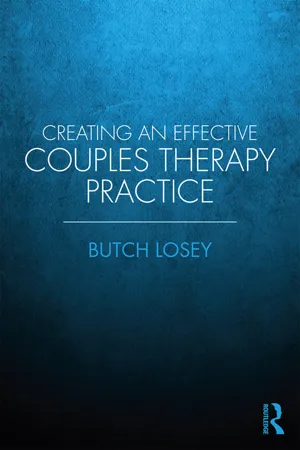
Most clinicians seek guidelines and indicators as to the effectiveness of their interventions with clients. Some may even be implementing evidence-based interventions and seek an in-depth understanding of their results. This book helps clinicians who provide couple's or marriage therapy and counseling go from the ambiguous realm of "thinking" or "knowing" their effectiveness to being able to demonstrate it. It identifies effective strategies for common treatment concerns that connect to the successful outcomes of therapy. Here, the process starts even before the couple enters therapy and goes beyond the final session. Dr. Losey discusses specific outcome measures and how they can be used in session so that the couple can assess their relationship and develop specific goals and interventions for treatment. The author also examines session notes, pre-treatment change, and developing quality post-treatment goals in his discussion of clinical effectiveness.
- 248 pages
- English
- ePUB (mobile friendly)
- Available on iOS & Android
eBook - ePub
Creating an Effective Couples Therapy Practice
About this book
Information
1 Effective Couples Therapy
Couples therapy is difficult work. Couples come to therapy with a high level of stress and emotional volatility, leaving the clinician to feel like they have little control at times in the session. Couples are at different places in their motivation for change and may have differing timelines for their recovery. Each partner may view the relationship in a very different way, resulting in very different goals for the relationship. With all the challenges, how is it possible for clinicians to be successful in their work and for couples to create significant changes in their relationships?
The Gap Between Efficacy and Effectiveness
There is a distinction to be made between the terms research efficacy and clinical effectiveness. Efficacy refers to treatment effects observed in a randomized control trial, whereas effectiveness refers to treatment effects in routine practice. In routine practice, couples are self referred and have multi-problem focus, and clinicians use a wide range of techniques without relying on treatment manuals (Klann et al., 2011). As you can imagine, there is a preference in the research literature for randomized trials because researchers like to control as many confounding variables as possible. For this reason, we have a great and more confident understanding of research efficacy than we do clinical effectiveness.
To answer the question of whether couples therapy is effective, it is important to know that when most clinicians are talking about the effectiveness of a particular model or technique, they are likely referring to their understanding of the research and implying that the outcomes from the research studies translate to their practice setting. Effectiveness actually only speaks to the outcomes of treatment in a clinical setting, whereas efficacy is specific to the outcomes in a highly controlled research study. Efficacy may not translate to a clinical setting because the same controls are not in place in a private practice or community mental health agency. Clinicians would be more correct to say that a particular model has research efficacy and then discuss effectiveness of their practice by identifying the outcomes they have measured post-treatment with their clients. Therefore, there is a blending of the words efficacy and effectiveness because this is our common language. It should be mentioned that through the course of this book, the same blending of terms will occur.
Efficacy of couples therapy is quite good. A review of eight meta-analyses, mostly research on behavior couples therapy or emotion-focused couples therapy, shows strong outcomes as compared to control groups (Baucom, Hahlweg, & Kuschel, 2003).
Couple counseling shows a high level of efficacy yet much lower levels of effectiveness. In clinical effectiveness studies, couple recovery rates are less than half that reported in research efficacy trials. In addition, about 60% of couples studied showed no reliable benefit from couples therapy in effectiveness studies, compared to 35% in efficacy studies (Halford, Pepping, & Petch, 2015). From the perspective of a practitioner in private practice, one has to wonder if there is a disparity between the number of clinicians providing couples therapy and the number of clinicians that are actually trained in couples therapy. Research indicates that about 70%–80% of clinicians do couples therapy, yet most never took a course in couples therapy and never did their internships under supervision from someone who mastered the art (Doherty, 2017; Orlinsky & Ronnestad, 2005). This may be a strong reason for less-positive outcomes in practice than in research.
From observation, it is evident that inexperienced and untrained couple therapists do not manage sessions well. They struggle with the techniques of couples therapy, and clients often sense that these clinicians are not skillful. Inexperienced clinicians tend to lack structure in their sessions, they do not recommend changes for the couple, and they give up on the relationship because they feel overwhelmed by the couple’s problems (Doherty, 2017).
Researchers point to other variables that are within the design of research that may not be translated into the clinical setting, providing four potential explanations for the difference between research efficacy and clinical effectiveness (Halford, Pepping, & Petch, 2015). First, it could be the type of therapy provided in research studies. Most research studies focus on behavioral- or emotion-focused therapy and show efficacy; most practicing clinicians do not espouse allegiance to either of those models. Keep in mind, though, that there is no clear evidence that either model is better than the other.
The characteristic of the couple is a second explanation. In research, couples are held to stringent inclusion/exclusion criteria. There are likely more couples in the clinical setting that are ambivalent about staying in the relationship. Clinical effectiveness, then, would logically be lower.
Efficacy studies use comprehensive assessments and typically more than one. They are used pretreatment, throughout treatment and post-treatment. In contrast, practicing couple therapists are likely not to use assessments at all and prefer to use unstructured conjoined couple interviews.
The fourth explanation is quality control. Research studies are highly controlled with strong support by the researchers. In addition, the clinicians are highly trained in the treatments being evaluated, and they maintain strict adherence to the model.
Research informs practice. Understanding this divide between efficacy and effectiveness should be taken note of by clinicians. It is possible that some of these explanations described here might be keys to creating more positive outcomes of treatment.
Ingredients of Effective Couples Therapy
It may be beneficial to look beyond the evidence that supports a particular model. A primary reason for this is that in practice, clinicians who provide evidence-based treatment actually do not stick to one particular theoretical orientation. Instead, they adapt their approach to ensure that they are following a best practice model that takes into consideration both evidenced-based research and practice-based evidence. Following is a review of some of the general principles of effective couples therapy.
Consider for a moment the general framework of the total clinical experience for the couple. Even before therapy starts, pretreatment role expectations are a factor that has been shown to predict strong treatment alliance. The client’s expectation that they will have a personal commitment to therapy plays a strong role in the development of the treatment alliance early on in the treatment process. Couples expecting to take responsibility for the work of therapy create a stronger collaborative bond with the therapist and create a more productive relationship, and this can happen within the first three sessions of treatment (Patterson, Uhlin, & Anderson, 2008).
These early successes in treatment are critical to overall treatment outcomes. Lewis et al. (2012) led a study at the University of Indiana of 173 individuals ranging in age from eighteen to sixty-four. These individuals came in for treatment of depression and anxiety. Lewis found that decreases in depressive symptoms in the first five sessions of treatment directly predicted overall outcome in the participants. Interestingly, those in the study who continued to have symptom declines during the first five sessions had the most benefit from therapy.
Bradley Erford (Shallcross, 2012) offers a good summation of five clinical considerations that will increase the effectiveness of couples therapy. Effective treatment will start with the establishment of a strong therapeutic alliance. Without early development of the therapeutic alliance, a couple seeking treatment in a private practice setting will tend to move on to another clinician. Effective treatment will also require a focus on the needs of the couple and will be centered on achieving objectives. Without setting treatment goals the couple will lose confidence in the clinician, and gains of treatment will be stalled at best or not achieved. The clinician will need to stay aware of current evidenced-based practice standards and implement the necessary interventions based on the presentation of the couple’s concerns. The clinician will facilitate treatment adherence and challenge the couple to stay focused on the goals they set out to accomplish. Lastly, the clinician will identify and follow up on treatment gains. This will include the necessity of implementing outcome measure through the course of treatment and monitoring gains post-treatment.
Benson et al. (2012) identify five basic behaviors of the clinician for effective couples therapy. These are influential strategies of the clinician that will affect changes in the relationship and changes in the perception of the partner and the relationship.
The Clinician Helps Alter the View of the Relationship
Throughout the therapeutic process, the therapist attempts to help both partners see the relationship in a more objective manner rather than one sided and blaming. Most couples do not fully recognize that their own behaviors contribute to the relationship problems. From their perspective, the clinician can help this by creating a strong working alliance and sharing a casual analysis of the central relationship issue. The clinician can share their hypothesis of how the analysis may affect the dynamic of the relationship. Different therapists will use different strategies, but as long as they focus on altering the way the relationship is understood, the couple can start to see each other, and their interactions, in more adaptive ways.
The Clinician Modifies Dysfunctional Behavior
Effective clinicians attempt to change the way that the partners behave with one another. This means that in addition to helping them improve their interactions, therapists also need to ensure that their clients are not engaging in actions that can cause physical or psychological harm. In order to do this, therapists must conduct a careful assessment to determine whether their clients are, in fact, at risk. If there is risk, they need to intervene and may need to refer one partner to individual counseling and not continue with couple counseling, for example in cases of domestic violence.
The Clinician Challenges and Reduces Emotional Avoidance
Distressed couples tend to avoid expressing their private feelings, and this put them at greater risk of becoming emotionally distant and growing apart. Emotional avoidance perpetuates dysfunctional communication patterns such as the demand-withdraw pattern, in which one partner demands or requests change and the other withdraws by being defensive or avoidant. Effective clinicians will disrupt these patterns and elicit emotions and thoughts from each partner in hopes of opening up the perspectives of each partner.
The Clinician Takes the Necessary Steps to Improve Communication
Healthy communication requires more...
Table of contents
- Cover
- Title
- Copyright
- Contents
- Foreword
- Introduction
- 1 Effective Couples Therapy
- 2 The Hidden Beginning of Treatment
- 3 Ethical Practice
- 4 Principles of Assessment
- 5 Treatment Planning
- 6 Family of Origin
- 7 Communication
- 8 Managing Conflict in Session
- 9 Intimacy
- 10 Trust
- 11 The Trauma of Infidelity
- 12 Forgiveness
- 13 Documenting the Session: Necessary Evil or Clinical Tool?
- 14 Using Reflecting Team in Couples Therapy
- 15 Post-Treatment Planning
- Index
Trusted by 375,005 students
Access to over 1.5 million titles for a fair monthly price.
Study more efficiently using our study tools.
Frequently asked questions
Yes, you can cancel anytime from the Subscription tab in your account settings on the Perlego website. Your subscription will stay active until the end of your current billing period. Learn how to cancel your subscription
No, books cannot be downloaded as external files, such as PDFs, for use outside of Perlego. However, you can download books within the Perlego app for offline reading on mobile or tablet. Learn how to download books offline
Perlego offers two plans: Essential and Complete
- Essential is ideal for learners and professionals who enjoy exploring a wide range of subjects. Access the Essential Library with 800,000+ trusted titles and best-sellers across business, personal growth, and the humanities. Includes unlimited reading time and Standard Read Aloud voice.
- Complete: Perfect for advanced learners and researchers needing full, unrestricted access. Unlock 1.5M+ books across hundreds of subjects, including academic and specialized titles. The Complete Plan also includes advanced features like Premium Read Aloud and Research Assistant.
We are an online textbook subscription service, where you can get access to an entire online library for less than the price of a single book per month. With over 1.5 million books across 990+ topics, we’ve got you covered! Learn about our mission
Look out for the read-aloud symbol on your next book to see if you can listen to it. The read-aloud tool reads text aloud for you, highlighting the text as it is being read. You can pause it, speed it up and slow it down. Learn more about Read Aloud
Yes! You can use the Perlego app on both iOS and Android devices to read anytime, anywhere — even offline. Perfect for commutes or when you’re on the go.
Please note we cannot support devices running on iOS 13 and Android 7 or earlier. Learn more about using the app
Please note we cannot support devices running on iOS 13 and Android 7 or earlier. Learn more about using the app
Yes, you can access Creating an Effective Couples Therapy Practice by Butch Losey in PDF and/or ePUB format, as well as other popular books in Psychology & Mental Health in Psychology. We have over 1.5 million books available in our catalogue for you to explore.