eBook - ePub
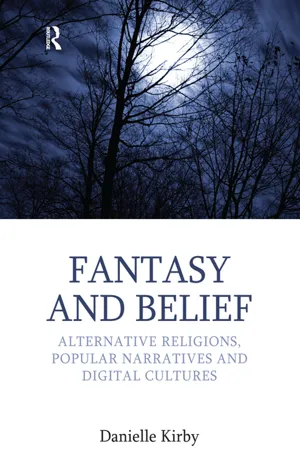
Fantasy and Belief
Alternative Religions, Popular Narratives, and Digital Cultures
- 224 pages
- English
- ePUB (mobile friendly)
- Available on iOS & Android
eBook - ePub
About this book
Religion and spirituality are being transformed in our late modern and secularising times. New forms of belief proliferate, often notable for not being limited to traditional systems of reference or expression. Increasingly, these new religions present worldviews which draw directly upon popular culture - or occulture - in fiction, film, art and the internet. Fantasy and Belief explores the context and implications of these types of beliefs through the example of the Otherkin community. The Otherkin are a loosely-affiliated group who believe themselves to be in some way more than just human, their non-humanity often rooted in the characters and narratives of popular fantasy and science fiction. Challenging much current sociological thinking about spirituality and consumption, Fantasy and Belief reveals how popular occulture operates to recycle, develop, and disseminate metaphysical ideas, and how the popular and the sacred are combining in new ways in today's world.
Information
CHAPTER 1
RELIGION, OCCULTURE AND THE MODERN WORLD
Talking about alternative and emergent religion in the late modern era is not an uncomplicated task. Non-traditional religion is, more or less by definition, decoupled from many, if not most, normative assumptions of what constitutes acceptable religious beliefs, communities and practices. Simultaneously, a post-modern bent and the primacy of subjectivity in the Western world has reoriented the attribution of value towards a strongly relative and subjective position, which manifests in both sacred and secular locales. Such positions tend to be pitted in a silent war with more traditional hierarchies of value which might, for instance, denigrate new religions for a lack of authenticity or dismiss fantasy literature as juvenile escapism. Given the contested and constantly negotiated nature of these areas of engagement, this chapter is given over to exploring current understandings of religion, occulture and the circumstances of the modern world.
RELIGION AND SPIRITUALITY: NEW, ALTERNATIVE AND ENCHANTING
Religion
The problems are manifold in delineating a general definition of religion: a situation that is particularly exacerbated by the attempt to incorporate often-obscure new religious movements. From the outset, academic definitions of the term “religion” are lacking in consensus, as we are still without a designation that is both widely accepted and capable of incorporating the many and varied beliefs and practices that are commonly accepted as religious. That said, there are some general approaches that allow for some degree of precision in locating what is considered to be the mark of religiosity in any given situation. Approaches to the classification of religion can be divided into two main types, termed functional and substantive.1 These alternative methods are not necessarily mutually exclusive, but rather highlight different elements of the phenomenon of religion. A functionalist understanding of religion prioritizes religion in its social/communal role: that is to say, a religion is a religion insofar as it provides a specific framework of cultural/social/moral meaning within which to interpret the world. A substantive understanding, on the other hand, upholds the focus on “the sacred, the supernatural or the superempirical”2 as the primary reference point to which religions must ascribe to be validly considered as such. This approach is effectively an extension of the minimum definition proposed by Tylor, that religion is the “belief in spiritual beings”,3 but such a method sufficiently allows for the breadth and scope of the varieties of personal religiosity while denoting very specific territory.
Rather than focusing upon structural elements, important though they certainly are, I take, as a starting point, a substantive view of religions. Given that new and alternative religions differ enormously in structure, geography and participatory modes from the more traditional “churchlike” hierarchies that have historically been the norm, interpretation is, in such cases, particularly facilitated by locating the notion of religiosity in the intention of participants, rather than in the extrinsic manifestations of beliefs. By prioritizing the search for and the experience of the sacred, the way is opened up for recognition of the validity of ideologies that may not give the appearance of religion, but are nonetheless inherently so due to participants’ stated concerns. Here, then, if participants demonstrate a concern with and a focus upon the superempirical, they are considered to be engaging in substantively religious behaviour.
Even when accepting a substantive approach to delineate what may be considered broadly religious behaviour, there is still some issue with the specific meanings that this and other related terms may denote. As noted above, expressions of religiosity may manifest themselves in modes that fall outside traditional “churched” understandings of religious affiliation. But while participants’ concerns may be religious, they are not necessarily participating in “religion”. Hanegraaff’s proposed distinction between religion and spirituality is of particular interest here:
Religion = any symbolic system which influences human action by providing possibilities for ritually maintaining contact between the everyday world and a more general meta-empirical framework of meaning.4
Spirituality = any human practice which maintains contact between the everyday world and a more general meta-empirical framework of meaning by way of the individual manipulation of symbolic systems.5
In defining these two separate forms of religious impulse, Hanegraaff has provided a distinction that highlights the differences of approach without disallowing crossover between the two. He goes on to point out that
When talking of “spiritualities” we should definitely not think merely or even mainly of the comparatively rare phenomenon of “religious virtuosi”. In principle we are dealing with a common everyday phenomenon: every person who gives an individual twist to existing symbols (be it only in a minimal sense) is already engaged in the practice of creating his or her own spirituality.6
The Otherkin, and other groups holding like beliefs, can comfortably be understood to exist within the latter category, and, on occasion, also within the former. As a general rule, though, they exist far more clearly within the understanding of spirituality rather than that of religion, and will generally be referred to as such.
New religious movements and alternative religion
Two other classifications that are central to academic understandings of groups such as the Otherkin, yet once again are challenging to clearly define, are new religious movements and alternative religion. These are but two of a number of terms that have been formulated in recent years that attempt to incorporate non-traditional religiosity into academic understandings, while maintaining the distinction between them and the more accepted or normalized forms of religion. “New religious movements” appears to have become the most generally accepted category of this sort, although “alternative religion” and, more recently, “religions of re-enchantment” also have some use. The problems associated with such terminology are by no means overwhelming, and they certainly have proven to be useful, but in themselves raise as many issues as they solve. Take the term “new” for instance. Deriving from the Japanese shin shukyo (“new religions”), the word “new”, in its academic religious sense, originally came into common usage in response to the rise of new forms of religiosity evident in post-World War II Japan.7 Even in this context, “new” is not always an accurate designator, as movements may be, and often are, comprised of older ideas or, as in this particular case, extant religions that had been repressed by the secular authority.8 The term “new” was broadened to include the counter cultural spiritualities of 1960s America, and then more generally was applied to religions that did not comfortably fall within the church/sect/cult typologies that were then and, to a degree, still are in general use today.9
In Beckford’s analysis, he locates the term “new religious movements” (NRMs) as one that “refer[s] principally to the groups which have attracted the most publicity and/or notoriety”.10 According to his study of Scientology, Children of God, Unification Church, and the International Society for Krishna Consciousness,11 there are three observable points that can be seen as relatively consistent between the various groups: first, that the actual substance of beliefs does not show any necessary kinship; second, that their systems are all self-referential and internally consistent (or at least aiming to be so); and third, that the originality and diversity demonstrated by each of these groups is a key element in attracting believers to the various groups. It is evident then that the category of NRMs, in Beckford’s understanding, is not a term implying any form of shared philosophy or situation within a history of religious ideas, but rather a sociological category regarding the placement of NRMs in relation to mainstream contemporary society. It is essential that the appellation of NRM is understood as indicating a shared social status rather than representative of a commonality of religious beliefs. This is particularly important when seen in relation to some of the more obscure groups that fall under this rubric, as assuming any actual relation between NRMs on a substantive level will lead to some confusion.
Melton also makes the case that the use of shared characteristics in positing definitions of NRMs is inevitably unsatisfactory as such schemas simply do not withstand the variety of beliefs and behaviours that are incorporated within the term.12 He again refers to the relationship with normative culture as the key factor in NRMs as a category:
The field of new religious studies is concerned with groups of religious bodies/movements which, though they do not share any particular set of attributes, have been assigned to the fringe by, first, the more established and dominant voices in the religious culture and, second, various voices within the secular culture (government officials, watchdog groups, the media, etc.), and thus are basically to be seen as a set of religious groups/movements existing in relatively contested spaces within society as a whole.13
Melton goes on to propose that NRMs are effectively those that are left once we remove the churches, sects and ethnic religions.14
Furthering the argument, Robbins15 finds that New Religions and Alternative Religions are separate categories, and must be treated as such. Seeing difficulties with the “new”, as the vagueness of the term could imply either a newness of chronology,16 organization or structure,17 Robbins questions the relational definition proposed by scholars such as Melton18 and Bromley.19 It may be, as Robbins points out, that defining NRMs in terms of alignment to dominant cultural forces in addition to the chronological and organizational issues can lead to some confusion. NRMs may be chronologically new but culturally well-aligned, or alternatively they may be ideologically established but culturally deviant.20 What Robbins proposes instead is the distinction made between NRMs, which would refer to the chronological newness of a group, and Alternative Religions, which would reference the tension with dominant cultural alignment.21
While Robbins’s resolution of these definitional difficulties does go some way towards allowing such technical terminology practical application, the framework is still lacking. Attempting to ascertain whether a group is chronologically new is not a simple process. Nor is there any clear method to be found for approaching new variations of older beliefs, Melton’s approach of tracking a history of ideas notwithstanding.22 With groups that fall within the Pagan stream of spirituality and belief, for instance, there is rarely a formal structure that would allow for classification on the basis of the chronology of the organization, or even more broadly, movement. This focus upon chronology can be further complicated by the internal narratives and myths of any given group. Many spiritual paths lay claim to a basis in ancient tradition that is not factually or textually supported,23 and further, individuals may deliberately obfuscate the origins of any given text or set of practices. To use an example from contemporary Paganism again, see the writings of Gerald Gardner. His descriptions of covens and rituals are of significant importance in contemporary witchcraft, and the content is explicitly attributed to ancient tradition, but is actually likely to have been created by Gardner.24 Further, groups and individuals that fall within the alternative of Robbins’ approach are not necessarily likely to be forthcoming about their beliefs, for many reasons that can range from a fear of persecution25 to the deliberate silences surrounding initiatory knowledge. In addition, there is also a problem that specifically relates to syncretic forms of religiosity: is the belief system to be judged new when some of its component parts are clearly derived from other, older, traditions, while other elements are clearly original? While this point may appear to be an excessive problematization of the issue, it is of particular relevance to the syncretic forms of belief focused upon here, as content may be sourced from a wide variety of locations that may simultaneously include, for instance, ancient myth, popular fiction, utopian idealism and political activism.
As is perhaps now obvious, the idea of a new religion or new religious movement is deeply problematic. That said, however, functionally, the category does broadly represent a body of religious, spiritual and metaphysical stances that differ from the mainstream of traditional beliefs. This in no way implies that NRMs in general are, historically speaking, new phenomena, as the category, at least as is defined here, is situated in tension with normative culture at any time or locale. Thus any emergent religion can feasibly be located under the rubric of a new religion or movement.26 What is evident from the above analysis is that NRMs are constituted as such by their perceived outsider status in relation to mainstream culture. This does not necessarily imply that the premise or philosophy of any given NRM is essentially foreign to mainstream culture, but rather that it is viewed as contentious by either participants and/or the larger culture of which it is a part.
Religions of re-enchantment
A final scholarly construction that pertains to alternative religiosity that is essential to understanding emergent narrative and popular culture-oriented beliefs is the notion of “religions of re-enchantment”.27 This idea directly relates to, and seeks to correct, the “disenchantment of the world” put forward by Weber,28 and has gained ground over the last few decades.29 It is intrinsically bound up in notions of secularization, which will be explored more thoroughly below, but primarily it states that, rather than the de...
Table of contents
- Cover
- Half Title
- Title Page
- Copyright Page
- Dedication
- Table of Contents
- Acknowledgements
- Introduction
- 1. Religion, occulture and the modern world
- 2. The Otherkin
- 3. Fantasy and re-enchantment: sources of content
- 4. The internet and popular cultures: sources of context
- Conclusions
- Appendix: Otherkin survey results
- Notes
- Bibliography
- Index
Trusted by 375,005 students
Access to over 1.5 million titles for a fair monthly price.
Study more efficiently using our study tools.
Frequently asked questions
Yes, you can cancel anytime from the Subscription tab in your account settings on the Perlego website. Your subscription will stay active until the end of your current billing period. Learn how to cancel your subscription
No, books cannot be downloaded as external files, such as PDFs, for use outside of Perlego. However, you can download books within the Perlego app for offline reading on mobile or tablet. Learn how to download books offline
Perlego offers two plans: Essential and Complete
- Essential is ideal for learners and professionals who enjoy exploring a wide range of subjects. Access the Essential Library with 800,000+ trusted titles and best-sellers across business, personal growth, and the humanities. Includes unlimited reading time and Standard Read Aloud voice.
- Complete: Perfect for advanced learners and researchers needing full, unrestricted access. Unlock 1.5M+ books across hundreds of subjects, including academic and specialized titles. The Complete Plan also includes advanced features like Premium Read Aloud and Research Assistant.
We are an online textbook subscription service, where you can get access to an entire online library for less than the price of a single book per month. With over 1.5 million books across 990+ topics, we’ve got you covered! Learn about our mission
Look out for the read-aloud symbol on your next book to see if you can listen to it. The read-aloud tool reads text aloud for you, highlighting the text as it is being read. You can pause it, speed it up and slow it down. Learn more about Read Aloud
Yes! You can use the Perlego app on both iOS and Android devices to read anytime, anywhere — even offline. Perfect for commutes or when you’re on the go.
Please note we cannot support devices running on iOS 13 and Android 7 or earlier. Learn more about using the app
Please note we cannot support devices running on iOS 13 and Android 7 or earlier. Learn more about using the app
Yes, you can access Fantasy and Belief by Danielle Kirby in PDF and/or ePUB format, as well as other popular books in Theology & Religion & Religion. We have over 1.5 million books available in our catalogue for you to explore.