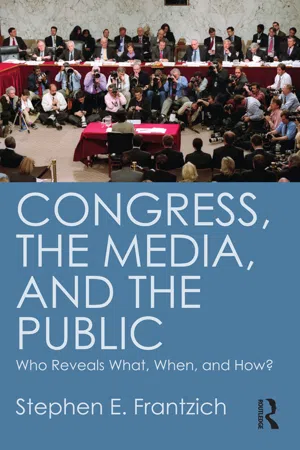
From the beginning of the Republic, members of Congress have been in the media spotlight. In recent years, the expansion of media venues has provided both challenges and opportunities to Representatives and Senators, the public, and even the media itself. Legacy media such as newspapers and broadcast television each carry with them their own needs and accepted usages affecting the kind and volume of news about Congress delivered to the public. These sources still serve important roles for much of the public and are covered here. This book goes beyond the traditional legacy media to include Congress' portrayal on live television, in political cartoons, in film, as a part of the emerging "infotainment†venues, and through social media such as web pages, Facebook, and Twitter. We increasingly live in a world where the lines between traditional news and others sources of information have been erased.
This is an exciting, if challenging, time, for Congress, the media, and the public as each attempts to sort out the new media environment and employ it to its advantage. Using a comprehensive analysis of previous research, dozens of interviews, and the inclusion of empirical data, this book assesses the current status of the relationship between Congress and the media and sorts out the temporary changes from those likely to represent future trends. Whether one is associated with Congress, is an interested citizen, or is part of the media industry, understanding the relationships and developments between and among them is key to understanding how the public behaves in relation to Congress, and vice versa.
- 214 pages
- English
- ePUB (mobile friendly)
- Available on iOS & Android
eBook - ePub
About this book
Trusted by 375,005 students
Access to over 1.5 million titles for a fair monthly price.
Study more efficiently using our study tools.
Information
Chapter 1
The Media and Representative Government
The Necessary Evil?
This is a book about the media and Congress. Three key rationales stand out for new effort to explain this relationship. First, previous books have limited their attention to relatively narrow media, ignoring the vast array of ways information about Congress enters the public consciousness. Second, both Congress and the media have undergone significant changes in the last few decades, challenging the context of many previous studies. Third, there is little question that Congress is in trouble when it comes to its public relations. Understanding how Congress is portrayed in the media may help Congress more effectively play its intended role in American democracy.
It is important to remember that the word “media” is plural. Individual media formats are transmission tools by which ideas, impressions, images, and feelings flow from a source to a recipient. Much research on Congress and the media focuses on traditional “legacy” media (print, radio, and television news) and emerging media (websites, Facebook, YouTube, and Twitter), but such a list should not imply full coverage of the multiple ways in which the public learns about Congress and its members. To this list we will add editorial cartoons, and gavel-to-gavel coverage on C-SPAN as well as a variety of popular culture entertainment venues. Even with these additions time and resources force us to largely bypass radio, theater, comic books, music, and a variety of other existing and emerging media.
Just as the various media present different content in different ways, the research tools herein will include a variety of approaches. Impressionistic data from interviews, empirical summaries, graphical presentations, and visual examples all will be relied upon. The analysis borrows heavily from the excellent research of others. A number of the research tools highlighted have been or could be used to analyze other political institutions and processes and it is hoped that usage here will encourage an expansion of our thinking and research. What the public knows about Congress and how it affects their behavior is important enough that we should not limit the media we look at or the approaches we use.
The Democratic Conversation
Democratic politics involve a series of conversations between the public and elected officials, facilitated, in part, by the media. Citizens express opinions on what government should be doing and how it should do it, while elected officials communicate back with guidelines for behavior (laws) and reports on their efforts. Useful conversations involve “shared islands of understanding” terminology, and knowledge which allows each partner in the conversation to assume some common understanding and to make the conversation interesting by adding some new information. In the extreme case, two people who have no knowledge of each other’s language are reduced to communicating with grunts and visual signals. On the other end of the spectrum, if two people know exactly the same things, there is no need to communicate. A “good” conversation emerges as a building process in which one partner signals a level of common knowledge and adds a relevant tidbit, to which the other partner reacts and adds their own unique contribution. In the congressional realm, a constituent may write, “I read today that Congress is considering a new import tax on shoes. Let me tell you how that will affect my business.” The member of Congress might write back,
Thank you for the insight. That bill has already passed in the House, but you might want to contact Senator Smith, since he is on the tax committee in the Senate and they have yet to take action. Since I hope to be on the conference committee, I would be willing to support the revised Senate version.
In this interchange, both partners have learned something.
The explosion of media sources threatens the development of the necessary islands of shared understanding. As we move from an era of broadcasting to “narrow-casting,” the potential for a fragmented citizenry uninformed about major areas of politics, while hyper-informed by information in other realms, could threaten the development of meaningful conversations. In the above example, the citizen unaware of upcoming congressional action, uninformed about the name of his or her representative, or not knowledgeable about how to communicate with them, is unlikely to be a relevant player. It is not so much that contemporary citizens are uninformed, but rather they may remove politics and world affairs from their infosphere altogether.1
Members of Congress and journalists both are in the communication game, attempting to deliver their preferred messages to chosen audiences. While the word fails to appear in any dictionary, much of what both members of Congress and journalists do could better be called “munication”: communication lacking the “co.” Many intended messages fall on fallow ground, having no impact on the intended recipient since they were ignored or misunderstood. “Messages fly back and forth like so many salvos of arrows loosed by hostile tribes, some of which hit their targets while others bury themselves ineffectually in the ground.”2 Both members of Congress and journalists constantly fiddle with the message content (the arrow), and the delivery mechanism (the bow), while attempting to locate and anticipate the nature of the target (the opposing tribe). When one sends the right message, in the right way, to the right people there is potential for an effect. Messages about and from Congress can come in two basic forms, dramatic infusions of new information (the “hypodermic effect”) or the slow accumulation of stories leading to similar outcomes (the “stalactite effect”) (see Box 1.1).
Box 1.1 Creating the Congressional Story
For the typical citizen, information about Congress, even if acquired, does not reside on one’s mental “ready reference shelf,” ready to be used immediately or on a regular basis. New information about anything arrives in two ways.
Hypodermic effect: Some congressional events have enough drama to break through everyday concerns and impinge on us like a needle piercing the skin and leaving a residue. When Congress or one of its members acts in an atypical way, the action has the potential to pierce our attention and force a reassessment of our thinking with headlines such as:
“Republican incumbents topped by tea party challengers in primaries”
“Representative Joe Wilson (R-CA) yells out at President Obama, ‘You lie’.”
“Congress passes Obamacare”
“Bi-partisan congressional delegation sings ‘God Bless America’ on
Capitol steps on 9/11”
Stalactite effect: Is like the slow building up of positive or negative impressions over a long period of time. None of the individual stories stand out as powerful enough to change the publics’ minds, but in total they develop a mindset. Each related story helps develop a mindset almost imperious to conflicting evidence. As one congressional staff member put it, the message about Congress “is not something that is delivered overnight. It is the filling in of a mosaic, and has to be assembled over a long period of time.”a Stories with quotes such as the following repeated enough create conventional wisdom of a partisan, inefficient, and lazy set of lawmakers:
“In another partisan battle with all Republicans opposing all Democrats…”
“Just the most current example of kicking the can down the road…”
“Leaving for vacation break, Congress fails to…”
Source: a Robert. W. Stewart, “Lawmakers Perfect Art of One-Minute Zinger,” Los Angeles Times, October 4, 1992, p. A13.
Congress serves as the source, subject, and creator of informative messages. Information processing is the “core technology” of Congress. Unlike other production processes, the House and Senate do not “make” anything tangible such as cars or refrigerators. Members of Congress receive information from outside the institution, share information within the two chambers, and export information in the form of press releases, speeches, and most importantly legislation. The media play an important role in what information members of Congress hear, what they share with their colleagues, and what they are able to transmit to the public. While members of the public and members of Congress do communicate directly, it is the media that amplify messages from the public and efficiently spreads information from Congress and its members to a wide audience. “Communication is at the core, if not synonymous with, all understandings of politics.”3
What the Public Needs and Wants to Know About Congress
The idea of an attentive public fed full information by an open Congress through a willing media stands more as the myth of an ideal representative democracy. Few citizens have the time or interest to pay attention to Congress on a regular basis. They have mortgages to pay, jobs to perform, and kids to raise. Congress only enters their consciousness sporadically, if at all. For members of earlier Congresses, invisibility was less of a curse than an opportunity to go about their business with only limited interference. “Congress lived rather happily through generations of comparative anonymity, making scant public relations efforts and feeling little intruded upon by journalists.”4
Seeking information about Congress is not a driving motivation for most citizens. Few go out on their own to seek unique information and tailor it to their interests. “What citizens know about politics and public affairs is largely determined by what the press chooses [emphasis added] to cover.”5 Much classic political theory made the demands on citizens virtually impossible to fulfill. The “police-patrol oversight” model expects active citizen monitoring of congressional behavior reported by the media. The “fire alarm oversight” approach delegates the day-to-day observation to more interested parties (other politicians, interested groups, and the media themselves), expecting them to alert the public through the media when something clearly out of the ordinary reveals something of wide interest and importance about Congress.6
The media also support an even lower level of awareness and problem identification. The “public library/archive” analogy points out how print media and increasingly electronic media have developed repositories of past behavior and promises. Testing the veracity of a politician’s previous actions and commitments with contemporary behavior may increase accountability by creating a story in which the media may make a politician look good (consistent, farsighted, etc.) or bad (inconsistent, duplicitous, or foolish). By contributing to the permanent public record, the media give members of Congress fewer places to avoid criticism.
It is hard to get a true fix on how much attention citizens pay to politics in general or to Congress and its members in particular. Attentiveness is a socially acceptable behavior and polling responses clearly over-represent the amount of actual interest or absorption of congressional information. While a relatively small percentage of the population actively seeks out congressional stories, the particular medium an individual uses affects the degree to which one’s usage pattern leads to inadvertent exposure. Television provides pre-packed sets of stories, making it difficult to pick and choose what one is exposed to. Few people physically or mentally turn off congressional stories if they happen to come along. Print consumers may well have their favorite sections and topics, but receive some inadvertent information as they scan headlines to find the stories in which they are most interested in. Web searchers are much more intentional, aimed at looking for particular content. Once they click on a story, they tend to drill down deeper and more narrowly. Websites, blogs, tweets, YouTube, and Facebook pages allow one to opt in or out with very little effort, presumably f...
Table of contents
- Cover
- Title
- Copyright
- Contents
- 1 The Media and Representative Government: The Necessary Evil?
- 2 The Love/Hate Relationship: The Media Approach Congress
- 3 The Congressional P.R. Machine: Selling a Single Product
- 4 Catch Me If You Can: News Hooks and Nobodies
- 5 From Props to First Responders: Congress and the State of the Union Message
- 6 Mr. Chair and My Loyal Fans: Celebrity Testimony on Capitol Hill
- 7 Bombasters and Buffoons: Making Congress an Easy Target
- 8 Congress, the Houses of Ill Repute: Cartoonists Take on the House and Senate
- 9 Congress and Popular Culture: Dissing Congress on a Grand Scale
- 10 C-SPAN: A Window on Congress
- 11 Congress and the New Media: Challenges and Opportunities
- 12 Congress and the Media: The Continuing Odyssey
- Index
Frequently asked questions
Yes, you can cancel anytime from the Subscription tab in your account settings on the Perlego website. Your subscription will stay active until the end of your current billing period. Learn how to cancel your subscription
No, books cannot be downloaded as external files, such as PDFs, for use outside of Perlego. However, you can download books within the Perlego app for offline reading on mobile or tablet. Learn how to download books offline
Perlego offers two plans: Essential and Complete
- Essential is ideal for learners and professionals who enjoy exploring a wide range of subjects. Access the Essential Library with 800,000+ trusted titles and best-sellers across business, personal growth, and the humanities. Includes unlimited reading time and Standard Read Aloud voice.
- Complete: Perfect for advanced learners and researchers needing full, unrestricted access. Unlock 1.5M+ books across hundreds of subjects, including academic and specialized titles. The Complete Plan also includes advanced features like Premium Read Aloud and Research Assistant.
We are an online textbook subscription service, where you can get access to an entire online library for less than the price of a single book per month. With over 1.5 million books across 990+ topics, we’ve got you covered! Learn about our mission
Look out for the read-aloud symbol on your next book to see if you can listen to it. The read-aloud tool reads text aloud for you, highlighting the text as it is being read. You can pause it, speed it up and slow it down. Learn more about Read Aloud
Yes! You can use the Perlego app on both iOS and Android devices to read anytime, anywhere — even offline. Perfect for commutes or when you’re on the go.
Please note we cannot support devices running on iOS 13 and Android 7 or earlier. Learn more about using the app
Please note we cannot support devices running on iOS 13 and Android 7 or earlier. Learn more about using the app
Yes, you can access Congress, the Media, and the Public by Stephen Frantzich in PDF and/or ePUB format, as well as other popular books in Politics & International Relations & American Government. We have over 1.5 million books available in our catalogue for you to explore.