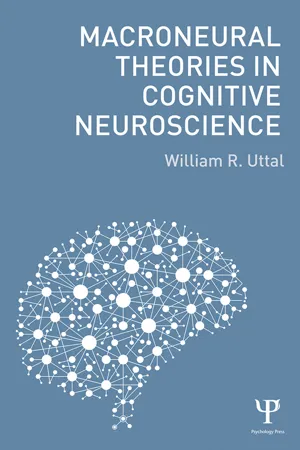
In this book, William R. Uttal continues his analysis and critique of theories of mind. This book considers theories that are based on macroneural responses (such as those obtained from fMRI) that represent the averaged or cumulative responses of many neurons. The analysis is carried out with special emphasis on the logical and conceptual difficulties in developing a theory but with special attention to some of the current attempts to go from these cumulative responses to explanations of the grand question of how the mind is generated by the brain. While acknowledging the importance of these macroneural techniques in the study of the anatomy and physiology of the brain, Uttal concludes that this macroneural approach is not likely to produce a valid neural theory of cognition because the critical information—the states of the individual neurons—involved in brain activity becoming mental activity is actually lost in the process of summation. Controversial topics are considered in detail including discussions of empirical, logical, and technological barriers to theory building in cognitive neuroscience.
- 196 pages
- English
- ePUB (mobile friendly)
- Available on iOS & Android
eBook - ePub
Macroneural Theories in Cognitive Neuroscience
About this book
Information
Publisher
Psychology PressYear
2015Print ISBN
9781138887473
9781138887466
Edition
1eBook ISBN
9781317392729
1 What Is a Theory?
DOI: 10.4324/9781315678955-4
1.1 Toward a Definition of a Theory1
The crown jewels of any science are the integrative theories developed to consolidate a sometimes enormous and chaotic body of empirical evidence. As exciting are the fortuitous discoveries of new worlds, creatures, processes, or phenomena, each discovery becomes truly meaningful only in terms of the synoptic interpretations that are made of it and others like it. This is not meant to disparage exploration or well-controlled experimentation, but rather to emphasize that what we make collectively of such findings is the most important product of a science. Whether it is an understanding of the overall geography of a previously undiscovered land on Earth or in the cosmos or of the relations between animal species or between elemental materials, it is the syntheses of particular observations into general laws and principles and then the integration of these laws into overarching theory that characterize the great accomplishments of science.
Individual observations remain largely isolated and their meaning often cryptic, if not useless, without some kind of a conceptual framework. It is the cumulative and general impact of a body of knowledge, rather than the particulars of individual findings, that lead to prediction and control and all of the rest of the progress that comes from scientific inquiry. It is the ability to see general implications, as opposed to observed individual “facts,” that provides the great payoff. It is this understanding and its application that eventually leads us to the betterment of life and the indescribable joy of discovering something universal about the world in which we live. Although individual experiments may excite, stimulate, and illuminate a dark corner of what had been ignorance, they mean nothing until their implications are made clear. Flames are charming and beautiful, but they took on a much deeper meaning when the general idea of combustion was explicated. When the spectrum of the light emitted from such a process permitted us to probe the nature of atomic structure, even deeper insights and theories became possible and science transcended from the mysterious to the comprehensible.
It is in this context that the word “theory” takes on such an especially important role in science. Nevertheless, it is probably among science's most misunderstood words. Debate concerning its meaning is ubiquitous among philosophers as well as among empirically oriented investigators. This is especially true in cognitive neuroscience—a science that has one foot in the tangible biochemistry and electrophysiology of nervous action and the other in the excruciatingly intangible phenomena of thought, consciousness, attention, perception, and emotion among other concepts of even less precise denotation.
In this book, I not only attempt to describe progress in current theory but also consider the constraints and barriers to theory building in cognitive neuroscience. After considerable research, I have some grave doubts about some of the theoretical goals in this field. My negative conclusion concerning the ultimate solubility of the mind-brain question is not unique or completely idiosyncratic. Others such as Rakover (2011) essentially came to the same conclusion. He cited a number of scholars (e.g., Dietrich & Hardcastle, 2005; Heil, 2003; Ludwig, 2003; McGinn, 1989; Palmer, 1999; Putnam, 1975) most of whom are philosophers, but all of whom express the same opinion—we have not yet explained how mental processes emerge from neural activity, and there is little hope that we will be able to do so in the immediate future! As a result, these scholars have come to be referred to as the “New Mysterians.”
Cognitive neuroscientists, of course, have quite a different outlook about the ultimate solvability of the mind-brain problem, by which I mean specifically the search for a neuroreductionist explanation of how the brain produces the mind. Indeed, the entire corpus of their work is based on the presumption that not only is an explanation possible but also that we are making progress toward that goal. This is not to say that there is any ontological disagreement between current philosophers and cognitive neuroscientists about the physical basis of mind. Both groups mainly agree (no matter how much popular opinion may run against the idea) that the immaterial mind is nothing more or less than a function of the material brain. Both groups can accept the ontology of materialistic monism in principle while also accepting the epistemological in practice constraints on the task. To do otherwise is to flirt with a cryptic kind of dualism.
In such a context, if we are to talk sensibly about current developments in cognitive neuroscience, it is essential that we are as precise as possible about what we mean by the word “theory.” In an earlier work (Uttal, 2005), I attempted to define the term by an exhaustive search of the literature. It did not take long to discover that there was a great diversity of meanings that had been attached to the word over the centuries. Some are pejorative (one common use of the word “theory” is as a substitute for knowledge), as a designation of our ignorance rather than of our understanding. In this context, “theory” is used to imply unsupported speculation as in, “Oh, that is only a theory.”
Similarly, the word “theory” is also sometimes used as a prevailing, informal statement of some presumed, but unsupported, relationship. For example, “the theory is that most children have a natural affinity for music.” Whether this statement is true, the scientific literature justifying such a “theory” is controversial, to say the least. This “theoretical” assertion, like many other such conjectures about human nature, is far less strongly substantiated than we would wish. The meaning of the word “theory” in this case is more akin to a preliminary assumption, hypothesis, or premise than a general law.
In other contexts, theory is used as the beginning, and not the end, of a scientific inquiry. Here it is frequently mistakenly confused with “hypothesis.” Not all hypotheses, of course, are theory free; they may well have developed from a previous synthesis—a previous prototheory or hypothesis that offered a preliminary understanding of a collection of observations.
Hypotheses are, at best, limited intermediate steps by means of which proto-theories and theories can be invoked and tested.
A prototheory is defined as an intermediate step between observational data and a true, complete, explanatory theory. Prototheories include organized collections of data as well as preliminary interpretations, simulations, and correlational statements. Although usually “explaining” very little, they have the possibility of stimulating subsequent steps towards overarching explanatory theories.
Thus, a hypothesis still does not represent the ideal goal of a unifying synthesis. Of course, theoretical constructs can be tested by playing the role of “hypotheses” in experiments; however, the prototypical experiment in such a case is usually framed in something more akin to a limited question than as an overarching theory. For example, the measurement of the deflection of light by the gravitational attraction of the sun by Dyson, Eddington, and Davidson (1920) was a test of a hypothesis (light would be bent by gravity) that then could be applied as a test of a theory (Einstein's general relativity theory). By itself, the observation was of minor practical significance (no human endeavor was obviously changed by the observation itself). In the context of the theory of which it was a test, confirmation of the predictive hypothesis was world changing.
I sought an answer to the nature of a theory in my earlier book by quoting from the Merriam-Webster Collegiate Dictionary (2000). What I found was a number of definitions, some of which came close to my use whereas others were really nothing more than colloquialisms. [The bracketed responses are my own.]
- the analysis of a set of facts in their relation to one another. [Good!]
- abstract thought: Speculation [Terrible!]
- the general or abstract principles of a body of fact, a science, or an art <music theory > [GOOD!]
- a belief, policy, or procedure proposed or followed as the basis of action <her method is based on the theory that all children want to learn> (b): an ideal or hypothetical set of facts, principles, or circumstances—often used in the phrase in theory <in theory, we have always advocated freedom for all> [TRIVIAL!]
- a plausible or scientifically acceptable general principle or body of principles offered to explain phenomena <wave theory of light> [GOOD!]
- a hypothesis assumed for the sake of argument or investigation [Poor!] (b): an unproved assumption: CONJECTURE [POOR!] (c): a body of theorems presenting a concise systematic view of a subject < theory of equations> [GOOD!]
Synonyms see Hypothesis2 [Poor and Misleading!]
My purpose in pointing out the variety of usages of the word “theory” is to lay the foundation for the meaning of the word as I use it throughout the rest of this book. The most important point to be made explicit at this point in our discussion is that an assemblage of data does not a theory make. That is, no matter how extensive may be a body of empirical knowledge, it is just a collection of observations until organized into a coherent story. By “coherent” I mean that the individual observations must collectively imply some general synthesis. Only when the similarities and relationships are highlighted and the general principles extracted does the beginning of a theory emerge.
A theory is an integrated interpretation of a body of related empirical evidence. As such, a theory incorporates or summarizes a body of observations by extracting general principles, rules, and laws implied by the data. Theories come in many types—some mathematically formal and some ambiguously verbal—but all of which transcend the particular to illuminate the general. In this book, I emphasize the neuroreductionist approach, in particular, at the macroneural level.
There are a variety of theories about the how the brain makes the mind, but none is unique or dominant. Some theories are purely descriptive, using logical and mathematical frameworks to depict the behavior of a system. Some dote on predictability as their central idea. Some are patently reductive, invoking and synthesizing data that hopefully bridge the huge conceptual and empirical gap between the neural and the mental.
Philosophers (e.g., Hesse, 1967) invoke a hierarchy of observations, laws, and theories. The first being the raw data, the second being generalities inferred from the data, and the third incorporating the laws into a system that may have reductive, deductive, or predictive implications. Throughout this hierarchy, there is a consolidation and simplification of the world as we observe it into ever more general ideas. Thus a law, however general, is not a theory until it is combined with other laws. Throughout this process, there is the progressive consolidation from particulars to ever more encompassing generalities.
For example, Guthrie (1946) asserted the following:
A flood of new publications is not automatically a flood of new facts. In addition, it may include many facts that do not contribute materially to the science of psychology. Collections of facts are not science. They are the material out of which science can grow, but they are only the raw material of science, and sometimes they are not even that.(p. 3)
The essence of my use of the word “theory” is that a theory is a collection of general laws and principles that transcend and enlarge on the meaning of the empirical observations on which the theory was based. The particular emphasis that I make as a cognitive neuroscientist is that the cognitive should in principle be explained (or an effort made towards explanation) by linking the languages of psychology and neurophysiology.
A common theme expressed by those of us who have seriously considered the issue—what is a theory?—is that the primary attribute of a theory is that it is comprehensive, inclusive, and integrative of the findings of many experiments. The metaphorical image to which a theory is often compared is of a pyramid, in which the lower levels represent the particular data, findings, or observations, and the upper levels are increasingly more inclusive of a variety of general rules, laws, and principles—in other words, the most general apex of the pyramid represents the theory.
To the extent that we can predict the future, it will most likely be discovered that that the level of brain activity that will ultimately emerge as the foundation of cognition is that of neuronal network interactions at the microneuronal level (Hebb, 1949). Macroneural signals such as those obtained with an fMRI system may pool, sum, and combine these salient neuronal (cellular) interactions and thus obliterate the information that is necessary for theory development.
By macroneural, I refer to neural processes and responses that are the summed, pooled, or cumulative effects of a large number of neurons distributed over extended regions of the brain. By microneuronal, I refer to the neural processes of single neurons or to networks of neurons in which the identity and function of the individual neurons are preserved.
There are two main barriers to the development of neuroreductionist theories. The first, inhibiting macroneural theory, is that any inconsistency between cognitive and neural activities may reflect the fact that macroneural electrophysiological signals are actually unrelated to cognitive processes, but are, instead, statistical artifacts based on inadequate sample size or too liberal p-values. The possibility that we are reading order into what is actually a stochastic process is not too far-fetched, given the recent contributions of Thyreau et al. (2012) and Gonzalez-Castillo et al. (2012) that are discussed extensively in Chapter 5. If their arguments and findings turn out to be valid when replicated, it would be a major problem for any theory depending on some form of localization, for then there would be no robust evidence of separable, localizable brain regions in particular places—a major postulate of current cognitive neuroscience. Data sets from brain imaging experiments would have to be considered as cumulative expressions of a myriad of components in a complex system rather than as prototheories. Under some conditions, particularly those of brain-like systems, this may pose intractable barriers to theory building.
The second major barrier affects putative microneuronal theories. It may be that the number of neurons and the complexity of the neuronal networks are such that the combinatorial problem they specify to understand their cognitive functions may pose, for the foreseeable future, intractable computational or data-handling obstacles.
It is uncertain how profound are these barriers. If consistency is to be found when comparable experiments are replicated, then at least the raw materials of a prototheory may be present.3 The term “prototheory” refers specifically to a body of data, or a loose interpretation of them, that does not meet the criteria of generality and synoptic convergence required of a true or complete explanatory theory. Instead, prototheories are often little more than simple restatements, tabulations, collections, or organizations of the empirical data.
It is not entirely clear what constitutes a prototheory. Nor, for that matter, is it necessarily true that just a body of accumulated data, no matter how voluminous, would ipso facto constitute a theory. The ideal theory, as I have already noted, goes beyond the data to tease out the generalities and universals in a manner that transcends the corpus of empirical evidence.
Obviously, the converse is also true—just as a scientific theory must be based on relevant empirical evidence, a putative summary ba...
Table of contents
- Cover Page
- HalfTitle Page
- Serirs Page
- Fulltitle Page
- Copyright Page
- Front Other
- Dedication Page
- Table Of Contents
- Preface
- Acknowledgments
- Prologue—On the Antiquity of Cognitive Neuroscience
- 1 What Is a Theory?
- 2 Prototheories and Nontheories
- 3 Conceptual Issues
- 4 Macroneural Connectionist Theories of Cognition
- 5 Additional Critiques of Macroneural Connectionist Theories
- 6 Implications and Emerging Principles
- References
- Index
Trusted by 375,005 students
Access to over 1.5 million titles for a fair monthly price.
Study more efficiently using our study tools.
Frequently asked questions
Yes, you can cancel anytime from the Subscription tab in your account settings on the Perlego website. Your subscription will stay active until the end of your current billing period. Learn how to cancel your subscription
No, books cannot be downloaded as external files, such as PDFs, for use outside of Perlego. However, you can download books within the Perlego app for offline reading on mobile or tablet. Learn how to download books offline
Perlego offers two plans: Essential and Complete
- Essential is ideal for learners and professionals who enjoy exploring a wide range of subjects. Access the Essential Library with 800,000+ trusted titles and best-sellers across business, personal growth, and the humanities. Includes unlimited reading time and Standard Read Aloud voice.
- Complete: Perfect for advanced learners and researchers needing full, unrestricted access. Unlock 1.5M+ books across hundreds of subjects, including academic and specialized titles. The Complete Plan also includes advanced features like Premium Read Aloud and Research Assistant.
We are an online textbook subscription service, where you can get access to an entire online library for less than the price of a single book per month. With over 1.5 million books across 990+ topics, we’ve got you covered! Learn about our mission
Look out for the read-aloud symbol on your next book to see if you can listen to it. The read-aloud tool reads text aloud for you, highlighting the text as it is being read. You can pause it, speed it up and slow it down. Learn more about Read Aloud
Yes! You can use the Perlego app on both iOS and Android devices to read anytime, anywhere — even offline. Perfect for commutes or when you’re on the go.
Please note we cannot support devices running on iOS 13 and Android 7 or earlier. Learn more about using the app
Please note we cannot support devices running on iOS 13 and Android 7 or earlier. Learn more about using the app
Yes, you can access Macroneural Theories in Cognitive Neuroscience by William R. Uttal in PDF and/or ePUB format, as well as other popular books in Biological Sciences & Cognitive Psychology & Cognition. We have over 1.5 million books available in our catalogue for you to explore.