- 1,033 pages
- English
- ePUB (mobile friendly)
- Available on iOS & Android
eBook - ePub
About this book
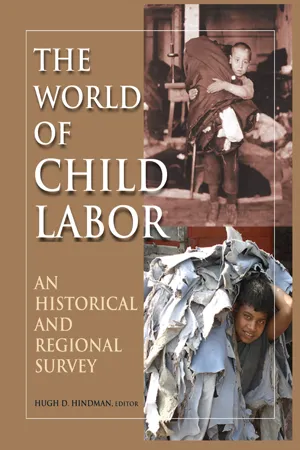
"The World of Child Labor" details both the current and historical state of child labor in each region of the world, focusing on its causes, consequences, and cures. Child labor remains a problem of immense social and economic proportions throughout the developing world, and there is a global movement underway to do away with it. Volume editor Hugh D. Hindman has assembled an international team of leading child labor scholars, researchers, policy-makers, and activists to provide a comprehensive reference with over 220 essays. This volume first provides a current global snapshot with overview essays on the dimensions of the problem and those institutions and organizations combating child labor. Thereafter the organization of the work is regional, covering developed, developing, and less developed regions of the world.The reference goes around the globe to document the contemporary and historical state of child labor within each major region (Africa, Latin and South America, North America, Europe, Middle East, Asia, and Oceania) including country-level accounts for nearly half of the world's nations. Country-level essays for more developed nations include historical material in addition to current issues in child labor. All country-level essays address specific facets of child labor problems, such as industries and occupations in which children commonly work, the national child welfare policy, occupational safety regulations, educational system, and laws, and often highlight significant initiatives against child labor.Current statistical data accompany most country-level essays that include ratifications to UN and ILO conventions, the Human Development Index, human capital indicators, economic indicators, and national child labor surveys conducted by the Statistical Information and Monitoring Program on Child Labor. "The World of Child Labor" is designed to be a self-contained, comprehensive reference for high school, college, and professional researchers. Maps, photos, figures, tables, references, and index are included.
Information
Table of contents
- Cover Page
- Half Title Page
- Series Page
- Title Page
- Copyright Page
- Contents
- List of Contributors
- Acknowledgements
- Abbreviations
- Editor’s Introduction: Child Labor in Global and Historical Perspective
- Editor’s Note: Measuring Child Labor
- Part 1: World
- Section 1. Understanding Child Labor
- The Economic View of Child Labor
- Social Science Views on Working Children
- A Brief Historiography of Child Labor
- Toward an Integrative Theory of Child Labor
- Section 2. More Developed Regions of the World
- Periods of History: Childhood and Child Work, c. 1800-Present
- Child Labor in the Industrial Revolution
- Coming to Terms with Child Labor
- Coming to Terms with Child Labor: The Historical Role of Education
- Coming to Terms with Child Labor: History of Child Welfare
- Coming to Terms with Child Labor: The Role of Technology
- Child Labor in the Developed Nations Today
- Global Trade and Child Labor
- Visual Representations of Child Labor in the West
- Section 3. Less Developed Regions of the World
- Worst Forms of Child Labor
- Worst Forms of Child Labor: Agriculture
- Worst Forms of Child Labor: Child Domestic Labor
- Worst Forms of Child Labor: Street Children and Street Trades
- Worst Forms of Child Labor: Commercial Sexual Exploitation of Children
- Worst Forms of Child Labor: Children and War
- Worst Forms of Child Labor: Child Bonded Labor
- The Puzzle of “Idle” Children, neither in School nor Performing Economic Activity
- Child Labor Policy for Developing Nations
- Education and Child Labor: A Global Perspective
- Special Health Risks of Child Labor
- Section 4. Action Against Child Labor
- The United Nations and UNICEF
- Millennium Development Goals
- International Labor Organization (ILO) and the International Program for the Elimination of Child Labor (IPEC)
- The Role of Nongovernmental Organizations
- The Role of Trade Unions
- Organization of Working Children
- The Economics of Consumer Actions Against Products with Child Labor Content
- Global March Against Child Labor
- Part 2: Sub-Saharan Africa
- Section 1. Introduction
- Child Labor in Postcolonial Africa
- Child Labor in Colonial Africa
- HIV/AIDS and Child Labor in Sub-Saharan Africa
- Influence of Orphanhood on Children's Schooling and Labor: Evidence from Sub-Saharan Africa
- Children's Work Among Traditional Healers in Africa
- Child Labor Unions in Africa
- Section 2. Western Africa
- Trafficking for Labor Exploitation in West and Central Africa
- Koranic Schools and Child Labor in West Africa
- Child Labor in Burkina Faso
- Children's Work, Child Domestic Labor, and Child Trafficking in Côte d'Ivoire
- Gambia
- Child Labor in Ghana
- Guinea-Bissau
- Child Labor in Mali
- Niger
- Child Labor in Nigeria
- Children in Street Trading in Nigeria
- Child Labor in Nigeria: Historical Perspective
- Child Labor in Senegal: Contemporary and Historical Perspective
- Sierra Leone
- Togo
- Section 3. Middle Africa
- Child Soldiers in the Great Lakes Region of Africa
- Angola
- Child Labor in Cameroon
- Central African Republic
- Chad
- Burundi
- Section 4. Eastern Africa
- Child Labor in Ethiopia: Overview and Policy Challenges
- Attending School, Learning, and Child Work in Ethiopia
- Child Labor in Kenya
- Children and Forced Labor in Colonial Kenya
- Madagascar
- Malawi
- Rwanda
- Child Labor in Tanzania
- Child Labor in Uganda
- Child Labor in Zambia
- Working Children in Zimbabwe
- Child Labor in Colonial Zimbabwe
- Section 5. Southern Africa
- Lesotho
- Namibia
- Mapping Children's Work in South African History
- Swaziland
- Part 3: Latin America and Carribean
- Section 1. Introduction
- Child Labor in Latin America
- History of Childhood and Child Labor in Latin America
- Child Labor and Education in Latin America
- Children's Social Movements in Latin America
- Section 2. South America
- Worst Forms of Child Labor in the Andes Region
- Child Labor in Bolivia
- Recent History of Child Labor in Brazil
- Child Street Vendors in Brazil
- Prostitution and Commercial Sexual Exploitation of Children and Adolescents in Brazil
- Special Health Risks to Child Workers in Brazil
- The Intergenerational Persistence of Child Labor in Brazil
- Child Labor Labeling in Brazil
- Development of Child Labor Law in Brazil
- The History of Child Labor in Brazil
- Orphans and the Transition from Slave to Free Labor in Northeast Brazil
- Chile
- Child Labor in Colombia
- Ecuador
- Guyana
- Paraguay
- Peru
- Venezuela
- Section 3. Central America
- Belize
- Costa Rica
- Child Labor in El Salvador
- Child Labor in Guatemala
- Child Labor in Honduras
- Child Labor in Mexico
- Street Children in Mexico
- PROGRESA/Oportunidades: Mexico's School Stipend Program
- Impact of Temporary Labor Migration on Schooling Among Mexican Children
- History of Child Labor in Mexico
- Child Labor in Nicaragua
- Panama
- Section 4. Caribbean
- Child Slaves on West Indies Sugar Plantations
- Dominican Republic
- Child Labor in Haiti
- Child Labor in Jamaica
- Commercial Sexual Exploitation of Children in Jamaica
- Part 4 North America
- Section 1. Canada
- Child Labor in Canada
- Children in Canadian Mining
- Nation Builders: Orphans in the Canadian Wilderness
- Evolution of Child Welfare Policy in Canada
- Section 2. United States
- History of Child Labor The Work of Enslaved Children in the United States
- Orphan Trains
- History of Children in U.S. Coal Mining
- Child Labor in the American Glass Industry
- Child Labor in American Textiles
- Child Labor in Commercialized Agriculture, 1890–1966
- Evolution of U.S. Child Labor Policy
- Florence Kelley and the National Consumers League
- National Child Labor Committee
- Felix Adler
- Edgar Gardner Murphy
- Lewis Wickes Hine
- The U.S. Children's Bureau
- Child Labor and the United States Today
- Children in the Fields: America's Hidden Child Labor Problem
- Twenty-First-Century Adolescence in America
- American Students' Activism Against Global Child Labor
- Part 5: Europe
- Section 1. Introduction
- Europe: An Intr@duction and Overview
- European Proto-Industrialization
- European Industrialization and Child Labor
- History of Education in Europe: Schooling and Child Labor in Europe Since the Reformation
- Apprenticeship Practices in Europe
- Church and Child Labor—Catholicism
- Church and Child Labor—Protestant Reformation
- Section 2. United Kingdom
- History of Child Labor in Britain
- Pauper Apprenticeship in England
- History of Child Labor in Coal Mining in Britain
- Child Labor in the United Kingdom—Textiles
- Child Work in Agriculture in Britain
- Street Children and Street Trades in the United Kingdom
- Chimney Sweep—Cultural Icon
- Anthony Ashley-Cooper, Seventh Earl of Shaftesbury
- National Society for the Prevention of Cruelty to Children
- Child Work and Child Labor in the United Kingdom Today
- Section 3. Northern Europe
- History of Child Labor in the Nordic Countries
- Family Policy in the Nordic Countries
- Denmark Child Labor in the Danish Textile Industry
- Finland History of Child Labor in Finland
- Sweden History of Child Labor in Sweden
- Financial Incentives in Child Auctions in Nineteenth-Century Sweden
- Child Work and Child Labor in Sweden Today
- Section 4. Western Europe
- Belgium Child Labor in Belgium
- Child Labor in the Ghent Cotton Mills, Nineteenth Century
- France France: A Historical Overview
- Germany History of Child Labor in Germany: An Overview
- New Risks and New Opportunities in SchooI-to-Work Transition: The Transformation of the German Apprenticeship System
- The Netherlands Child Labor in the Netherlands During Proto- and Early Industrialization
- Work, Education, and Discipline: Attitudes Toward Child Labor in the Netherlands, 1500 to 1875
- Development of Child Labor Policy in the Netherlands Since 1874
- Newspaper Delivery in the Netherlands
- Section 5. Southern Europe
- Albania Exploitation of Albanian Children in Greece
- Bosnia and Herzegovina
- Portugal History of Child Labor in Portugal
- Child Labor in Portugal Today
- Child Labor in Portuguese Textiles
- Spain Children's Work in Spanish Textiles During the Nineteenth and Twentieth Centuries
- Section 6. Eastern Europe
- Romania Child Labor in Romania
- Russia History of Child Labor in Imperial Russia
- Child Labor in the Russian Textile Industry
- Children in Sex Trades in Russia
- Position of Children and Child Labor in Russia Today
- Part 6: North Africa and Middle East
- Section 1. North Africa
- History of Child Labor in North Africa
- History of Child Labor in Algeria
- History of Child Labor in Libya
- History of Child Labor in Morocco
- Morocco: Why Children Go to Work Instead of School
- The Pyjama Trail Affair: A Case Study in Child Labor
- Small Maids in Morocco
- History of Child Labor in Tunisia
- Section 2. Middle East
- Child Labor in Azerbaijan
- Child Labor in Egypt
- Child Labor in Georgia
- Child Labor in Iran
- Iraq
- Child Labor and Child Growth in Jordan
- Selling Girls in Kuwait
- Child Labor in Turkey
- Legal Protection of Working Children in Turkey
- Primary Education and Child Labor in Turkey
- Sexual Exploitation of the Girl Child: Juvenile Commercial Sex Workers in Istanbul
- Children Trafficked to Gulf States for Use as Camel Jockeys
- Child Labor in Yemen
- Part 7: Central and South Asia
- Section 1. Central Asia
- Child Labor in Kazakhstan
- Uzbekistan
- Section 2. South Asia
- Rural Child Labor in South Asia
- Bangladeshi Garment Industry: From the Harkin Bill to the Bangladesh Garment Manufacturers and Exporters Association
- Economic History of Modern India
- Evolution of the Law on Child Labor in India
- Children in India's Carpet Industry
- Children in India's Glass Industry
- Children in India's Tea Industry
- Children of Kolkata Slums
- Children of Delhi Slums
- Working Children's Unions in India
- Child Labor and HIV and AIDS in India
- Education and Child Labor in India
- Challenges for Tribal Schooling in India
- Child Labor in Nepal
- Child Labor in the Tibeto-Nepalese Carpet Industry
- Social Labeling Programs in Nepal's Carpet Industry
- Trafficking of Child Workers in Nepal
- The Recruitment and Use of Children in Nepal's Armed Conflict
- Child Labor in Pakistan
- Child Work and Schooling Costs in Pakistan
- Child Labor Policy and Legislation in Pakistan
- Child Labor in Pakistan's Export Industries
- Forcible Recruitment of Children in Sri Lanka
- Part 8: East Asia and the Pacific
- Section 1. East Asia
- Child Labor in China: An Overview
- Education in the People's Republic of China
- History of Child Labor in China
- History of Chinese Education
- Japan History of Child Labor in Japan
- Education and Child Labor in Japan
- Mongolia
- Section 2. Southeast Asia
- Child Labor in Cambodia
- Child Labor in Indonesia
- Child Labor in Subcontracting Sectors of Indonesia's Garment and Footwear Industries
- Children and Work in Indonesia: Historical Overview
- Development of Child Labor Policy in Indonesia
- Child Soldiers in Myanmar
- Education and Child Labor in the Philippines
- Child Labor on Sugarcane Plantations in the Philippines
- Child Domestic Work in the Philippines
- Children in Muro-Ami Fishing
- Children in the Philippine Gold-Mining Industry
- The Role of NGOs in the Philippines
- Child Labor in Thailand
- Social Transformation and Children's Work in Vietnam
- Street Children in Vietnam
- Section 3. Oceania
- Australia Development of Child Welfare Policy in Australia
- Aboriginal Child Labor in Colonial Australia
- New Zealand Child Labor in New Zealand
- Index
Trusted by 375,005 students
Access to over 1.5 million titles for a fair monthly price.
Study more efficiently using our study tools.
Frequently asked questions
Yes, you can cancel anytime from the Subscription tab in your account settings on the Perlego website. Your subscription will stay active until the end of your current billing period. Learn how to cancel your subscription
No, books cannot be downloaded as external files, such as PDFs, for use outside of Perlego. However, you can download books within the Perlego app for offline reading on mobile or tablet. Learn how to download books offline
Perlego offers two plans: Essential and Complete
- Essential is ideal for learners and professionals who enjoy exploring a wide range of subjects. Access the Essential Library with 800,000+ trusted titles and best-sellers across business, personal growth, and the humanities. Includes unlimited reading time and Standard Read Aloud voice.
- Complete: Perfect for advanced learners and researchers needing full, unrestricted access. Unlock 1.5M+ books across hundreds of subjects, including academic and specialized titles. The Complete Plan also includes advanced features like Premium Read Aloud and Research Assistant.
We are an online textbook subscription service, where you can get access to an entire online library for less than the price of a single book per month. With over 1.5 million books across 990+ topics, we’ve got you covered! Learn about our mission
Look out for the read-aloud symbol on your next book to see if you can listen to it. The read-aloud tool reads text aloud for you, highlighting the text as it is being read. You can pause it, speed it up and slow it down. Learn more about Read Aloud
Yes! You can use the Perlego app on both iOS and Android devices to read anytime, anywhere — even offline. Perfect for commutes or when you’re on the go.
Please note we cannot support devices running on iOS 13 and Android 7 or earlier. Learn more about using the app
Please note we cannot support devices running on iOS 13 and Android 7 or earlier. Learn more about using the app
Yes, you can access The World of Child Labor by Hugh D Hindman,Hugh Hindman in PDF and/or ePUB format, as well as other popular books in Social Sciences & World History. We have over 1.5 million books available in our catalogue for you to explore.