The concept of masculinity was crucial not only to Jung's revolutionary theories of the human psyche, but also to his own personal development. If, as Jung believed, "modern man is already so darkened that nothing beyond the light of his own intellect illuminates his world," then it is essential to show every man the limits of his understanding and how to overcome them. In Aspects of the Masculine Jung does this by revealing his most significant insights concerning the nature and motivations of masculinity, both conscious and unconscious, and explaining how this affects the development of the personality. Offering a unique perspective on the masculine, based upon both his personal and clinical experiences, Jung asks questions that remain as insistent as ever. He offers answers that--whether they surprise, shock or edify--challenge us to re-examine our contemporary understanding of masculinity.
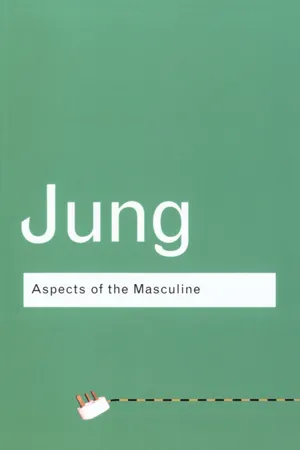
- 224 pages
- English
- ePUB (mobile friendly)
- Available on iOS & Android
eBook - ePub
Aspects of the Masculine
About this book
Information
1
THE HERO
THE ORIGIN OF THE HERO
251 The finest of all symbols of the libido is the human figure, conceived as a demon or hero. Here the symbolism leaves the objective, material realm of astral and meteorological images and takes on human form, changing into a figure who passes from joy to sorrow, from sorrow to joy, and, like the sun, now stands high at the zenith and now is plunged into darkest night, only to rise again in new splendour.1 Just as the sun, by its own motion and in accordance with its own inner law, climbs from morn till noon, crosses the meridian and goes its downward way towards evening, leaving its radiance behind it, and finally plunges into all-enveloping night, so man sets his course by immutable laws and, his journey over, sinks into darkness, to rise again in his children and begin the cycle anew.
[…]
297 The psychic life-force, the libido, symbolizes itself in the sun59 or personifies itself in figures of heroes with solar attributes. At the same time, it expresses itself through phallic symbols. Both possibilities are found on a late Babylonian gem from Lajard’s collection (fig. 19 [see p. 4]). In the middle stands an androgynous deity. On the masculine side there is a snake with a sun halo round its head; on the feminine side another snake with a sickle moon above it. This picture has a symbolic sexual nuance: on the masculine side there is a lozenge, a favourite symbol of the female genitals, and on the feminine side a wheel without its rim. The spokes are thickened at the ends into knobs, which, like the fingers we mentioned earlier, have a phallic meaning. It seems to be a phallic wheel such as was not unknown in antiquity. There are obscene gems on which Cupid is shown turning a wheel consisting entirely of phalli.60 As to what the sun signifies, I discovered in the collection of antiquities at Verona a late Roman inscription with the following symbols61:

298 The symbolism is plain: sun = phallus, moon = vessel (uterus). This interpretation is confirmed by another monument from the same collection. The symbols are the same, except that the vessel62 has been replaced by the figure of a woman. Certain symbols on coins can probably be interpreted in a similar manner. In Lajard’s Recherches sur la culte de Vénus there is a coin from Perga, showing Artemis as a conical stone flanked by a masculine figure (alleged to be the deity Men) and a female figure (alleged to be Artemis). Men (otherwise called Lunus) appears on an Attic bas-relief with a spear, flanked by Pan with a club, and a female figure.63 From this it is clear that sexuality as well as the sun can be used to symbolize the libido.
299 One further point deserves mention here. The dadophor Cautopates is often represented with a cock64 and pine-cones. These are the attributes of the Phrygian god Men whose cult was very widespread. He was shown with the pileus65 (or “Phrygian cap”) and pine-cones, riding on the cock, and also in the form of a boy, just as the dadophors were boyish figures. (This latter characteristic relates both them and Men to the Cabiri and Dactyls.) Now Men has affinities with Attis, the son and lover of Cybele. In Imperial times Men and Attis merged into one. Attis also wears the pileus like Men, Mithras, and the dadophors. As the son and lover of his mother he raises the incest problem. Incest leads logically to ritual castration in the Attis-Cybele cult; for according to legend the hero, driven mad by his mother, mutilates himself. I must refrain from going into this question more deeply at present, as I would prefer to discuss the incest problem at the end of this book. Here I would only point out that the incest motif is bound to arise, because when the regressing libido is introverted for internal or external reasons it always reactivates the parental imagos and thus apparently re-establishes the infantile relationship. But this relationship cannot be reestablished, because the libido is an adult libido which is already bound to sexuality and inevitably imports an incompatible, incestuous character into the reactivated relationship to the parents.66 It is this sexual character that now gives rise to the incest symbolism. Since incest must be avoided at all costs, the result is either the death of the son-lover or his self-castration as punishment for the incest he has committed, or else the sacrifice of instinctuality, and especially of sexuality, as a means of preventing or expiating the incestuous longing. (Cf. fig. 20. [see p. 4]) Sex being one of the most obvious examples of instinctuality, it is sex which is liable to be most affected by these sacrificial measures, i.e., through abstinence. The heroes are usually wanderers,67 and wandering is a symbol of longing,68 of the restless urge which never finds its object, of nostalgia for the lost mother. The sun comparison can easily be taken in this sense: the heroes are like the wandering sun, from which it is concluded that the myth of the hero is a solar myth. It seems to us, rather, that he is first and foremost a self-representation of the longing of the unconscious, of its unquenched and unquenchable desire for the light of consciousness. But consciousness, continually in danger of being led astray by its own light and of becoming a rootless will o’ the wisp, longs for the healing power of nature, for the deep wells of being and for unconscious communion with life in all its countless forms. Here I must make way for the master, who has plumbed to the root of these Faustian longings:

Figure 19 Androgynous divinity. Late Babylonian gem

Figure 20 Cybele and her son-lover Attis. Roman coin
MEPHISTOPHELES: This lofty mystery I must now unfold.
Goddesses throned in solitude, sublime,
Set in no place, still less in any time,
At the mere thought of them my blood runs cold.
They are the Mothers!
. . . . . . . . . . . . . . . . . . . . . . . . . .
Goddesses, unknown to mortal mind,
And named indeed with dread among our kind.
To reach them you must plumb earth’s deepest vault;
That we have need of them is your own fault.
FAUST: Where leads the way?
MEPHISTOPHELES: There’s none! To the untrodden,
Untreadable regions—the unforgotten
And unforgettable—for which prepare!
There are no bolts, no hatches to be lifted,
Through endless solitudes you shall be drifted.
Can you imagine Nothing everywhere?
. . . . . . . . . . . . . . . . . . . . . . . . . .
Supposing you had swum across the ocean
And gazed upon the immensity of space,
Still you would see wave after wave in motion,
And even though you feared the world should cease,
You’d still see something—in the limpid green
Of the calm deep are gliding dolphins seen,
The flying clouds above, sun, moon, and star.
But blank is that eternal Void afar.
You do not hear your footfall, and you meet
No solid ground on which to set your feet.
. . . . . . . . . . . . . . . . . . . . . . . . . .
Here, take this key.
. . . . . . . . . . . . . . . . . . . . . . . . . .
The key will smell the right place from all others:
Follow it down, it leads you to the Mothers.
. . . . . . . . . . . . . . . . . . . . . . . . . .
Then to the depths!—I could as well say height:
It’s all the same. From the Existent fleeing,
Take the free world of forms for your delight,
Rejoice in things that long have ceased from being.
The busy brood will weave like coiling cloud,
But swing your key to keep away the crowd!
. . . . . . . . . . . . . . . . . . . . . . . . . .
A fiery tripod warns you to beware,
This is the nethermost place where now you are.
You shall behold the Mothers by its light,
Some of them sit, some walk, some stand upright,
Just as they please. Formation, transformation,
Eternal Mind’s eternal recreation.
Thronged round with images of things to be,
They see you not, shadows are all they see.
Then pluck up heart, the danger here is great,
Approach the tripod, do not hesitate,
And touch it with the key.69
THE BATTLE FOR DELIVERANCE FROM THE MOTHER
For Jung, the hero is a symbol of the developing ego’s libido. By libido, Jung means not simply desire or psychological energy but psychological purpose as well. For him, the hero myth expresses the ego’s desire to replace dependency upon the unconscious with self-direction—a purpose that necessitates an ambivalent struggle with the mother, who symbolizes the unconscious.
441 Once again we recognize the typical elements of a libido myth: original bisexuality, immortality (invulnerability) through entry into the mother (splitting the mother with the foot), resurrection as a soul-bird, and production of fertility (rain). When a hero of this type causes his lance to be worshipped, he probably does so because he thinks it a valid equivalent of himself.
442 From this standpoint the passage in Job, which we quoted in Part I [not included here], appears in a new light:
He hath set me up for his mark.
His archers compass me round about,
He cleaveth my reins asunder, and doth not spare;
He poureth out my gall upon the ground.
He breaketh me with breach upon breach,
He runneth upon me like a giant.50
443 Here Jo...
Table of contents
- Cover
- Half Title
- Title Page
- Copyright Page
- Table of Contents
- EDITOR’S INTRODUCTION
- 1 The Hero
- 2 Initiation and the Development of Masculinity
- 3 The Father
- 4 Logos and Eros: Sol and Luna
- 5 The Masculine in Women
- 6 The Anima
- 7 The Spirit
- INDEX
Trusted by 375,005 students
Access to over 1.5 million titles for a fair monthly price.
Study more efficiently using our study tools.
Frequently asked questions
Yes, you can cancel anytime from the Subscription tab in your account settings on the Perlego website. Your subscription will stay active until the end of your current billing period. Learn how to cancel your subscription
No, books cannot be downloaded as external files, such as PDFs, for use outside of Perlego. However, you can download books within the Perlego app for offline reading on mobile or tablet. Learn how to download books offline
Perlego offers two plans: Essential and Complete
- Essential is ideal for learners and professionals who enjoy exploring a wide range of subjects. Access the Essential Library with 800,000+ trusted titles and best-sellers across business, personal growth, and the humanities. Includes unlimited reading time and Standard Read Aloud voice.
- Complete: Perfect for advanced learners and researchers needing full, unrestricted access. Unlock 1.5M+ books across hundreds of subjects, including academic and specialized titles. The Complete Plan also includes advanced features like Premium Read Aloud and Research Assistant.
We are an online textbook subscription service, where you can get access to an entire online library for less than the price of a single book per month. With over 1.5 million books across 990+ topics, we’ve got you covered! Learn about our mission
Look out for the read-aloud symbol on your next book to see if you can listen to it. The read-aloud tool reads text aloud for you, highlighting the text as it is being read. You can pause it, speed it up and slow it down. Learn more about Read Aloud
Yes! You can use the Perlego app on both iOS and Android devices to read anytime, anywhere — even offline. Perfect for commutes or when you’re on the go.
Please note we cannot support devices running on iOS 13 and Android 7 or earlier. Learn more about using the app
Please note we cannot support devices running on iOS 13 and Android 7 or earlier. Learn more about using the app
Yes, you can access Aspects of the Masculine by C.G. Jung in PDF and/or ePUB format, as well as other popular books in Psychology & Philosophy History & Theory. We have over 1.5 million books available in our catalogue for you to explore.