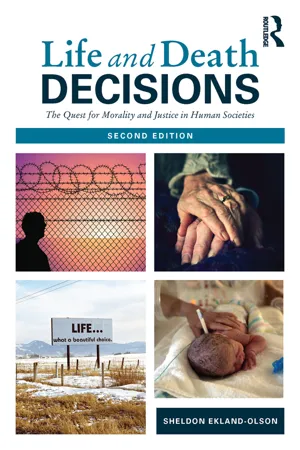
Issues of Life and Death such as abortion, assisted suicide, capital punishment and others are among the most contentious in many societies. Whose rights are protected? How do these rights and protections change over time and who makes those decisions? Based on the author's award-winning and hugely popular undergraduate course at the University of Texas, this book explores these questions and the fundamentally sociological processes which underlie the quest for morality and justice in human societies. The Author's goal is not to advocate any particular moral "high ground" but to shed light on the social movements and social processes which are at the root of these seemingly personal moral questions. Under 200 printed pages, this slim paperback is priced and sized to be easily assigned in a variety of undergraduate courses that touch on the social bases underlying these contested and contentious issues.
eBook - ePub
Life and Death Decisions
The Quest for Morality and Justice in Human Societies
- 180 pages
- English
- ePUB (mobile friendly)
- Available on iOS & Android
eBook - ePub
About this book
Information
1
A Moral System Evolves
A Single Question
Every society ever known has held to two deeply important moral imperatives:
• Life is sacred and should be protected.
• Suffering, once detected, should be alleviated.
And yet, these imperatives are routinely violated. Illustrations are repeatedly found. Here we will explore the moral landscape of eugenics, abortion, neonatal care, assisted dying, lynching, and capital punishment. We ask a single question. How do we, through our laws, religions, and customs, go about justifying the violation of deeply important, perhaps universal, moral signposts, all the while holding tightly to their importance?
The answer we find is this: We draw boundaries to establish social worth, and we set priorities to resolve dilemmas. In the process, we arrive at understandings calling for, even demanding, actions otherwise seen as deeply disturbing. From time to time, science, technology, and crystallizing events disturb, clarify, and inform our existing understandings. Such occurrences call for renewed resolution of dilemmas and definitions of life’s protective boundaries. Along this jagged and often contentious path moral systems evolve. We begin with a movement to eliminate people judged to be “unfit.”
An Exclusionary Movement is Born
The story of Nazi atrocities has been told countless times. It is only more recently that the evolution of the Final Solution has been linked to an international eugenics movement, anchored in the evolutionary theories of Charles Darwin, and legitimized by the U.S. Supreme Court.1 An exclusionary assessment of social worth provided the cornerstone.
In the formative years of the eugenics movement, no one was more important than the man who coined the term, Francis Galton. Galton was convinced that the means could be found to give “the more suitable races or strains of blood a better chance of prevailing speedily over the less suitable.”2 To Galton, these means were imperfect, but still more humane than the brutal processes of natural selection. In an oft-cited self-reflective passage, Galton noted:
Man is gifted with pity and other kindly feelings; he has also the power of preventing many kinds of suffering. I conceive it to fall well within his province to replace Natural Selection by other processes that are more merciful and not less effective.3
We could make life better by minimizing suffering that would otherwise occur. It was our duty to do so.
Galton was convinced that “man’s natural abilities are derived through inheritance.”4 He also saw that some of these influences were working toward “the degradation of human nature, and that others are working towards its improvement.”5 We had enormous power—via careful breeding—to influence the makeup of society. We had a duty to humanity to ensure that this power “shall be most advantageous to future inhabitants of the earth.”6 With this rationale, eugenics the scientific investigation became eugenics the progressive social movement. The practical implications of exclusionary differential worth were taking root.
To make matters worse for Galton and those of like mind, birth rates among the less fit were markedly higher. Society was providing a safety net for these less advantaged persons arriving in greater numbers, thus weakening the natural winnowing that would otherwise occur. Eugenicists began to criticize this “indiscriminate benevolence” for the poor, as it produced artificially long life spans for those considered unfit. If left unchecked, these higher birth rates and artificially reduced death rates among society’s least capable could mean only one thing—the slow but sure degradation of the populace. The very survival of a thriving, prosperous society was at stake.
Wouldn’t it be better to have a society enriched by those who are productive, healthy, emotionally stable, and smart than one stifled by degenerate, feeble-minded, disabled, and criminal citizens? To protect LIFE, the lives of the less worthy should be reduced in number. A loosely connected network of individuals and organizations, dedicated to the eugenics cause, began to chart the course toward what they saw as a more secure and prosperous future.7
A Base of Operation
The framing message and assumption of the eugenics social movement was that some lives were more worthy of support and protection than others. Its proponents set about performing research, the fruits of which could be used for the betterment of all. The Station for the Experimental Study of Evolution (SESE) and the Eugenics Record Office (ERO) served as critical early bases of operation.
The SESE and ERO were launched through the efforts of Charles Benedict Davenport, a young professor with entrepreneurial designs. While teaching at Harvard and later at the University of Chicago, Davenport began to seek funding for an independent laboratory. He soon discovered that the recently founded Carnegie Institution of Washington (CIW) had priorities that coincided with his interests. Davenport had just the place for his laboratory—a small summer institute at Cold Spring Harbor, on the northwestern shore of Long Island where he had taught previously. In December 1903, he was awarded a grant from CIW with commitments, as the award put it, to continue indefinitely, or for a long time. The Station for the Experimental Study of Evolution was born.
As Davenport’s work moved forward, it soon became clear that he would need a safe repository for his data. He began to search again for funding. In testament to the strength of weak ties8 and the importance of a tenacious entrepreneurial spirit for the success of any social movement, Davenport thought immediately of his connection to railroad magnate Edward Henry Harriman. Harriman had recently died and left his fortune to his wife, Mary; their daughter (also named Mary) had been a student of Davenport’s three years earlier in the summer program at Cold Spring Harbor.
The widow Harriman placed special emphasis on the use of scientific principles to secure a rational, orderly society.9 Davenport renewed their acquaintance and noted his admiration for her philanthropic endeavors, suggesting that the newly launched endeavor at Cold Spring Harbor would be a good fit for the priorities of Mary’s Harriman Foundation. Eventually, Mrs. Harriman offered a financial commitment to Davenport that made the ERO possible. Harry Laughlin, a former teacher and school superintendent from Missouri, was appointed to head it up.
Funding from the Carnegie Institute of Washington and the Harriman Foundation provided not only resources, but also credibility among society’s elite. The operation at Cold Spring Harbor was to be taken seriously. It soon became “a meeting place for eugenicists, a repository for eugenics records, a clearinghouse for eugenics information and propaganda, a platform from which popular eugenic campaigns could be launched, and a home for several eugenical publications.” The ERO, in short, “became a nerve center for the eugenics movement as a whole.”10 It would be a long-lasting, far-reaching, and in the end a quite troubling legacy.
Framing the Agenda
The Cold Spring Harbor operation worked hand-in-hand with the American Breeders Association (ABA).11 Davenport had been elected to the ABA’s oversight committee, and in 1906 he helped establish a eugenics committee within the organization. The eugenics committee’s charge was to develop methods for mapping traits of families, individuals, and races, with the underlying assumption that some blood lines were beneficial, and some detrimental, to the health of society.
The first president of Stanford University, David Starr Jordan, agreed to serve as the committee’s Chair. The committee’s purpose was to advance the “interests of the Association that relate to human improvement by a better selection of marriage mates and the control of the reproduction of defective classes.”12 Harry Laughlin was asked to assume the responsibility for producing an early report for Jordan’s committee.
Jordan had long-standing interests in these matters. As a young professor at Indiana University, where he later served as president, he became acquainted with Oscar McCulloch, the minister of the Indianapolis Congregational Church where he attended services. Reverend McCulloch, who was a spokesman for what came to be known as the social gospel movement, had been responsible for establishing numerous charitable organizations in the Indianapolis area. In his sermons, McCulloch spoke frequently of the degradation of society and the need for well-planned change.13 McCulloch had been impressed by Galton’s research along with Richard Dugdale’s 1877 study of an extended New York family, “The Jukes”: A Study in Crime, Pauperism, Disease, and Heredity. McCulloch believed that Dugdale’s book provided important insights into both the cause of and the remedy for the degenerates who so troubled and damaged the society he aimed to improve.
McCulloch had heard stories of a similar family in his home state of Indiana, so he decided to launch his own investigation. His inquiry extended over the next decade, eventually including some 250 families connected through an extended familial network. From this group, he selected thirty families to investigate in greater depth. In 1888, after eleven years of research, McCulloch presented his findings at the National Conference of Charities and Corrections in Buffalo, New York. There, he introduced the world to The Tribe of Ishmael: A Study of Social Degradation.
There were parallels, McCulloch noted, between members of this family and a small, free-swimming, parasitic crustacean. Soon after birth, he wrote: “an irresistible hereditary tendency seizes upon [the crustacean],”14 leading it to attach itself to a crab and in the process become “degraded in form and function.” This behavior, McCulloch went on to note, was learned by its offspring, continuing “in nature as a type of degradation through parasitism, or pauperism.” With this vivid parasitic imagery in place, McCulloch continued, “I propose to trace the history of similar degradation in man. It is no pleasant study, but it may be relied upon as fact. It is no isolated case. It is not peculiar to Indiana.” Like parasites, generation after generation of McCulloch’s Tribe of Ishmael sucked nutrients from society and accordingly became useless dependants.
This energy-sapping degradation, McCulloch concluded, was hereditary, and misplaced charity accelerated its pace. “The so-called charitable people who give to begging children and women with baskets have a vast sin to answer for.… So-called charity joins public relief in producing still-born children, raising prostitutes, and educating criminals.” For the moment, this preacher of the social gospel, organizer of charitable organizations, and creator of innovative reformatories had apparently become disenchanted with the New Testament’s account of the final judgment involving those who were charitable and those who were not.15 McCulloch closed his presentation with a final three-part admonition. “What can we do? First, we must close up official out-door relief. Second, we must check private and indiscriminate benevolence, or charity, falsely so-called. Third, we must get hold of the children.”
Three years after presenting his findings, McCulloch the minister, researcher, and social reformer became president of the National Conference of Charities and Corrections. Shortly thereafter, at the age of 48, he died from Hodgkin’s disease.16 McCulloch’s dehumanizing metaphor for the Tribe of Ishmael lived well beyond his lifetime.
Branching Out
David Starr Jordan, McCulloch’s parishioner, as president of Indiana University, had become a well-known academic by the time he was appointed chair of the American Breeders Association’s committee. In the same year Oscar McCulloch died, Jordan moved from Indiana to become president of Stanford University. Jordan’s position and academic standing made him an attractive draw on the lecture circuit both nationally and internationally. In 1898, he collected many of his writings in Foot-Notes to Evolution: A Series of Popular Addresses on the Evolution of Life. In 1902, a speech he gave at Stanford in 1899 was published as The Blood of a Nation: A Study of the Decay of Races Through the Survival of the Unfit.17
By this time, Jordan’s eugenics position had solidified. In Blood of a Nation he wrote:
For a race of men or a herd of...
Table of contents
- Cover
- Half Title
- Title Page
- Copyright Page
- Table of Contents
- Preface
- 1 A Moral System Evolves
- 2 The Early Moments and Months of Life: Should the Baby Live?
- 3 The Boundaries of Tolerable Suffering
- 4 Taking Life: Lynching and Capital Punishment
- Epilogue: Six Lessons Learned
- Notes
- Index
Trusted by 375,005 students
Access to over 1.5 million titles for a fair monthly price.
Study more efficiently using our study tools.
Frequently asked questions
Yes, you can cancel anytime from the Subscription tab in your account settings on the Perlego website. Your subscription will stay active until the end of your current billing period. Learn how to cancel your subscription
No, books cannot be downloaded as external files, such as PDFs, for use outside of Perlego. However, you can download books within the Perlego app for offline reading on mobile or tablet. Learn how to download books offline
Perlego offers two plans: Essential and Complete
- Essential is ideal for learners and professionals who enjoy exploring a wide range of subjects. Access the Essential Library with 800,000+ trusted titles and best-sellers across business, personal growth, and the humanities. Includes unlimited reading time and Standard Read Aloud voice.
- Complete: Perfect for advanced learners and researchers needing full, unrestricted access. Unlock 1.5M+ books across hundreds of subjects, including academic and specialized titles. The Complete Plan also includes advanced features like Premium Read Aloud and Research Assistant.
We are an online textbook subscription service, where you can get access to an entire online library for less than the price of a single book per month. With over 1.5 million books across 990+ topics, we’ve got you covered! Learn about our mission
Look out for the read-aloud symbol on your next book to see if you can listen to it. The read-aloud tool reads text aloud for you, highlighting the text as it is being read. You can pause it, speed it up and slow it down. Learn more about Read Aloud
Yes! You can use the Perlego app on both iOS and Android devices to read anytime, anywhere — even offline. Perfect for commutes or when you’re on the go.
Please note we cannot support devices running on iOS 13 and Android 7 or earlier. Learn more about using the app
Please note we cannot support devices running on iOS 13 and Android 7 or earlier. Learn more about using the app
Yes, you can access Life and Death Decisions by Sheldon Ekland-Olson in PDF and/or ePUB format, as well as other popular books in Social Sciences & Sociology. We have over 1.5 million books available in our catalogue for you to explore.