eBook - ePub
Another World is Possible
Spiritualities and Religions of Global Darker Peoples
- 256 pages
- English
- ePUB (mobile friendly)
- Available on iOS & Android
eBook - ePub
Another World is Possible
Spiritualities and Religions of Global Darker Peoples
About this book
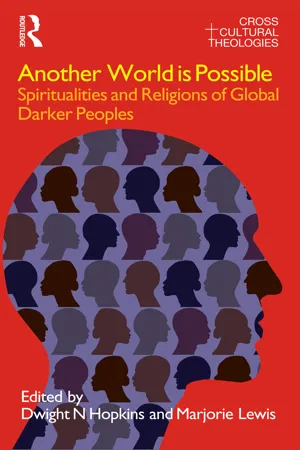
'Another World is Possible' examines the many peoples who have mobilized religion and spirituality to forge identity. Some claim direct links to indigenous spiritual practices; others have appropriated externally introduced religions, modifying these with indigenous perspectives and practices. The voices of Black people from around the world are presented in essays ranging from the Indian subcontinent, Japan and Australia to Africa, the UK and the USA. From creation narratives to trickster heroes, from the role of spirituality in HIV positive South Africa to its place in mental health and among the poor, spirituality is shown to be essential to the survival of individuals and communities.
India
1 The Untouchable “Dalits”*of India and their Spiritual Destiny
B. M. Leela Kumari
Introduction
Untouchability forbids the very presence of fellow humans. It is banned in the constitution of India. But it is prevalent in every village of 700,000 villages in India. In 1991 there were 160 million Dalits in number. At present there are more than 200 million Dalits in India. Untouchables (Dalits) are third-rate citizens, who reside on the outskirts of the villages. They are not allowed to draw water from village wells. They are not allowed to walk in the village main streets; they are not allowed to wear shoes and neat and decent dresses. Separate glasses greet them in hotels and restaurants. Their entry into temples, parks, recreation centers and other public places is banned. Inter-dining and inter-caste marriages are strictly prohibited. Menial jobs are allotted them. The Indian Hindu religious caste system is the root cause for this Untouchability.
The Indian Caste System
Castes are the building blocks of the Hindu religious social order in India. The caste system contains three important characteristics: (1) Mutual repulsion; (2) Hierarchical unequal socioeconomic organization; and (3) Heredity (descent based discrimination). The Hindu society recognizes the caste hierarchy of four classes (Chaturvarnas)1: (1) Brahmins2 (Priests), (2) Kshatriyas (Kings), (3) Vaishyas (Merchants), and (4) Shudras (Servants). Those who are outside of this caste system are "Out Castes" or untouchables (i.e., Dalits or Scheduled Castes); the Brahman Hindu scriptures, Gods, and Law givers have always accepted and maintained caste inequality. Hatred is inbuilt in the very social stratification of caste.
Thus the caste system for centuries came to acquire the following principles; (1) Placement of a person in the scheme of hierarchy based on birth; (2) Prohibition of marriage outside one's own caste; (3) The principle of purity and pollution; and (4) Hereditary occupation. The caste system not only propagates division of labor but it divides laborers also.
The caste system in India embodied an organization of economic production and a mechanism of distribution giving monopoly of all privileges into the hands of the upper castes and all sufferings to the lower caste Shudras. The conditions of the untouchables were worse than those of the Blacks in America during the slave trade; even today, untouchability, though abolished according to the constitution of India, still exists in society in different forms in some of the remote villages in India.
Untouchability
Inequality is the official doctrine of Brahminical Hinduism. The out-caste untouchables are a byproduct of the caste system. Untouchability conveys a sense of impurity and defilement. It implies certain socio-religious disabilities. It includes customs and practices sanctioned by the Brahimincal Hindu caste system whereby persons belonging to the scheduled caste, Dalits, were debarred from entering Hindu temples, public places, streets,, public conveyances^ eating places, educational institutions, etc. There are other disadvantages—segregation in colonies (separate ghettos) and in the village, denial of land rights, low wages for manual services, and denial of access to service (e.g., by barbers, washer men) and to health care and education. The untouchable Dalits' occupational work assigned by the Hindu caste system are unclean and hard jobs such as sweepers, scavengers, cobblers, cremation workers, hide and leather works, agricultural laborers, etc. At present there are more than 120 forms of Untouchability practices prevailing in India.
In addition, the Hindu caste system encourages forcible prostitution among Dalit women by treating them as prostitutes of God (e.g., naming them Devadasi, Basivi, Jogini, Matangi, etc.) and sexually exploiting them.
Untouchability—Its Source
Untouchability is an infliction and not a choice.3 The thesis on the origin of Untouchability is an altogether novel one; according to Dr B. R. Ambedkar: "It comprises the following propositions:
- There is no racial difference between the Hindus and untouchables;
- The distinction between the Hindus and untouchables in its original form before the advent of Untouchability was the distinction between Tribesmen and Broken men from alien tribes. It is the Broken men who subsequently came to be treated as untouchables;
- Just as Untouchability has no racial basis so also has it no occupational basis;
- There are two roots from which Untouchability has sprung: (a) contempt and hatred of the Broken men as of Buddhists by the Brahmins; b) continuation of beef-eating by the Broken men after it had been given up by others.
- In searching for the origin of Untouchability care must be taken to distinguish the untouchables from the impure. All orthodox Hindu writers have identified the impure with untouchables. This is an error. Untouchables are distinct from the impure.
- While this impure as a class came into existence at the time of the Dharma Sutras (Hindu Religious Laws) the untouchables came into being much later than 400 A.D."4
According to Dr Ambedkar, Untouchability resulted from the war between Brahminical Hindu Religion and Buddhism. The defeated Buddhists were made untouchables and segregated into separate ghettos outside of every village in India. They are considered to be polluted because they continue to eat beef.
The untouchables of India face two problems: (a) the problem of discrimination and (b) the problem of isolation. Discrimination and isolation in every field of life manifest itself in the exclusion of untouchables from schools, wells, temples, means of conveyances, securing land, credit, and jobs, and denying them dignity and status of an equal human being.
The problem of Untouchability can be attributed to the "observance of Untouchability as an act of religious merit, and non-observance of it as a sin" as found in the Hindu Religion.
Dalit Emancipation Movements in India
Pollution and poverty, being integral parts of Untouchability, manifested in discrimination, isolation and social exclusion. The Dalits of India revolted against this several times in the history of India. But, thanks to the western colonial ideology of equality, their rebellion took the shape of social movements which are visible in their magnitude, their number and their impact.
Ancient Movements
The struggle for equality by the ancient Chandalas (Dalits) was manifested in the teachings of Buddha; and Buddhism may be considered to be the first spiritual and socio-religious movement in India which fought against inequalities of caste and Brahminical Hindu Religion.
As caste and Untouchability are the byproducts of the Hindu Religion, the protest movements also emerged as religious movements with a revolutionary content of equality. These religious movements, known as Bhakthi (Devotional) movements, challenged the doctrine of inequality propagated by Hinduism. Important among the Bhakthi movement are Veera shaiva (1131-1167 ad) movement by Basava, Sant (saint or holy man) Ravi Das (1376-1427 AD), Sant Kabir (1440-1518 AD), Sant Eknath (1533-1599 AD), and Sant Chokhamela movements. They propagated equality through their devotional songs about divine love and declared that "all human beings are equal in the eyes of God." The fact is that these movements did not unsettle the caste system and even less Untouchability because they never challenged the basic inequality concept of Hindu hierarchical Chaturvama (four classes) philosophy. On the whole, the upward social mobility of the untouchables is a mirage until the start of the nineteenth century with the advent of colonial rule.
Post-colonial Movements
The colonial government in India, through its census enumeration, had evoked the sense of caste identity, consciousness, mobilization and articulations. Prior to that, caste was a limited notion confined to the Asiatic model of enclosed village systems. The census operation on the Indian national level has contributed to the caste consciousness among different castes. The early nineteenth century saw different events; important among them are the inclusion of untouchables in the British army, starting with colonial education, employment and industries. These opportunities, though limited, provided a base for anti-Brahmin movements. The most prominent leaders among the anti-Brahmin movement are Mahatma Jotiba Phule (1829-1890 ad) and Periar Ramaswamy (1879-1970 AD). The above two non-Dalit leaders tried their best to uplift the untouchables.
Dalit Aboriginal Movements
After this the Dalit aboriginal (Adi) movements started all over India: Adi Dravida (aboriginal Dravidian) movement in Tamilnadu state in 1890, Adi Dharma (Aboriginal religion) movement in Punjab (1926), Nama Shudra (a Dalit caste) movement in west Bengal (1920s), Adi Hindu movement in Uttar Pradesh (1920s), Adi Andhra (1917), and Adi Arundhatiya (1931) movements in Andhra Pradesh. These movements strived for the dignity of Dalits and asked the colonial government to accommodate them in new opportunities in the fields of education and employment.
Religious Protest
In this era, the Dalits also carried out religious protests. In 1898, Pandita Ayoti Das, a south Indian Dalit leader, started a Buddhist movement. But the impact of Christianity spread among the Dalits and particularly in south India they converted into different Christian denominations (from 1700 AD). In Muslim dominated areas, they also converted into Islam (from 1000 AD). Even today Dalits form more than 70 percent of the population among Indian Christians. These conversions can be seen as seen in the form of the religious protests and the spiritual thirst of the Dalits, who in Hinduism are never allowed into the so-called "Holy temples." But unfortunately for the Dalits, almost all religions in India have been polluted by the "bad breath" (caste and Untouchability) of Hinduism.
Ambedkar’s Emancipatory Struggle
The beginning of the twentieth century witnessed the birth of a great leader of the Untouchables, Dr B. R. Ambedkar (1891-1956). He is the greatest figure ever born to the untouchable community. The personality of Ambedkar is fascinating and an inspiration to all Dalit communities. Ambedkar was keenly aware that caste was the principal impediment to social justice, liberty, equality and fraternity and he was in agreement that caste and Untouchability could not be separated from the beliefs and institutions of Hinduism. In his opinion, "Untouchability is cruelty as compared to slavery" and "the hope of removing Untouchability without destroying the caste system is an utter futility. Untouchability is only an extension of the caste system. There can be no difference between the two. The two stand together or fall together."
Ambedkar first took up the cause of educational access for untouchables in British India. From 1927 to 1947, he led socio-political and economical struggles of Dalits in British India. He achieved constitutional civil rights (basic socio-political rights) for Dalits by heading the draft committee of the Indian constituent Assembly. Ambedkar proposed four major tenants for an egalitarian India and emancipation of Dalits. They are (1) Annihilation of caste, (2) State Socialism, (3) Political power to the Dalits, and (4) Conversion to Buddhism.
Apart from his material contribution (providing reservations in government education, and employment) to the cause of Dalit emancipation, Ambedkar advocated spiritual emancipation of Dalits by converting to Buddhism. He himself paved the way for spiritual liberation by converting to Buddhism and, along with 500,000 Dalits, he converted to Buddhism on October 14-15, 1956, in Nagpur, India.
The social democratic revolutionary philosophy of Ambedkar is located in the ideas of justice, liberty, equality and fraternity which he draws from the teachings of Lord Buddha. Ambedkar felt that the existence of graded inequality of the caste system is detrimental to any democratic principle. To Ambedkar, the caste system and Untouchability, which are sanctioned by the Hindu religious creed, perpetuates inequality, injustice and hatred. He believed that Buddhism was the only alternative to meet the social, psychological and spiritual needs of the untouchables to discover a new social identity. He considered Buddhism, as a religion, to be an important source of moral teaching based on justice, liberty, equality and fraternity because Buddha denied the existence of super human (god), heaven. And his teachings centered on human enlightenment (emancipation).
Pollution and Poverty
Infliction of pollution and enforcement of poverty on Dalits can be treated as two major issues that the dark skinned untouchables are facing today in India. Dr B. R. Ambedkar believed that Untouchability arose out of the category of pollution inflicted on Dalits by Hindu religious dogma. In his opinion, "It is also beyond dispute that caste and Untouchability are not innocuous dogmas to be compared with other dogmas relating to the condition of the soul after death. They are parts of the code of Conduct which every Hindu is bound to observe during his life on earth. Caste and Untouchability, far from being mere dogmas, are among the foremost observances prescribed by Hinduism. It is not enough for a Hindu to believe in the dogmas of caste and Untouchability. He must also observe caste and Untouchability in the conduct of his daily life"5 and this religious dogma not only showed negative impact on Dalit spirituality but also on material progress. Ambedkar believed that pollution (the Untouchability concept) and poverty are an inseparable pair that oppressed Dalits in India: "Untouchability is more than a religious system. It is also an economic system which is worse than slavery."6
This understanding led Ambedkar towards Buddhism; he believed that "Buddhism was a revolution. It was as great as the French revolution. Though it began as a Religious revolution, it became more than a Religious revolution. It became ...
Table of contents
- Cover Page
- Half Title page
- Series page
- Title Page
- Copyright Page
- Dedication
- Contents
- Acknowledgements
- List of Contributors
- Introduction
- Part I India
- Part II Japan
- Part III Australia
- Part IV Hawaii
- Part V England
- Part VI South Africa
- Part VII Botswana
- Part VIII Zimbabwe
- Part IX Ghana
- Part X Cuba
- Part XI Jamaica
- Part XII Brazil
- Part XIII USA
- Select Bibliography
- Index of Subjects
- Index of Names
Trusted by 375,005 students
Access to over 1.5 million titles for a fair monthly price.
Study more efficiently using our study tools.
Frequently asked questions
Yes, you can cancel anytime from the Subscription tab in your account settings on the Perlego website. Your subscription will stay active until the end of your current billing period. Learn how to cancel your subscription
No, books cannot be downloaded as external files, such as PDFs, for use outside of Perlego. However, you can download books within the Perlego app for offline reading on mobile or tablet. Learn how to download books offline
Perlego offers two plans: Essential and Complete
- Essential is ideal for learners and professionals who enjoy exploring a wide range of subjects. Access the Essential Library with 800,000+ trusted titles and best-sellers across business, personal growth, and the humanities. Includes unlimited reading time and Standard Read Aloud voice.
- Complete: Perfect for advanced learners and researchers needing full, unrestricted access. Unlock 1.5M+ books across hundreds of subjects, including academic and specialized titles. The Complete Plan also includes advanced features like Premium Read Aloud and Research Assistant.
We are an online textbook subscription service, where you can get access to an entire online library for less than the price of a single book per month. With over 1.5 million books across 990+ topics, we’ve got you covered! Learn about our mission
Look out for the read-aloud symbol on your next book to see if you can listen to it. The read-aloud tool reads text aloud for you, highlighting the text as it is being read. You can pause it, speed it up and slow it down. Learn more about Read Aloud
Yes! You can use the Perlego app on both iOS and Android devices to read anytime, anywhere — even offline. Perfect for commutes or when you’re on the go.
Please note we cannot support devices running on iOS 13 and Android 7 or earlier. Learn more about using the app
Please note we cannot support devices running on iOS 13 and Android 7 or earlier. Learn more about using the app
Yes, you can access Another World is Possible by Dwight N. Hopkins,Marjorie Lewis in PDF and/or ePUB format. We have over 1.5 million books available in our catalogue for you to explore.