- 122 pages
- English
- ePUB (mobile friendly)
- Available on iOS & Android
eBook - ePub
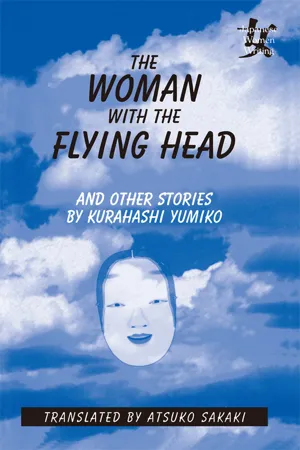
The Woman with the Flying Head and Other Stories
About this book
This is an English-language anthology dedicated to the short stories of Kurahashi Yumiko (1935-), a Japanese novelist of profound intellectual powers. The eleven stories included in this volume suggest the breadth of the author's literary production, ranging from parodies of classical Japanese literature to cosmopolitan avant-garde works, from quasi-autobiography to science fiction. Her subversive fiction defies established definitions of "literature", "Japan", "modernity" and "femininity", and represents an important intellectual aspect of modern Japanese women's literature.
Information
The Long Passage of Dreams
(Nagai yumeji (1968))
___________________
When Mariko arrived home, Keisaku’s face had already changed into a face she did not know. Without uttering the word Father, she stood frozen at the foot of the sickbed. This was the first time she had seen the shadow of death. Though it resembled the mask of the yaseotoko, or “lovelorn man,” worn by the protagonist, Lesser Captain Fukakusa, in Courting Komachi,* the still-living face was in fact uglier. The lower jaw had dropped onto the chest, and the forced-open dark cavern of the mouth dominated the entire face. All one saw was the respirator. Compared to this outlandish gaping breathing hole, the face itself looked extremely small. It made one think of the neck mummies, shrunken to the size of fists, which they say are made by the savage tribes of the Amazon. What power must have been at work to change this face so completely? Mariko felt as though she had seen something in the shape of a black dog dragging her father between its teeth. That was the dream she always had at times of sickness, but Mariko, having dreamt countless times of the black dog biting her father, toppling him, dragging him along, could not forget it. Could that black dog be Cerberus, out of Greek mythology? But the thing now by her father’s pillow, grasping her father’s face with its hand, despite being formless and invisible, was a far more distinct entity; it was death. It was no eerie black dog, no Cerberus—it was the horrible Thanatos. Mariko had always confused the Greek word for “death” with that for “time,” Chronos. As if confusing twin brothers, she often imagined death to be Chronos and time Thanatos. Now both words floated before her eyes. The thing that had laid hold of Keisaku’s face and transformed it into the shadow of death was the same whether one called it Death or Time. No one can obstruct the workings of that power; Mariko herself had kept aloof from the people who had been working to obstruct it. She left Time to his cruel work, to the decline that had transformed her father into something one would not think human, and spent these more than ten months with forced indifference. Now as Mariko tried to sit in this room, that fact pierced her like a lance, from pelvis to breast.
“Please address your father,” Fusa said. As if dragged by these words, Mariko swung her knees down and brought her face close to her father’s. His eyes were open and glistening but they still made her think of Himi’s mask of the lovelorn man—the mask of a man from the realm of the dead, whose eyes were painted with gold dust. Then in a voice that wasn’t a voice she said sharply, “Father!”
“Sis, you made it in time,” said Masayo. Surprisingly Mariko, hearing this tearful voice, was better able to control her own emotions, which had been about to explode.
“I didn’t think he would last until evening.” It was Keisaku’s younger cousin, one of the many doctors in Keisaku’s family, who said this. “He was definitely waiting for Mari-chan to get home.”
Mariko accepted this hackneyed sentiment gently. The cousin went on to say in a physician’s tone that they had tried everything; now there was nothing left to do but wait.
“You must be tired, Mari-chan,” said her aunt. “How long does it take from New York to here?”
“It can take less than a whole day, at its fastest,” Mariko said. “Of course you have to allow time for changing planes,” she added. She felt a slight dizziness. Having flown in the opposite direction of the spinning earth, her sense of time was completely screwed up. When had she been walking across the Brooklyn Bridge? She couldn’t tell. She had come to feel as if the Brooklyn Bridge was the same bridge that spanned the bay right outside the city.
On that bridge, Mariko was embracing a foreign man. Wound in her windswept hair, her face was like a ball rolling in straw. The man’s arms were strong; he held her so close she could hardly breathe. The man’s lips sought Mariko’s through her hair.
The bridge resembled one of those dangerous footpaths made of narrow boards laid over the outer edges of a steel trestle, which country children loved to cross on their way home from school, although it’s forbidden. Now that it had grown dark, it was not a place one should be walking. No matter how far they went, the bridge stretched ever farther. In the center of the bridge the lights of cars trailed off like spermatozoa. There was no one walking across the bridge besides Mariko and the man. The man holding Mariko as they walked was like a dark-faced messenger from the nether world. The water under the bridge, neither river nor sea nor lake, as far away as heaven is from earth, was a sheet of darkness like the skin of the beast that covers hell, and Mariko and the man seemed about to fall into it, entangled.
Wrapped in the man’s arms, in a corner of her mind apart from her fear, Mariko thought about a novel. If she crossed this bridge safely, she could write about it in a novel. Writing novels was her work, so it was not unusual that there was another Mariko who should think soberly about novels at a time like this.
Mariko tried to remember what it was that could be put in a novel, but she was not confident of capturing it. It disappeared immediately, like a flimsy soap bubble. Why did she self-indulgently fill her mind with trivial thoughts like this in the middle of the ritual gathering around a human being nearing death? It was like doing obscene things to your body under your clothes, where no one can see. Knowing it was an attempt at self-distraction from the fact of her father’s death, Mariko looked at her mother, as if in search of something that would suppress this capricious impulse.
Mother said, “Your kimono has been set out downstairs.”
Mariko stood up, saying, “Yes,” bowed to the people gathered in the room, and went into the hallway. A strange feeling as she trod across the straw matting drew Mariko’s attention to her feet, which were feeling stuffy from wearing shoes for a long time. The nylon stockings she had worn all the way from the U.S. seemed like a tissue of dust veiling her feet.
She descended the stairway and, going into the bathroom, washed her feet with the light off. There was a new electric washing machine. The bathtub with no bottom was still there from the old days. But the cover was dry, and it was gathering dust; it seemed not to have been used in some time. Straining her eyes, she made out a spiderweb in the dim light. Had Mariko returned to a deserted house whose inhabitants had all passed away? Were the ones she had just been observing demons converted into human form? Suddenly a shadow blocked the doorway. It called out “Sis!” to Mariko, whose cry of surprise caught in her throat.
“What are you doing in here? If you’re looking for the bathtub, a new one’s been installed over there.”
She replied weakly, “Oh, really?” and tried to calm herself. “I was washing my feet. Aren’t those insect calls something?”
“There are a lot of insects in the back of the garden. Sometimes you can hear fruit crickets in a whole creaking orchestra. Even in the furnace of this bathtub there are crickets chirping.”
Mariko faced the mirror stand to fix her hair.
“I’ll help you,” said Masayo, making her way around behind Mariko.
“What happened to the old mirror stand?”
“That one’s in a corner of the sitting room. Mother uses it now and then. This one was bought for me—when I started learning Kabuki dancing.”
Mariko remembered her younger sister saying she had been taking dance lessons two or three years earlier. Mariko tried her best not to concern herself with family affairs, including facts like that.
“My hair’s filthy, isn’t it”
Masayo said, “No it’s not,” and set about combing it. “Maybe because you haven’t been taking good care of it, it looks stiffer than before.”
To Mariko this seemed like a criticism of her lifestyle. Mariko hoped to hear the praise Masayo had often bestowed in the past.
As expected, Masayo said, “The nape of your neck is long and clean, Sister. It really looks good in a kimono.” She continued putting up Mariko’s hair, a very serious expression on her face. The two sisters’ faces were side by side in the mirror.
Unsmiling, Masayo said, “You’ve become thinner, Sister.”
In the face of her chubby younger sister Mariko saw an excess of stifling youthfulness. The full cheeks made her eyes seem even narrower, and slightly turned up at the edges. If Masayo’s face was koomote for a young woman’s role, then Mariko’s was a rōjo or komachi face for an aging woman’s. Mariko glanced at the traces of emaciation around her own eyes as Masayo said “You’re getting to look more and more like Mother.” This too was something that Mariko had expected her to say.
Kōji came out of the kitchen. “Sister, have you had supper yet?” he asked.
“Come to think of it, I haven’t eaten since Anchorage.”
“If only Mother would eat too,” Masayo said. “A body can’t survive without eating.”
“Still won’t eat,” Kōji said. When Kōji talked about his mother with outsiders, he called her “my mother,” but within the family, he would avoid referring to her directly. Mariko had noticed this before. Her mother, who had shed hunger like a snake sheds its skin, always ate as if she were putting something unclean in her mouth. And Mariko could hardly remember the last time her mother had eaten anything even that way. Her mother had been sitting up straight as a candlestick at her father’s bedside since morning.
“Go call Mother,” Mariko said.
“He’ll be okay for ten or fifteen minutes, don’t you think,” said Kōji, but without making a move to go up to the second floor. He motioned to his younger sister with his chin.
Their mother came downstairs. Mariko asked if the maid was around. “I sent her home last night,” Fusa replied, and sat down on her legs at the wide dining table above the large dugout brazier. Mariko sat down, her legs dangling. In the unlit kotatsu she felt the coolness of an autumn wind on her free bare legs as it had drifted in. With only Keisaku missing, the four family members began a simple dinner. Even when Keisaku was healthy, there were times when he was busy treating patients until nearly nine o’clock, so this had happened often. At those times, however, Fusa would sit at the table with the children, without eating. When Keisaku finished work, he would have a late supper and a late-night drink; she would sit in the same manner and wait on him. Mariko had often wondered when her mother would ever have dinner. Now, with her father’s place empty, her mother was quietly eating. Among the things that Kōji, a skillful cook, had lined up and called “the twelve-dish traditional family chazuke,” Fusa touched neither the red miso soup with red snapper nor the scrambled eggs. But she did quickly eat two bowls of rice. It wasn’t a manner of eating driven by hunger, nor did she make an unsightly display of consuming food as if it were distasteful; and it was far from the way animals eat. It was exactly like part of some ceremony; she didn’t make a sound, and only the very tips of her chopsticks got the least bit dirty. In regard to dining, Keisaku, who was hard to please and concerned with manners above all else, was no rival for Fusa. He tended to slurp away, engrossed in his eating.
“Mr. Takatsu is here.”
“Mr. Takatsu?” Mariko said, startled.
“The fall exams have just begun at the university, so he doesn’t have classes. He’s been showing up for a few days now.”
“You didn’t ask him to leave?”
“I’d like to have Mr. Takatsu see that man’s last days,” her mother replied in a hoarse, composed voice. “He does have that kind of relationship with us. Also, I thought that if by some chance you didn’t return in time …”
Mariko sensed the frightening, more than cruel intent behind her mother’s words, and her shoulders stiffened. The word witch floated again through her mind. Existing beyond the bounds of such things as psychological explanations, a witch was nothing other than a deep-rooted fantasy that over time had taken the fixed form of a mountain witch. In spite of any modern explanation that might be offered, this seemed to her just as plausible as the tales of how a mountain potato had changed into a mountain witch, or how a gate blown away by a typhoon had become a mountain witch.
“At any rate, it’s good that you did make it in time,” said her mother. “I’m sure he knows that you’ve come back; it’s just that he doesn’t have the strength to express it with his face.”
“And if only the transfers had worked out more smoothly, I could have come even sooner,” said Mariko. In the presence of her mother she could never speak but in excuses, and she was fully aware that they were never good enough.
When she had arrived at Haneda, as she walked along the passageway for transfers from international to domestic lines, Mariko had remembered the premonition she’d had before, that when the time came to walk breathlessly through this passageway, it would be when something bad had occurred. That inauspicious event could only be her father’s death—she could not imagine any misfortune befalling her mother. Mariko firmly believed that her mother would never die of a disease—were she to die, it would be suicide. But why should a woman who had become alienated from humanity commit suicide? In that moment too, the notion of the “mountain witch” had floated through her mind.
That her father’s condition might become critical at any moment she had gathered from her mother’s overseas call to New York. Something similar had happened at the height of summer, but then she had let the impulse to return home pass. At that time, her father had still been able to speak.
In the lobby of Haneda Airport, Mariko had seriously considered stopping off somewhere on the way home, perhaps in Kyoto or Kobe. Her mind was still capable of something like that—the impulse to delay her return had entwined itself about her body like the sea serpents that crushed Laocoön to death. To preempt it, M...
Table of contents
- Cover
- Half Title
- Title Page
- Copyright Page
- Dedication
- Table of Contents
- Acknowledgments
- Introduction
- An Extraterrestrial
- We are Lovers
- The House of the Black Cat
- The Woman with the Flying Head
- The Trade
- The Witch Mask
- Spring Night Dreams
- The Passage of Dreams
- The Special Place
- Flower Abstraction
- The Long Passage of Dreams
- List of Japanese Sources of the Translated Works
Trusted by 375,005 students
Access to over 1.5 million titles for a fair monthly price.
Study more efficiently using our study tools.
Frequently asked questions
Yes, you can cancel anytime from the Subscription tab in your account settings on the Perlego website. Your subscription will stay active until the end of your current billing period. Learn how to cancel your subscription
No, books cannot be downloaded as external files, such as PDFs, for use outside of Perlego. However, you can download books within the Perlego app for offline reading on mobile or tablet. Learn how to download books offline
Perlego offers two plans: Essential and Complete
- Essential is ideal for learners and professionals who enjoy exploring a wide range of subjects. Access the Essential Library with 800,000+ trusted titles and best-sellers across business, personal growth, and the humanities. Includes unlimited reading time and Standard Read Aloud voice.
- Complete: Perfect for advanced learners and researchers needing full, unrestricted access. Unlock 1.5M+ books across hundreds of subjects, including academic and specialized titles. The Complete Plan also includes advanced features like Premium Read Aloud and Research Assistant.
We are an online textbook subscription service, where you can get access to an entire online library for less than the price of a single book per month. With over 1.5 million books across 990+ topics, we’ve got you covered! Learn about our mission
Look out for the read-aloud symbol on your next book to see if you can listen to it. The read-aloud tool reads text aloud for you, highlighting the text as it is being read. You can pause it, speed it up and slow it down. Learn more about Read Aloud
Yes! You can use the Perlego app on both iOS and Android devices to read anytime, anywhere — even offline. Perfect for commutes or when you’re on the go.
Please note we cannot support devices running on iOS 13 and Android 7 or earlier. Learn more about using the app
Please note we cannot support devices running on iOS 13 and Android 7 or earlier. Learn more about using the app
Yes, you can access The Woman with the Flying Head and Other Stories by Kurahashi Yumiko,Atsuko Sakaki in PDF and/or ePUB format, as well as other popular books in Literature & Asian Literary Collections. We have over 1.5 million books available in our catalogue for you to explore.