- 640 pages
- English
- ePUB (mobile friendly)
- Available on iOS & Android
eBook - ePub
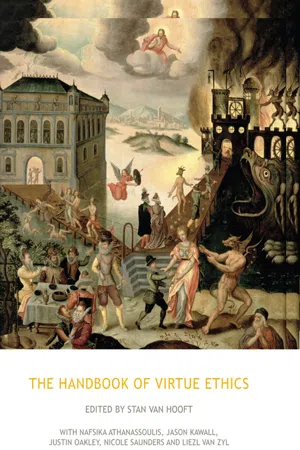
The Handbook of Virtue Ethics
About this book
Virtue ethics has emerged as a distinct field within moral theory - whether as an alternative account of right action or as a conception of normativity which departs entirely from the obligatoriness of morality - and has proved itself invaluable to many aspects of contemporary applied ethics. Virtue ethics now flourishes in philosophy, sociology and theology and its applications extend to law, politics and bioethics. "The Handbook of Virtue Ethics" brings together leading international scholars to provide an overview of the field. Each chapter summarizes and assesses the most important work on a particular topic and sets this work in the context of historical developments. Taking a global approach by embracing a variety of major cultural traditions along with the Western, the "Handbook" maps the emergence of virtue ethics and provides a framework for future developments.
Information
1
Introduction
Two very significant developments have marked the field of ethics and moral theory over the last fifty years or so. First, there has been the emergence of a new area of discussion (or the revival of an old one) called “virtue ethics” as a distinct field within moral theory alongside utilitarianism, deontology and the oft-neglected natural law theory of morality. Second, there has been an increased attention on issues in applied or practical ethics with the main focus initially turned on bioethics but soon extending to ethical issues in a large range of professional fields and issues relevant to social policy and individual behaviour. As a result of the interaction between these two developments, virtue ethics has become a distinctive field with theoretical approaches and methodologies of its own along with a range of applications of unusually wide scope. It is timely, then, to collect and publish the reflections of leading contributors to debates on the most important current themes in virtue ethics. The Handbook of Virtue Ethics is devoted to collecting these reflections. It is hoped that such a publication will prove useful for specialists in the field of virtue ethics and its many sister fields in philosophy, sociology and theology, as well as for those whose concerns are more directly practical in such fields as law, politics and bioethics.
The chapters are written by those at the forefront of the field with established international track records on a variety of related topics. There are also contributions from younger scholars bringing a fresh approach to a burgeoning field. Moreover, the collection aims to attain a global relevance by including chapters that embrace a variety of major cultural traditions aside from the Western tradition. The authors of each chapter were asked to summarize and critically comment on the most important work that has been done by ethicists to date on the relevant theme. Rather than merely summarizing previous work and insights, however, authors were also asked to contribute their “next big thought” on the topic they were writing on. Accordingly, many chapters are both comprehensive overviews of the state of the art and predictors of future directions. Many also have a polemical thrust. Thus this handbook is intended to both map the emergence of virtue ethics and also provide a framework for future developments.
The themes selected for the chapters of the handbook reflect several considerations. One is to summarize the most interesting and exciting work that has been done by ethicists in this area over the past several decades and to show how specifically virtue-ethical approaches have emerged as significant new directions in moral theory. An example of this is work on the virtue theory of right action that has seen lively debate in recent years. A second consideration is to draw attention to pressing moral issues that admit of a virtue-ethical approach, even if they have been relatively under-theorized by virtue ethicists. The discussion of the virtues required of business executives provides a good example. A third consideration is to embrace non-Western traditions of reflection on virtue. A fourth consideration is to extend the methodological background for virtue ethics beyond that of analytic philosophy and to embrace the phenomenological and post-Hegelian traditions of continental European philosophy and other relevant disciplines such as psychology.
SOME HISTORY
Virtue ethics is a distinctive approach to ethical and moral issues. In its contemporary Western guise it was inaugurated by a seminal essay published in 1958 by Elizabeth Anscombe entitled “Modern Moral Philosophy”. The line of thought introduced in this essay was continued in a ground-breaking book, After Virtue, published by Alasdair MacIntyre in 1981. Bernard Williams’s 1985 book, Ethics and the Limits of Philosophy, was also influential in challenging the hegemony of what Williams called “the morality system”. The conception of virtue ethics proposed by these writers and the many who were influenced by them appeals to the concern of ancient Greek philosophers like Plato for the harmony of the soul. In contemporary terms this would be a concern for the individual’s character. Most significantly, their appeal was to Aristotle and his conception of eudaimonia (often translated as “human flourishing”) as the goal of ethics. In this tradition, the normativity of the virtues arises from social and existential standards of honour and admirability rather than having objective grounds in religion, pure reason or utilitarian calculation. Accordingly, this conception would see it as a limitation on the scope of virtue ethics to confine it to the resolution of such specifically moral questions as which actions are right or wrong. As Anscombe put it:
The concepts of obligation, and duty – moral obligation and moral duty, that is to say – and of what is morally right and wrong, and of the moral sense of “ought”, ought to be jettisoned if this is psychologically possible; because they are survivals, or derivatives from survivals, from an earlier conception of ethics which no longer generally survives, and are only harmful without it.
(1958: 1)
Whereas mainstream moral thinking concerns itself with what we are required to do, forbidden from doing or permitted to do, with some consideration also being given to so-called supererogatory actions which are morally laudable without being required, the virtue approach is less concerned with the moral status of actions than with the virtuous status of the agent. Virtue ethics theorizes the characteristic states of the agent which lead to action, deeming those that lead to morally good actions or, more broadly, socially acceptable actions, to be virtues, and those that lead to unacceptable or morally bad actions as vices. In this way, the focus is upon what sort of person one is rather than upon what sorts of actions one performs. This focus allows for an exploration of motivations and leads to reflection upon the inner lives of agents. It leads to an understanding of our moral psychology and is sensitive to the complexities and obscurities of our motivational lives. The goal of thinking about virtue is not just to decide upon which actions are required of us, but the enrichment and deepening of our lives as sensitive and deliberative individuals and as responsible members of society. As Clifford Williams puts it,
Virtue accounts for the value we attach to motives and other inner states. It fits with the fact that persons and their character, not actions, are the basic items of moral predication. It explains why we regard enrichment as significant. Overall, it helps us to understand our moral lives better than does the concept of duty or consequences, or even both duty and consequences.
(2005: 10)
Such an orientation places the accent on the good rather than the right, where the good is understood as the complex of values and ideals through commitment to which we constitute our identity and sense of self-worth, while the right is that which duty enjoins us to do. Moreover, the scope of virtue ethics differs from the scope of the morality of duty. Its scope is wider because it embraces norms that have no moral significance, such as the norms of etiquette. It is a virtue to be pleasant to others, but it would seem to be pushing the concept of obligation too far to say that we have a duty to do so.
Nevertheless, there are many virtue ethicists today who continue to explore the way in which conceptions of virtue might play a theoretical role in the context of the modern morality of duty. This role is that of providing a new way of establishing which actions are right and which are wrong, and also a new way of providing guidance to the moral novice as to which actions are right or wrong. Saying that a right action is one that would be performed by a virtuous agent is offered as an alternative to saying that it is one which answers to the moral demands that arise from human nature, or that it is one which could be universalized by a rational agent, or that it is one which would conduce to the greatest happiness for the greatest number. In this way virtue ethics has come to be seen as offering a coherent and plausible alternative to utilitarian and deontological approaches to ethics; one in which reference to character and virtue are indispensable to the justification of right action.
This book offers no reconciliation between the various strands of virtue-ethical thinking represented in it. What it does offer is a rich and compelling account of a way of thinking about ethics that will have utility and validity for many years to come.
THE CONTENTS OF THE BOOK
Part I: Normative theory
Books of this kind often begin with a historical survey: one that standardly includes chapters about Aristotle. We have taken a less direct route to the same destination by beginning our collection with a chapter that demonstrates Aristotle’s ongoing contemporary relevance. Anne Baril writes about “eudaimonism” in contemporary virtue ethics. What does the notion of eudaimonia mean and to what extent does it still influence our thinking today? It clearly means something more than well-being and its influence extends to utilitarianism and Kantianism almost as much as virtue theory. According to Baril, a virtue ethics is eudaemonist if it recommends that one lives one’s life in such a way as to aim for eudaimonia and if it recommends that one acquire the canonical virtues (courage, justice, honesty, etc.) as the character traits through which one can achieve this.
Matt Sharpe continues the loose historical trajectory of the early chapters by detailing the concepts of virtue developed by the Stoic philosophers. He examines the key Stoic claims that a life well lived is one characterized by what Zeno termed a “smooth flow”, and then explores the Stoic claim that virtue is the only good, so that external “goods” are in fact not goods but “indifferents”. Making a connection with the contribution to the book by Timothy Chappell, Sharpe’s chapter then argues that, for the Stoics, virtue consists in a “stochastic technē” or “technē of living”, characterized by a wise reservation concerning our attachments to external things. On the basis of these theoretical foundations, Sharpe then examines the Stoic table of virtues, noting its contrast with Aristotle’s comparable table in the Nicomachean Ethics. Particular attention is paid to the transformed Stoic emphasis on courage and megalopsychia or great-souledness, and their strange claims that logic and physics are virtues. Sharpe then discusses recurrent criticisms of Stoic virtue ethics, and flags the shapes of Stoic responses to these critical charges.
Taking his cue from the work of Philippa Foot, Richard Hamilton explores the role of naturalism in virtue ethics, asking whether ethical values exist in the world or are merely the projection of human valuations onto a neutral world. If the latter view is to be rejected, the kind of naturalism to which virtue ethics is committed needs to be explored. Hamilton rejects the kind of scientistic or reductionist account of ethics provided, for example, by evolutionary biology. However, he says we should be wary of “conceptual purism”: the idea that philosophy should have no truck with empirical matters. Hamilton defends a form of naturalism which is liberal and pluralistic, and stands in a dialogic relationship with other disciplines. He draws upon new trends in biology in order to show that values can be discovered to already exist in the biological world and thus that virtue can be understood as a response to them which is both cognitive and emotional. Moreover, these values owe as much to culture and upbringing as they do to biology – but they are no less naturalistic for that.
One important form of naturalism in moral theory – and also an important form of virtue ethics – is “moral sentimentalism”. Michael Slote is the principal spokesperson for this view today. His chapter begins with a historical survey that locates the Western origins of this view in the work of Augustine, Hume and Hutcheson. He makes reference also to the Eastern traditions which are discussed more fully in other chapters of this volume. Slote then goes on to argue that moral sentimentalism can offer us accounts of moral rightness, social justice and liberal policies in relation to hate speech and spousal violence that are superior to the accounts offered by deontological and Kantian theories. In so far as moral sentimentalism is a form of virtue ethics, these arguments deserve close scrutiny on the part of any proponent of virtue ethics.
In his chapter, Justin Oakley highlights some key differences between virtue ethics and various forms of utilitarianism, particularly in regard to the value of virtues and the relevance of motives to right action. He then discusses several major concerns that utilitarians and consequentialists more generally have recently raised about virtue ethics. Virtue ethicists such as Rosalind Hursthouse have responded to such criticisms and Oakley demonstrates how their responses illuminate some important aspects of the approach. Oakley also highlights areas of common ground between virtue ethics and utilitarian perspectives, such as their consensus on the importance of doing “empirically informed ethics”. He then discusses in more detail how an agent’s motives can bear on the rightness of their actions and how this phenomenon is better accommodated by virtue ethics than by utilitarianism, despite some recent utilitarian attempts to recognize the moral significance of motives. In closing, Oakley considers what implications the increasing overlap between virtue ethics and recent Kantian approaches on this and certain other issues might have for the plausibility of utilitarianism. He also raises a new challenge for approaches that link motive and character to right action and briefly discusses how this issue might be best addressed.
Timothy Chappell takes vigorous issue with those theorists who would define virtue ethics, in contrast to utilitarianism and Kantianism, as not concerned with the following of moral rules. He takes issue also with the close cousin of this view: particularism.1 Chappell describes a wide variety of kinds of rules and argues that acting virtuously cannot avoid at least some of these kinds. Indeed, it may often be the case that following a rule is constitutive of a virtue. To make this point, Chappell highlights the link that Aristotle makes between virtue and technē. Just as following various kinds of rules is constitutive of a technē, so it is often constitutive of a virtue. Chappell does admit that there could be no virtue ethics in which the rules are foundational in the way that they are for the Kantian or the utilitarian. Virtue ethics denies that it is imperative to keep the rules just because they are the rules. But that is not to deny that the excellence of acting virtuously cannot be grounded in the rules of a practice through which that excellence can be realized.
Given the length, breadth and sophistication of the Christian tradition, Christian moral theology offers a wealth of resources for contemporary virtue ethicists, whether they are working within a Christian theological framework or not, argues Glen Pettigrove. His chapter highlights four strands within recent theologically informed work on virtue ethics, each of which is directly relevant to current controversies in moral philosophy: (a) Thomistic virtue ethics, (b) narrativist virtue ethics, (c) neo-Augustinian virtue ethics and (d) divine motivation theory. Along the way Pettigrove sheds light on what it means to offer a virtue ethic, as opposed to a virtue theory.
Although there is no attempt to offer a historical survey of virtue ethics in these chapters, it is true that we started with Aristotelian themes, moved on to Stoicism, discussed Thomas Aquinas among others, and then explored Hume’s and even Kant’s approaches to virtue. In this spirit we should also discuss Friedrich Nietzsche’s contributions to the tradition. Christine Swanton’s chapter argues for the validity of Nietzsche’s place in the pantheon of virtue ethicists. She rejects the view that Nietzsche is a mere immoralist and offers an understanding of his depth psychology, showing that it is essential to his account of the virtues of the “virtuous egoist”, by contrast with the correlative vices of the immature egoist and the self-sacrificing altruist. Defending this reading of Nietzsche is not yet to defend a reading of Nietzsche as a virtue ethicist and so Swanton goes on to interpret Nietzsche as a virtuous egoist in order to argue that his ethical views are indeed a form of virtue ethics. Swanton then argues against objections to a virtue-ethical reading of Nietzsche that stem from Nietzsche’s apparent relativism and perspectivism, and from Nietzsche’s alleged communitarianism.
The question as to the relation between virtue and right action has been mentioned several times and there are essays in the book that address this question directly. Liezl Van Zyl broaches this question by way of a thorough exploration of the agent-centred view developed by Christine Swanton, in which the rightness of an action depends upon the degree to which the target of a relevant virtue has been reached. In exploring this view, Van Zyl discovers that “rightness” is an attribute that often takes the outcome of an action into account while the “goodness” of an action is an attribute that refers more to the motivations and character of the agent. She discovers also that rightness conceived within a virtue-ethical framework can be a matter of degree and that the rightness of an action and its obligatoriness can come apart.
Jason Kawall’s chapter examines two prominent virtue-ethical approaches to the question of what makes an action right: (a) “qualified agent” accounts which argue that a right action is that action that would be performed by an agent who is qualified to judge, that is, a virtuous agent; and (b) agent-based virtue ethics, which argues that a right action is one that stems from the virtuous motivations of the agent. Kawall also considers how these two approaches impinge on what is meant by the term “right action”. A variation of Socrates’ question posed to Euthyphro seems apt: is a right action right because a virtuous agent would perform it or would a virtuous agent perform it because it is right? Or again, is a right action right because virtuous motivations would lead one to perform it, or would virtuous motivations lead one to perform such an action because it is right? The second option in these questions demands an independent account of rightness such as might be offered by mainstream moral theory. But virtue ethics claims to be able to rest on the first option in each case. Kawall turns to a series of important objections that have been raised against these accounts, and considers some of the more prominent and promising responses that these objections have inspired.
Yuval Eylon offers an intriguing argument which challenges the dependence on the part of many virtue ethicists on the paradigm of the “virtuous person” (VP) in such a way as to assert that what the VP would do in a given situation is what virtue demands of us. This may solve the problem of how ethical norms can be both objective and also “for us” so as to be motivational (because the VP is one of us), but there is still the difficulty of understanding whether what is demanded of us is demanded because the VP would do it, or whether the VP would do it because it was, independently, demanded of us. However, Eylon’s main point is that the values and norms encapsulated by the VP are not determinate. Positing a VP as a yardstick cannot be foundational. We recognize a VP on the basis of values that we either already possess or first have to choose, and it would be circular for this choice to be based on what the VP has already chosen. Eylon shows, on the basis of Wittgensteinian arguments developed by John McDowell, that there is no independent or objective way of identifying the VP and that, as a result, any delineation of such a standard will be prescriptive.
What is it that motivates us to virtue if it is not a deontological concern for rightness? Van Hooft points out that virtue is often defined with reference to society or its practices. It highlights character traits which are deemed admirable in a person in so far as that person is useful to society and conducive to the success of its practices. But from the virtuous person’s own point of view it relates to one’s sense of identity and takes its motivational power from the sense of self-worth which it gives to that virtuous person. The existential project of being virtuous is not a matter of conforming to social expectations or objective moral norms: it is a matter of fulfilling one’s own ideals of oneself. But where do these ideals come from? Are they constituted by the ideal of acting as a rational agent, as Christine Korsgaard has argued? Given what Sabina Lovibond has described as our communitarian second nature, the moral forms that our moral communities impart to us allow us to affirm ourselves as the persons we are in the context of our societies, and to express our inclinations in forms acceptable to, and structured by, ou...
Table of contents
- Cover Page
- Half-Title Page
- Title Page
- Copyright Page
- Table of Contents
- Acknowledgements
- 1 Introduction
- Part I: Normative Theory
- Part II: Types of Virtues
- Part III: Applied Ethics
- Part IV: The Psychology of Virtue
- Contributors
- References
- Index
Trusted by 375,005 students
Access to over 1.5 million titles for a fair monthly price.
Study more efficiently using our study tools.
Frequently asked questions
Yes, you can cancel anytime from the Subscription tab in your account settings on the Perlego website. Your subscription will stay active until the end of your current billing period. Learn how to cancel your subscription
No, books cannot be downloaded as external files, such as PDFs, for use outside of Perlego. However, you can download books within the Perlego app for offline reading on mobile or tablet. Learn how to download books offline
Perlego offers two plans: Essential and Complete
- Essential is ideal for learners and professionals who enjoy exploring a wide range of subjects. Access the Essential Library with 800,000+ trusted titles and best-sellers across business, personal growth, and the humanities. Includes unlimited reading time and Standard Read Aloud voice.
- Complete: Perfect for advanced learners and researchers needing full, unrestricted access. Unlock 1.5M+ books across hundreds of subjects, including academic and specialized titles. The Complete Plan also includes advanced features like Premium Read Aloud and Research Assistant.
We are an online textbook subscription service, where you can get access to an entire online library for less than the price of a single book per month. With over 1.5 million books across 990+ topics, we’ve got you covered! Learn about our mission
Look out for the read-aloud symbol on your next book to see if you can listen to it. The read-aloud tool reads text aloud for you, highlighting the text as it is being read. You can pause it, speed it up and slow it down. Learn more about Read Aloud
Yes! You can use the Perlego app on both iOS and Android devices to read anytime, anywhere — even offline. Perfect for commutes or when you’re on the go.
Please note we cannot support devices running on iOS 13 and Android 7 or earlier. Learn more about using the app
Please note we cannot support devices running on iOS 13 and Android 7 or earlier. Learn more about using the app
Yes, you can access The Handbook of Virtue Ethics by Stan van Hooft in PDF and/or ePUB format, as well as other popular books in Philosophy & Ethics & Moral Philosophy. We have over 1.5 million books available in our catalogue for you to explore.