- 256 pages
- English
- ePUB (mobile friendly)
- Available on iOS & Android
eBook - ePub
About this book
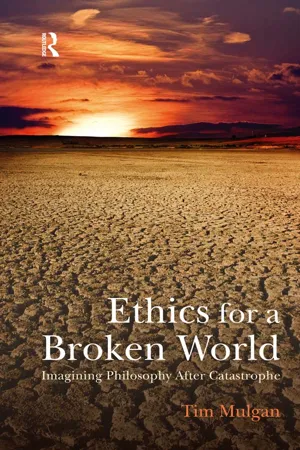
Imagine living in the future in a world already damaged by humankind, a world where resources are insufficient to meet everyone's basic needs and where a chaotic climate makes life precarious. Then imagine looking back into the past, back to our own time and assessing the ethics of the early twenty-first century. "Ethics for a Broken World" imagines how the future might judge us and how living in a time of global environmental degradation might utterly reshape the politics and ethics of the future. This book is presented as a series of history of philosophy lectures given in the future, studying the classic texts from a past age of affluence, our own time. The central ethical questions of our time are shown to look very different from the perspective of a ruined world. The aim of "Ethics for a Broken" World is to look at our present with the benefit of hindsight - to reimagine contemporary philosophy in an historical context - and to highlight the contingency of our own moral and political ideals.
Information
Part I
Rights
Lecture 1
Nozick on rights
1. Introducing Nozick
Robert Nozick was a late-affluent academic philosopher, who spent his entire career at one institution of learning. His Anarchy, State, and Utopia is one of the few affluent works to survive intact. Nozick’s topic was rights. His approach was called libertarianism, because it emphasized freedom. (A quite different view of freedom was liberal egalitarianism, our topic in Part III.)
Affluent people were obsessed with rights. They claimed rights to do and say things, rights over their bodies and life choices, rights over external things, and rights against one another. Almost any dispute in affluent society was eventually expressed in the language of rights. This persistent rights-talk raises many questions. Who (or what) has rights? What is a right? What rights are there? What is the function of rights? Where do rights come from? What makes something a right, rather than a moral claim of some other sort? How do we know what rights there are?
Nozick was perhaps the staunchest affluent defender of rights. He represents, in an exaggerated form, the preoccupations and presuppositions of his age. Nozick began with a deceptively simple claim:
Individuals have rights, and there are things no person or group may do to them (without violating their rights). So strong and far reaching are these rights that they raise the question of what, if anything, the state and its officials may do. How much room do individual rights leave for the state?
(Nozick, Anarchy, State, and Utopia, ix)
For Nozick, rights were held by individual human beings: more precisely (and more controversially) by individual persons. Persons are sentient and rational. They feel pain and pleasure, respond to reasons, and can lead meaningful lives. By Nozick’s definition, we (in this class) are all persons. But most non-human animals – as well as human infants, young children and some disabled or elderly human beings – are not. We are now persons, but each of us was once not a person, and many of us will cease to be persons before we die. Nozick did not grant rights to groups of humans. Although each of you has rights, this class has no rights beyond the individual rights of its members.
Enough about you; let’s talk about me. I am an individual. Nozick would have said I have the following rights. I have rights over my body. I can decide whether to raise my arm, where to walk or what to say. No one may use my body without my consent. I have a right not to be assaulted, and to decide with whom I engage in intimate physical activities. I also have a right to decide when to discuss those activities, so let us move on. More abstractly, I have rights over my person. This includes my body, but also my labour, my talents and my thoughts.
Nozick also gave people rights over things outside themselves, often called property or ownership rights. I might own this writing implement or this apple. For affluent philosophers, property was not a single right, but a complex bundle of rights. Affluent philosophers disputed the content of this bundle, as well as its scope and ground.
Although rights in the person were Nozick’s official foundation, rights over external things provided his conceptual (and intuitive) starting-point. Nozick talked of “self-ownership”, and of “an individual’s property in herself”. Lecture 2 interrogates these metaphors.
Why were rights so important to affluent philosophers? What is a right? My rights grant me liberties, and create moral duties for others. I decide what happens to my body or my apple. Others must not interfere with me – and they must also prevent third parties from interfering. If A has a right to x, then B has a duty not to interfere with A’s x-ing, and C has a duty to prevent B from interfering with A. Rights must be protected and enforced, as well as respected. Affluent rights were moral guarantees.
Affluent rights-talk is alien to us, in part, because it evolved in a world where something morally significant really could be guaranteed to everyone. To translate this discourse into our broken world, we might ask what we would insist on. What are our “rights”?
For Nozick, rights were natural, intrinsic, absolute, negative, moral and exhaustive. Each term captured a key affluent distinction. Natural rights depend on human nature, and are discovered. (The alternative view was that rights are constructed or invented by human beings. We do not discover our rights. Instead, we agree what rights we will have. Rights are social, not natural.)
The doctrine of natural rights was developed by pre-affluent philosophers who saw human beings, along with the rest of the physical universe, as the creation of an omnipotent benevolent God. Human morality and rights flowed from a natural law that God had ordained. Affluent philosophers such as Nozick avoided God, or any other supernatural or religious foundation for rights. (Other affluent philosophers doubted whether natural law and natural rights really could survive without God. If God is not the foundation of rights, what is?)
Nozick’s rights were intrinsic rather than instrumental. Instrumental rights depend on something else that has value in its own right. For instance, utilitarians, who attached intrinsic value to human welfare, regarded all rights as instrumental (see Part II). Instrumental rights are contingent. If circumstances change, then our rights might change. Intrinsic rights are more secure, but also less flexible. In particular, intrinsic rights are less likely to alter in the transition to a broken world.
Nozick’s rights were absolute side constraints. They set limits to the promotion of the common good, the activities of government and the search for agreement. For Nozick, interference with rights was never a moral option. His rights carved out a protected sphere around each individual. If I thought that others might violate my rights, then I would live in constant fear that my apple will be taken away. (Most affluent philosophers defended less extreme accounts of rights. And, as we shall see, even Nozick allowed some exceptions.)
Nozick’s rights were negative, rather than positive. With a positive right, I can require others to assist me, while a negative right only prevents interference. Suppose I have a right to climb this wall. A negative right only means that others must allow me to try to climb. But suppose I am disabled: I cannot succeed unaided. With a negative right, others can simply watch me fail. If my right is positive, then others must help me. Positive rights are obviously much better to have. But they are problematic. Which others are obliged to provide which assistance? Is everyone in the world obliged to drop everything and assist my climbing, at whatever cost? Or does some specific person have this obligation? If so, who? And what if they refuse? Are others then obliged to take up the slack?
Nozick avoided all these problems. He largely rejected positive rights, and insisted that individuals only have negative rights of non-interference. However, Nozick did allow three exceptions. One exception was that positive rights can arise through agreement. If you promise to help me, then I have a right to your assistance. Another exception was enforcement. Suppose I have a negative right to use my apple as I please, and someone interferes. Third parties now have a duty to protect my right. My negative right thus gives me a positive right. Nozick’s third exception was rectification, considered below.
But these were very specific exceptions. Nozick recognized no general positive rights. In particular, he denied any right to be given food, water, health care or other assistance. In Nozick’s imaginary free society, it was possible to starve to death without any violation of your rights. Nozick rejected any principle grounding rights in human need. You cannot acquire rights over something just because it is necessary for your flourishing, your goals, your dignity or even your survival. By contrast, many affluent philosophers saw need as the basis of the most important rights.
Affluent philosophers distinguished between moral, political and legal rights. Moral rights are enjoyed by all moral agents; political rights are enjoyed by citizens; and legal rights are created by an established legal system. Nozick’s rights were moral. But he focused on their political and legal implications.
2. Reading Nozick
Anarchy, State, and Utopia is a puzzling book. Nozick did not proceed by carefully laying out his arguments, or explaining his conclusions. His style was informal, almost chatty, with frequent asides, digressions and rhetorical questions. This makes the book fun to read, but hard to summarize. How are we to read Anarchy, State, and Utopia? Consider three interpretive puzzles. How did Nozick justify his premises? What was the role of Nozick’s hypothetical histories? What did Nozick claim about the real world?
Nozick made very strong claims about rights. How did he justify them? The short answer is that he didn’t. Here is a longer answer. Nozick used a method of thought experiments or micro-examples. He told a simple story, made a claim about that story, and then used rhetorical questions to elicit the reader’s agreement. Nozick’s simple stories were supposed to generate principles. The reader was then to apply those principles to new stories, even if she found those new verdicts very counter-intuitive. Nozick used some intuitions to undermine others. We might wonder – as did many of Nozick’s contemporaries – whether this is a legitimate philosophical method. Nozick’s intuitions often relied on unstated features of his cases. As these features may be foreign to our broken world, we need to tread especially carefully.
For Nozick, the first task of political philosophy was to rebut the anarchist claim that no state is legitimate. Nozick defended a minimal state that upheld moral rights. Moral rights exhaust the legitimate activity of the state; they are the only legitimate basis for political and legal rights. The resulting society contains a free market and a capitalist economy. Nozick called it a “free society”. Any more extensive state is morally unacceptable, as it would violate rights. Other affluent philosophers defended a more expansive state because they either believed in more extensive moral rights or saw a role for the state beyond the protection of rights.
Nozick defended the minimal state by sketching a history where a minimal state emerged from a “state of nature” without any violation of rights. Nozick never claimed that this actually happened. (Just as well, as it never did!) His history was not actual, but hypothetical. It showed that a minimal state could arise justly. This is a strange method of justification. What is the moral relevance of a purely hypothetical story? Wouldn’t it be better to show that some real-world minimal state actually did arise justly? Indeed, wouldn’t that be necessary if we were trying to justify some actual state?
The answer is that Nozick was not seeking to justify any actual state. His minimal state never existed. All actual affluent states were more extensive. So Nozick’s aim was to show that, while no actual state was legitimate, his minimal state at least could have been legitimate. (Nozick himself conceded that even the most extensive state could be given a just hypothetical history. Any state could have arisen without the violation of rights. But the minimal state was much more likely to arise justly. And no actual affluent state did so arise. So, by Nozick’s lights, every actual affluent state was illegitimate.)
Nozick’s use of hypothetical history brings out the central interpretive puzzle: was Nozick defending the rights claimed by his contemporaries? Many of his readers – especially impressionable affluent college students – thought he was defending their property rights. (This was one major source of his popularity, and explains why his works have survived.) But this reading cannot be sustained. Once Nozick laid out the conditions for property rights, the only conclusion available to anyone with the slightest acquaintance with affluent history was that no one had ever owned anything. This conclusion was so obvious that Nozick never bothered to spell it out. Anarchy, State, and Utopia is perhaps most consistently read as a sustained and unrelenting reductio ad absurdum of its own opening clause: “Individuals have rights … [No, sorry, they don’t]”. The free society is purely imaginary. Any resemblance to any actual society – living or dead – is entirely coincidental.
This interpretation of Nozick will emerge gradually, as we work through his account of how rights could arise.
3. The acquisition of rights
If Nozick’s theory is correct, then it really matters who owns this apple. How could I come to own it? Nozick’s answer was historical. Whether I have a right to my apple entirely depends on how I came to possess it. Rights depend on history. Nozick judged history according to three principles: justice in acquisition, justice in transfer and justice in rectification.
We begin with just acquisition. Nozick recognized two ways to acquire something: to make it, or to appropriate it. I own anything that I make using something I already own. Nozick began with self-ownership: I own myself. Therefore, I own anything I make using only myself. Sadly, as I am not a god, this will ...
Table of contents
- Cover Page
- Half Title Page
- Title Page
- Copyright Page
- Contents
- Acknowledgements
- Preface: Imagining a broken world
- Introductory lecture: Philosophy in the age of affluence
- Part I: Rights
- Part II: Utilitarianism
- Part III: The social contract
- Part IV: Democracy
- Reading list
- Bibliography
- Index
Trusted by 375,005 students
Access to over 1.5 million titles for a fair monthly price.
Study more efficiently using our study tools.
Frequently asked questions
Yes, you can cancel anytime from the Subscription tab in your account settings on the Perlego website. Your subscription will stay active until the end of your current billing period. Learn how to cancel your subscription
No, books cannot be downloaded as external files, such as PDFs, for use outside of Perlego. However, you can download books within the Perlego app for offline reading on mobile or tablet. Learn how to download books offline
Perlego offers two plans: Essential and Complete
- Essential is ideal for learners and professionals who enjoy exploring a wide range of subjects. Access the Essential Library with 800,000+ trusted titles and best-sellers across business, personal growth, and the humanities. Includes unlimited reading time and Standard Read Aloud voice.
- Complete: Perfect for advanced learners and researchers needing full, unrestricted access. Unlock 1.5M+ books across hundreds of subjects, including academic and specialized titles. The Complete Plan also includes advanced features like Premium Read Aloud and Research Assistant.
We are an online textbook subscription service, where you can get access to an entire online library for less than the price of a single book per month. With over 1.5 million books across 990+ topics, we’ve got you covered! Learn about our mission
Look out for the read-aloud symbol on your next book to see if you can listen to it. The read-aloud tool reads text aloud for you, highlighting the text as it is being read. You can pause it, speed it up and slow it down. Learn more about Read Aloud
Yes! You can use the Perlego app on both iOS and Android devices to read anytime, anywhere — even offline. Perfect for commutes or when you’re on the go.
Please note we cannot support devices running on iOS 13 and Android 7 or earlier. Learn more about using the app
Please note we cannot support devices running on iOS 13 and Android 7 or earlier. Learn more about using the app
Yes, you can access Ethics for a Broken World by Tim Mulgan in PDF and/or ePUB format, as well as other popular books in Philosophy & Ethics & Moral Philosophy. We have over 1.5 million books available in our catalogue for you to explore.