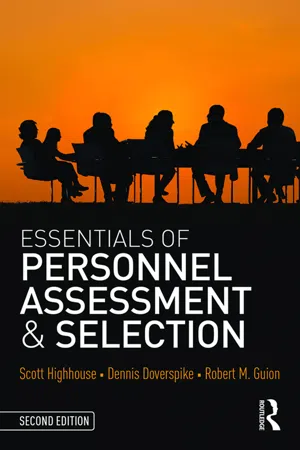
This second edition provides managers and students the nuts and bolts of assessment processes and selection techniques. With this knowledge, managers learn to make informed personnel decisions based on the results of tests and assessments. The book emphasizes that employee performance predictions require well-formed hypotheses about personal characteristics that may be related to valued behavior at work. It also stresses the need for developing a theory of the attribute one hypothesizes as a predictor—a thought process too often missing from work on selection procedures. Topics such as team-member selection, situational judgment tests, nontraditional tests, individual assessment, and testing for diversity are explored. The book covers both basic and advanced concepts in personnel selection in a straightforward, readable style intended to be used in both undergraduate and graduate courses in Personnel Selection and Assessment.
eBook - ePub
Essentials of Personnel Assessment and Selection
- 286 pages
- English
- ePUB (mobile friendly)
- Available on iOS & Android
eBook - ePub
Essentials of Personnel Assessment and Selection
Part I Deciding What to Assess
1 Understanding Personnel Assessment
Assumptions of This Book, Validation and Its Limits, and Theory and Practice
DOI: 10.4324/9781315690667-1
- In 1921, applicants who answered a job advertisement anonymously posted by the world-famous inventor Thomas A. Edison arrived at the Menlo Park facility only to find that they needed to answer a series of brainteasers such as “Is Australia larger than Greenland in area?” “If you were to inherit $1,000,000 within the next year, what would you do with it?” and “How is leather made?”
- Nearly 100 years later, applicants who made it through the initial screening process for a job with an Internet superstore were subjected to a grueling interview that included such oddball questions as “Why is a tennis ball fuzzy?” “Why are manhole covers round?” and “How many cows are in Canada?”
As these anecdotes show, employers are constantly inventing (or recycling) innovative methods for attempting to figure out if a job applicant has what it takes to succeed in their firm. What is vastly different between the two examples above is the public’s reaction to such innovative methods. The public reaction to Edison’s questions was almost uniformly negative (Dennis, 1984). The New York Times published 23 articles about the Edison questions in one month alone. Most of these articles ridiculed Edison for attempting to assess the fitness of job candidates with outrageous questions (“More Slams at Edison,” May 22, 1921). Today, companies such as Microsoft, Zappos, and Xerox are praised for using brainteaser interview questions, presumably because they enable candidates to provide atypical responses and demonstrate their creativity (e.g., Fuscaldo, 2014; Poundstone, 2012). Despite this, there is no evidence that such methods have any utility for predicting future job performance. For instance, the senior vice president of “people operations” at Google commented, “On the hiring side, we found that brainteasers are a complete waste of time … They don’t predict anything. They serve primarily to make the interviewer feel smart” (Bryant, 2013).
Brainteaser questions are just one example of how employers often become enamored by their personal theories of what good applicants should be like in order to be successful at work. We believe that personnel assessment in practice will not be taken seriously by upper management until the people who use it become serious advocates for tests, acknowledge and master the complexities of selection, and thoroughly and persistently communicate the utility of using sound methods to reach decisions to key stakeholders.
Human Resource (HR) managers need to make a case to upper management for giving employee selection as much research and development (R&D) attention as is given to patent development. Staffing courses need to give the science of employee selection as much attention as they give to designing performance management systems or strategizing about human capital. Getting a “seat at the table” is about proving to management that you can find diamonds in the rough, using state-of-the-art techniques in performance prediction. It is not about talking the right business lingo or rejecting proven methods as old-fashioned.
Wise Decisions
An organization functions through its members. New members are chosen in the belief that they will benefit the organization. Employees benefit the organization by accepting fairly specific organizational roles—fairly specific sets of functions, duties, and responsibilities. When existing members of an organization seek a new hire for a designated role, the dominant consideration is the suitability of the candidate for that role. Once in the organization, a person may keep the original role, be transferred or promoted, be trained for a somewhat changed role, or be terminated. All are personnel decisions. All are based, if the organizational leaders are not too whimsical and impulsive, on some sort of assessment of the person. Organizational decision makers hope to make wise decisions and competent assessments help.
Results of wise decisions can range from the mere absence of problem hires to the acquisition of genuine superstars, or top talent, who promote organizational purposes. Good hiring decisions can result in substantial increases in performance levels and productivity. Consequences of unwise decisions can range from inconvenience to disaster. An examination of past U.S. presidential elections or NFL draft choices can provide ready examples of good and bad hiring decisions.
Wisdom in selection decisions depends greatly on knowing the characteristics that are truly important in an anticipated role and on not being distracted by irrelevant characteristics. Assessing relevant characteristics may be as easy as looking at a driver’s license and noting whether it is current, but most are more abstract and harder to assess. If it is inferred from job analysis that qualifications include skill in getting along with others, that skill might be assessed in an interview, or from personal history information, but special efforts are needed to be sure that these assessments provide valid information related to future behavior on the job. Many qualifications are best assessed by tests or specially developed work samples.
This book emphasizes work organizations and how they may improve the chances that their personnel decisions will be wise ones. Wisdom in decision making is elusive; there are opposing points of view about what is wise, desirable, and valued. In this book, we want to state our view explicitly and assist managers in refining and analyzing their own philosophy toward decisions concerning human resources.
Organizations exist when people join forces voluntarily to reach a common goal; they earn their existence by producing goods or services valued in at least a segment of the larger society. An organization, therefore, prospers according to its contribution to society (Eels & Walton, 1961), and individual members contribute by functioning well in their assigned roles. The interests of the consumers of the goods or services are compromised, no less than the personal interests of those in the organization, when a person who can function very well is denied a position given to one less qualified. Enough multiplication of such selection errors, and the organization fails—with resulting human and economic waste. If there are more applicants than openings, choices must be made. Choices could be random, or quasi-random, like “first come, first chosen.” Choices might be based on social values, giving preference to veterans, women, or minorities. The choices might be based on nepotism, prejudice, or a similar-to-me bias. Or they can be based on the science of selection and result in the proven prediction of future performance.
We believe the principal basis for personnel decisions should be merit. Some people reject merit as elitist. Some consider profit-oriented concepts of merit inimical to the interests of a broader society. Some dismiss the idea of merit in the belief that situational factors (e.g., having a good boss) influence work performance more than the personal characteristics people bring to the job. If the merit principle is accepted, however, methods for establishing relative merit are needed. We prefer psychometric methods that give standardized, even-handed assessments of all candidates, similar results from one time or situation to another, and demonstrable relevance to performance.
The term psychometric results from the combination of two Greek words and, literally translated, means “measurement of the mind.” The psychometric approach involves developing imperfect indicators of some underlying concept. They are imperfect because they are subject to measurement error.
It is wasteful to deny qualified people employment for invalid reasons, including whims known only as “company policy.” Wasting human resources is as inexcusable as wasting physical resources. An organization has a responsibility to itself, to the society that supports it, and to the people who seek membership in it, to be sure that it conserves and optimizes human talent.
The Role of Research in Staffing Decisions
The history of assessment for personnel selection is old. The ancient Chinese developed civil service examinations (Bowman, 1989; DuBois, 1970). Plato devised procedures for selecting the Guardians in his Republic. Another example is Biblical. Gideon had too many candidates for his army. On God’s advice, he used a two-stage personnel testing procedure. The first was a single-item preliminary screening test (“Do you want to go home?”); on the basis of the answers, he cut 22,000 candidates down to 10,000. A behavioral exercise—to observe candidates drinking from a stream—was used for those remaining; 300 were chosen. No one questioned the validities of these procedures for they were given by God. Unfortunately, many contemporary testers behave as if they believe that they, too, have God-given tests and do not need to worry about research evidence. Selection researchers, however, recognize that tests and interpretations of results are fallible and that the validity of any given procedure for assessing candidate characteristics needs to be questioned. Such questioning has led to fairly standard procedures for evaluating (validating) selection procedures.
Fundamental Assumptions
Freyd (1923) identified five assumptions that were fundamental to the research process. With some updating, they are also fundamental to this book:
- People have abilities and other traits: mental abilities, psychomotor abilities, knowledge, specifically learned skills (including social skills), and habitual ways of dealing with things and events (including personality or temperament). We do not assume that traits are permanently fixed, either by heredity or early life experiences. We do assume, however, that some of them, especially abilities, are reasonably stable for most adults, stable enough that the level of ability observed in a candidate will stay pretty much the same for some time. Thus, even if traits or characteristics cannot be directly observed, they can be inferred on the basis of their effects and are, thus, real. Psychometricians often refer to the existence of underlying latent traits.
- People differ in any given trait. Those with higher levels of abilities relevant to the performance of a job are expected to perform better, other things being equal, than those with lower levels. Thus, individual differences exist on traits and characteristics.
- Relative differences in ability remain pretty much the same even after training or experience. People with higher levels of a required ability before being hired will be the better performers on that job after training or after a period of time has passed.
- Different jobs require different traits. For example, one job may require specialized mathematical skills; another may require conscientious attention to procedural detail.
- Required abilities can be measured. Cognitive abilities, for example, can be measured with many different kinds of tests. Not only can traits or abilities be measured, but the resulting scores or numbers have some real mathematical meaning.
Cognitive tests have been used successfully for employee selection and for many other purposes. The measurement of motivational requisites of successful performance has a less impressive record of success in employee selection. The record may be more impressive when the research effort expended on the definition and measurement of such traits approaches that expended on cognitive abilities.
Steps in Traditional Validation
Personnel research has traditionally focused on jobs that employ large numbers of people. For such jobs, traditional employment test validation follows steps like these:
Analyze Jobs and Organizational Needs. These procedures are sometimes casual, sometimes very systematic (see Chapter 2). Both job and organizational need analysis inform judgments of whether the need is for improved selection or some other sort of organizational intervention, such as redesigning the job or training current employees. Clearly, no new selection procedure can solve a problem that springs primarily from inadequate equipment or inept management.
Job analysis asks what a worker does, how it is done, and the resources (personal and organizational) used in doing it. Jobs are analyzed to get enough understanding of the job to know what app...
Table of contents
- Cover Page
- Half-Title Page
- Title Page
- Copyright Page
- Dedication
- Table of Contents
- Preface
- Part I Deciding What to Assess
- Part II Knowing How to Assess
- Part III Choosing the Right Method
- Index
Trusted by 375,005 students
Access to over 1.5 million titles for a fair monthly price.
Study more efficiently using our study tools.
Frequently asked questions
Yes, you can cancel anytime from the Subscription tab in your account settings on the Perlego website. Your subscription will stay active until the end of your current billing period. Learn how to cancel your subscription
No, books cannot be downloaded as external files, such as PDFs, for use outside of Perlego. However, you can download books within the Perlego app for offline reading on mobile or tablet. Learn how to download books offline
Perlego offers two plans: Essential and Complete
- Essential is ideal for learners and professionals who enjoy exploring a wide range of subjects. Access the Essential Library with 800,000+ trusted titles and best-sellers across business, personal growth, and the humanities. Includes unlimited reading time and Standard Read Aloud voice.
- Complete: Perfect for advanced learners and researchers needing full, unrestricted access. Unlock 1.5M+ books across hundreds of subjects, including academic and specialized titles. The Complete Plan also includes advanced features like Premium Read Aloud and Research Assistant.
We are an online textbook subscription service, where you can get access to an entire online library for less than the price of a single book per month. With over 1.5 million books across 990+ topics, we’ve got you covered! Learn about our mission
Look out for the read-aloud symbol on your next book to see if you can listen to it. The read-aloud tool reads text aloud for you, highlighting the text as it is being read. You can pause it, speed it up and slow it down. Learn more about Read Aloud
Yes! You can use the Perlego app on both iOS and Android devices to read anytime, anywhere — even offline. Perfect for commutes or when you’re on the go.
Please note we cannot support devices running on iOS 13 and Android 7 or earlier. Learn more about using the app
Please note we cannot support devices running on iOS 13 and Android 7 or earlier. Learn more about using the app
Yes, you can access Essentials of Personnel Assessment and Selection by Scott Highhouse,Dennis Doverspike,Robert M Guion in PDF and/or ePUB format, as well as other popular books in Business & Gestione delle risorse umane. We have over 1.5 million books available in our catalogue for you to explore.