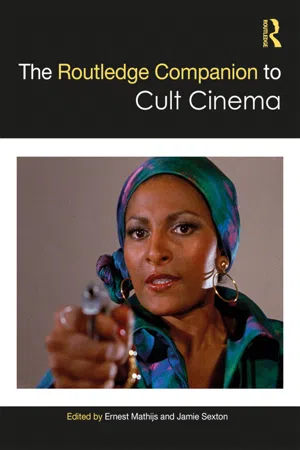
The Routledge Companion to Cult Cinema offers an overview of the field of cult cinema – films at the margin of popular culture and art that have received exceptional cultural visibility and status mostly because they break rules, offend, and challenge understandings of achievement (some are so bad they're good, others so good they remain inaccessible).
Cult cinema is no longer only comprised of the midnight movie or the extreme genre film. Its range has widened and the issues it broaches have become battlegrounds in cultural debates that typify the first quarter of the twenty-first century. Sections are introduced with the major theoretical frameworks, philosophical inspirations, and methodologies for studying cult films, with individual chapters excavating the most salient criticism of how the field impacts cultural discourse at large. Case studies include the worst films ever; exploitation films; genre cinema; multiple media formats cult cinema is expressed through; issues of cultural, national, and gender representations; elements of the production culture of cult cinema; and, throughout, aspects of the aesthetics of cult cinema – its genre, style, look, impact, and ability to yank viewers out of their comfort zones.
The Routledge Companion to Cult Cinema goes beyond the traditional scope of Anglophone and North American cinema by including case studies of East and South Asia, continental Europe, the Middle East, and Latin America, making it an innovative and important resource for researchers and students alike.
As noted in the introduction to this collection, cult cinema (or cult film) is not easy to define in a straightforward manner, partly because cult film can be considered a kind of meta-genre, a category that encompasses a number of other film types. Discussing the ways that cult cannot be considered a genre in the traditional sense, Telotte has argued – drawing on Cawelti – that unlike many genres, it has no clear ‘supertext’, a term Cawelti uses to describe ‘an abstract of the most significant characteristics or family resemblances among many particular texts’ (Cawelti quoted in Telotte 1991: 6). The lack of any clear cult film supertext is related to how cult cinema indicates both reception contexts and audience responses as much as it does textual characteristics but also to the multiplicity of film modes, genres and subgenres that the category incorporates. This section contains chapters on a number of film categories that prominently feature within cult discussions and lists.
The first chapter in this section by Ernest Mathijs focuses on exploitation filmmaking. Exploitation is more of a mode than a genre, a specific type of production which has historically been demarcated from the mainstream of the film industry and which spans different genres. In particular, the exploitation film emerged in the 1920s as a mode of practice differentiated from Hollywood filmmaking: these films were low budget, tending to deal with topics considered taboo within Hollywood, and often screened in low end cinemas (particularly in grindhouse theatres). The term ‘exploitation’ related to the ways in which these films often exploited their sensational elements in an appeal to potential customers. (Schaefer 1999: 3–4). It is partly because of the exploitation film’s marginal position within the broader film industry that it became attractive to cultists. By the 1970s, many exploitation films were being screened on the midnight circuit and gained cult reputations; since this point, the cult reputation of exploitation films has intensified, with a number of exploitation films from a broad historical range being issued on home video.
Glyn Davis explores underground film, another broad mode of filmmaking that also significantly influenced cult cinema, though not quite as markedly as exploitation film. Like exploitation films, underground film – which emerged around the late 1950s – was also often challenging in terms of presenting taboo imagery. It was, though, more artisanal and specialist than exploitation filmmaking, more linked to the world of the artist and often personal in nature, as opposed to the small-scale industrial nature of most exploitation films, which were geared towards making financial profit. Yet, as Davis explains, many aspects of underground filmmaking overlap with cult cinema, including the importance of midnight screenings, transgressive aesthetics, gender politics, and stardom.
David Andrews explores a very different, and more recently coined, mode of cinema: ‘art-cult’. In contrast to exploitation filmmaking, this is a form of cinema which blends elements of art cinema and cult film. As a combination of modes which are themselves difficult to define in any straightforward manner, it is no surprise that ‘art-cult’ is itself a somewhat slippery concept. Nevertheless, it is a concept that has gained traction. Andrews contends that, while these forms of filmmaking are often opposed – in that art cinema has mostly been linked to high art status and cultural legitimacy, whilst many forms of cult film have challenged such ideas of legitimacy – there are also overlaps between them, including how they are often distinguished from the mainstream. The cult-art film, Andrews argues, is often a type of film that falls between legitimate and illegitimate modes of cinema.
Andrews refers in passing to the ‘badfilm’, which is a cultist category explored in this section by Rebecca Bartlett, who outlines some of the knotty philosophical issues around intention and the ways in which badfilm is embraced in ostensibly contradictory ways. Whilst exploitation and underground cinema are modal categories which pre-dated the emergence of cult cinema, and art-cult is a mode that combines a pre-existing mode with cult, badfilm is arguably a category of filmmaking which specifically emerges out of cultism, and is influenced by cultist audience reading strategies such as ironic readings.
The next two chapters cover horror and science fiction filmmaking, which are arguably the two most represented genres within cult film discourse. Both of these genres are linked to cult cinema, largely through their historical background as lowbrow genres (linking again to Andrews’ notion of illegitimate films) and because they have both been associated with dedicated fan followings. Horror has also been linked to cult via its transgressive aesthetics, which has led to many horror films being subject to controversy and censorship, heightening for some cultists their dangerous aura. Both of these genres have, however, undergone shifting reputations and arguably have moved further into legitimate cultural positions. Yet within these genres there can be arguments amongst fans over which examples are more ‘authentic’ and worthwhile; as Hantke notes in his chapter, horror films which are considered mainstream are less likely to gain cult status than more marginal examples. Within science fiction this also can be the case, though there are a number of larger budgeted science fiction films that have arguably attained the status of cult classics, such as Star Wars (Lucas, 1977), while many contemporary mainstream science fiction films are subject to intensely dedicated fan followings. More relevant factors feeding into the cult status of science fiction films, as Bould outlines in his chapter, are gaps and fissures in certain films, which encourage fans to actively speculate about the films and the worlds they portray; such speculation is particularly encouraged in the ‘puzzle film’ (and while these are not confined to the science fiction genre, they are many sf puzzle films).
Comedy can exist as a mode or a genre, but while it is a particularly well-known and loved genre, Seth Soulstein highlights how it has been little discussed in cult cinema literature. This is quite surprising considering the number of comedic films that appear in cult film lists and discourse. Soulstein explores – via a detour into high and low distinctions and the Surrealists’ fascination with slapstick – reasons as to why comedy has been overlooked in many studies of cult cinema, and links this partly to the ways that the comedic mode can inform other genres that might not be studied primarily as comedy. As he argues, many films which might be assigned to different generic categories nevertheless feature comedic ‘kinks’.
The final chapter in this section concerns a cycle, or subgenre, in the form of the Italian giallo film. The giallo film refers to particular mode of violent crime cinema, often dating from the late 1960s to the early 1980s, which was often noted for its stylistic bravura. Alexia Kannas looks at the features of this cycle and explores its gradual cult following, which was spurred by the rise of home video throughout the 1980s and which has become even more subject to cult followings internationally. Through this process – and particularly by becoming embroiled within controversies about extreme material being released on video – it also became considered a subset of the horror film, and as such its fandoms increasingly overlapped with that of horror more broadly.
References
Schaefer, Eric. 1999. “Bold! Daring! Shocking! True!” A History of Exploitation Films, 1919–1959. Durham, NC: Duke University Press.
Telotte, J.P. 1991. ‘Beyond All Reason: The Nature of Cult’. In Telotte, J.P. (ed.), The Cult Film Experience: Beyond All Reason. Austin: University of Texas Press, 5–17.
In 1963, the magazine Film Comment, then one year old, devoted an article to exploitation film.1 The short essay by Frank Ferrer was an eccentric account of a film circuit shunned by the mainstream media that was nonetheless a popular albeit offbeat part of the film industry. Equally a manual-of-sorts and a warning for investors, the essay is valuable because it is one of the earliest attempts to define exploitation film while it was at a crossroads – in between classical ‘moral danger’ film and modern risqué film, and because it highlights core industry practices. ‘It is obvious that everyone exploits one another,’ Ferrer writes, yet ‘everyone [makes] a contribution, artistically or technically.’ ‘The distributor’ he quickly adds, ‘is a parasite. […] the man who ultimately realizes the biggest profit from the suckers who patronize this kind of film trash’ (33).
In 1964, Film Comment returned to the topic, this time with an interview entitled ‘The Truth, the Whole Truth, and Nothing but the Truth About Exploitation Films,’ with director, producer and distributor Barry Mahon, of Morals Squad (1960), The Love Cult (1965) and Nudes on Tiger Reef (1965). Mahon refuted most of what Ferrer had claimed. Exploitation films, he said, were not an attempt at aesthetics but instead an industry necessity – a technique of salesmanship, not a craft. As a ‘sexual attraction type of film’ they center around the manufacturing of professional yet mediocre content with ‘advertising generally overselling what you see when you get inside.’ He did agree exploitation films were cheap, had a high return on investment, and that they sought out titillating subjects in order to provoke the ‘hangover of religious and moral feelings’ (4). Mahon identified Hershell Gordon Lewis’s Blood Feast (1963), together with Roger Corman’s and American International Pictures’ Edgar Allan Poe stories, as the pinnacle of exploitation film because it added ‘sadism as an offbeat form of sexuality’ to the exploitation mix. Mahon thus referred to a typical motive in exploitation film: that of the sensual but monstrous woman and her ever-changing body. The move from ‘naughty’ to ‘nasty,’ and the tension between the two, would be one that typified exploitation film since – and has brought forward a lot of criticism. Film Comment would return to exploitation film again at several points in subsequent decades, not least when it started championing, via critic Robin Wood, horror films such as Night of the Living Dead (Romero, 1968) and The Texas Chainsaw Massacre (Hooper, 1974). It is perhaps symptomatic that the magazine that first highlighted exploitation film would grow to become one of the most esteemed in the world: an unofficial totem for global cinema taste and its critics. Like Film Comment, exploitation film too has grown, and it now occupies a more central spot in debates about film at large.
In 1993, Joe Dante – a filmmaker who had grown up as a fan of exploitation films and had become a film reviewer (for Castle of Frankenstein), one of Roger Corman’s apprentices (including editing trailers to help sell films), and a successful director (Piranha 1978, The Howling 1981, Gremlins 1984) – directed Matinee, a film in which Lawrence Woolsey (John Goodman), a huckster showman and producer of B-movies, attempts to exploit the anxieties surrounding the Cuban missile crisis to sell a horror film about an Ant-Man, called Mant. Featuring numerous winks and nudges to exploitation films from the 1950s and 1960s, Dante’s film, with its nostalgia for B-movies and genre cinema, ‘matineed’ exploitation film, mainstreamed it while keeping intact its cult appeal. Matinee showcased Mahon and Ferrer’s assertions that exploitation films were primarily a product of showmen and producers, but it also paid attention to the skills of those who directed them and starred in them. In doing so, Matinee reflected a change in how exploitation films had been regarded since the 1970s, when Dante himself, together with John Sayles, Jonathan Demme and Stephanie Rothman (and Jean Rollin and Jess Franco in Europe) had emerged as intrepid filmmakers active in the exploitation category. Matinee, and Joe Dante, gave exploitation film the recognition Mahon and Ferrer had aimed at: it acknowledged and celebrated its achievements and it highlighted the films’ competence (both naughty and nasty), as well as its salesmanship (both opportunistic and culturally sensitive), as professional components of a matured industry. In doing so, Matinee also helped put forward the understanding that the accreditation of exploitation films’ success lay with its cult appeal – with the eagerness and curiosity of audiences, always ready for a new thrill, even if they were oversold on a promise that ‘what you see when you get inside’ was going to be ‘something weird’ (to use the name of a company specialized in distributing exploitation films). Matinee came at a time when repeat home viewing of films was fast becoming a staple component of enjoying them, and that repetition cemented the fandom for exploitation films (true to form, Dante has offered numerous audio commentary tracks for exploitation films released on home viewing formats, from The Wasp Woman [1959] to Candy Stripe Nurses [1974] and beyond).
Film Comment and Matinee, when taken in combination, are beacons for the cult trajectory of exploitation film, from a curiosity that was in need of commentary in order to ‘place’ it to an over-the-top self-reflection on an afternoon binge rush.
Figure 1.1Lawrence Woolsey (John Goodman) as an exploitation showman in Joe Dante’s Matinee (Dante, USA, 1993). Universal Pictures/Renfield Productions
How to study this subject?
The nomenclature of cult cinema and exploitation film is often used in tandem, and there are historical and theoretical reasons to do so. For the purposes of this chapter, exploitation cinema will be regarded as a set of prime, defining elements of cult cinema. In that sense, it means that the characteristics that make up cult cinema will be highlighted in discussing exploitation cinema as a ‘type’ of cult cinema. That said, this chapter recognizes that exploitation film can be discussed outside the perspective of cult cinema, although, I argue, it would be near impossible to shake that perspective altogether (see Mathijs and Sexton, 2011, for an extensive overview). Whatever the angle, complete inclusiveness covering both the term ‘exploitation’ and ‘cult’ is impossible to obtain. Some sources outright refuse to handle the term and they frequently resist calling films exploitation by preferring more mobile and reception-dependent terms such as ‘sleaze’ or ‘trash,’ ‘grindhouse,’ or ‘cinéma bis’ (in French). The term ‘cult’ figures prominently in these corners too. To further complicate matters, within the use of exploitation film numerous small and sub-genres operate, many of which are highly formulaic,...
Table of contents
Cover
Half Title
Title Page
Copyright Page
Contents
Images
Contributors
Acknowledgements
Introduction: The cult cinema studies experience
Part I Genres and cycles
Part II Global and local cult cinema
Part III Critical concepts
Part IV Exhibition, distribution
Part V Fandom
Part VI Music and sound
Part VII Aesthetics and intermediality
Part VIII Auteurs
Part IX Actors
Index
Trusted by 375,005 students
Access to over 1.5 million titles for a fair monthly price.
Study more efficiently using our study tools.
Frequently asked questions
Yes, you can cancel anytime from the Subscription tab in your account settings on the Perlego website. Your subscription will stay active until the end of your current billing period. Learn how to cancel your subscription
No, books cannot be downloaded as external files, such as PDFs, for use outside of Perlego. However, you can download books within the Perlego app for offline reading on mobile or tablet. Learn how to download books offline
Perlego offers two plans: Essential and Complete
Essential is ideal for learners and professionals who enjoy exploring a wide range of subjects. Access the Essential Library with 800,000+ trusted titles and best-sellers across business, personal growth, and the humanities. Includes unlimited reading time and Standard Read Aloud voice.
Complete: Perfect for advanced learners and researchers needing full, unrestricted access. Unlock 1.5M+ books across hundreds of subjects, including academic and specialized titles. The Complete Plan also includes advanced features like Premium Read Aloud and Research Assistant.
Both plans are available with monthly, semester, or annual billing cycles.
We are an online textbook subscription service, where you can get access to an entire online library for less than the price of a single book per month. With over 1.5 million books across 990+ topics, we’ve got you covered! Learn about our mission
Look out for the read-aloud symbol on your next book to see if you can listen to it. The read-aloud tool reads text aloud for you, highlighting the text as it is being read. You can pause it, speed it up and slow it down. Learn more about Read Aloud
Yes! You can use the Perlego app on both iOS and Android devices to read anytime, anywhere — even offline. Perfect for commutes or when you’re on the go. Please note we cannot support devices running on iOS 13 and Android 7 or earlier. Learn more about using the app
Yes, you can access The Routledge Companion to Cult Cinema by Ernest Mathijs, Jamie Sexton, Ernest Mathijs,Jamie Sexton in PDF and/or ePUB format, as well as other popular books in Media & Performing Arts & Film History & Criticism. We have over 1.5 million books available in our catalogue for you to explore.