Childhood Abuse, Body Shame, and Addictive Plastic Surgery explores the psychopathology that plastic surgeons can encounter when seemingly excellent surgical candidates develop body dysmorphic disorder postoperatively. By examining how developmental abuse and neglect influence body image, personality, addictions, resilience, and adult health, this highly readable book uncovers the childhood sources of body dysmorphic disorder. Written from the unique perspective of a leading plastic surgeon with extensive experience in this area and featuring many poignant clinical vignettes and groundbreaking trauma research, this heavily referenced text offers a new explanation for body dysmorphic disorder that provides help for therapists and surgeons and hope for patients.
eBook - ePub
Childhood Abuse, Body Shame, and Addictive Plastic Surgery
The Face of Trauma
- 320 pages
- English
- ePUB (mobile friendly)
- Available on iOS & Android
eBook - ePub
About this book
Information
Topic
MedicineSubtopic
Psychiatry & Mental HealthTHE SECOND PIECE The Roots Developmental Trauma and Its Effects
3 THE VALLEY OF THE SHADOW Core Issues and Parenting
DOI: 10.4324/9781315657721-5
Franz Kafka traces the entire pathway of emotional abuse to toxic shame in Letter to My Father—and advances it to bodily obsession and illness.
I was a fearful child. . . . You would normally admonish me in this way, Can’t you do it properly?. . . . And all such questions were accompanied by an evil laugh and an evil face … referring to me [in the] third person. . . . I lost my self-respect… . I was sick because I was a disinherited son. . . . You would make your reprimands more cutting by referring to me in the third person, as if it wasn’t worth talking to me. . . . I feel guilty because of you, my guilt stems uniquely from you.1
Notice that his father referred to him in the third person, a trait that we see in borderline personality disorder. Kafka speaks repeatedly of his father’s own shame, and then:
“I was worried about my hair falling out… . I was sick because I was a disinherited son, who needed constant reassurance about his own peculiar existence … And who was even insecure about the thing which was next to him: his own body… . My back was bent; I could hardly exercise; the road was open to hypochondria.”
*****
It was his eyes that I noticed first: defocused, emotionless, heavy-lidded, impenetrable—what the posttraumatic stress disorder literature calls, “The Thousand Yard Stare.”
“So tell me, what don’t you like about your nose,” I said.
Shrug. “It doesn’t look right.”
“You already had surgery.”
Shrug. He had the slow movements of a third shift custodian. In his hand was the photo of a younger man, just as expressionless.
“What was wrong with your nose?”
His voice was empty and uninterested, its tone uninflected. He looked like he didn’t get much exercise. I wondered if I could help.
“I don’t know.” He hesitated. “It was big.” His voice contracted. “I didn’t want to look like my father.”
The original nose was broad, with a large bump on the bridge and a tip that hung over his upper lip.
“Okay. If you want another operation, what don’t you like now?”
He winced at the photograph, which he held like a live grenade.
Shrug. “This thing is too low.” He pointed to his columella (the skin between his nostrils).
To my eye, his columella was one of the few areas that didn’t need improvement. There were more obvious deformities: his bridge was concave; his nose was short with sunken sidewalls; his tip was shapeless; and there was an odd, irregular lump just below his forehead. I felt it. It was movable.
Shrug. “The last doctor put that in.”
“Do you want me to take it out?”
Shrug. Each time the movement got more dramatic. “I don’t care. Just push this up.” He lifted his columella with a thumb.
Generally men are less analytical about their faces than women, perhaps because they don’t change their hair color as often, don’t learn about makeup as teenagers, and don’t worry about coordinating eyeshadow and lipstick. Maybe that was his problem.
“Let me take photographs. You can show me what you don’t like.” Perhaps then he would see what I did.
I knew that he wasn’t an ordinary patient. Like his father and brothers, he had been a barber. But after his rhinoplasty, he said that his reflection in the barbershop mirror upset him so much that he had stopped working. Ordinarily patients so disabled by one surgery are not good candidates for more surgery, but I understood why he was self-conscious. I would have been.
With permission, I spoke to his psychiatrist. Aside from being depressed, his father had often beaten him.
“Your therapist said that your father was very rough. I am sympathetic. A lot of us didn’t have easy childhoods.
“Look at the pictures.” I turned them around to face him. “What don’t you like?”
He rubbed his eyes with his palms and shrugged just enough to show that he was still listening. Maybe he couldn’t collect enough energy to speak.
“This thing is too low.”
Patients who can’t define surgical goals and are vague and indecisive are famously poor surgical risks and often unhappy postoperatively. Don’t operate on patients who don’t know what they want. Don’t operate on patients who don’t smile. None of my choices were comforting.
There are a number of reasonable explanations for why this man might not be able to describe his surgical goals. Perhaps he wasn’t insightful or intelligent enough. Perhaps he was too depressed. Perhaps I wasn’t interviewing him well.
I have seen other patients like him. Insufficient intelligence and apparent depression are rarely satisfactory explanations for total disempowerment.
What Makes People the Way They Are
“Are people born wicked, or do they have wickedness thrust upon them?” a character asks in the musical Wicked. How do we answer this question?
Most of us want to feel important. Not necessarily famous, but to have lived a life that mattered. How we measure that importance varies.
What, then, creates self-worth? Why do some people have it, and others don’t? Why do some seem to have too much, and others, none at all? If you don’t have self-worth, where do you get it? How, indeed, do we become functional adults?
One of the best models I know to explain these concepts was developed by Pia Mellody, the creative mind behind the trauma treatment program at The Meadows in Wickenburg, Arizona.2, 3, 4, 5, 6 I have also been influenced by John Bradshaw, Judith Herman, Claudia Black, Paul Gilbert, Bernice Andrews, Bessel van der Kolk, Peter Levine, Robert Scaer, and many other fine researchers’ interpretations of shame and its fallout.7–31
Mellody, a nurse who arrived at The Meadows when it was still a drug and alcohol rehabilitation center, realized that behind many of these addictions lay the footprints of childhood traumas that needed attention and that had become the geneses of coping mechanisms that patients used to medicate their pain. Over twenty-five years she developed an elegant and dense model that explains the effects of childhood trauma in the individual and family. What I find provocative is that the majority of her model organized quickly, within the space of about four years (Mellody, personal communication, 2016), a phenomenon that I have observed in other extremely creative minds: concepts appear rapidly, almost simultaneously, with great energy. What attracts me to this model is not only its clarity and the number of conditions that it explains, but its beautiful simplicity, in my opinion one test of real truth.32
*****
I conceptualize the Mellody model into five components:
- The childhood role that you played in your family of origin
- Where it came from
- The developmental age at which you still play it
- The way in which you relate to others
- How each of these factors (role, origin, current developmental age, and relational model) influence and impair the five core components that make up a functional adult
The first, second, and third components determine the fourth and fifth. Conversely, individuals who become functional adults through nurturing childhoods or through trauma work and live in moderation, don’t play roles, don’t act like compensated children, and relate to others in healthy ways that allow appropriate intimacy and self-care. However, these five components do not have linear relationships: they chase each other, strengthening or handicapping us in our lives (See Figure 3.1)
Origins and Core Issues in Relational Trauma
All relational trauma arises from either disempowering abuse or falsely empowering abuse. But first let’s examine the characteristics of any functional adult (See Table 3.1).
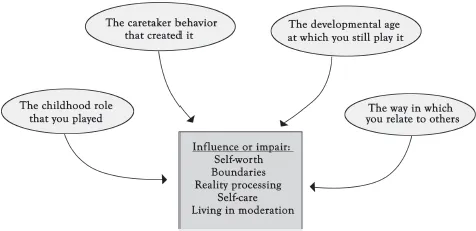
FIGURE 3.1 The Five Core Iss...
Table of contents
- Cover
- Half Title
- Title
- Copyright
- Dedication
- Contents
- Foreword
- Preface
- Acknowledgments
- THE FIRST PIECE: The Tip of the Thread
- THE SECOND PIECE: The Roots: Developmental Trauma and Its Effects
- THE THIRD PIECE: The Fruits: How We Suffer and Medicate
- THE FOURTH PIECE: How Nature Copes
- THE FIFTH PIECE: Toward the End of the Thread: Trauma, Body Image, Plastic Surgery, and Resilience
- Afterword
- Index
Trusted by 375,005 students
Access to over 1.5 million titles for a fair monthly price.
Study more efficiently using our study tools.
Frequently asked questions
Yes, you can cancel anytime from the Subscription tab in your account settings on the Perlego website. Your subscription will stay active until the end of your current billing period. Learn how to cancel your subscription
No, books cannot be downloaded as external files, such as PDFs, for use outside of Perlego. However, you can download books within the Perlego app for offline reading on mobile or tablet. Learn how to download books offline
Perlego offers two plans: Essential and Complete
- Essential is ideal for learners and professionals who enjoy exploring a wide range of subjects. Access the Essential Library with 800,000+ trusted titles and best-sellers across business, personal growth, and the humanities. Includes unlimited reading time and Standard Read Aloud voice.
- Complete: Perfect for advanced learners and researchers needing full, unrestricted access. Unlock 1.5M+ books across hundreds of subjects, including academic and specialized titles. The Complete Plan also includes advanced features like Premium Read Aloud and Research Assistant.
We are an online textbook subscription service, where you can get access to an entire online library for less than the price of a single book per month. With over 1.5 million books across 990+ topics, we’ve got you covered! Learn about our mission
Look out for the read-aloud symbol on your next book to see if you can listen to it. The read-aloud tool reads text aloud for you, highlighting the text as it is being read. You can pause it, speed it up and slow it down. Learn more about Read Aloud
Yes! You can use the Perlego app on both iOS and Android devices to read anytime, anywhere — even offline. Perfect for commutes or when you’re on the go.
Please note we cannot support devices running on iOS 13 and Android 7 or earlier. Learn more about using the app
Please note we cannot support devices running on iOS 13 and Android 7 or earlier. Learn more about using the app
Yes, you can access Childhood Abuse, Body Shame, and Addictive Plastic Surgery by Mark B. Constantian in PDF and/or ePUB format, as well as other popular books in Medicine & Psychiatry & Mental Health. We have over 1.5 million books available in our catalogue for you to explore.