eBook - ePub
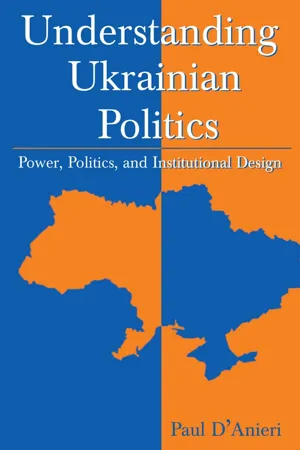
Understanding Ukrainian Politics: Power, Politics, and Institutional Design
Power, Politics, and Institutional Design
- 312 pages
- English
- ePUB (mobile friendly)
- Available on iOS & Android
eBook - ePub
Understanding Ukrainian Politics: Power, Politics, and Institutional Design
Power, Politics, and Institutional Design
About this book
Ukraine made headlines around the world during the winter of 2004-05 as the colorful banners of the Orange Revolution unfurled against the snowy backdrop of Kyiv, signaling the bright promise of democratic rebirth. But is that what is really happening in Ukraine? In the early post-Soviet period, Ukraine appeared to be firmly on the path to democracy. The peaceful transfer of power from Leonid Kravchuk to Leonid Kuchma in the election of 1994, followed by the adoption of a western-style democratic constitution in 1996, seemed to complete the picture. But the Kuchma presidency was soon clouded by dark rumors of corruption and even political murder, and by 2004 the country was in full-blown political crisis. A three-stage presidential contest was ultimately won by Viktor Yushchenko, who took office in 2005 and appointed Yulia Tymoshenko as premier, but the turmoil was far from over. The new government quickly faltered and splintered. This introduction to Ukrainian politics looks beyond these dramatic events and compelling personalities to identify the actual play of power in Ukraine and the operation of its political system. The author seeks to explain how it is that, after each new beginning, power politics has trumped democratic institution-building in Ukraine, as in so many other post-Soviet states. What is really at work here, and how can Ukraine break the cycle of hope and disillusionment?
Information
———— 1 ————
Introduction
In November 2004 the eyes of the world focused on Ukraine, as the brightly colored banners of the Orange Revolution were unfurled in snowy Kyiv. The sight of hundreds of thousands of young Ukrainians braving freezing weather to overturn the results of a rigged election was inspiring. Equally inspiring was the courage of opposition leader Viktor Yushchenko, who survived a poisoning attempt that ravaged his skin, and continued on to lead the democratic reform movement. The Orange Revolution promised a fundamentally new era of democracy in a country that had never really experienced it. It was seen as finally bringing Ukraine into Europe after centuries of externally enforced separation.
Yet, within a few short months after the Orange Revolution, disillusionment set in, as many of the expected reforms failed to materialize. Corruption prosecutions against the previous leaders were delayed. The review of illegally privatized companies bogged down. Trade legislation needed for Ukraine to join the World Trade Organization was defeated. Several of Yushchenko’s cabinet ministers did not give up their seats in parliament, as required by law. Yushchenko’s own twenty-year-old son was seen driving about Kyiv in a BMW worth over $100,000. And Yushchenko split bitterly with his partner in revolution, the charismatic Yulia Tymoshenko. A sense that little had changed, or that not enough had changed, quickly emerged. In March 2006, Viktor Yanukovych’s Party of Regions, apparently doomed after its effort to steal the 2004 election, won a large plurality in a free and fair parliamentary election. Finally, in August 2006, Viktor Yushchenko agreed to nominate Viktor Yanukovych for prime minister. In the eyes of many observers, the Orange Revolution was undone.1
How did the Orange Revolution run into difficulties so quickly? Has the pace of reform merely been slowed, or is there a more fundamental problem? What factors in Ukrainian politics continue to hamper the construction of liberal democracy? The optimism of 2004 appears to have been unwarranted, but it is not clear that the despair of 2006 is based on firmer analytical ground.
This book seeks to answer these questions through a careful analysis of Ukraine’s political system. By examining Ukrainian politics prior to the Orange Revolution, we can see the extent of the obstacles to reform. The mis-judgment made by many within and outside Ukraine was that Leonid Kuchma, Ukraine’s president since 1994, was the heart of the problem, and that replacing him would be a large part of the solution. This book shows that reform in Ukraine is hindered by deep problems in both its political institutions and in the concentration of political power. Kuchma certainly took advantage of these characteristics, but he did not, by himself, create them, and they endure after him.
There are no insurmountable barriers to Ukraine becoming a vibrant democracy, integrated with Europe, and thriving economically. However, for its political problems to be solved, they must be clearly understood.
The Puzzle: Authoritarianism in Ukraine
The faltering of the Orange Revolution surprised most observers, but it is not the first time that Ukraine surged toward consolidated democracy, only to get bogged down. By the end of 1994, Ukraine had established itself as among the most democratic of the post-Soviet countries. In parliamentary and presidential elections earlier that year, incumbent legislators fared poorly, and the incumbent president, Leonid Kravchuk, was defeated. A peaceful transfer of power was never in doubt. Competitive elections and a relatively open contest for power were taken for granted by all participants. This peaceful transition contrasted starkly with events in Russia, where in October 1993, President Yeltsin disbanded the parliament and ordered a military assault on it. When Ukraine held another round of parliamentary elections in 1998, many observers concluded that the country had indeed established itself as a “consolidated” democracy. Political scientist Samuel Huntington has defined a consolidated democracy as one that has had two successful transfers of power.2
By 1999, however, Ukrainian democracy was showing signs of strain. In presidential elections that year, the administration of President Leonid Kuchma used a variety of means to foil serious competition. By 2001, when Kuchma was implicated in the murder of an opposition journalist, one could no longer speak of Ukraine as a “democracy” without adding substantial qualification. Terms such as “delegative democracy”3 and “competitive authoritarianism”4 were used to characterize Ukraine.
The optimism engendered by the Orange Revolution should have been tempered by the knowledge that a similar optimism had prevailed a decade earlier, but was followed by the steady erosion of democracy under Leonid Kuchma. With the resurgence of Viktor Yanukovych, despair has replaced optimism, but it is not clear whether that despair is warranted, for Yanukovych’s return to power represented the playing out of a largely democratic and legal process.5 The key question in Ukraine’s next phase is whether its future will be dominated by the kind of politics that characterized Yanukovych’s rise under Leonid Kuchma, or by the kind that characterized his return under free and fair elections. If Ukraine is to consolidate the advances of the Orange Revolution, it is necessary to understand why democracy was not consolidated in the 1990s. Leonid Kuchma was only part of the problem.
Ukraine’s Democratic Shortcomings
While Ukraine had many of the attributes of a democracy after 1994, it did not fit the standard definitions used in political science. Adam Przeworski defines a democracy simply as a polity in which parties can lose elections.6 By this he means that parties have confidence that, if they lose one election, they will still be able to compete in the next one. In Ukraine’s 2004 elections, both the ruling group and the opposition feared that if they lost the election they would lose all. Naturally, in such “all or nothing” circumstances, actors have strong incentives to do whatever it takes to prevail.
Robert Dahl argues that democratic institutions are intended above all to provide for political competition that is constrained by rules. The importance of political competition explains why civil liberties such as freedom of the press and freedom of speech are so important.7 Much of Ukrainian politics after 1999 was occupied with efforts to limit political competition (or to predetermine its outcomes) through a variety of measures. These included interference with civil liberties, harassment of the opposition, and control of the media. The goal of many of Kuchma’s policies was to ensure that there was no serious competition for power. He succeeded in large measure, but not completely.
Samuel Huntington states that “elections, open, free and fair, are the essence of democracy, the inescapable sine qua non.”8 Ukraine has had elections, but until 2006 they were not open, free, or fair. Guillermo O’Donnell takes it for granted that democratic institutions “preclude the use or threat of force and the outcomes that this would generate.”9 Force and the threat of it have been a central part of politics in Ukraine. The implicit threat of force was a key part of Kuchma’s governing strategy, and the explicit threat of force by thousands of protestors was crucial in ejecting Kuchma’s designated successor from power. In these ways, Ukraine before the Orange Revolution did not meet the basic definition of “democracy.” While Ukraine after the Orange Revolution does appear to be a democracy, we should probably withhold a definitive judgment.
Explaining the Erosion of Ukrainian Democracy
In order to understand the challenges in building democracy in Ukraine today, we need to understand what undermined it from 1994 to 2004. Authoritarianism emerged in spite of contextual and institutional factors that should have promoted democratization after 1994. Two contextual factors were present. The economy was improving, and the Western countries were actively supporting Kuchma’s announced reform programs. Moreover, Ukraine appeared to have established the institutional basis for democracy: It had a constitution modeled on Western examples, a parliament characterized by vibrant debate, and a plurality of political parties.
Despite these favorable factors, democracy eroded rapidly. This weakening of democracy, despite a favorable climate and appropriate institutions, is a central puzzle motivating this book. Solving that puzzle will be essential to assessing Ukraine’s chances for consolidating democracy in the coming years. Again since the Orange Revolution, Ukraine faces similarly favorable circumstances, but formidable challenges as well, and again the outcome is not predetermined.
What were the factors that undermined Ukraine’s democracy, despite the favorable environment and the apparently appropriate institutions? Do these forces continue to exist after the Orange Revolution? Answering these questions is the central goal of this book. Therefore, the book examines the major institutions and processes of Ukrainian politics, both before and after the revolution. It also seeks to provide an understanding of a broader problem in postcommunist politics, the advent of systems that have regular elections, but are not democratic.
This book will attempt to show how politics in Ukraine actually “works.” It also, however, provides an explanation of why Ukrainian politics works this way. Why, prior to 2004, were almost all serious political disputes resolved in favor of the president? Why has the Ukrainian parliament been so weak, despite concerted efforts to strengthen its role? Why are political parties so ineffectual and transient, despite electoral laws that were intended to promote consolidation? To what extent will the political and constitutional changes of 2004 put these problems to rest?
Institutional Design Versus Power Politics
It seems that Ukraine has had reasonably designed institutions, but that somehow they have not led to liberal democracy. In many cases, the institutions have seemed inadequate to constrain the behavior of key actors (especially the president). Yet the situation is not one of anarchy. This is crucial, for a polity with imperfect enforcement of rules is very different from one with no enforceable rules at all. Most of the time, Ukraine’s formal institutions do matter. Unless institutional performance improves, the Orange Revolution will likely be short-lived. Therefore a central question is: why do Ukraine’s institutions seem to constrain behavior in some situations and not others?
The requirements and prohibitions of Ukraine’s constitution, for example, are inconsistently enforced. And while it is easy to attribute these violations to the vague cause of the “absence of rule of law,” such an explanation does not tell us why, in fact, most of the time, the constitution and laws do indeed constrain behavior. In the 2004 election dispute, legal procedures governed the process; in a referendum to amend the constitution in 2000, existing constitutional processes were largely ignored. We cannot say that the rules, laws, and institutions are uniformly irrelevant. Rather they seem to have more “grip” in some situations than others. If we are to understand the nature of politics in Ukraine, and the chances of successfully building democracy there, we must account for this variation.
Answering these questions is not an academic exercise. In the wake of the Orange Revolution, there is a “window of opportunity” for political reform to regain momentum, and for Ukraine to begin moving again in the direction of liberal democracy. Both government and opposition, as well as those who would advise them, need to understand why Ukraine has not achieved liberal democracy, and what the obstacles are. Only then can they make intelligent choices as they recast political institutions and political practices in the country.
Despite the importance of these questions, they have received much less attention than they deserve. Both Ukrainians and Western observers have focused on near-term issues, primarily the 2004 election. The conventional wisdom was that the coming to power of Viktor Yushchenko would automatically solve Ukraine’s problems, and that the Orange Revolution was therefore over by the end of December 2004.
While there is no reason to doubt that Ukraine will be better off under Yushchenko than Kuchma, the focus on individual politicians is dangerous, for it deflects attention from underlying problems that will remain in place regardless of who is president. If Yushchenko is to build a liberal democracy in Ukraine, serious change will be needed. Two institutional changes already adopted—the reduction of the president’s powers and the adoption of a fully proportional election law—will do more to alter the long-term prospects for Ukraine than the election of a president who will last two terms at most. If positive changes introduced by Yushchenko are to endure after he leaves office, both the rules of the game and the balance of power in Ukrainian politics will need to fundamentally change.
Specific Empirical Questions
In order to answer the broad explanatory questions elaborated above, we need to address a series of specific empirical questions about the working of Ukrainian politics. These questions will structure the book, with each of the empirical chapters focusing primarily on one of the key questions. It is imperative that we search for the underlying as well as the immediate causes of political behavior in Ukraine. For example, in examining how Leonid Kuchma was able to win reelection in 1999 despite his low popularity, one clear answer is that the opposing candidates were badly hampered by an inability to reach the public through the media. While this is true, and well documented, we need to take the next step and ask how the media were so easily controlled, and why opposition parties were unable to do anything about it despite their common interest in changing these practices.
To provide a second example, if we ask why the parliament has been so ineffective, we can answer that it has been ineffective because it has fragmented into many small and amorphous factions. But this answer prompts two further lines of inquiry. First, there are numerous countries, such as Israel, where numerous small parties routinely coalesce to form governing majorities. Why does the opposite seem to happen in Ukraine? Second, to the extent that Ukraine’s parliamentary party system is fragmented, is it because public opinion is fragmented, and therefore elects a fragmented parliament? Or is it because there are particular institutional incentives against forming more durable coalitions?
Key Questions to Be Addressed
1. How did the process of Ukraine’s transition from Soviet rule, which was negotiated rather than revolutionary, constrain subsequent political change? (Chapter Four)
2. How do Ukraine’s societal cleavages make democratic rule more difficult? (Chapter Five)
3. Does Ukraine’s constitution provide a sound institutional basis for liberal democracy? (Chapter Six)
4. To what extent has Ukraine’s electoral law been responsible for parliamentary fragmentation? Will changes that took effect in 2006 improve the situation? (Chapter Seven)
5. To what extent do the parliament’s internal rules and procedures inhibit its effective function? (Chapter Eight)
6. How and why was Kuchma able to use “power politics” to shape institutions and to use the formal rules as a political weapon? What are the prospects for “power politics” in post-Orange Ukraine? (Chapter Nine)
7. How does Ukraine compare to other postcommunist and post-authoritarian democracies that have democratic institutions but authoritarian politics? (Chapter Ten)
8...
Table of contents
- Cover
- Half Title
- Title Page
- Copyright Page
- Table of Contents
- List of Tables, Figure, Appendices, and Maps
- Acknowledgements
- 1. Introduction
- 2. Institutions and Democracy: Questioning the Connections
- 3. Power and Institutions: Overview of the Argument
- 4. The Evolution of Ukrainian Politics, 1989–2006
- 5. Societal Divisions and the Challenge of Liberal Democracy in Ukraine
- 6. The Constitution and Executive-Legislative Relations
- 7. The Electoral Law: Cause or Effect of Weak Parties?
- 8. Parliamentary Rules and Party Development
- 9. How Power Politics Trumps Institutional Design
- 10. Ukraine in Comparative Perspective: Electoral Authoritarianism in the Former Soviet Union and Beyond
- 11. Beyond the Orange Revolution: An Agenda for Further Reform
- Notes
- Index
- About the Author
Trusted by 375,005 students
Access to over 1.5 million titles for a fair monthly price.
Study more efficiently using our study tools.
Frequently asked questions
Yes, you can cancel anytime from the Subscription tab in your account settings on the Perlego website. Your subscription will stay active until the end of your current billing period. Learn how to cancel your subscription
No, books cannot be downloaded as external files, such as PDFs, for use outside of Perlego. However, you can download books within the Perlego app for offline reading on mobile or tablet. Learn how to download books offline
Perlego offers two plans: Essential and Complete
- Essential is ideal for learners and professionals who enjoy exploring a wide range of subjects. Access the Essential Library with 800,000+ trusted titles and best-sellers across business, personal growth, and the humanities. Includes unlimited reading time and Standard Read Aloud voice.
- Complete: Perfect for advanced learners and researchers needing full, unrestricted access. Unlock 1.5M+ books across hundreds of subjects, including academic and specialized titles. The Complete Plan also includes advanced features like Premium Read Aloud and Research Assistant.
We are an online textbook subscription service, where you can get access to an entire online library for less than the price of a single book per month. With over 1.5 million books across 990+ topics, we’ve got you covered! Learn about our mission
Look out for the read-aloud symbol on your next book to see if you can listen to it. The read-aloud tool reads text aloud for you, highlighting the text as it is being read. You can pause it, speed it up and slow it down. Learn more about Read Aloud
Yes! You can use the Perlego app on both iOS and Android devices to read anytime, anywhere — even offline. Perfect for commutes or when you’re on the go.
Please note we cannot support devices running on iOS 13 and Android 7 or earlier. Learn more about using the app
Please note we cannot support devices running on iOS 13 and Android 7 or earlier. Learn more about using the app
Yes, you can access Understanding Ukrainian Politics: Power, Politics, and Institutional Design by Paul D'Anieri in PDF and/or ePUB format, as well as other popular books in Politics & International Relations & Economic History. We have over 1.5 million books available in our catalogue for you to explore.