eBook - ePub
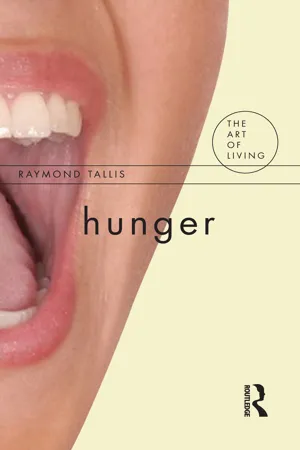
Hunger
About this book
Understanding hunger is the key to understanding ourselves. While they seem the most obvious things about us, our hungers are also deeply mysterious, arising out of, and casting light on, the unique character of human consciousness. In humans, physiological need is transformed into a multitude of needs that are remote from organic necessity. Even first-level biological hunger is experienced differently in humans; and little in human feeding behaviour has any parallel in the animal kingdom.In this book, Ray Tallis takes us through the different levels of our hunger. Out of our primary appetites arise a myriad of pleasures and tastes that are elaborated in second-level hedonistic hungers creating new values. The evolution of appetite into desire opens the way to social hungers such as the hunger for acknowledgement. Awareness of death awakens a further level of hunger for something that lies beyond the pell-mell of successive experiences leading towards extinction. The art of living is the art of managing our hungers.
Information
1. The first hunger
From dynamic equilibrium to dinner
The universe is restless. Every object in it is more or less transient. Towards one extreme, we have rocks, which outlast the longest gaze; towards the other, smoke, which vanishes before our eyes. Between rock and smoke are living creatures. They are born, grow, pass their lives and die over a span that is impressive by the standards of smoke, unimpressive compared with rocks.
Rocks endure because they have built-in stability; smoke does not, for the opposite reason. Why some things are stable and others are ephemeral is not fully understood. Our knowledge of what is happening at the most fundamental level is currently in great difficulties, with the two most comprehensive, powerful and majestic theories of the physical world - the general theory of relativity and quantum mechanics - at odds with one another. At the intermediate level, however, things seem a little clearer. The most comprehensive account of the patterns of evanescence and endurance is the second law of thermodynamics, the supreme, perhaps the most metaphysical, of all the laws of nature. One formulation of this law is that the sum total of things tends towards thermodynamic equilibrium in which differences - say, of temperature, or density - are ironed out. This universal tendency towards disorder or increasing “entropy” has a simple statistical explanation: there are many more ways of being disordered than being ordered and so random change will tend towards disorder.
For our present purposes, we may translate the second law of thermodynamics as follows: highly differentiated, that is to say highly ordered, structures such as living creatures are less probable than undifferentiated ones, which have a low level of order. This translation is not without its problems: a non-anthropocentric conception of “order”, for example, is not easily won from the mathematics behind the second law. Nor is it clear why, if there is a tendency towards disorder, the universe began in a relatively undisordered state. It will, however, do, because it helps us to get a handle on our theme. At the root of hunger is the fact that living organisms are very highly ordered systems and are, consequently, improbable. They have what the physicist and prophet of molecular biology Erwin Schrödinger (1992) called “negative entropy”. They are intrinsically unstable. Their endurance, unlike that of a rock, consequently has to be earned: their order has to be actively maintained.
The maintenance of the order seen in living matter costs energy. A living organism may, at one level, be seen as a device for securing energy exchanges with the nearest parts of the rest of the universe, on terms favourable to itself. (The relationship between order and energy is a little complex and some would regard organisms as devices for extracting “information” rather than energy from their surrounds. The ubiquitous use of the word “information”, however, is a fashion that will pass.) The energy thus extracted is then used to extend, maintain and repair the organism and support its means of reproduction: above all, maintaining relative stability by correcting changes. “Life” as the great biochemist Sir Frederick Gowland Hopkins said, “is the expression of a particular dynamic equilibrium which obtains in a polyphasic system”.
Spinoza’s assertions in his Ethics that “Everything, in so far as it is in itself, endeavours to persist in its own being” (3, prop. VI) and “The endeavour wherewith a thing endeavours to persist in its being is nothing else than the actual essence of that thing” (3, prop. VII) is most clearly applicable to living creatures. A living organism is an entity whose ultimate purpose is to maintain itself – its life consists of staying alive – or, through replication, ensure the existence of things like itself. In short, it has no more intrinsic purpose than a rock: a melancholy thought, given that a rock does not apparently have to stir itself to secure continuance. This existential tautology, whereby the end of life is primarily not to end, will come to haunt mankind, but we have a long way to go before such haunting is possible.
It is fascinating to think of the dramatic metamorphoses in the means by which organisms extract their wherewithal from their surrounds. Single cell organisms pass their lives in the bath of nutrient in which they are born. While their requirements are complex (their diet includes carbon, nitrogen, sulphur, phosphorus, numerous inorganic salts and a large number of egregious micronutrients such as zinc and molybdenum), they are not able to stir themselves much to obtain them. At best they can manage a modest amount of chemotaxis: they adjust their location by swimming in directions marked out by rising gradients of goodies such as sugar or away from toxins. As organisms get more complex, nutrition becomes more sophisticated than mere foodbathing: increasingly elaborate systems devoted to obtaining, absorbing and distributing food are differentiated; and the business of obtaining food becomes more explicit and, indeed, active. These two developments do not necessarily take place in parallel.
While some highly differentiated organisms such as trees have separate systems clearly devoted to accessing nutrition (roots and leaves) and to distributing it (through the xylem and phloem), they hardly exert themselves in order to get what they need. Although the life of the plants is, according to the poet W. H. Auden, “one continuous, solitary meal”, feeding is entirely passive. A little untaxing heliotropism and a tendency to grow towards water is all the effort most plants seem to expend. In the animal kingdom, the elaboration of feeding structures is paralleled by ever more complex feeding behaviours.
One is surprised sometimes that the game is worth the candle. A lot of energy goes into the growth and maintenance of organs and systems that support feeding, ingestion and digestion. In the case of higher organisms, resources are also deployed to creating and regulating the so-called internal environment – exemplified in fluid such as blood and lymph – whose temperature, pressure and chemical composition are minutely controlled, and which buffer the cells from the fluctuations of the external environment so that those cells can get on with their business relatively undisturbed. This, too, is not without considerable metabolic cost. Indeed, when one thinks of the amount of energy that all of this takes, the picture that emerges is rather reminiscent of a taxi-driver who earns only a little more from fares than he expends cruising for customers, paying for his licence and buying and servicing his cab.
The evolution of feeding behaviour as we progress through multicellular organisms towards the primates is rather astonishing. Let us look at some randomly chosen milestones. Consider, first, a couple of invertebrates. The earthworm feeds on fragments of leaves and other plant matter in the soil that it drags down into its burrow. In its own way, it is a gatherer, although it cannot see or hear. The mouth cavity opens directly into the digestive tract without any intermediate structures. In the case of the ant, things are a little more complicated. It has two sets of jaws: one for carrying the food and the other for chewing it. This clear separation of the obtaining of food from its ingestion is an anatomical key to the ability to feed other ants and hence the basis of a quasi-social life. If we move to the vertebrates, we see not only an elaboration of the anatomical structures deployed in obtaining, ingesting and digesting food, but also a great extension of the physical range over which food is sought. The most remarkable expressions of this are seasonal or climate-driven migrations. With the extension of range, the sphere of awareness also widens: the bubble of the umwelt or experienced universe expands. Its boundaries are marked by the increasing distances at which cues to the presence of food (or water) can be detected by ever more acute telereceptors such as smell, sight and hearing. In the case of hunters, the acquisition of nutriment acquires new dimensions. The food itself has ideas of its own, most importantly not to be food. This requires more complex strategies on the part of the hunter and, possibly, working in cooperative groups or mere packs that win through weight of numbers.
We have moved a long way from bacteria bathed in their means of subsistence, exacting directly from their surroundings the wherewithal to enable them to come into being and to slow their dissolution until at least they have reproduced. The journey itself makes a central puzzle of evolution visible: why is it that we have ever more complex organisms? How specific complexities arise seems pretty straightforward: the operation of natural selection on random variation over a huge period of time seems able to account for many of the things that we see. What we cannot account for – particularly if we begin with the molecular perspective that is now conventional in biology – is why the direction of travel has been towards increased complexity, to organisms that have ever higher maintenance costs. (Think again about the taxi driver.) We are familiar with the famous “arms race” whereby prey and predators get ever more cunning, with the one building progressively better defences and the other obtaining ever more powerful weapons. There is a very obvious evolutionary explanation of that, on the basis of selective survival of the better armed and the better defended. What is more diffi cult to explain – although evolutionary theorists do have some good models as to how it happened – is the inner competition within an evolving organism, such that increasing sophistication – differentiation into systems, improvement of the systems – brings costs that the organism itself has to deal with. Increased complexity may make the organism better equipped to cope with a wider range of environments but it brings in its wake increased improbability. Hungers become more explicit and clamant.
It has been pointed out, by Stephen Jay Gould and many others, that the seeming trend over time towards increasing complexity, climaxing by a remarkable coincidence in the organism that is judging the complexity, Homo sapiens, is an illusion. The vast majority of organisms today are unicellular, just as they were in Precambrian times, before the astonishing Cambrian explosion 500 million years ago that gave rise (after nearly 3 billion years of exclusively unicellular life) to the phyla to which all present day living organisms belong. “This is truly the age of the bacteria – as it was in the beginning, is now and ever shall be”, as Gould says (1994: 85). Modal, or typical, levels of complexity have not changed in 500 million years and the impression that life over all has evolved to ever more complex forms, or that this is an intrinsic tendency of evolution, is due to selective noticing of more complex organisms, which will emerge as the overall range of complexity increases. Decreased complexity may be as adaptive as increased complexity.
The point of dwelling on this is to remind ourselves how contingent and accidental are complex creatures – notably the seemingly most complex, ourselves – and how those hungers that have such a hold on us and place our lives in the grip of practical necessity may never have come about. It is sometimes diffi cult to see this contingency in our necessarily post hoc view of our origins. And this relates to another issue: the fact that the more complex creatures are more aware. That we experience our hungers is more puzzling than it may appear at first sight.
Living tissue is largely unaware of the things it needs, or of their lack. Bacteria, we may reasonably suppose, do not have a distinctive ache, thirst, pang or malaise associated with a lack of molybdenum or even of oxygen. Sentience, so far as we can tell, is very much a latecomer in the evolutionary process. Needs, and the consequences of their not being met, are explicit as hungers, as unpleasant sensations that demand relief, in only a tiny minority of organisms. Many of the most successful organisms entirely lack sentience. Micro-organisms have been around for 3.5 billion years; bees and ants have not needed to evolve for 50 to 100 million years; while man arrived perhaps 2 million years ago. Indeed, the key to evolutionary success is more likely to be something as down to earth as the ability to exhibit great diversity and flexibility in metabolic strategies and low metabolic costs. Suffering your needs does not seem to be a particularly smart way of getting ahead of the competition. From the point of view of maximizing the chances of replication of the genome, it seems at least as likely that better mechanisms should have evolved as that consciousness-led behaviour did. When we think of the extraordinary things that can be achieved by means of entirely insentient processes – for example, the growth of the brain in utero – the benefits of consciousness seem less self-evident. And, as we have already noted, by far the greatest part of the ascent up “Mount Improbable” – Richard Dawkins’s metaphor for the evolution of complex organisms – takes place without sentience of any kind. The assumption that a teeny-weeny scrap of consciousness can give one an edge over the competition and a little more consciousness gives one more of an edge, so that selective pressures may favour ever more conscious creatures, is just that: an assumption. There is no reason why the alternative path of ever more effective mechanisms should not have been the only way forward; after all, it is overwhelmingly the way things have gone.
That the biosphere is almost entirely insentient and its dominant species are remote from anything like being conscious is hardly surprising: a series of accidents leading to increasing awareness being wrung out of the unaware processes of physics seems difficult to accommodate in the physicalist world picture of contemporary biology. And, what is more, doing something deliberately – one of the manifestations of consciousness at its highest level – seems a second best to mechanisms that allow it to happen spontaneously, if only because mechanisms are, by definition, more reliable. Consciousness may as often confuse as well as illuminate. Indeed, when we conscious creatures try to learn to do something well, we do so by handing it over to mechanisms so that it seems to happen effortlessly rather than being done deliberately, as when we walk, catch a ball or play scales on the piano. At any rate, if the blind laws of physics were good enough to bring complex organisms into being, it would seem odd that something as vague and fallible as consciousness should confer advantage. Admittedly, consciousness at the highest level seems to enable one to model possibilities and try out strategies without exposing one’s self to their consequences. This does not, however, seem to compensate for the loss of the reliability that is built into the unbreakable laws of nature. The suggestion made by David Hodgson (2008) that consciousness may bring advantages because it can address a particular situation in its unique wholeness does not take account of the fact that all mechanisms are interactions between unique situations whose limits and/or wholeness are not intrinsic to them. Equally unpersuasive is the argument (Nichols & Grantham 2000) that, because phenomenal consciousness – subjective experience – is complex, it must be adaptive since all complex features of organisms are adaptive; and, if it is adaptive, then it must have causal efficacy.
It is true that once you are guided by conscious experience, it is prudent to remain conscious: coma renders you vulnerable because automatisms cannot take over the functions of consciousness. An unconscious human being would not make for a very long-lived zombie or robot. But this does not demonstrate that consciousness was a good thing in the first place. We tend to approach this question from the wrong end: retrospectively from the standpoint of sentient creatures, rather than prospectively, where sentience is only one of a range of strategies that might increase fitness. If, as standard Darwinian thought tells us, we are the products of “the blind forces of physics” operating in the biological realm through the intermediate pathways of molecular genetics and natural selection operating on phenotypes, it is difficult to explain the pain of hunger and the pleasure that comes with it. One would expect natural selection to favour improved mechanisms, more tightly wired into the environment, rather than rely on conscious actions, directed by a very vulnerable brain.
The emergence of sentience is mysterious for another reason: it is metabolically expensive. Metabolic costs increase in proportion to organic mass but neural tissue makes particularly high demands. By the time we reach Homo sapiens, the brain accounts for 20 per cent of oxygen consumption. (This probably explains why highly complex nervous systems are very rare, apart from in ourselves and the anthropoid apes. Only the cetaceans [whales and dolphins], cephalopods [squids and octopus], and elephants seem to have acquired brains that are large for their size.) In short, the standard idea that consciousness is unquestionably a good idea and that it was itself inevitable, as it has evolved to allow creatures capable of flexible action to decide among alternative courses of action on the basis of past experience and projected scenarios of possible future moves, glides over the fact that deliberate choice seems a rather inefficient way of arriving at the right thing to do, compared with having a mechanism to ensure it. Indeed, many of the more complex behaviours exhibited by higher organisms seem like attempts to deal with some of the consequences of being less snugly located in their environmental niche as a result of complexity and consciousness. This is vividly illustrated by the extent to which human beings have to be taught the survival skills that simply develop in other animals: we large-brainers have the longest periods of immaturity. While the looser connection permits flexibility, and creates elbow room for freer actions, it has delivered significant benefits in human beings in what are, in evolutionary terms, only relatively recent times, when the pooling of consciousness in a community of minds has created a second world – a human world – from which individual human beings can operate on nature as if from the outside, and on more favourable terms. Prior to that, hominids looked to be rather unpromising forms of living matter, at least compared with simpler organisms.
At the risk of seeming to prolong a digression, let us dig a little deeper. Sentience presents particular difficulties to those who subscribe to the view – subscribed to by most contemporary philosophers – that the fundamental stuff of the world is insentient matter. It is triply mysterious: it is not easy to see how it should arise (nerve impulses – the passage of ions across semi-permeable membranes – in the brain explain nothing); it is not clear that sensation-prompted behaviour is superior to ever improved mechanisms; and, given that its contents – for example, sensations of brightness and warmth (so-called secondary qualities) – do not correspond to anything intrinsic in the material world, it is not clear why they should be of any use. I mention this at this stage because it should make us challenge reductive approaches to the higher hungers – for pleasure, for the love of others, and for meaning – that see them as essentially untransformed biological needs understood in terms, ultimately, of the laws of physics.
The reader should not, at this point, be alarmed. The author is not a closet creationist or a propagandist for that most unintelligent of ideas, intelligent design. The reason that I am emphasizing that consciousness fits rather uncomfortably into the no-frills physicalism that underpins the most advanced evolutionary theory, and that it is by no means self-evident that, beyond a certain point, the pains of under-nourishment and the pleasures of feasting are nec...
Table of contents
- Cover
- Half Title
- Title
- Copyright
- Contents
- Acknowledgements
- Hors d'oeuvre: human is hungry
- 1. The first hunger
- 2. Hedonistic hunger: foodism and beyond
- 3. The hunger for others
- 4. The fourth hunger
- 5. Ending hunger
- Further reading
- Bibliography
- Index
Trusted by 375,005 students
Access to over 1.5 million titles for a fair monthly price.
Study more efficiently using our study tools.
Frequently asked questions
Yes, you can cancel anytime from the Subscription tab in your account settings on the Perlego website. Your subscription will stay active until the end of your current billing period. Learn how to cancel your subscription
No, books cannot be downloaded as external files, such as PDFs, for use outside of Perlego. However, you can download books within the Perlego app for offline reading on mobile or tablet. Learn how to download books offline
Perlego offers two plans: Essential and Complete
- Essential is ideal for learners and professionals who enjoy exploring a wide range of subjects. Access the Essential Library with 800,000+ trusted titles and best-sellers across business, personal growth, and the humanities. Includes unlimited reading time and Standard Read Aloud voice.
- Complete: Perfect for advanced learners and researchers needing full, unrestricted access. Unlock 1.5M+ books across hundreds of subjects, including academic and specialized titles. The Complete Plan also includes advanced features like Premium Read Aloud and Research Assistant.
We are an online textbook subscription service, where you can get access to an entire online library for less than the price of a single book per month. With over 1.5 million books across 990+ topics, we’ve got you covered! Learn about our mission
Look out for the read-aloud symbol on your next book to see if you can listen to it. The read-aloud tool reads text aloud for you, highlighting the text as it is being read. You can pause it, speed it up and slow it down. Learn more about Read Aloud
Yes! You can use the Perlego app on both iOS and Android devices to read anytime, anywhere — even offline. Perfect for commutes or when you’re on the go.
Please note we cannot support devices running on iOS 13 and Android 7 or earlier. Learn more about using the app
Please note we cannot support devices running on iOS 13 and Android 7 or earlier. Learn more about using the app
Yes, you can access Hunger by Raymond Tallis in PDF and/or ePUB format, as well as other popular books in Philosophy & Ethics & Moral Philosophy. We have over 1.5 million books available in our catalogue for you to explore.