- 288 pages
- English
- ePUB (mobile friendly)
- Available on iOS & Android
eBook - ePub
About this book
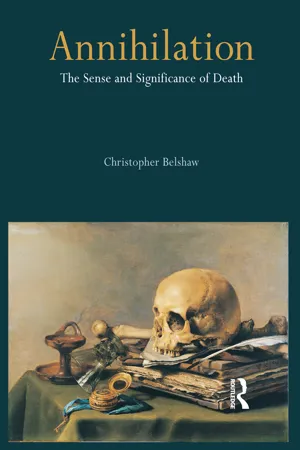
The ever-present possibility of death forces upon us the question of life's meaning and for this reason death has been a central concern of philosophers throughout history. From Socrates to Heidegger, philosophers have grappled with the nature and significance of death. In "Annihilation", Christopher Belshaw explores two central questions at the heart of philosophy's engagement with death: what is death; and is it bad that we die? Belshaw begins by distinguishing between literal and metaphorical uses of the term and offers a unified and biological account of death, denying that death brings about non-existence. How our death relates to the death of the brain is explored in detail. Belshaw considers the common-sense view that death is often bad for us by examining the circumstances that might make it bad as well as the grounds for thinking that one death can be worse than another. In addition, Belshaw explores whether we can be harmed after we die and before we were born. The final chapters explore whether we should prevent more deaths and whether, via cryonics, brain transplants, data storage, we might cheat death. Throughout Belshaw shows how questions of personhood and life's value are bound up with our views on the sense and significance of death. "Annihilation's" in-depth analysis and insightful exposition will be welcomed not only by philosophers working on the metaphysics of death but also by students and scholars alike looking for a foundation for discussions of the ethics of abortion, euthanasia, life-support and suicide.
Information
1
Death
What is death? It will surely seem appropriate to address this question in a book like this. It is, aft er all, a book about death. And so it is a book about a subject that is of considerable interest to all of us, as it has been for thousands of years. It may well seem appropriate, then, to address the question more widely, and to recognize that this is not simply of philosophical but of quite general concern. And I shall ask, and give an answer to, the question here. There is a second question. Does it matter that we discover what death is? It might simply be taken for granted that this does matter, and that it is not only here appropriate, but also generally important to ask and to answer this first question. So it might be thought that this second question is not one that needs in any further way to be addressed. But, of course, mattering comes in degrees, and the “we” of the question might be philosophers, or other people having a professional interest in death, or those – surely almost everyone – having a non-professional interest in the matter. As the question cannot then, have a simple yes/no answer, I shall consider it and give it in the end a less simple answer here.
What is death? I shall say that it is the irreversible breakdown of, or loss of function in, the organism as a whole.1 But that should be taken only as a sketch of an answer; there is much that needs to be explained, and a number of qualifications that will need to remain in place. Does it matter that we discover what death is? I shall say that it does matter, and matters a lot, that we know a good deal about death. But we already do know a good deal. It matters that doctors and scientists know even more, and that they look further into its causes, its nature and the ways in which it might be countered. They are doing that. As many of the questions about death are important, and philosophically challenging, so it matters too that philosophers address these questions. If I did not think that mattered, I would not have written the book. Even so, I think it is possible to exaggerate the importance of all this. And in particular, I shall want to suggest that it does not much matter that we settle on a strict definition of death, or that we discover or decide of all cases just when and where it comes.
Candidates
We will die. So too will our parents, children, pets, birds that visit our gardens, insects they feed on, daffodils that cheer up the spring and trees that we plant now with an eye to posterity. It is a mistake to think that death comes only to human beings. Rather, it is a widespread phenomenon throughout the natural world. But it is a mistake too to think that what death involves is in any detail the same wherever it occurs. Our deaths involve heart failure, brain damage and collapsing lungs. Trees have none of these organs, but they die all the same. Even so, what death involves is in some ways the same whenever it occurs. It always involves, as I have suggested above, an irreversible breakdown in the organism as a whole. I mean to imply here, as I have hinted above, that death is something that affects living things: something that is visited on animals, plants and on other biological organisms. These things operate or function in certain ways. Very roughly, when, irreversibly, that functioning ceases, they are dead.2
Does it affect only living things, only biological organisms? People talk of death in other contexts. We talk of batteries, telephones, hairdryers, seas, volcanoes, stars, being dead. And we talk as well of the death of ideas, of democracy, or liberalism in America, or culture. Function fits in here. These things, when dead, no longer work, no longer play an active role in our lives. So too does life fit in. The batteries that were once dead, like the ideas now defunct, once had some life in them. But none of these things are organisms. So there appears already to be something wrong with what I have said death is. But I can, of course, appeal to a familiar distinction. Animals and plants are literally alive, and will literally die, whereas machines and ideas are only metaphorically alive, and die only in some metaphorical or figurative sense.
But what is this distinction between the literal and metaphorical use of terms? What determines, and how can we tell, just how a term is used? This is not straightforward. I knew a girl in California who cultivated some interesting turns of phrase. She spoke of someone involved in traffic accident: “Motorbikes, they’re life killers, man”. This was intended to be funny. What else can be killed but a living thing? “And afterwards, in hospital, he was a vegetable, literally a vegetable.” This too was supposed to amuse, affected hyperbole. But did it succeed? Doctors – and philosophers – will refer to the brain dead as human vegetables. These people lack sentience, and movement. So is it, perhaps, literally true that an animal can turn into a vegetable? Or think of music. Do sopranos literally or metaphorically have higher voices than tenors? And what of an instrument’s sounding bright? I think we can only say that there are some clearly literal uses of a word, some clearly metaphorical, and much room for finessing in between.
Consider another case. Nietzsche, famously, wrote that God is dead. Was he speaking literally or metaphorically here? Many people think that God exists. Perhaps many of them think that God is alive. None of these believers think that God’s ceasing to exist, or ceasing to live, is even possible. And Nietzsche too was not suggesting that God once existed, once lived, but now exists, or lives, no longer. What he meant was that the idea of God, or belief in God, is no longer doing the kind of work, or playing the kind of role, it did. He could claim that this is literally true. Even so, that the idea of God is dead is, I think, only metaphorically true. Ideas are only metaphorically alive. But consider the believers further. They think that God is alive, but will not and cannot die. Do they think that God is literally alive, or only metaphorically so? Perhaps it is just not clear what they think. But certainly people do seem to have believed in fantastical creatures, gods and monsters, and to have believed that these things are literally alive, and in many cases able literally to die. Does this make sense? The only uncontroversially living and dying things that we know of are biological entities: carbon-based, DNA- or RNA-containing, genetically linked with all other living things. But must living and dying things be this way? Or could there be creatures with a different chemistry, say silicon-based, or highly complex and self-replicating machines, that also, and literally, live and die?
That is one area to consider further. It concerns creatures that have a merely hypothetical existence. It is speculative. Here is another area, concerning now things that do exist, and with which we are all familiar. Biological organisms, I have said, are the kinds of things that are literally alive, and that literally die. What about parts of organisms? What about, say, a human kidney, a headless chicken, a tomato, the branch of a tree? Are any of these literally alive? Will any of them literally die?
In attempting to answer this question, there are various things to note. First, in some of these cases we do talk frequently, and confidently, in terms of life and death. We talk of a still-living heart or kidney. We say that there remains life in a damaged branch, and refer to old cut flowers as dead and now ready to throw away. In other cases – tomatoes, carrots, seeds, joints of meat – we are little inclined to use such terms. In still other cases – hair, nails, an oyster shell – these terms seem even less apt. I shall suggest some reasons as to why this might be below. Second, in all these cases we can, at least in principle, describe the biochemical condition of the thing in full detail. And we can say just how it relates to the organism as a whole, how it has developed into the thing it is, and how it might or might not assist with the functioning of that organism, or give rise to further organisms of the same or a similar kind. Hearts, pieces of skin, individual cells, acorns and feathers can all be accounted for in these ways. Are any of these things dead or alive? If so, this will follow from just these sorts of facts then coupled with accounts developed by biologists and others as to what death is. It will not depend (or so most of us now believe) on further and different sorts of facts, whether the things contain souls, or have the life force within them, or some such. And it is clear, I think, that none of these things is as evidently alive as is some paradigm organism – you, a magpie, an oak tree – or as clearly lacking in life as a book or a stone. It is clear too that all, or almost all, of these things can exist in different conditions such that they are more appropriately described as alive in some, and more appropriately described as dead in others. So if anything is a living kidney then it is one whose functioning is not irretrievably lost, one that can again operate within an organism aft er a transplant. If anything is a dead kidney it is one whose functioning is altogether lost, one that is useless for transplant purposes. But is a so-called living kidney literally alive? Some think, or appear to think it is, others that it is not. There seems not to be full agreement here.
A kidney is, in a fairly clear sense, a part of an organism. Clearly too organisms can contain other organisms, as when I swallow an oyster, or when the cat suffers from worms. But the smaller organisms here are not really parts of the larger. Can one organism be genuinely a part of another, so that the two function together, as if in the maintenance of one system? Unlike kidneys, individual cells can reproduce. And this is often taken to be a characteristic of living things. Perhaps, as some maintain, cells are both themselves organisms and parts of larger and more complex organisms. Thus cells, unlike organs, might be literally alive, and destined literally to die.3
I think that only organisms are literally alive, so rule out organs. And I do not know enough about cells to know whether they are really organisms. But the important point here is that I think organisms are alive, organs not, only because this seems to be the way we mostly, usually coherently, and often confidently speak about such things. I do not think organs lack life and that this can be shown by appeal to some observations in biology, but these are things many people have failed to notice. Similarly, the suggestion that cells might be literally alive implies not that there might be further facts about cells of which we are unaware, but only that there might already be a settled way of talking about such things, a pattern to our language, which has so far passed me by. And this important point is fairly general. Although there are, of course, some exceptions, most of the puzzles I shall be concerned with are, or so I claim, linguistic rather than scientific.4
Life and death
These terms are obviously connected, but how? I have suggested that only living things can die. The things that can die literally are, at some earlier time, literally alive. And similarly for things that can die metaphorically.5 So all that is now dead was once alive.
That might appear to be an altogether uncontroversial claim. But it has been challenged. This challenge is, I think, successful but uninteresting.6 Suppose the five-minute hypothesis is true. The world is only five minutes old. And we only seem to remember the middle of last week. Then there are many dead things – on battlefields, in butchers’ shops, in morgues – that were never alive. We either say that, or we say that these things only appear to be dead. I prefer the former option. And so the seemingly uncontroversial claim is false. Fair enough. But, setting such sceptical hypotheses to one side, this claim – call it the death from life thesis – is surely true.
Here is a second claim, again apparently uncontroversial, but again no doubt susceptible to some elaborate counter-example: nothing is, at one and the same time, and in the same way, both dead and alive. The terms are exclusive.
Two questions remain. Is everything that is at some time alive destined at some later time to be dead? And is everything alive or dead? That is, are the terms exhaustive?
Life to death
The answer to the first question, concerning what we can call the life to death thesis, falls into two parts. Perhaps we can at least imagine some beings, literally alive, that will live forever. We can at least imagine immortality. Of course, many people think that God is such a being, and many think that we are, or at least have, immortal souls. Apart from the obvious questions about their existence there is, as I have suggested, the further question of whether such beings – let us assume they are understood as non-physical – are literally alive. But certainly there seems nothing obviously incoherent about supposing that a genuinely living thing, some biological entity, should continue to live forever. That is one, and a familiar, form of immortality. But could there be another? Could a living thing cease to live without dying? Is a so-called deathless exit7 possible?
Some have argued that this is possible, because it is, and frequently, actual. The amoeba does not die, but rather divides. And the caterpillar does not die but turns into a butterfly.8 So fission and metamorphosis are two ways in which things can cease to exist, and so cease to live, while yet avoiding death. But although importantly different, neither example is altogether happy. The difficulties for the caterpillar case are evident. There is, it seems, nothing here that ceases to live, or ceases to exist. A caterpillar is not itself a thing. Rather it is a stage in the history of a thing, and is to the butterfly very much as an awkward and spotty teenager is to a mature adult. Th e objector appeals here to a strong intuition that the caterpillar is a phase in an animal’s life, rather than itself a particular animal. No similarly strong intuition figures in the amoeba case. We do not believe the amoeba continues to exist, after the divide, either as one, or as both of the resulting organisms.9 But then neither do we believe, perhaps, that the amoeba is a particular thing that with fission ceases to exist, yet does not die. That is, or so I suspect, we just do not have here any firm beliefs either way. When something divides into two in this way it neither continues, nor ceases, to exist. And if that is right, then even the amoeba case does not clearly refute the life to death thesis.10
Consider now some imaginary cases. Many of the stories in Ovid suggest deathless exits. But distinguish those where someone seems to continue living, but is trapped in a different body (Actaeon, Callisto as a bear), and those where someone is altogether transformed, and both physically and psychologically nothing of the original person remains (Narcissus, Callisto as a constellation). In both types of story we certainly start out with someone who is literally alive. But the first sort of case resembles that of the caterpillar. The youth or nymph or god continues to exist, but in very much a different form. Yet whereas the caterpillar turns naturally into the butterfly, these transformations are unnatural, resulting only from intervention elsewhere. In the second it is much more tempting to say that the youth, the nymph, ceases to exist. In a more recent story,11 the Queen turns into a swan, and similarly ceases to exist. Yet I am disinclined to say that any deaths have occurred. And if that is right, then these cases, although imaginary, do involve deathless exits, and counter the life to death thesis. But think about some details. Perhaps part of my reluctance to suppose that the Queen is dead is because I suspect that if she can be turned into a swan, this process can be reversed, and the swan turned back into a queen. And as, controversially, I believe there can be two beginnings of existence12 then this could be the very same queen, and thus the Queen. Suppose we turn her into a swan and then kill the swan. There is a dead swan, the Queen is now gone forever, but even so she never died. Suppose the magical transformation is, for some reason, from the outset irreversible. We turn a nymph into a cake stand. This may be just an outré way of murdering someone.
What should we conclude from this? Suppose you do think that the amoeba exits deathlessly. Should we say death does not occur when, in fission, new organisms are formed? No. Fred Feldman imagines a machine that separates a mouse into its component cells.13 Each cell is, he maintains, an organism. But this kills the mouse. Suppose you think Callisto exits deathlessly, when transformed into stars. Should we say death does not occur unless there is a corpse? No. The mouse separator produces no corpse. Nor, in the actual world, does a very proximate nuclear bomb. Should we think there can be deathless exits? In the actual world it seems as if living things all die. None of them cease to exist instead of, or prior to, dying. Only the behaviour of the amoeba, and perhaps some other single-celled organisms, puts any s...
Table of contents
- Cover
- Half Title
- Title
- Copyright
- Contents
- Preface
- 1. Death
- 2. Definitions
- 3. Human beings
- 4. Is it bad to die?
- 5. Circumstances and degrees
- 6. Posthumous harms
- 7. An asymmetry
- 8. Numbers
- 9. Cheating death
- Appendix: Brain death - history and debate
- Notes
- Bibliography
- Index
Trusted by 375,005 students
Access to over 1.5 million titles for a fair monthly price.
Study more efficiently using our study tools.
Frequently asked questions
Yes, you can cancel anytime from the Subscription tab in your account settings on the Perlego website. Your subscription will stay active until the end of your current billing period. Learn how to cancel your subscription
No, books cannot be downloaded as external files, such as PDFs, for use outside of Perlego. However, you can download books within the Perlego app for offline reading on mobile or tablet. Learn how to download books offline
Perlego offers two plans: Essential and Complete
- Essential is ideal for learners and professionals who enjoy exploring a wide range of subjects. Access the Essential Library with 800,000+ trusted titles and best-sellers across business, personal growth, and the humanities. Includes unlimited reading time and Standard Read Aloud voice.
- Complete: Perfect for advanced learners and researchers needing full, unrestricted access. Unlock 1.5M+ books across hundreds of subjects, including academic and specialized titles. The Complete Plan also includes advanced features like Premium Read Aloud and Research Assistant.
We are an online textbook subscription service, where you can get access to an entire online library for less than the price of a single book per month. With over 1.5 million books across 990+ topics, we’ve got you covered! Learn about our mission
Look out for the read-aloud symbol on your next book to see if you can listen to it. The read-aloud tool reads text aloud for you, highlighting the text as it is being read. You can pause it, speed it up and slow it down. Learn more about Read Aloud
Yes! You can use the Perlego app on both iOS and Android devices to read anytime, anywhere — even offline. Perfect for commutes or when you’re on the go.
Please note we cannot support devices running on iOS 13 and Android 7 or earlier. Learn more about using the app
Please note we cannot support devices running on iOS 13 and Android 7 or earlier. Learn more about using the app
Yes, you can access Annihilation by Christopher Belshaw in PDF and/or ePUB format, as well as other popular books in Philosophy & Ethics & Moral Philosophy. We have over 1.5 million books available in our catalogue for you to explore.