- 224 pages
- English
- ePUB (mobile friendly)
- Available on iOS & Android
eBook - ePub
About this book
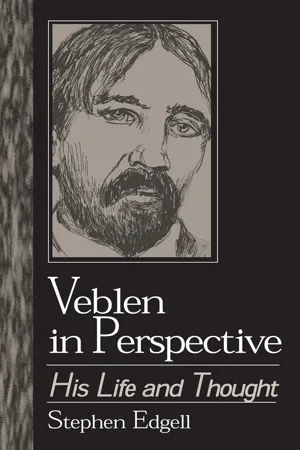
This work discusses the impact and contemporary relevance of the work of Thorstein Veblen, as well as the source of his ideas. It suggests that he was one of the first modern sociologists of consumption whose analysis of contemporary display and fashion anticipated later theories and research.
Information
–—— 1 ——–
The Times, Life, and Works
of Thorstein Veblen
(1857–1929)
Social thoughts are indubitably related in complex ways to the context in which they arise. Broadly, writers during the formative development of sociology from the late nineteenth century can be said to have been impressed with and influenced by political and economic revolutions, notably democratization and industrialization, plus intellectual innovations, including socialism and the growth of science (Ritzer 1992). In addition, the personal experience of these factors in any national setting are relevant to an appreciation of the origins of any one social scientific contribution (Genov 1989).
It has been commonplace for some time among American (e.g., Nisbet 1970; Kivisto 1998; Skocpol 1984) and British (e.g., Abrams 1972; Davis and Scase 1985; Giddens 1971; Lee and Newby 1983) sociologists to contend that social scientific thought was in large part a response to the historically unique combination of economic and political transformations in Northwestern Europe and North America. However, in order to consider any one social thinker in their historical context, it is necessary to go beyond this generalization and focus on the distinctiveness of the society in which they lived and worked.
Thorstein Veblen was born in 1857 on the family farm in the town of Cato, Manitowoc County, Wisconsin, on the eve of the most turbulent period of civil disorder in the growth of the United States. He died, with impeccable ironic timing, in the momentous year of 1929, a couple of months before the mega-stock market crash. It is entirely appropriate that Veblen’s eventful life should encompass what are arguably the two most significant sociopolitical crises in the history of America, thus far, the Civil War and the Great Depression. Moreover, at the beginning of Veblen’s life, America was a predominantly agricultural society, acutely divided by race and space. By the end of his life, an expanded and politically unified America had displaced Britain as the world’s leading industrial nation, and had inaugurated the era of mass production and consumption. This metamorphosis of the United States, from agrarian frontier society to the forefront of capitalist industrialization, arguably informed Veblen’s sociological contribution in much the same way that the emergence of industrial capitalism in Britain and later in Germany provided the empirical reference points for Karl Marx and Max Weber, respectively. Veblen was well acquainted with the rapid development of American capitalism by virtue of his farming family of origin and his first wife’s capitalist family of origin. According to Andrew Veblen, the Veblen farmstead “was an outstanding case of ‘self sufficiency,’” and he described his parents as “rather more skilled than their neighbours.”1 The contrast between land as a source of speculative profit (predation) and land as a means of livelihood (workmanship) could not have been greater than during this remarkable period of economic change. The pecuniary priorities of the urban business classes and the role of farmers in this scheme found expression in Veblen’s famed accounts of the American country town (see Vidich and Bensman 1968 [1958], quoted in part by Dorfman 1934, 7), and more generally in his omniprescient distinction between predation and workmanship. In other words, the organization of production for profit and production oriented to the satisfaction of enduring human needs (see especially Veblen 1975 [1904]). The skilled farmers worked the soil, while the Yankee businessmen focused on “getting something for nothing at the expense of the foreign immigrants who were unfamiliar with the common law” (Veblen 1966 [1915], 355; see also Veblen 1964c [1923], 142–65).
Veblen’s personal experience of rampant individualism was furthered by his first marriage to Ellen Rolfe, the niece of the Carleton College president, the undergraduate school where they had met as students. It was not a popular union as far as her Christian capitalist family was concerned, although Veblen’s father-in-law did try to use his family connections to get Veblen a job as an economist for the Santa Fe Railroad at the time when the company was being “taken over by a committee of bankers” (Dorfman 1934, 67; see also Jorgensen and Jorgensen 1999). The new Mrs. Veblen’s father “had extensive interests in grain elevators and was a member of the Kansas City Board of Trade” (Dorfman 1934, 33). She also had an uncle in the railroad business who “secured favourable state legislation and aid and engaged in successful warfare with competing companies which reached a climax in the Grand Canyon War, a two year battle carried on with violence and bloodshed, law suits and injunctions, innumerable writs and counter-writs” (Dorfman 1934, 33). Through these expanding family ties, Veblen had personal knowledge of the rapacious captains of industry who were to figure so prominently in all his book length studies of American capitalism. Typically, he portrayed them not as cultural heroes, but as predators, adept at “capitalistic sabotage” (Veblen 1963 [1921], 40). Veblen was highly critical of the various business strategies, such as freezing out and buying up competitors, routinely undertaken by capitalists, especially those “to do with railways,” in the name of profit and at the cost of “industrial serviceability” (Veblen 1975 [1904], 34; 37). Thus, Veblen’s childhood and early adulthood experiences of the free market system during an era of unprecedented industialization were extensive and largely negative, and his critical account of this system was entirely congruent with these firsthand encounters.
Indeed, it has been argued that the agrarian radicalism of the American Midwest, which peaked in the early 1890s, is a neglected dimension of the debate regarding the possible influences on the young Veblen (Schimmer 1994). Populism was a social movement fueled by the declining economic circumstances of farmers and working people who sought to resist the increasing influence of monopolistic industrial capitalism (Saloutos 1974). Specifically, it has been noted that Veblen “seems to have derived many of his famous insights, as well as a major part of his terminology, from the discourse of the Populists” (Schimmer 1994,4). Certainly, as part of a Midwest pioneer farming family, “he took an interest in the farmers’ movements” according to Andrew Veblen.2 Consequently, Thorstein Veblen was fully aware of the economic plight of American farmers during his lifetime (1964c [1923], 129–41) and their political predicament (1969b [1919], 165–175). Hence, it is unsurprising to find that populist themes, such as the increasingly pervasive something-for-nothing culture of American capitalism as exemplified by the free income of absentee owners, as well as some of the rhetoric of populist leaders and satirical style of the populist press (Goodwyn 1976), were key parts of the language and thrust of Veblen’s social criticism. To this extent, the thesis that there is an affinity between American populism and Veblen, the person and his ideas, is not without foundation.
However, this thesis raises two related issues; the political character of American populism during the late nineteenth century and of Veblen’s radicalism. There are conservative (e.g., Hofstadter 1955), liberal (e.g., Hicks 1931), and radical (e.g., Goodwyn 1976) understandings of American populism, which taken together are symptomatic of what has been referred to as its “contradictions” (Diggins 1973,42). Schimmer (1994) seems to favor the more recent radical scholarship and hence highlights the affinity between the anti–big-business dimension of populism and Veblen’s critique of advanced capitalism, both of which were articulated via the industry and business dichotomy. Yet, American populism, unlike Veblen, was not antagonistic to private property per se (Diggins 1992; Lasch 1973). Even in its most radical moments, along with the industrial army movement, what was demanded was a change in government policy, not a “Marxian revolution” (McMurry 1970 [1929], 284). After all, notwithstanding its variegated geopolitical manifestations and radical rhetoric, essentially populism was a producerist movement fighting for the survival of small-scale capitalism against the onslaught of an increasingly powerful corporate capitalism (McMath 1993).
This point was not lost on Veblen, who noted that pioneer farmers “have been culitivators of the main chance as well as of the fertile soil” and therefore qualify as “quasi-” or “pseudo-” absentee owners (1964c [1923], 131, 135). Like all owners of real estate, pioneer farmers were animated primarily by a “passion for acquisition” rather than “workmanship” (Veblen 1964c [1923], 139). Consequently, “their demands have consistently run on a rehabilitation of property on some new basis of distribution, and have been uniformly put forth with the avowed purpose of bettering the claimants in point of ownership” (Veblen 1969a [1919], 320). The populist commitment to an individualistic conception of economic activity is therefore in marked contrast to Veblen’s collective conception of “workmanship”; it was too bourgeois to appeal to a socialist (Larson 1992). This divergence belies Schimmer’s claim that the “instinct of workmanship” is “the quintessential Populist category in Veblen’s work” (1994, 30).
Veblen elaborated his appreciation of this key distinction when he noted that for socialists the “natural rights of the individual are not accepted as the standard except by certain large bodies of neophytes, especially rural American, who are carrying under socialist mottoes the burden of animosities and preconceptions that once made populism” (1975 [1904], 339). Thus, while Veblen was undoubtedly cognizant of the populist protest movement of his day and the manner of its expression, his rejection of industrial capitalism was arguably more total in that he regarded the eighteenth-century principles of natural rights, which underpinned the modern business system and its culture, as nothing less than obsolete. The oft-noted symmetry of their concerns and rhetorical flourishes, of which Schimmer (1994) is merely the most recent and detailed example, cannot camouflage Veblen’s more complete rejection of modern capitalism.
Economic Sufflation
During Veblen’s lifetime, America was transformed in every regard. This is readily apparent by reference to certain impressive facts obtainable from any standard text on the history of the United States (e.g., Ratner et al. 1979; Robertson and Walton 1979; Scheiber et al. 1976; Temin 1973; Tindall and Shi 1992). Following the end of the traumatic Civil War in 1865, which resulted in the preservation of the Union, the renewed nation-state entered a period of geopolitical expansion and economic growth unparalleled in American history. Despite occasional economic hiccups related to the business cycle, plus intermittent social unrest, the long-term trend throughout Veblen’s life was one of increased economic prosperity and ideological satisfaction. Continental and economic expansion were especially marked throughout the last three decades of the nineteenth century. Over this period, a land mass equal in size to the whole of western Europe passed from public to private ownership. The “frontier” disappeared and a national railroad network was established as the West was settled and developed by pioneers, and resulted in agricultural output more than doubling. Despite this notable expansion, agriculture declined relative to industry, which increased an estimated sevenfold over the same period. This remarkable economic transformation was accompanied by a rise in the real annual earnings of an expanding industrial labor force that was working shorter hours. The phenomenal growth of the American economy can be judged by the fact that “throughout the years from 1865 to 1914, gross capital formation was at the astonishingly high level of 22 to 25 percent of GNP during each decade” (Scheiber et al. 1976, 195–96). It has been claimed that compared to the economic growth of other industrializing countries during the same era, the expansion of the American gross national product (GNP), “was exceptionally rapid” (Gallman 1973, 24).
These developments served to reinforce the idea that America was an unusually wonderful society—founded on economic abundance and democratic institutions, and characterized by limitless opportunity in which everybody was free and equal—nothing less than a land of unique promise and destiny. Terms such as “the American Dream” (Warner 1960 [1949], v) and “the American way” (Lipset 1979,106), are familiar expressions of this vainglorious national ideology. Central to this ideal is a belief in the possibility of material success for all, regardless of social origins. Notwithstanding that this “dream” was flawed from the outset by virtue of the ethnic cleansing of the continent’s native peoples in less than four centuries and the institution of slavery, and can be shown to be empirically suspect (Dowd 1974; Edgell 1993; Rossides 1990), this dominant ideological message is a potent one in that it combines the prospect of individual economic achievement with the expectation of social and political equality (Strauss 1971).
With the singular exception of Veblen, key contemporary figures in the development of sociology in America tended to celebrate rather than critique the progress of American capitalism. For example, William Graham Sumner (1840–1910), who taught the first course in sociology in America (Ritzer 1992), was a founding member of the American Sociological Society and its second president (Oberschall 1972), and one of Veblen’s teachers at Yale. Sumner came from a rural background and was a zealous Puritan who approved not only of the market system and its concomitant extremes of inequality, but also of patriotism (Bierstedt 1981). Similarly, Charles Horton Cooley (1864–1929), a Christian imbued with “moral optimism” (Bierstedt 1981, 122), was also a founding member and subsequently president of the American Sociological Society (Coser 1977 [1971]). Although he is referred to as a “Progressive sociologist” (Coser 1977 [1971], 323), he was more gratulatory than dissenting about the advancement of American society (Bierstedt 1981).
A more critical, though essentially reformist contribution was made by Lester F. Ward (1841—1913), who became a sociology professor at the age of sixty-five after four decades in government service, and was the first president of the American Sociological Society (Bierstedt 1981). Ward placed his confidence in the enlightening role of education, the increased intervention of the state, and ultimately in the establishment of a “sociocracy” (Coser 1978). One of Ward’s disciples, Edward A. Ross (1866–1951), was also a founding member and sometime president of the American Sociological Society (Bierstedt 1981). He was a prolific writer of books and pamphlets and a prominent supporter of reformist causes, who popularized the term social control and favored an enlarged policy-oriented and necessarily elitist role for sociologists within an interventionist state (Ross 1991). Finally, George Herbert Mead (1863–1931), a colleague of Veblen’s at Chicago, was a Christian and a patriot who expressed great pride in the economic and social development of America (Ross 1991; Tilman 1992).
Taken together, these founders of American sociology expressed views about the nature and future of America that ranged from outright admiration to qualified approval. Thus, in marked contrast to Veblen, they eschewed radical change and supported American capitalism to a greater or lesser extent; they merely disagreed about how best to progress it in order that its promise might be fulfilled.
While Veblen, in one of his earliest articles, fully acknowledged that in America “the system of industrial competition, based on private property, has brought about, or has at least co-existed with, the most rapid advance in average wealth and industrial efficiency the world has seen,” he was not persuaded that modern capitalism was the best system for the future (1969a [1919], 391). He argued that it was inherently wasteful and his ideal was the exact opposite of the current society in which “the ulterior end sought is an increase of ownership, not industrial serviceability” (Veblen 1975 [1904],37). Veblen’s rejection of modern capitalism involved quoting extensively and effectively from the American Report of the Industrial Commission, much as Marx had done from official reports on the factory system in Britain. This led him to conclude that the “full domination of the business enterprise is necessarily a transitory dominion” since it is “incompatible” with the optimum development of the industrial arts upon which the survival of the community ultimately depends (Veblen 1975 [1904], 400). Thus, to Veblen’s considerable chagrin, as a direct consequence of the inversion of economic priorities, characteristic of modern capitalism, the community suffers in terms of industrial serviceability. This is a point that Veblen did not lose sight of throughout his life, although his views on the likelihood of radical change varied over time.
Veblen’s negative appraisal of American capitalism in an era of unprecedented prosperity and therefore optimism endeared him to “radicals” (Dorfman 1934, 196), but those of a more conservative disposition were appalled by the idea that capitalists were parasites and detected parallels with “Marxian philosophy” in his analysis (Cummings 1899,451). The tendency to polarize opinion became a pattern that endured throughout Veblen’s lifetime and beyond, and indeed survives to this day (Tilman 1992). Arguably, it derives from the persistence of Veblen’s penchant not to view industrial capitalism beneficently, unlike virtually all his academic and political contemporaries. He saw it as wasteful since “at no time is it free from derangements” instigated “as a matter of course” by the business class (Veblen 1975 [1904], 34). Veblen regretted that this “normal” situation did not “attract particular notice” (35), until,...
Table of contents
- Cover
- Half Title
- Title Page
- Copyright Page
- Dedication
- Table of Contents
- Preface
- Acknowledgments
- 1. The Times, Life, and Works of Thorstein Veblen (1857-1929)
- 2. The Mistaken Marginality of the "Man from Mars"
- 3. Beyond the Myth of Marginality: Ethnicity and Evolutionism
- 4. Evolutionary Change: Back to the Future?
- 5. The Conspicuous Conservation of Leisure Class Culture
- 6. The Problem: Predatory Institutions
- 7. The Solution: Workmanship Institutions
- 8. Conclusions
- References
- Index
Trusted by 375,005 students
Access to over 1.5 million titles for a fair monthly price.
Study more efficiently using our study tools.
Frequently asked questions
Yes, you can cancel anytime from the Subscription tab in your account settings on the Perlego website. Your subscription will stay active until the end of your current billing period. Learn how to cancel your subscription
No, books cannot be downloaded as external files, such as PDFs, for use outside of Perlego. However, you can download books within the Perlego app for offline reading on mobile or tablet. Learn how to download books offline
Perlego offers two plans: Essential and Complete
- Essential is ideal for learners and professionals who enjoy exploring a wide range of subjects. Access the Essential Library with 800,000+ trusted titles and best-sellers across business, personal growth, and the humanities. Includes unlimited reading time and Standard Read Aloud voice.
- Complete: Perfect for advanced learners and researchers needing full, unrestricted access. Unlock 1.5M+ books across hundreds of subjects, including academic and specialized titles. The Complete Plan also includes advanced features like Premium Read Aloud and Research Assistant.
We are an online textbook subscription service, where you can get access to an entire online library for less than the price of a single book per month. With over 1.5 million books across 990+ topics, we’ve got you covered! Learn about our mission
Look out for the read-aloud symbol on your next book to see if you can listen to it. The read-aloud tool reads text aloud for you, highlighting the text as it is being read. You can pause it, speed it up and slow it down. Learn more about Read Aloud
Yes! You can use the Perlego app on both iOS and Android devices to read anytime, anywhere — even offline. Perfect for commutes or when you’re on the go.
Please note we cannot support devices running on iOS 13 and Android 7 or earlier. Learn more about using the app
Please note we cannot support devices running on iOS 13 and Android 7 or earlier. Learn more about using the app
Yes, you can access Veblen in Perspective by Stephen Edgell in PDF and/or ePUB format, as well as other popular books in Social Sciences & Social Science Biographies. We have over 1.5 million books available in our catalogue for you to explore.