eBook - ePub
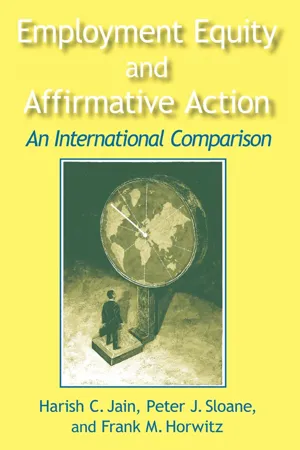
Employment Equity and Affirmative Action: An International Comparison
An International Comparison
- 248 pages
- English
- ePUB (mobile friendly)
- Available on iOS & Android
eBook - ePub
Employment Equity and Affirmative Action: An International Comparison
An International Comparison
About this book
The authors of this comparative study of affirmative action compare the employment practices of six countries: the U.S., Canada, Great Britain/Northern Ireland, India, Malaysia, and South Africa. They look at mandatory quota policies; legislated versus voluntary policies; goals and timetables; restrictions and other policies; as well as recruitment, selection, compensation, performance appraisal, promotion, training, and career development. Their findings will prove useful for training managers of companies with global operations.
Chapter 1
Introduction
The current millennium has signaled a range of ideas and reflections on whether national policymakers and organizations are capable of meeting the challenge posed by globalization and increasing competition. One such challenge is the extent to which equality of opportunity is afforded to all members of the increasingly diverse labor force in the global economy.
The degree to which comparative convergence in policy and practice may occur is also influenced by the degree of cultural diversity in a country. The concept of diversity includes three types: demographic, cultural, and workforce diversity. The particular mix of these types of diversity varies cross-culturally and internationally. This underlines the importance of skillful management of diversity and change in global and local firms. Learning to manage diversity is one of the greatest challenges in managing human resources in the global economy. Cultural change in firms such as Motorola, Texaco, and Bank of Montreal (BMO) for example, has involved an integrated strategy for recruitment and selection to widen the pool of candidates, identifying talent from minority groups, ensuring fair treatment and practices, holding managers accountable, rewarding attainment of diversity goals, and improving relationships with external stakeholders.
In one sense, globalization may increase the demographic diversity of labor markets, but in another it may in the long run make them more homogeneous. Increasingly, talented people with skills in high demand are becoming internationally mobile. Expatriate professionals and executives are increasing globally as multinational corporations (MNCs) compete for scarce skills and talent. Although MNCs have become more powerful, they cannot assume that identical human resource practices can be applied cross-culturally (Dowling, Welch, and Schuler 1999). This raises the question as to whether specific practices such as employment equity (EE), affirmative action (AA), and diversity are converging or diverging internationally.
Affirmative Action, Employment Equity, and Workforce Diversity
The terms AA, EE, and workforce diversity are often used interchangeably. However, they are conceptually different. In the North American context, AA originated in the United States as a response to segregation and the disadvantage of blacks in employment, education, and other areas of life. Some have described AA as “hiring by numbers” due to its focus on increasing the representation of designated groups through targeted hiring, and to some extent training and promotion. AA compliance does not emphasize changing organizational policies, practices, and climate so that designated groups could become equal partners with other workers and share with other employees promotion and rewards for their performance (Agocs and Burr 1996). The term EE was coined by Judge Rosalie Silberman Abella, appointed chair of a Royal Commission on Equality in Employment in 1984 by the Canadian federal government. Judge Abella set a course different from AA and sought to avoid the controversy and stigma attached to it. EE is designed not only to improve numerical representation of designated groups through hiring, but also to provide supportive organizational culture for the retention, promotion, and training of the designated groups.
Thus, EE is a much more comprehensive strategy that stresses both quantitative and qualitative measures. Accordingly, the emphasis is not only on improving numerical representation but also on providing equality of opportunity through fair staffing procedures and a supportive organizational climate (Jain 1999).
In this book we examine EE/AA with the perspective described above. Both refer to selective policies and programs by government and nongovernmental institutions proactively to redress work-related inequalities that exist within countries along racial, ethnic, gender, caste, disability, and other lines. Diversity management, on the other hand, is a voluntary corporate response and an extension, not substitution, of proactive policies to ensure fair treatment of all employees.
AA/EE programs are legislatively driven, whereas diversity management is strictly voluntary and is a strategic corporate response to the growth of diversity in the workforce and is motivated by business objectives. Diversity management can complement, but not replace, EE/AA (Jain and Verma 1996).
EE/AA is particularly important in assessing the impact of public and organizational policies and human resource practices aimed at addressing unfair discrimination. Globalization implies powerful forces for convergence in respect of diversity and EE, with policies and practices arguably becoming more similar cross-culturally. Yet there is a growing body of evidence supporting the divergence hypothesis, especially regarding enterprise-level policy, practices, and initiatives aimed at differentiating the firm strategically from its competitors. Convergence may more likely occur at the macro-regulatory and institutional levels, as countries struggle to find the right policies to improve race and ethnic relations and to redress inequalities based on past discrimination in these and other important areas such as gender and disability.
Multinational firms often seek consistency and integration of approach, policy, and practices globally. Theirs is a geocentric approach; which stands in comparison to ethnocentric approaches where little local autonomy is allowed, or a polycentric approach where an MNC subsidiary is treated as a distinct national entity. In the last named, local nationals can exhibit some decision autonomy and management and do not always have to defer to expatriate executives (Heenan and Perlmutter 1979). Regiocentric approaches consider geographic strategies in respect of human resource management and diversity, recognizing the institutional and regulatory context. Some MNCs use a combination of approaches based on a contingency perspective. This view acknowledges that, while basic principles of sound employment practices may apply, unique features of the local context have an impact on the way policies and practices are designed, implemented and monitored. A combination of approaches may be used by the same MNC in different countries (Jain, Lawler, and Morishima 1998).
The propensity for effective management of diversity through EE, AA, and other similar measures is, however, mediated quite strongly by the national and local context. Organizations need to consider an integrated framework that evaluates policy constraints and the appropriate choice or mix of measures and practices used to address unfair discrimination and establish fair labor practices. Factors such as the constitutional and legal framework for employment discrimination and equity, labor market attributes such as supply and demand for particular skills, availability of talent, cultural diversity, and historical relations between ethnic and other groups are key factors that may enhance or limit effective EE/AA policy performance at the firm level. Strategic outcomes are vital in evaluating the effectiveness of both legislation and firm practices in addressing unfair discrimination at work. A key question considered in this book is the extent to which global convergence is occurring in policy and practice, and also how these are best applied given the distinctiveness of certain jurisdictional contexts.
This chapter further examines: (a) the experiences of countries where equal employment and employment equity/affirmative action policies have been designed to assist the majority population such as in South Africa and Malaysia and (b) selected country experiences with quotas/reservations, legislated goals and timetables, and positive action policies and programs. For example, India and Malaysia have affirmative action (AA) programs with constitutionally sanctioned mandatory programs; the United States has Presidential Executive Orders requiring AA for federal contractors and subcontractors with mandated goals and timetables; Canada and South Africa have legislated equal opportunity and employment equity/affirmative action (EE/AA) policies with goals and timetables; Britain relies more on a voluntarist approach; and Northern Ireland in the United Kingdom (UK) has legislated goals and timetables and AA programs for Catholic minorities; and (c) lessons to be drawn from the success/failure of these policies in the six countries; and whether or not such policies can be a source of competitive advantage in the global economy.
The chapter is divided into several sections presenting an examination of: the country experiences for each of the six countries, considering advantages and disadvantages; an outline of the micro-organizational level implications; and conclusions and implications. The plan of the book includes eight chapters. This first chapter deals with equity in selected countries; followed by theories of discrimination in the second chapter; a discussion and empirical analysis of studies dealing with the effect of equal opportunities and EE/AA policies on human resource management policies of recruitment, selection, promotion, and training in the third chapter; an analysis of best practices, including an EE index as well as discussion and analysis of the qualitative and quantitative methods of effective measurement of EE in the fourth chapter; a comparative perspective of pay equity policies in the selected countries in the fifth chapter; labor union equity policies in the sixth chapter; an analysis of public policies in the seventh chapter; and finally, conclusions and implications in the final chapter.
Selected Country Policy Responses to Employment Equity/ Affirmative Action Programs
We have selected several countries to illustrate policy responses to discrimination in employment in the public and private sectors at the macro and micro levels, respectively. These are India, Malaysia, Canada, the United States, South Africa, and Britain, including Northern Ireland. The employment equity/affirmative action (EE/AA) policies of these countries will be examined in some detail.
In Malaysia and South Africa, AA policies deal with the majority communities. As Table 1.1 indicates, in Malaysia, such policies deal with the Bumiputras (“sons of the soil”) who comprise approximately 66 percent of the estimated 22.3 million population, Chinese 25.3 percent, and Indians 7.4 percent of the population (Treasury, Economic Report 2000). In South Africa, EE policies in the form of constitutional guarantees of equality of opportunity and employment equity legislation and other policies deal with women (both white and black) who make up 52 percent of the total population and with blacks who account for more than 88 percent of the country’s population, including men and women such as blacks (76.7 percent), coloureds (8.9 percent), Asians (2.6 percent) (Statistics South Africa 2001), and others. In India, the government’s task is one of addressing inequalities for women, who make up 48 percent of the population, and a significant number of minorities such as scheduled castes (SCs) and scheduled tribes (STs).1 Both groups constitute 21 percent or more than 200 million of the 864 million population as of 1991 (Jain and Ratnam 1994). In Canada...
Table of contents
- Cover
- Half Title
- Title Page
- Copyright Page
- Table of Contents
- List of Tables and Figures
- Foreword
- Preface
- 1. Introduction
- 2. Theories of Discrimination
- 3. A Comparative Look at the Impact on Human Resources Management of Employment Equity Legislation
- 4. Measuring Employment Equity Effectiveness: Quantitative and Qualitative Approaches
- 5. Fair Pay
- 6. Trade Unions and Discrimination
- 7. Public Policy
- 8. Conclusions and Policy Implications
- Index
Trusted by 375,005 students
Access to over 1.5 million titles for a fair monthly price.
Study more efficiently using our study tools.
Frequently asked questions
Yes, you can cancel anytime from the Subscription tab in your account settings on the Perlego website. Your subscription will stay active until the end of your current billing period. Learn how to cancel your subscription
No, books cannot be downloaded as external files, such as PDFs, for use outside of Perlego. However, you can download books within the Perlego app for offline reading on mobile or tablet. Learn how to download books offline
Perlego offers two plans: Essential and Complete
- Essential is ideal for learners and professionals who enjoy exploring a wide range of subjects. Access the Essential Library with 800,000+ trusted titles and best-sellers across business, personal growth, and the humanities. Includes unlimited reading time and Standard Read Aloud voice.
- Complete: Perfect for advanced learners and researchers needing full, unrestricted access. Unlock 1.5M+ books across hundreds of subjects, including academic and specialized titles. The Complete Plan also includes advanced features like Premium Read Aloud and Research Assistant.
We are an online textbook subscription service, where you can get access to an entire online library for less than the price of a single book per month. With over 1.5 million books across 990+ topics, we’ve got you covered! Learn about our mission
Look out for the read-aloud symbol on your next book to see if you can listen to it. The read-aloud tool reads text aloud for you, highlighting the text as it is being read. You can pause it, speed it up and slow it down. Learn more about Read Aloud
Yes! You can use the Perlego app on both iOS and Android devices to read anytime, anywhere — even offline. Perfect for commutes or when you’re on the go.
Please note we cannot support devices running on iOS 13 and Android 7 or earlier. Learn more about using the app
Please note we cannot support devices running on iOS 13 and Android 7 or earlier. Learn more about using the app
Yes, you can access Employment Equity and Affirmative Action: An International Comparison by Harish C. Jain,Peter Sloane,Frank Horwitz in PDF and/or ePUB format, as well as other popular books in Business & Business General. We have over 1.5 million books available in our catalogue for you to explore.