eBook - ePub
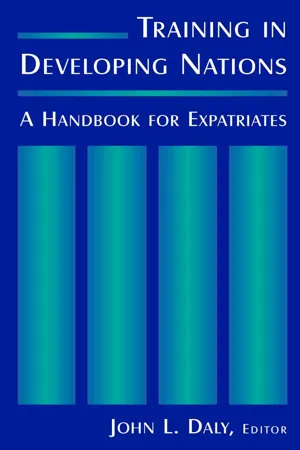
Training in Developing Nations: A Handbook for Expatriates
A Handbook for Expatriates
- 232 pages
- English
- ePUB (mobile friendly)
- Available on iOS & Android
eBook - ePub
About this book
This practical text offers students, consultants, and training specialists proven strategies for launching successful training initiatives in developing nations. While there are many resources available for trainers, no other book takes the expatriate perspective - to prepare international trainers for the unique challenges they face when conducting training in underdeveloped regions. Truly global in scope, the book features examples and experiences from a variety of third world settings, including sub-Saharan Africa, Eastern Europe, and Central and South America. The contributors provide essential general strategies for trainers in developing countries, as well as specific advice on training in various fields - including public health, economic development, public sector development, and media and journalism.
Information
Part I
Practical Strategies for Training
in Developing Settings
in Developing Settings
1
Issues of Safety, Security, and Personal
Well-being in Developing Nations
Well-being in Developing Nations
William A. Marjenhoff
Maintaining your personal safety, security, and well-being, whether at home or abroad, is largely a matter of common sense. Common sense and caution are always the most reliable measures for crime prevention. Follow your instincts. Your gut feelings about a sketchy environment or situation are usually right.
That said, there is a great deal more you can do to help ensure that your training experience abroad will end happily. A happy ending starts with a smart beginning, long before you step aboard that plane to your overseas destination.
Before You Go
Learn all you can about the countries you plan to visit and your host institution. Thorough library and Internet research is essential. Bookstores, travel magazines, travel sections of major newspapers, travel agents, and foreign tourist bureaus are good sources of information on everything from discount airfares to international health insurance.
Visas and Work Permits
Most governments require foreigners to have an appropriate visa to visit or reside in their country. This endorsement or stamp placed in your passport by a foreign government permits you to enter that country for a specified purpose. If you are planning to reside in a country for an indefinite period of time, most countries will require you to seek resident status. In most instances, you must obtain the necessary visa before you leave the United States. Apply for your visa directly from the embassy or nearest consulate of the country you plan to visit. Your employer or host institution should provide you with a letter or document that will help you obtain a visa.
A work permit is usually required as a separate document from your visa or residency permit. It is necessary if you plan to work in a foreign country. It may be obtained either before you leave the United States or after you arrive in the foreign country, depending on the laws of the particular country. The Department of State cannot help you obtain visas or work permits. Rely on assistance provided by your employer and/ or host institution.
Be particularly attentive to visa requirements for countries that you may transit en route to your country of destination.
Consular Information Sheets
The best sources of up-to-date travel information about the countries you plan to visit are Department of State consular information sheets.1 They can be accessed on the World Wide Web at http://travel.state.gov. They cover health conditions, unusual currency and entry regulations, crime and security conditions, drug penalties, and areas of instability.
Much of the advice in consular information sheets is generic. Here are some random excerpts. Just fill in the name of the developing country you are visiting:
• As a visitor to ______, be alert to your surroundings. In large cities, take the same precautions against assault, robbery, or pickpockets that you would take in any large U.S. city. Be aware that women and small children, as well as men, can be pickpockets or purse-snatchers. Persons carrying valuables in backpacks, in back pockets of pants, and in coat pockets are especially vulnerable to pickpockets. Keep your billfold in an inner front pocket, and wear the shoulder strap of your purse, camera, or bag across your chest. Walk away from the curb and carry your purse away from the street. You are most vulnerable in underground walkways, subways, trams, overnight trains, train stations, airports, markets, tourist attractions, restaurants, Internet cafes, hotel rooms, and residences—even when locked or occupied.
• Armed carjackings have occasionally occurred in ______. Travelers are urged not to try to resist or fight off robbers. Many are armed or have an accomplice. Automobile doors should remain locked at all times, windows should be rolled up, and valuables should be placed in the trunk or under seats and out of view. If you are driving, leave adequate maneuver room between your vehicle and the one in front of you at stop signs, red lights, and roadblocks.
• The use of public minibuses in ______ is discouraged, due to widespread unsafe driving and poor maintenance.
• In ______, hotel breakfast rooms and lobbies attract professional, well-dressed thieves who blend in with guests and target purses, briefcases, and computer bags left unguarded by unsuspecting tourists and business travelers.
• The U.S. embassy in ______ warns travelers to avoid travel outside of major metropolitan areas after dark, and to avoid travel on unpaved roads at all times because of random banditry, carjackings, kidnappings, criminal assaults, and lack of police and road-service facilities. Most fatal traffic accidents or robberies and assaults occur during the evening or early morning hours. Travelers with conspicuous amounts of luggage, late-model cars, or foreign license plates are particularly vulnerable, even in the capital.
• Do not hail taxis on the street in ______. It is safer to use telephone-dispatched radio taxis or car services associated with major hotels.
• Despite efforts to increase police presence in areas frequented by foreigners, the police in ______ are poorly paid, poorly equipped, and lack the professionalism that Americans are accustomed to in the United States. Also, it is not uncommon for Americans to become victims of harassment, mistreatment, and extortion by law enforcement and other officials in ______. Try to obtain the officer’s name, badge number, and patrol car number, and note where the incident happened, as this information assists local officials in identifying the perpetrators. Report crimes committed against you by persons presenting themselves as police or other governmental authorities to the U.S. embassy or the nearest U.S. consulate. Travelers should be aware that certain activities that would be normal business activities in the United States and other countries are either illegal under the legal code of ______ or are considered suspect by the police or military authorities.
• The mail system in ______ can be unreliable and mailed monetary instruments (credit cards, checks, etc.) are frequently stolen. International couriers provide the safest means of shipping envelopes and packages, and anything of value should be insured.
Forewarned is forearmed. Read the consular information sheets on the countries you plan to visit and heed their advice. The consular officers who write and revise these sheets know what they are talking about.
Emergency Document Kit
Thieves are not usually after your passport. They are after cash, jewelry, and credit cards, but passports are very often carried in the bags and purses that thieves snatch. Without proper identification and proof of U.S. citizenship, getting a replacement for a lost or stolen passport can be a real hassle. Before you leave home, make a document kit that contains a photocopy of the biographical page at the front of your passport and two recent passport-size photos. Jot down the addresses and telephone numbers of the U.S. embassies and consulates in the countries you plan to visit. It is also a good idea to write down your credit card numbers and contact information for reporting lost or stolen cards. Also, write down the numbers of your travelers’ checks and airline tickets. Keep the document kit in a place separate from your passport, purse, or wallet.
It is a good idea to leave a copy of the emergency kit documents with a friend or relative at home, as well, along with your travel schedule and the names, addresses, and telephone numbers of the persons and institutions you plan to visit.
What Not to Pack
Do not pack anything that you would hate to lose, such as valuable jewelry, family photos, or objects of sentimental value. Leave clothes that are flashy or too casual (halter-tops come to mind) at home. Pack to dress conservatively. Your Hawaiian shirts, Armani suits, short-shorts, and sequined gowns will only attract the attention of thieves or con artists. Remember, there are clothing shops where you are going, and you can buy replacements for what you did not pack, if need be.
Do not take a lot of cash. Bring most of your money in travelers’ checks. Convert your travelers’ checks to local currency as you need it, not all at once. Most international airports have money exchange facilities, and local banks generally give more favorable rates of exchange than hotels, restaurants, or stores when you convert U.S. dollars or travelers’ checks into local currency. Automated Teller Machines (ATMs) are increasingly available overseas, and generally provide good exchange rates. ATM availability is not universal, however, and ATMs should be used only as a backup method for your financial transactions abroad. Remember that ATM machines are prime locations for the operations of thieves and con artists.
Health Insurance
Before you travel abroad, you should review your health insurance policy. If your policy does not cover you abroad, purchase a short-term health insurance policy that is designed specifically to cover travel. The U.S. government cannot pay to have you medically evacuated home, and escorted medical evacuation can cost thousands of dollars. Medical assistance programs, with or without health insurance coverage, are well worth consideration. They offer consultative and evacuation services. Also, some credit card and travelers’ check companies offer travel protection packages that provide benefits for accident and illness while traveling. Be sure you have adequate coverage, and be sure to carry your insurance policy identity cards and claim forms with you when you travel.
Older Americans take note: The Social Security Medicare program does not provide for payment of hospital or medical services obtained outside the United States. Some Medicare supplement plans offer foreign medical care coverage at no extra cost for treatments considered eligible under Medicare. These are reimbursement plans, and you must pay the bills first and obtain receipts for submitting them later for compensation. Many of these plans have a dollar ceiling per trip.
Immunizations
Information on immunizations and health precautions for travelers can be obtained from the Centers for Disease Control and Prevention’s international travelers hotline, (404) 332–4559, and should also be available from your personal physician. Immunizations recommended for travelers to many developing countries include diphtheria, tetanus, polio, typhoid, and hepatitis A and B.
Medication
If you need medicines, bring an ample supply in their original containers. Do not use pill cases. There are strict laws concerning narcotics throughout the world, so take copies of your prescriptions with you and, if possible, carry a letter from your physician explaining your need for any drugs you are carrying. As an extra precaution, carry the generic names of your medications with you. Pharmaceuticals overseas may use different names from those prescribed in the United States.
If you wear eyeglasses, take an extra pair in your hand luggage. At the very least, carry your eyeglass prescription with you.
If you have allergies or reactions to certain medications, foods, or insect bites, or have other serious medical problems, consider wearing a “medical alert” bracelet.
Arrival
Okay, you have planned your trip well. You have read up on the culture and customs of the country you are visiting, gotten your immunizations, made sure that you have adequate health insurance coverage and medications, and you have packed wisely.
You have arrived alive and your plane is taxiing to the terminal. You are excited. Most likely, you are also tired and jet-lagged, so be especially cautious.
Perhaps the most dangerous times for travelers to be targets of criminal activity are upon arrival at an airport, in transit from airports to hotels, and in transit from hotels to airports for departure. Remember: Where there are tourists and business travelers, there are thieves and con artists.
Travelers to developing countries should be alert to the fact that some airport personnel may attempt to perpetrate a number of scams. In Luanda, Angola, even immigration and customs officials sometimes detain foreigners without cause, demanding gratuities before allowing them to enter the country. Airport health officials there have sometimes threatened arriving passengers with “vaccinations” with nonsterile instruments if gratuities are not paid. In these situations, the smart traveler will ask to consult with airline personnel or demand to be put in contact with American consular officials.
On our first trip to Paris, my wife and I landed at Charles de Gaulle Airport, and I was trying to figure out how to buy a train ticket from a machine. A well-dressed young man saw my hesitation and confusion and offered to assist me. He said the tickets cost 50 francs each. I handed him the money, he slipped some francs into the machine and gave us our tickets, happy to have been of assistance. Well, of course he was happy! The cost of the tickets, I later discovered, was 15 francs each, and he had pocketed 70 francs for his trouble.
It was a cheap lesson: Do not accept unsolicited assistance from anyone.
Gangs of thieves commonly operate on rail links from airports. They prey on jet-lagged, luggage-burdened tourists and business travelers. Even experienced travelers can be robbed when they let their guard down.
On another visit to Paris, I found myself momentarily distracted by someone tugging at the cuff of my pants as I tried to board the Metro from Gare du Nord to downtown. Meanwhile, another man was trying to block my entrance to the car. When I realized what was about to happen, I began yelling at the top of my lungs, holding firmly to my luggage and shoving my way onto the car. My shouts drew the attention of the other passengers and caused the thieves to give up on me as a target. As the car door was closing, the thief who tried to block my entrance slipped out. The man who had been tugging at my cuff gave me a sheepish grin from the platform as the train pulled out.
Later on that same trip, I watched in fascinated horror as pickpockets worked the turnstiles at crowded Metro stations. Just as someone was walking through a turnstile, the thief would boldly stick his hand into the victim’s pocket or purse. Once the victim was on the other side of the turnstile, there was no easy return to the other side. The thief could leisurely nod and smile at his victim and nonchalantly walk away.
Pickpockets, luggage thieves, and purse-snatchers are active in most major cities and tourist sites around the...
Table of contents
- Cover
- Half Title
- Title Page
- Copyright Page
- Table of Contents
- Preface and Acknowledgments
- Introduction
- Part I. Practical Strategies for Training in Developing Settings
- Part II. Training in Specific Fields
- Part III. Observations and Conclusions
- Index
Trusted by 375,005 students
Access to over 1.5 million titles for a fair monthly price.
Study more efficiently using our study tools.
Frequently asked questions
Yes, you can cancel anytime from the Subscription tab in your account settings on the Perlego website. Your subscription will stay active until the end of your current billing period. Learn how to cancel your subscription
No, books cannot be downloaded as external files, such as PDFs, for use outside of Perlego. However, you can download books within the Perlego app for offline reading on mobile or tablet. Learn how to download books offline
Perlego offers two plans: Essential and Complete
- Essential is ideal for learners and professionals who enjoy exploring a wide range of subjects. Access the Essential Library with 800,000+ trusted titles and best-sellers across business, personal growth, and the humanities. Includes unlimited reading time and Standard Read Aloud voice.
- Complete: Perfect for advanced learners and researchers needing full, unrestricted access. Unlock 1.5M+ books across hundreds of subjects, including academic and specialized titles. The Complete Plan also includes advanced features like Premium Read Aloud and Research Assistant.
We are an online textbook subscription service, where you can get access to an entire online library for less than the price of a single book per month. With over 1.5 million books across 990+ topics, we’ve got you covered! Learn about our mission
Look out for the read-aloud symbol on your next book to see if you can listen to it. The read-aloud tool reads text aloud for you, highlighting the text as it is being read. You can pause it, speed it up and slow it down. Learn more about Read Aloud
Yes! You can use the Perlego app on both iOS and Android devices to read anytime, anywhere — even offline. Perfect for commutes or when you’re on the go.
Please note we cannot support devices running on iOS 13 and Android 7 or earlier. Learn more about using the app
Please note we cannot support devices running on iOS 13 and Android 7 or earlier. Learn more about using the app
Yes, you can access Training in Developing Nations: A Handbook for Expatriates by John L. Daly in PDF and/or ePUB format, as well as other popular books in Education & Entrepreneurship. We have over 1.5 million books available in our catalogue for you to explore.