eBook - ePub
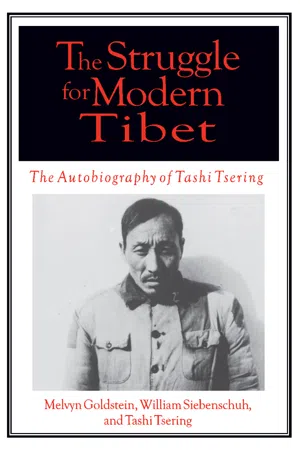
The Struggle for Modern Tibet: The Autobiography of Tashi Tsering
The Autobiography of Tashi Tsering
- 209 pages
- English
- ePUB (mobile friendly)
- Available on iOS & Android
eBook - ePub
The Struggle for Modern Tibet: The Autobiography of Tashi Tsering
The Autobiography of Tashi Tsering
About this book
This captivating autobiography by a Tibetan educator and former political prisoner is full of twists and turns. Born in 1929 in a Tibetan village, Tsering developed a strong dislike of his country's theocratic ruling elite. As a 13-year-old member of the Dalai Lama's personal dance troupe, he was frequently whipped or beaten by teachers for minor infractions. A heterosexual, he escaped by becoming a drombo, or homosexual passive partner and sex-toy, for a well-connected monk. After studying at the University of Washington, he returned to Chinese-occupied Tibet in 1964, convinced that Tibet could become a modernized society based on socialist, egalitarian principles only through cooperation with the Chinese. Denounced as a 'counterrevolutionary' during Mao's Cultural Revolution, he was arrested in 1967 and spent six years in prison or doing forced labor in China. Officially exonerated in 1978, Tsering became a professor of English at Tibet University in Lhasa. He now raises funds to build schools in Tibet's villages, emphasizing Tibetan language and culture.
Information
1
My name is Tashi Tsering.
In Tibetan, Tashi means “good luck” and Tsering means “long life.” Looking back on my life now, I believe my name has turned out to be prophetic. For a long time, though, it didn’t seem so. But that is getting ahead of my story.
There was nothing particularly unusual about my childhood. I came into the world in 1929—the year of the “iron horse”—in a small village called Guchok in a mountain river valley about a hundred miles west of Lhasa. I was born during what is now called the “old society,” although while I was growing up I had no idea there was going to be a “new society.” There was simply our traditional Tibetan way of life.
My first ten years were like those of most other Tibetan peasant boys. When I was very young, I ran and played on the slopes and in the meadows, carefree and without many duties or responsibilities. On those wonderful days when it was warm enough in our valley, I sometimes ran around naked with the other children just for the joy of it. Although the country was rugged, the horizons were majestic. There seemed to be an endless expanse of great mountains and beautiful valleys, and I loved the physical sense of freedom.
Guchok was like most other small Tibetan villages. The few hundred inhabitants lived in clusters of stone houses scattered along the sloping foothills of a mountain valley fed by a glacial stream that provided the precious water needed for irrigating our crops. The flat-roofed houses were two and three stories high, and like most families, we lived on the second and third floors, keeping our animals on the first.
Guchok was divided into an upper and a lower village. We lived in the upper village, in the higher part of the valley where it was harder to grow crops but easy to find forage for the grazing animals. Thus not only did we grow barley and lentils, but we kept many yaks, goats, and sheep. Ours was basically a subsistence economy. We ate the produce of our fields and flocks and made virtually all of our clothing—spinning our wool and weaving it on wooden looms. When we needed something we couldn’t produce ourselves, such as salt, we bartered to get it, although Tibet had its own coinage, which we sometimes used. Like most villagers throughout Tibet, we were surprisingly self-sufficient.
My family was large, ten of us in all. There was my mother and then my four paternal aunts who, though they were celibate Buddhist nuns, mostly lived at home and provided the family with a significant labor force. There were also my paternal grandmother, two younger brothers, and my two fathers. I say two fathers because it is common in Tibetan society for brothers to take a wife jointly. It was only when I lived abroad that I learned how rare and shocking this marital custom was to Americans and even to other Asians like Chinese and Indians. I never thought about it then, and it does not bother me now. In our culture, it was completely natural for brothers to marry the same woman, and there was no stigma at all about brothers sharing a woman sexually. We saw this custom as an effective way to conserve resources and enhance the material well-being of the family. We believed that polyandry, as this custom is called by anthropologists in the West, prevents fragmentation of the family’s land across generations. If each son in a family marries monogamously and brings in a new unrelated bride, we think the family is unstable and likely to split up, with each son and his wife and children taking a share of the land. By contrast, with polyandry, there is only one wife and one set of children, so fission is far less common.
Keeping brothers together was also important for us because not only was all of the work of our household done without machines—by people (and animals)—but our normal activities often involved the need to provide people for free corvée labor. For example, we had to provide animals and people to move goods and commodities for the government’s transportation system. The more available the labor, the stronger the whole family unit became.
The older of the two brothers who were my fathers was the one we actually called “father.” He also was the head of the household and slept with my mother in a separate room on the second floor of our stone house. My other father, his younger brother, was always called “uncle” in our region. In our household, he slept downstairs, where we kept the animals. I remember now that my mother would sometimes go downstairs to sleep with him, but I didn’t think much about it at the time. In our culture the wife played the key role in holding such marriages together. She was responsible for visiting all the brothers regularly and making sure they were satisfied and that the marriage and household functioned effectively. My mother must have done a good job, because there was no friction between my fathers.
We never worried about who the biological father was, and I had no idea which of the two fathers was actually mine. My mother never told me anything, and it never occurred to me to ask. I don’t think the brothers knew the truth themselves—or cared. Both “father” and “uncle” called me “son,” and they treated all the children equally. To this day I cannot fathom why non-Tibetans find polyandry so strange and even disgusting. In America it is common for one woman to have two or three husbands in the course of her life and occasionally to have sexual relations with more than one man at a time. In Tibet it is the same; the only difference is that sometimes both husbands are there at the same time, and they are brothers. We find this system eminently logical and natural.
My family was relatively well off by local standards, and I had a carefree youth with little or no work until about the age of seven, when I started doing odd jobs around the house. My first major responsibility came when I was eight years old and my father told me I was to work as a shepherd in the summers like the older boys. I was thrilled. My job really was not hard, but I felt great pride. I had to help drive the animals (about three hundred sheep and goats) into the mountains each day, stay with them while they grazed, and bring them back in the evening. In summer the days were long, the skies were immense, and the mountain valleys were beautiful. I loved the feeling that I was doing something that mattered to my family. But I have to admit that it was mainly just fun, because I met many other young herders like myself, and there was always something to do while watching the herd graze. When the weather was hot, we shepherds played in the icy streams. And despite the dominance of Buddhism in our society, with its strong emphasis on the sanctity of life, we often hurled stones at birds and rabbits with our slingshots, and sometimes we even caught fish in the streams with our hands. When we spotted a fish hiding we reached out with cupped hands, careful that no sudden movement frightened it. Then, holding our breath, we would grab as fast as we could. Usually we missed, but occasionally we got lucky and were able to fling a fish onto the bank. We boys thought that was a great feat and would immediately set up a makeshift hearth of stones and dung, which we lit with the flint strikers we all wore. I can still recall the glorious taste of the freshly cooked fish. On quieter days we spun wool on simple handmade spindles or sewed boots for the winter. We ran, occasionally fought, and mostly played and enjoyed the delicious feeling that we were on the way to becoming men while our charges grazed on the mountain meadows! Herding was serious work since our animals represented the major portion of our family’s wealth, but for us kids, it was mostly fun.
The way my family and my village lived from day to day, season to season, and year to year seemed a timeless, comfortably repetitive pattern. As I think back about this life after so many years, I find it easy to idealize and to become nostalgic—but only up to a point. Most of the people I knew then had no interest in change. They worked hard to improve their place in the social and economic system but not to change the ground rules. They had no wish to leave the places they were accustomed to or to break the seamless continuity of the traditional way of life. However, even as a young boy I began to realize that I was different. I liked the life I was living, but I also began to feel dissatisfied. As a child I found it hard to put my finger on exactly what was wrong, and I recall feeling more than a little bit confused about my misgivings. Somehow I felt I wanted something more out of life even though I had no words to describe it. I think that this feeling stemmed from my intense desire to become literate.
From as early as I can remember I wanted to learn to read and write. This desire was not common in our village or in the rest of Tibet. There were no newspapers or radios, and although most people were illiterate, that was not a problem for them or for the village as far as anybody could see. In our tradition-bound world there was no need for literacy in the modern sense. The community and the culture told you who you were and what to do. There were clear and prescribed roles for persons of every age and gender, and, therefore, the possibilities open to restless or ambitious individuals were extremely limited. You didn’t have to think much and weren’t encouraged to question. In any case, there were no schools, so reading and writing were skills possessed only by the rich and by government officials, and of course also monks. Later when I lived in America one of the things that struck me most was the strong value everyone placed on education as a means of social and economic advancement. I, too, felt that education was vital, but this idea was not something village Tibetans thought much about.
I’m not sure what it was that made me want to learn so badly, but I think my desire may have come from watching my father, who was one of the two or three literate people in the village. Looking back, I am not even sure how literate he really was, but I vividly remember how I loved to sit and watch him in the physical act of writing. I was fascinated by his deft, sure movements when he mixed his own ink, carefully filled the inkpot, sharpened the point of his bamboo pen, and then proceeded to create letter after letter. Where did he learn to draw these shapes? How did he know which ones to use? I think the purposeful physical acts themselves became a symbol of some kind of special power that I wanted for myself. I felt the same way when my father was doing arithmetic. Tibetans used a complicated system in which objects like beans, sticks, and stones representing tens, hundreds, and thousands were laid out on a board and moved around to do computations. I used to watch with wonderment as my father magically moved the beans and stones. Of course I wouldn’t have put it that way at the time, but as I’ve thought back the fascination was exactly what I’ve just described. I was certain that I wanted to know what my father and others like him knew. And that presented problems.
There were no schools in our village, so I remember asking my father and mother to send me to the district center, three or four hours’ walk from our village, where a few men offered private tutoring in reading and writing to children. But I could never convince them to agree. I still don’t understand why my parents wouldn’t send me. They always said, “Yes, yes, we’ll think about it.” But as far as I could tell, they never did. The closest I got was when my youngest aunt, a nun, taught me the alphabet for a few weeks. Then she stopped, and I wasn’t sure why. As I said, people in our village weren’t interested in education; they didn’t consider it important because they saw little connection between literacy and the physical realities of their daily lives, including their material success. To them, history was a sort of continuous past that was just like the present and would presumably be just like the future. Why did they need to know more than they already knew?
Even though I was very young, I still remember how frustrated I was at having so little control over my own life. Indeed, if it hadn’t been for a stroke of luck, I probably would have grown up an illiterate peasant like my playmates. I call it a stroke of luck, but my parents didn’t see it that way.
It all began in 1939 when I was ten years old. In that year the Tibetan government needed replacements for the Dalai Lama’s ceremonial dance troupe, called the gadrugba. It was the custom for the government to recruit young boys (from eight to ten years of age) from the provinces of rural Tibet as a tax on the better families. The boys selected for the troupe were taken to Lhasa to be trained. They served until they reached the age of eighteen, when they were retired and replaced by a new cohort of youngsters. It was a recruit year, and so in 1939 the Council of Ministers in Lhasa ordered a number of districts, ours among them, each to send two boys to the capital as candidates for the final selection for the gadrugba.
In our village everyone hated this tax, as it literally meant losing a son, probably forever. Parents, therefore, often told lies about the ages of their children to avoid their being candidates. I don’t know if my parents tried such deceptions, but if they did it did not work, for one day my father received an order from the district governor to send me for the preliminary examination. This order threw my family into chaos and changed my life completely.
My mother cried, sobbing loudly, when she heard the news. In fact, I recall clearly that the whole family was angry and fearful. The possibility that the son they thought would take over the family farm might be lost was awful to contemplate. Their immediate reaction was to try to find a way to avoid sending me. In Tibet when we want to influence an outcome it is typical to go to a relevant official, give an appropriate “gift,” and solicit his assistance. My mother acted immediately, giving a minor district officer she thought might be able to intervene when it came time to choose the boys a present of five large balls of expensive yak butter, and asking him to help the family.
While this action calmed my parents’ anxiety somewhat, I had a totally different view of the situation. I was not at all afraid of leaving my home and village. To the contrary, I was excited and eager to go to Lhasa. At night I would stay up dreaming about the holy city and a new life that included learning and knowledge. So despite my parents’ unhappiness, I couldn’t wait to go to the district for the competition. In fact, I was so eager that on the day we were required to travel to the district center, I got up early and left without waiting for my family. I found out later that my mother looked for me frantically all over the village before learning that I had gone on alone. The district meeting place was three or four hours by foot from our village, and when my mother caught up with me about halfway along, she scolded me severely, I think in part because of her apprehension at the thought of losing me. But at that point nothing could dampen my spirits. This competition, I thought, was going to be my chance!
When we got to the district center, we were called to the governor’s castle and told to wait in the courtyard till His Excellency came to examine us. A crowd of about twenty or thirty other boys had already gathered, each accompanied by a parent. You could feel the tension of the parents and the excitement or fear among the boys. The air was charged with electricity, and I couldn’t stand still for a minute. My mother, who was still angry that I had been selected in the first place, tugged at my hair and clothing and warned me to stop jumping around. She tried everything she could to keep me from drawing any attention to myself. “Stand still and keep your eyes looking downward,” she ordered. But I had never been in a castle before, and far from being intimidated, I was fascinated by it. Full of energy, I ran around looking out of the windows at the town below, trying to imagine what might lie ahead, even looking slyly at the other boys to see what the competition was going to be like.
When the officials assembled, they had all the candidates line up in a row while they walked by and studied us carefully. They seemed to be looking only at physical features, and they asked no questions. I don’t know on what basis they made their decisions, but eventually they picked two boys to go to Lhasa, a first choice and an alternate. I was chosen as the alternate from my district. My mother was furious on hearing this, but my heart was racing. My dream was coming true; I was one step closer to a new life.
When we got back to our village my mother went straight to the minor official and demanded the “gift” butter back. I’m told that she made quite a scene—yelling at him and calling him all kinds of names. He returned the butter but that did not change my situation, and in about a month my father and I were on our way to Lhasa.
From the minute my mother knew the exact date when I was supposed to leave, she asked me to sleep in the same bed with her. Each night we would talk far into the night. One day while we were talking, her voice broke and she said, “Olo [a loving name for son], when you leave I may never see you again. You must write to me.” And then she remembered, smiling, “I know you do not know how to write. But I will not forget you, and I will see to it that you do not forget me. I will send you dried meat, butter, and warm clothing with the travelers that pass through Guchok on the way to Lhasa.”
When it came right down to leaving, I also found it very hard to go. My mother met my fathers and me outside the house and put a ceremonial white scarf called a khatak around my neck, as is our custom. Then she gave me a full bowl of chang (traditional barley beer) and held my hands tightly together in hers. She scarcely spoke; she didn’t have to. Hot tears ran freely from her reddened eyes. When I looked at her familiar, strong, work-roughened hands, the hands that had washed me, fed me, brushed my hair, and held my face, my resolve began to collapse inside. Leaving the warmth and love of my family suddenly seemed enormously frightening. But at this point, my going was a tax obligation and had to be fulfilled whether we liked it or not. We had no choice in the matter.
Finally, my mother touched her forehead to mine, and we set off. She and the other family members stood silently looking after us, tears welling in their eyes. I also cried. I really wanted to go but also felt terribly sad. Try as I might, I could not banish the frightening thought that I would never see my mother and family again.
The first stages of our eight-day journey were difficult. We usually spent the night with peasant families we encountered on our way. We had brought our own food and bedding, and so had only to pay for fuel to cook with. I felt lost and empty inside and viewed the start of every day with apprehension. Fortunately, however, childhood is a time of great resiliency. The journey gave me some time to compose myself, and by the fourth day my spirits had risen high once again.
When we came in sight of the capital city I got my first glimpse of the magnificent Potala Palace. It totally dominated the Kyichu Valley where Lhasa is situated. The view, more grand than anything I had imagined, was truly awe-inspiring. The palace seemed bigger than our entire village; it seemed to cover the mountaintop like a gigantic hat. For better or worse, I knew I had entered a new wo...
Table of contents
- Cover
- Half Title
- Title Page
- Copyright Page
- Table of Contents
- Preface
- Prologue
- The Struggle for Modern Tibet: The Autobiography of Tashi Tsering
- Epilogue
- Index
Trusted by 375,005 students
Access to over 1.5 million titles for a fair monthly price.
Study more efficiently using our study tools.
Frequently asked questions
Yes, you can cancel anytime from the Subscription tab in your account settings on the Perlego website. Your subscription will stay active until the end of your current billing period. Learn how to cancel your subscription
No, books cannot be downloaded as external files, such as PDFs, for use outside of Perlego. However, you can download books within the Perlego app for offline reading on mobile or tablet. Learn how to download books offline
Perlego offers two plans: Essential and Complete
- Essential is ideal for learners and professionals who enjoy exploring a wide range of subjects. Access the Essential Library with 800,000+ trusted titles and best-sellers across business, personal growth, and the humanities. Includes unlimited reading time and Standard Read Aloud voice.
- Complete: Perfect for advanced learners and researchers needing full, unrestricted access. Unlock 1.5M+ books across hundreds of subjects, including academic and specialized titles. The Complete Plan also includes advanced features like Premium Read Aloud and Research Assistant.
We are an online textbook subscription service, where you can get access to an entire online library for less than the price of a single book per month. With over 1.5 million books across 990+ topics, we’ve got you covered! Learn about our mission
Look out for the read-aloud symbol on your next book to see if you can listen to it. The read-aloud tool reads text aloud for you, highlighting the text as it is being read. You can pause it, speed it up and slow it down. Learn more about Read Aloud
Yes! You can use the Perlego app on both iOS and Android devices to read anytime, anywhere — even offline. Perfect for commutes or when you’re on the go.
Please note we cannot support devices running on iOS 13 and Android 7 or earlier. Learn more about using the app
Please note we cannot support devices running on iOS 13 and Android 7 or earlier. Learn more about using the app
Yes, you can access The Struggle for Modern Tibet: The Autobiography of Tashi Tsering by Melvyn C. Goldstein,William R Siebenschuh,Tashi Tsering in PDF and/or ePUB format, as well as other popular books in Social Sciences & Social Science Biographies. We have over 1.5 million books available in our catalogue for you to explore.