- 248 pages
- English
- ePUB (mobile friendly)
- Available on iOS & Android
eBook - ePub
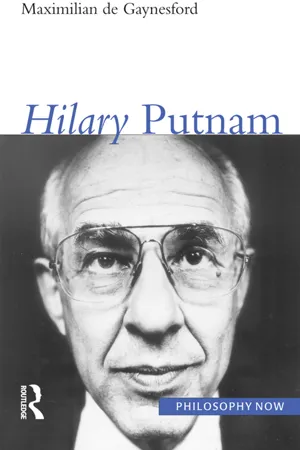
Hilary Putnam
About this book
Putnam is one of the most influential philosophers of recent times, and his authority stretches far beyond the confines of the discipline. However, there is a considerable challenge in presenting his work both accurately and accessibly. This is due to the width and diversity of his published writings and to his frequent spells of radical re-thinking. But if we are to understand how and why philosophy is developing as it is, we need to attend to Putnam's whole career. He has had a dramatic influence on theories of meaning, semantic content, and the nature of mental phenomena, on interpretations of quantum mechanics, theory-change, logic and mathematics, and on what shape we should desire for future philosophy. By presenting the whole of his career within its historical context, de Gaynesford discovers a basic unity in his work, achieved through repeated engagements with a small set of hard problems. By foregrounding this integrity, the book offers an account of his philosophy that is both true to Putnam and helpful to readers of his work.
Information
Chapter 1
Introduction
I am not writing philosophy for the next historical epoch and for our post-human descendants; I am writing for human beings in the present period.
Hilary Putnam, Meaning and Knowledge (1976a (v): 63)
Philosophy experiences few seismic shifts in the course of centuries. Hilary Putnam has been responsible for at least two in a single generation: functionalism about mental phenomena, and externalism about meaning. Major thinkers epitomize the possibilities of the art and sometimes change them. Putnam has had that kind of dramatic influence on the interpretation of quantum mechanics, on the formulation of alternative versions of realism, on the relative status of logic and mathematics, on the development of current pragmatist approaches to philosophical problems, and on the clarification of the conceptual settings within which various social scientific investigations take place. His enquiries into the history, methods, aims and role of philosophy have stimulated a more widespread and purposeful self-questioning among its practitioners than could have been predicted even ten years ago.
This book attempts to satisfy curiosity and stimulate thought about Putnam’s contributions to philosophy, insisting on the importance of the effect of the whole and opposing the usual emphasis on certain leading papers. For the primary hermeneutic problem posed by his work, the question which drives the present enquiry, is the problem of integrity. How are unity, wholeness and consistency manifest in this constantly developing body of philosophical argument and writing?
The book is not restricted to the study of what makes Putnam distinctive as a philosopher however. As the quoted passage indicates, his interventions in philosophical debate are of a kind that privilege the present. And this makes current overall context a subject in its own right, an area of separable interest, and not mere background. To represent Putnam accurately, therefore, we need not an intellectual portrait alone, but a portrait within a landscape. With this aim in mind, the book exposes his thinking gradually, first examining the fundamental determinants, features of context and character, and then drawing towards the essential contents.
Stimulus
Why interpret Putnam critically? Partly because, of all contemporary philosophers, he is most aptly described as a public thinker. He has reflected his generation to itself, supplying to conscious awareness and the attentive eye those fresh perspectives on old concerns that represent a common intellectual outlook in process of formation. Moreover, he has been effective in doing so, being one of the most influential thinkers of recent times, a philosopher whose authority stretches far beyond the confines of the discipline. This is the more surprising since philosophy matters about as little to our age as poetry does. So Putnam is significant above all because, being unusually sensitive to present conditions, unusually driven to thinking through them, and unusually direct in talking about them, he makes philosophy itself matter.
Other reasons for interpreting Putnam critically look to the future. Our intellectual landscape is very different from that of even a halfcentury ago, both in its overall shape and in its details. Philosophy at present is in ferment and undergoing yet further changes. If we are to understand how and why this is so, it is to Putnam’s work in particular that our attention should be drawn. This is not just because several important transformations can be traced to his writings, though this would be reason enough. More pressingly, Putnam has made the search for the desired shape of future philosophy his particular task. He has spent his career in uneasy relation to his own heritage, socalled “analytic philosophy”, asking what the genuine problems are and how we are to tackle them effectively. Much that we should now be attending to has been indicated by him.
These goals motivate. But it is no less stimulating philosophically to survey internal movements, and particularly to discern in the course of Putnam’s career the radical effects of discoveries he himself has made. Frequently tearing up the plans projected by his own hard-won earlier findings, his intellectual consistency is measured less by stability of view than by a constant willingness to begin searching anew with fresh guidelines and constraints. This has earned him admiration and puzzlement in equal measure, often from the same quarter.1 Of all philosophers, Putnam is least likely to be accused of passing off as hard thought mere reshuffles of bias.
Some, it must be admitted, are irritated by this irregular reinvention. It is not hard to see why once we register the charge most commonly laid against Putnam by his critics: that he presents a “moving target”.2 But this complaint betrays a comically belligerent conception of the philosophical task. Prey that fails to keep still long enough to be shot down is understandably a source of frustration. Yet there is no obligation to reserve all parts of the philosophical landscape for killing fields. And we certainly have no reason to choose Putnam as our target, so long as we do not mistake him for the truth. Tracking him takes us by unfrequented routes to remarkable places. The costs of pursuit are more than met by the rewards of insight.
Sources
Pursuing a philosopher with so many twists to his career requires immersion in the writing. There is a great deal of this in Putnam’s case. Since the mid-1950s, his influence has been central to the generation of research in most areas of philosophy, not just in each of the genera (logic, metaphysics, epistemology), but in most of the species also (philosophy of science, of mathematics, of language and of mind; latterly social and political philosophy). This influence reflects a generous outpouring of ideas in lectures, talks, papers and books. If one were to set about digesting as many of Putnam’s papers as would furnish an ambitious tutorial – four per week, say – it would take a full and restless year to cover the material drawn on in this book.
Putnam’s published writings in book form comprise (so far) fourteen volumes. There have been differences in output-volume, and certain rhythms to the flow. Thus the years 1962–67 were particularly high, followed by a low between 1968 and 1972. The years 1981–83, 1986–1994 and 1999–2002 were more productive still, with periods of lesser output in between, especially 1995–98.
Putnam is not a writer of monographs. One more or less helpful way to distinguish his books is between collections of papers on the one hand, and collections of lecture series on the other. The former are like compilations of disparate songs recorded by a single artist over some specific period. Five books belong to this first group: Mathematics, Matter and Method (1975), Mind, Language and Reality (1975), Realism and Reason (1983), Realism with a Human Face (1990) and Words and Life (1994). The second group, collections of lecture series, are more like songs grouped by a single artist under some specific overarching theme. There are nine books in this category: Meaning and the Moral Sciences (the John Locke Lectures for 1976), Reason, Truth and History (lectures given at Frankfurt in 1980), The Many Faces of Realism (the Paul Carus lectures for 1986), Representation and Reality (the Whidden Lectures for 1987), Renewing Philosophy (the Gifford Lectures for 1990), Pragmatism: An Open Question (the Lezione Italiane Lectures for 1992), The Three-Fold Cord (the Dewey Lectures for 1994), The Collapse of the Fact/Value Distinction and Other Essays (the Rosenthal Lectures for 2000), and Ethics without Ontology (the Hermes and Spinoza Lectures for 2001).
Method
With so much to attend to, something has to give. Interpretative criticism is first and foremost a matter of close, engaged reading; and that has been my main concern. This book does not offer a history of the criticisms Putnam has received at various points in his career, nor lengthy contrasts to his views.3 It is not a work of piety, and so it registers faults where perceived and pertinent. But its fundamental critical goal is interpretative. This aim is modest; it will be achieved if (but only if) the interpretation stimulates or provokes readers to go on to read widely for themselves in Putnam’s writings.
The challenge is to present Putnam accurately but accessibly. The usual methods are employed: description, elucidation, comment and critical evaluation. But there are particular problems in drawing Putnam within reach, given the width and diversity of his interests. It is impossible to deal accurately and confidently with any one part of the vast array of his writings without some grasp of the whole. So the key to introducing Putnam lies in mapping the entire spread of his philosophical writings.
It helps that, as a thinker, Putnam is powerfully of a piece. Deeper than any of the surface diversity with which commentaries and complaints have made us familiar, there is a clearly perceptible unity to the work, achieved through repeated engagements with a small set of hard problems: how are we to account for the directedness of experience, thought and language towards the empirical world? And how are we to account for the effect that the world has, in turn, on our experience, thought and use of language? The centrality of these questions to his work has been the spur to reviewing it as a whole and the backbone of this interpretation. So our interpretative criticism will stress essential continuity in the depths at the expense of instability on the surface; it will focus on the core concerns to which Putnam’s main ideas have contributed, not on the sets of mutually exclusive claims formulated on the way; and it will highlight what was retained in each move from one stage to another, rather than what was discarded. Above all, it will treat Putnam’s current and culminating position as the correct perspective from which to view his central contributions to philosophy, rather than the position held at each or indeed at any single earlier stage of his development. By foregrounding the basic integrity of his work, I hope to present an account that is both true to Putnam and helpful to his readers.
Structure
Putnam’s career has spanned one of the most momentous periods of change in the history of science and of philosophy. Like most thinkers who make an original contribution to the world in such circumstances, Putnam had to struggle for release from a cramping environment. To understand him, therefore, we need to be attentive to historical context and particularly the intellectual culture in which his thinking is situated. Without losing sight of his unique and defined presence, sufficient weight must be given to the various external pressures in relation to which he developed his own approach, and to the various internal pressures in relation to which he in turn formulated his original ideas. So what follows has been structured with this primary goal in mind: to present Putnam’s contributions in a comprehensible manner by attending to their determinants. In effect, this means moving through the context of his thinking and its character to its contents.
The first part of the book consists of a sketched survey of Putnam’s career, and an account of the intellectual climate in which he came to philosophy. The focus is on features of overall context up to the point in time when he was having as much of an effect on contemporary philosophizing as it was having on him.
The second part identifies certain core issues that initially stimulated Putnam and have remained of central concern throughout his career, together with the various methods and argumentative forms to which he has had constant recourse. These issues and methods, which have given character to Putnam’s thought and structure to his career, are themselves given character and structure by the place they occupy in contemporary debate. So by investigating them, we gain a sense of the ways in which Putnam’s contributions to philosophy have been embedded within recent history of philosophy.
The third and fourth parts of the book survey Putnam’s thinking from the 1950s to the present. Three dominant themes run through the discussion. First, Putnam’s relation to the philosophy of science, and particularly problems concerning the status of mathematics and logic, the interpretation of quantum mechanics, and the nature of scientific theorizing. Secondly, Putnam’s contributions to the philosophy of language, and particularly issues arising in the theory of reference and of meaning. Thirdly, Putnam’s relation to the philosophy of mind, and particularly problems concerning the nature of mental phenomena. The argument throughout is simple: Putnam’s development depended on a growing appreciation of the importance of intentionality to philosophy, of questions about how it is even possible for subjects and the world to relate, of how a subject’s representations can be about the world, of how the world can inform and justify those representations. The ordering in these latter parts of the book is partly chronological and partly topic-based. Over a series of case studies in the areas of philosophy of science, of mind and of language, the argumentative stance is centred first on interpretation and then on application. The aim is to move the reader constantly from questions about what Putnam thought, when and why, to questions about whether he was right. So the focus on discrete issues provides several opportunities to begin evaluating Putnam’s work critically.
By singling out what determines the stages of Putnam’s development, we discern the thematic patterns of his work, and thereby come to appreciate something of the depths of the philosophical tradition within which it is embedded. For if anything continues to bind the various strands of analytic philosophy, it is an underlying focus on intentionality issues and a unifying appreciation of their unique importance. Since we too are rooted in these depths no less than Putnam himself, we stand to learn something about ourselves, as well as about him, in pursuing this enquiry further.
Part I
Context
Chapter 2
Overview
Find a writer who is indubitably an American in every pulse-beat, snort and adenoid, an American who has something new and peculiarly American to say and who says it in an unmistakable American way, and nine times out of ten you will find that he has some sort of connection with the gargantuan and inordinate abattoir by Lake Michigan.
H. L. Mencken (Dedmon 1953: 283)1
Hilary Putnam was born in Chicago in 1926, the son of an author and translator (Samuel Putnam).2 When he arrived there from New York six years later, Milton Friedman found Chicago to be a “new, raw city bursting with energy, far less sophisticated than New York, but for that very reason far more tolerant of diversity, of heterodox ideas” (Atlas 2000: 6). There is no particular reason to expect instructive parallels between philosophers and their native cities. But the reflection is irresistible in this case. Putnam has an unmistakably American way of doing philosophy and of writing it. Moreover, his approach to the subject has always been open-minded and his voice dissenting, unorthodox, nonconformist.
Putnam moved with his family to Philadelphia in 1934. He remained in the city for his undergraduate studies in mathematics and philosophy at the University of Pennsylvania, graduating in 1948. He then transferred to Los Angeles, where he was supervised in his doctoral work at UCLA by Hans Reichenbach (1891–1953). Reichenbach was later identified by Putnam as one of “the two philosophers who have had the greatest influence on my own philosophical work” (Putnam 1975e: 153). His teacher’s areas of specialization included probability theory. Indeed, it was on probability that Reichenbach wrote his doctoral dissertation at the University of Erlangen. A generation later, he supervised Putnam’s dissertation on the same subject. Putnam gained his doctorate in 1951 with a dissertation on the application of the concept of probability to finite sequences. The essay was first published nearly forty years later, accompanied by a new authorial introduction (Putnam 1951).
Mathematics and mind
Putnam’s first teaching appointments were in mathematics, initially at Northwestern University and then at Princeton. In the late 1950s, along with Martin Davis and Julia Robinson, he answered a number of decision problems related to the tenth of the twenty puzzles bequeathed to posterity by David Hilbert (1862–1943), the German mathematician and advocate of formalism (see Putnam 1975b; 1958; 1960c; 1961b; Davis 1962; 1963; 1973; Robinson 1972a,b; Church 1971).
This relation is emblematic of deeper connections. For as we shall see, the research programme advanced by Hilbert was entirely commensurate with that taught to Putnam by his logical positivist supervisors: a set of assumptions and procedures that were largely responsible for structuring the debates to which his early work contributed. In Hilbert’s proof theory, for example, observable facts are the only facts there are, and propositions verifiable by observation and experiment are the only real propositions. And Hilbert was himself concerned to draw parallels between this view and contemporary versions of instrumentalism in his paper “The Foundations of Mathematics” (1967).3
The decision problems tackled by Putnam concerned “Diophantine equations”.4 These were named after Diophantus of Alexandria, the third-century Greek mathematician largely responsible for separating Greek algebra from geometric methods, and for introducing symbolic form to denote recurring quantities, operations and powers. H...
Table of contents
- Cover
- Half Title
- Title Page
- Copyright Page
- Table of Contents
- Preface
- 1. Introduction
- Part I: Context
- Part II: Character
- Part III: Content: earlier perspectives
- Part IV: Content: later perspectives
- Notes
- Bibliography
- Index
Trusted by 375,005 students
Access to over 1.5 million titles for a fair monthly price.
Study more efficiently using our study tools.
Frequently asked questions
Yes, you can cancel anytime from the Subscription tab in your account settings on the Perlego website. Your subscription will stay active until the end of your current billing period. Learn how to cancel your subscription
No, books cannot be downloaded as external files, such as PDFs, for use outside of Perlego. However, you can download books within the Perlego app for offline reading on mobile or tablet. Learn how to download books offline
Perlego offers two plans: Essential and Complete
- Essential is ideal for learners and professionals who enjoy exploring a wide range of subjects. Access the Essential Library with 800,000+ trusted titles and best-sellers across business, personal growth, and the humanities. Includes unlimited reading time and Standard Read Aloud voice.
- Complete: Perfect for advanced learners and researchers needing full, unrestricted access. Unlock 1.5M+ books across hundreds of subjects, including academic and specialized titles. The Complete Plan also includes advanced features like Premium Read Aloud and Research Assistant.
We are an online textbook subscription service, where you can get access to an entire online library for less than the price of a single book per month. With over 1.5 million books across 990+ topics, we’ve got you covered! Learn about our mission
Look out for the read-aloud symbol on your next book to see if you can listen to it. The read-aloud tool reads text aloud for you, highlighting the text as it is being read. You can pause it, speed it up and slow it down. Learn more about Read Aloud
Yes! You can use the Perlego app on both iOS and Android devices to read anytime, anywhere — even offline. Perfect for commutes or when you’re on the go.
Please note we cannot support devices running on iOS 13 and Android 7 or earlier. Learn more about using the app
Please note we cannot support devices running on iOS 13 and Android 7 or earlier. Learn more about using the app
Yes, you can access Hilary Putnam by Maximilian De Gaynesford in PDF and/or ePUB format, as well as other popular books in Philosophy & Philosophers. We have over 1.5 million books available in our catalogue for you to explore.