- 224 pages
- English
- ePUB (mobile friendly)
- Available on iOS & Android
eBook - ePub
About this book
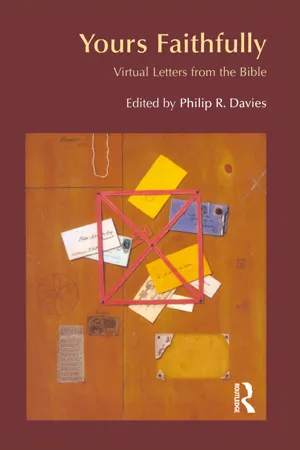
'Yours Faithfully' presents an anthology of virtual letters from the Bible, in which leading scholars imagine correspondence between biblical characters. Each letter conveys the insights that a given character might have and, together, the letters provide a rich sense of the concerns which propel and characters who inhabit the Bible. The letters are written in a range of styles - from the strictly historical to the very contemporary - and embrace the serious and the playful. The aim is to offer a commentary on familiar texts and events and to continue a long tradition of retelling stories from the Bible.
Information
Letter 1
SARAH TO ABRAHAM
(Genesis 11.26–23.2)
I really don’t know whether to laugh or cry today. I’ve shed so many tears since you nearly murdered my only son. (I sometimes think you forget that all I have is Isaac, while you have Ishmael as well.) I’ve just read the account you have sent me of that awful day on the mountain in Moriah – the high point of your life of obedience to El, you say. That leaves me stunned! I still don’t understand why you did it, and I know that Isaac has been damaged by this experience too. He never speaks of it, but I see a shadow in him, now, that was not there before; and to think that his name means ‘laughter’!
Last time I challenged you about this, you told me that you believed that El was testing you then, and that you needed to show him, once and for all, that you would trust him. You were so aware of your failures in the past to trust the god who called you, you said. That’s all very well, I said, but what about trusting me? Why sneak away with Isaac that morning, telling him that you were going to sacrifice together? And why, in heaven’s name, did you not share this word from El with me? Was not Isaac a blessing of El to me as much as you? Shouldn’t I have had a say in this show of trust? I don’t see any change of heart in your memoir.
Of course, I would never have agreed to it! And you know it. But did that give you the right to act alone? I still have nightmares – not about what might have happened, our son slaughtered and burnt on that altar, but what did happen: the way you calmly used him to carry the altar wood, then bound him alive like an animal for sacrifice, and then made to slash his throat.
That was when I decided I had to leave you – something else you miss out, making it look as if I died immediately afterwards. (In Hebron!)1 I couldn’t bear the feeling of betrayal. And now you send me this draft of your story of our life together as a peace offering – with a note saying you still love me and hope we can be together again.
Dear, dear Abe, you just don’t get it, do you? I come out of this badly in every way. Look back to the start of your story. You simply say that you ‘took’ me to be your wife, saying nothing at all about the way you wooed me. I didn’t fancy you at first – you already looked too old. But in truth you really loved me. Even when it turned out that I couldn’t conceive a child, you called me your ‘Beauty’. But here you just write ‘Sarai was barren’.
Then, thanks to Terah, you dragged me with your family away from our home in Ur. You said we were off to some fertile coastlands by the Great Sea, but, again because of your father, we stuck in the dull, northern town of Haran till he died. In that horrible place (it couldn’t compare for climate or culture with Ur) we eventually settled down, made some good friends and a good living, and grew middle-aged together. So what a blow when you suddenly had this urge – a call from Yahweh you now say – to move on to Canaan. I would have resisted more, but you insisted that we were at last going to settle down for good, in a fertile country.
Well, when we got there, there was a famine! We didn’t ‘settle down’ at all – we had to go on to Egypt. Maybe we would have died otherwise – but something died there anyway – and you know what I mean. I know that we had often joked about being half-brother and sister, and sometimes it even spiced up our lovemaking, but I never imagined you would actually give me to another man to save your own skin – or rather, to help you make a profit!
When the pharaoh suspected and he confronted me, I saved you from execution. Your account says nothing about this, nor your promise to me that it would never happen again. But, of course it did and I lied and said I was your sister. I guess if you’ve been forced into adultery once, the second time is easier. But thank heaven it didn’t come to that. Abimelech was a better man than you this time. So what a joke that your account records El saying to him in a dream that you were a prophet. I think that you have always been more interested in profiting than prophesying. You’re not attached to wealth, it is true, but wealth seems to attach itself to you. Whereas, as you know, I only care for Isaac. Sorry to be blunt, but your letter does ask for an honest assessment of your memories, and I appreciate that. But now that I am nearing death, I find myself living more and more in memories these days too. And not exactly the same memories as yours!
I’m not going to say anything about your memories of Lot. You know I found it hard to have him around all those years, and that I share your disappointment in him. You have been like a father to him. But you longed for your own son, and we agreed that you would have one with Hagar. I never realized what a disaster that would be. It simply tore open old wounds when Hagar began to look down on me. In return, I treated her badly, and much worse after Isaac was born. I wonder if your willingness to kill our son had anything to do with getting back at me for this?
I must end, because the caravan is leaving for Beersheba after lunch. But before I do, let me say something that intrigues me a lot. In the story of that terrible day, you switch from talking about El to Yahweh.2 As we have always worshipped the Most High, I find your new name for God rather confusing. Who is this Yahweh? The same god in different guises, as we might talk of El Elyon and El Shaddai, or a different one? There are times in your story when it seems that El and Yahweh have different characters and concerns. Are you suggesting that there on Moriah you heard the voice of another god – or discovered something new about our old one? Was it a new god who rescued Isaac?
Looking again through your story, I prefer the parts when you speak of Yahweh, not El. Yahweh gets me out of the pharoah’s bedroom, sends Lot away, cares for Hagar after I drove her away, and hears you when you plead for Lot’s safety in Sodom. Even when El promised us a son, it is Yahweh behind the mysterious visit of the three men, just before I conceived Isaac, the son of my laughter. When I think further about this, I wonder whether El tempted us at times to do things that were not for the best, like leading me to believe it was right to send Hagar and Ishmael out into the desert to die – and testing you to sacrifice Isaac.
When you come to revise this first draft, please think about what I have said. And tell me more about Yahweh. What does the name mean? It seems to me, looking back now, that not all that we heard from the mouth of the most high El was equally good and true. Perhaps this new god is a better one for you and your descendants?
Ah, dear Abe! Strangely, writing all this down has done me good. I feel the need to see you again, at least once more. Please come and visit me here soon, that we may talk more about your god, and give thanks for Isaac, the son of our laughter, as well as our tears.
Your beautiful princess,
Sarah
Sarah
Notes
1. The evidence for assuming that Abraham and Sarah were separated near the end of Sarah’s life comes from Gen. 22.19, which indicates that Abraham was living in Beersheba, and Gen. 23.2, which says that Sarah died at Kiriath-arba (Hebron), 25 miles to the north. Phyllis Trible writes, ‘Sarah died alone. Then Abraham went to her’ (Phyllis Trible, ‘Gen 22: The Sacrifice of Sarah’, in Alice Bach [ed.], Women in the Hebrew Bible: A Reader [London: Routledge, 1999], p. 287).
2. El or Elohim (both translated in the NRSV as God) is the name by which God or the gods would probably have been known by Abraham and Sarah, Isaac and Rebekah, Jacob, Leah and Rachel. According to the Pentateuch, the name Yahweh, (translated as ‘the LORD’), perhaps meaning ‘The one who is’, is first revealed to Moses (Exod. 3.15). Thus, the inclusion of Yahweh’s name at this time in the history of patriarchal religion is historically anachronistic. The letter seeks to make narrative sense of the use of both names in the canonical text, and to account for the way the narrator presents Elohim, (the creator God from Genesis 1) as a god who may ask Abraham to sacrifice Isaac, but the LORD, Yahweh, forbids this (see T. Desmond Alexander, Abraham in the Negev: A Source Critical Investigation of Genesis 20:1–22:19 [Carlisle: Paternoster Press], pp. 80–81, with reference to F. Delitzsch, A New Commentary on Genesis [Edinburgh: T. & T. Clark, 1988–89], II, pp. 90–91).
Letter 2
ISAAC TO ABRAHAM
(Genesis 22)
The last time we heard from Isaac was in his ‘Testament of Isaac’ (c. first century CE). That letter showed how he had absorbed the cultural obsessions of Jewish Egyptian and, later, Christian Coptic communities.1 This latest missive comes after a time lapse of two thousand years. This Isaac – clearly a fraud – has absorbed the skeptical, over-complicating literature so typical of the modern world. Unlike his namesake in the ‘Testament of Isaac’, he now refuses to submit himself to the ‘holy height’ of God and become ‘like the silver that is burned, smelted, purified in the fire’ (cf. Testament of Isaac 6.1–5; 8.3, 4). He represents the defiance of secular modernity, and the sad loss of the knowledge that God never actually allows the son to be harmed, and that the one who submits to God is saved.
In the interests of textual integrity we are publishing the letter in the form that it was passed to us. We are resisting the temptation to cut (sacrifice?) the more offensive parts to make it better. Readers are encouraged to consult our own careful annotations and footnotes. These are at least as important as the letter.
The Editors
Europe, December 2003
Europe, December 2003
Abraham,
I won’t, if you’ll excuse me, call you ‘Father’, or even ‘Dearest Father’, as Franz Kafka does in his love-hate epistle to his father. (I’ve been sitting here, pen poised for millennia, procrastinating by reading other letters from sons to fathers, and I have to say I find Kafka’s opening disingenuous in the extreme.) That word ‘Father’ is not a private one for us, you who are now for Every(monotheistic)Man generic father, Avraham Avinu, First Father, paternal origin, A-man, just as surely as Adam is The-First-Man-In-The-World. Once upon a time, long ago, in the childhood world before the ‘sacrifice’, I could call you ‘Father’ and you could reply to me, the one that God called your ‘only’, by saying ‘Hinneni beni; Here I am my son’. You were indeed physically ‘there’ for me then, but now you are everywhere and elsewhere. Indeed you were already rather elsewhere and, in that competition of ‘Hinnenis’, rather more ‘here’ for God than for me.2 So if I call you ‘Father’ now, in this post-Akedah world, how will you know that it’s me who is speaking?
Instead I’ll call you Abraham, that name that seems to suit you so much better, containing both your first name, Av-ram, ‘Exalted father’, ‘Very High Father’, and its extension – by a syllable and a universe – to ‘Abraham, father of multitudes’. That’s what that very high scene on the mountaintop was about, wasn’t it, Avram-Avraham? Making your high paternal name higher and also, more importantly, broader, potentially universal. It was about turning your name into an abstract noun, the ‘Abrahamic’, and setting it up as a vast canopy across the monotheistic skies. It was also about jeopardizing, risking, pruning and cutting the family tree as it was just beginning to sprout to make it ‘extremely fruitful’ [Gen. 17.6 – editorial note]. It was about sacrificing the one for the many, giving up the ‘only’, the favoured or most beloved (the yahīd, agapētos) in order to create a universe of sons as numerous as the stars.
As a result of that ‘sacrifice’ (which, as we and all the monotheisms know, is the climatic/mountaintop moment in the great Abrahamic saga) you became greater and I became lesser. You became more solid and I became more ghost-like, though we both know I wasn’t actually killed.3 You became the basis of existence, something solid, permanent, massive – a mighty noun: the Abrahamic, father of worlds of words, rituals, practices. And I became – what? The opposite? The intangible? Clearly I’m not constructed of the kind of solid, generalizable, stretchable stuff that can be made into synagogues, mosques, churches and nouns. You can’t turn me into something like the ‘Isaacamic’ or the ‘Isaacianic’. Any generalization of me sounds so absurd that it’ll make you laugh…
The difference between us seemed to be programmed into our names from the beginning: you, Very High Father, Father of Multitudes, Big Daddy, eternal ‘is’, paternal base note at the bottom of being, preceded only by the Christians’ Jesus who allegedly ‘was’ before you (Jn 8.58). You: beginning of the Word, Alpha-Abraham, active Father-Maker who, through obedience, co-creates with God the monotheistic worlds. Me: the fragile, precarious, absurd, untenable, laugh thing – the thing constantly threatened with becoming a no-thing. There’s something bizarrely appropriate about the way I emerge from a ninety year-old womb like a divinely-provoked belly laugh, only to then be put underneath the knife and dangled in the fire.4
The ‘I’ of Isaac, now I think about it, was never really a proper ‘I’ but was always somehow outside itself, bound up with laughter. My story happened to me, it was outside me, just as other people and other things make you laugh. The ‘I’ of Isaac was always like a reflex, a re-action, like the kick when someone hits your knee5 or the laugh that comes spontaneously when someone tickles you. It was also always somehow beyond itself, leaping over ‘me’ into the future and the promise. As Johannes de Silentio, a.k.a. Søren Kierkegaard, says, my ‘I’ means Beyond-Isaac, More-than-Isaac, After-Isaac. It means the world and future compressed in the seed in ‘Isaac’s loins’.6 Erich Auerbach understands this: he describes me as a vast white space – the acme of wordlessness in this most wordless of texts. The metaphor he uses suggests he sees me as a kind of ectoplasmic no-thing, from whom adjectives slide off the surface because there’s nothing solid, nothing (present, active) there. And actually, this German Jew in exile seems to be rather creeped out by this, as if there’s something just a little fascist about the way in which people are reduced to servants and tools of God in our text. For him I’m like one of those victims of oppressive regimes that they call the disappeared – in a sense.7
And I say nothing: even as you stand over me, bound and trussed up like an animal (when I have surely worked out that this is no normal fatherson-bonding-day-out or fishing trip) I say nothing. I do not scream, squeak or whimper. The lack of words or even sub-articulate noise of Isaac is unbelievable, incredible, unbearable – even Luther the great believer couldn’t believe or bear it, and castigated ‘Moses’ for having left the sounds of Isaac out.8 (But then the purpose of my ‘I’, I am coming to believe, is to stretch the limits of believability and credulity to the point of scepticism, recoil, even laughter. I’ll explain this a bit more later, Abraham). And then, when you and your two servants return, I’ve already disappeared. It’s as if I’ve become an anxious ‘Where is he?’ by way of counterpart to your solid ‘There/here he is’ or ‘There/here I am’.
From that knife-edge moment on, you expanded and I contracted to the point of virtual invisibility. First I was the blind spot within the orb of Genesis’ great all-seeing eye (it’s hard to find me in the great sacrificial vision) and then I went blind. I shrank to the tiny human conjunction in ABRAHAM and Isaac and JACOB. My ‘I’ turned on its side to connect you and Jacob as if ‘I’ were a mere hyphen, or the tiniest piece of that curious male umbilical cord that strings the Genesis genealogies together. I hardly appear in the rest of Genesis and when I do it’s by way of dimeyed, dim, reflection of you – a deflat...
Table of contents
- Cover
- Half Title
- Title Page
- Copyright Page
- Table of Contents
- INTRODUCTION: IN PRAISE OF VIRTUAL LETTERS
- 1. Sarah to Abraham
- 2. Isaac to Abraham
- 3. Sarah to Rebekah
- 4. Pharaoh Ramses to Moses
- 5. Aaron to Miriam
- 6. Jephthah’s Daughter to her Father
- 7. Samson to Delilah
- 8. Shmuel ben Elkanah to Achish
- 9. Absalom to David
- 10. Salu Father of Zimri to Zur Father of Cozbi
- 11. Ahitophel to Absalom
- 12. Ahitophel to Eliam, his Son
- 13. King Ahab to his Steward Obadiah
- 14. King Ahab to the Writers of the Books of Kings
- 15. Athaliah to Elijah the Tishbite
- 16. The Big Fish to Jonah
- 17. Nineveh to Judah
- 18. Jeremiah to Ezekiel
- 19. Between Zedekiah and Jeremiah
- 20. Haggai to Zechariah
- 21. Zechariah to Haggai
- 22. Esther to her Mother
- 23. John the Baptizer to Jesus
- 24. Jesus to his Mother
- 25. Judas Iscariot to James; James to his Family
- 26. From a Greek Woman of Tyre to Jairus of Galilee
- 27. Pilate’s Wife to her Husband
- 28. Publius Philostratus to an Author
- 29. Onesimus to Paul
- 30. ‘Jezebel’ of Thyatira to John of Patmos
- 31. Letter to Bible Authors [Draft]
- List of Authors
Trusted by 375,005 students
Access to over 1.5 million titles for a fair monthly price.
Study more efficiently using our study tools.
Frequently asked questions
Yes, you can cancel anytime from the Subscription tab in your account settings on the Perlego website. Your subscription will stay active until the end of your current billing period. Learn how to cancel your subscription
No, books cannot be downloaded as external files, such as PDFs, for use outside of Perlego. However, you can download books within the Perlego app for offline reading on mobile or tablet. Learn how to download books offline
Perlego offers two plans: Essential and Complete
- Essential is ideal for learners and professionals who enjoy exploring a wide range of subjects. Access the Essential Library with 800,000+ trusted titles and best-sellers across business, personal growth, and the humanities. Includes unlimited reading time and Standard Read Aloud voice.
- Complete: Perfect for advanced learners and researchers needing full, unrestricted access. Unlock 1.5M+ books across hundreds of subjects, including academic and specialized titles. The Complete Plan also includes advanced features like Premium Read Aloud and Research Assistant.
We are an online textbook subscription service, where you can get access to an entire online library for less than the price of a single book per month. With over 1.5 million books across 990+ topics, we’ve got you covered! Learn about our mission
Look out for the read-aloud symbol on your next book to see if you can listen to it. The read-aloud tool reads text aloud for you, highlighting the text as it is being read. You can pause it, speed it up and slow it down. Learn more about Read Aloud
Yes! You can use the Perlego app on both iOS and Android devices to read anytime, anywhere — even offline. Perfect for commutes or when you’re on the go.
Please note we cannot support devices running on iOS 13 and Android 7 or earlier. Learn more about using the app
Please note we cannot support devices running on iOS 13 and Android 7 or earlier. Learn more about using the app
Yes, you can access Yours Faithfully by Philip R. Davies in PDF and/or ePUB format, as well as other popular books in Theology & Religion & Biblical Commentary. We have over 1.5 million books available in our catalogue for you to explore.