Asian transportation systems and services, as well as their usage, are fraught with challenges. This handbook therefore seeks to examine the possible solutions to the problems faced by the region. It illustrates the history of transportation development in Asia and provides a comprehensive overview of research on urban and intercity transport. Presenting an extensive literature review and detailed summaries of the major findings and methodologies, this book also offers suggestions for future research activities from top-level international researchers.
Written from an interdisciplinary perspective, the topics covered include:
Transportation systems across Asia;
Traffic accidents;
Air pollution;
Land use and logistics;
Transport governance.
Considering the population and economic development scale, as well as the diverse cultures of Asia, the Routledge Handbook of Transport in Asia will be a valuable resource for students and scholars of transportation, Asian development and Asian Studies in general.
Transportation takes place in response to various needs in life at the micro level and economic activities at the macro level, regardless of location: Asia, Africa, America, or Europe. Nevertheless, this handbook focuses on Asia. Considering the population and economic development scale of Asia, this focus also has important implications for transportation development in other parts of the world.
Even though there are various issues in cities (e.g., a lack of fresh air and water, monotone and heartless streetscapes, unhealthy human relationships because of the gift principle, collapse of communities owing to a lack of attachment), many people still think that living/working in cities is better than living/working in rural areas. It is true that people working in cities can typically earn more money than those in rural areas; however, having more money does not necessarily make people happier and/or more satisfied with their lives because people who have more money usually have higher expectations for their lives than others. Nevertheless, the concentration of population in cities has not seen any sign of stopping. As long as people believe in the future of cities, they will continue to grow and impose increasing burdens on transportation systems.
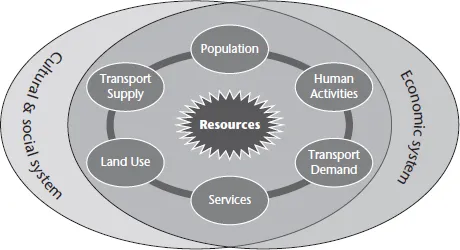
Transportation systems exist for cultural–social and economic systems (Figure 1.1). Therefore, solutions to transportation issues require efforts from these perspectives. If population size is a key factor to resolve the current traffic problems, then it should be part of the policy agenda regarding how to encourage more people to move from large-sized cities to small/medium-sized cities or rural areas. If transporting goods across a long distance causes serious energy and environmental issues, it should be logical policy to encourage more people to purchase goods produced in local areas. If excessive car dependence, as a kind of lifestyle, is the most crucial factor in determining current traffic problems, pricing-based measures should be taken, no matter how strong the objections from car users and automakers. If mobility issues among the elderly cannot be resolved at the community level, more policies and investments should focus on traditional family-based caring systems, i.e., allowing more people to take care of their parents at home. Transportation supply and demand are associated with populations, human activities, land use, and services, where two-way relationships may be applicable to any pair of these elements over a long period. All of these further consume various natural and man-made resources, resulting in environmental emissions and damage to the ecosystem. Thus, transportation issues are closely related to resource issues.
Figure 1.1 Transportation systems
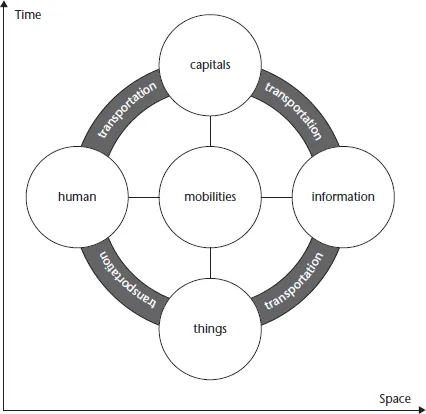
However, the supply of transportation systems has limitations because of limited urban spaces, natural resources, and financial capital, etc. In this sense, policy makers need to have a better understanding of transportation demand for meeting the supply capacity. Generally speaking, transportation is part of the concept of mobility (Urry, 2000; Leary, 2014). However, transportation researchers have narrowly treated the concept of mobility as the ability of the individual to travel (e.g., Chikaraishi, 2017). Fortunately, in recent years, a clear shift of this concept to indicate changes in life domains (including travel behavior) (e.g., Zhang, 2014; Scheiner, 2017) or more general movement of not only people, but also things, information, and ideas, has been observed (e.g., Urry, 2000). The journal Mobilities,1 founded in 2006, defines mobility as “the large-scale movements of people, objects, capital, and information across the world, as well as more local processes of daily transportation, movement through public and private space and the travel of material objects in everyday life.” Figure 1.2 conceptually presents the general scope of mobilities across space and over time, where transportation connects all four major mobility domains. Usually, transportation takes place to perform some human activities, and it needs the support of information (e.g., travel and destination information), capital (e.g., expenditure on transportation and relevant activities), and/or things (e.g., travel modes and transportation facilities).2 On the other hand, the search for activity information (i.e., information mobility) may lead to the generation of transportation. Purchasing behavior (i.e., capital mobility) on the Internet is accompanied by the transportation of purchased goods (i.e., the mobility of things). Thus, mobility is an extremely important keyword that will forecast the future of humans. Transportation issues should be understood within such a framework.
1.2 Challenges in transportation development in Asia
1.2.1 Urbanization
Currently, urbanization is growing very rapidly. It took 100 years to increase from one billion people in the early industrial revolution to two billion people in 1900; however, it took only 12 years to grow to six billion people in 1999 from five billion people in 1987. The United Nations (UN) predicts that the global urbanization rate will reach 60% by 2030, and the increase in the urban population in Asia is considered to be the main factor. Currently, Asia accounts for more than half of the world population, and the economic growth rate in Asia is the highest in the world. Even though the urbanization rate in Asia is still low, at around 40%, the total urban population in Asia is larger than that in any other region in the world. Considering the progress of globalization, urbanization in Asia may be affected to some extent; however, McKinnon (2011) noted that urbanization cannot always be assumed a by-product of globalization, even in Asia (p. 40). Nevertheless, more and more megacities (population of ten million or more) have been born in Asia. Around the world,3 as of 2016, there were 31 megacities, 17 of which are in Asia (11 in China and India). How about in 2030? There are expected to be 41 megacities around the world, 23 of which will be in Asia (UN, 2016). In some Asian countries, the over-concentration of the population in megacities such as Bangkok in Thailand, Dhaka in Bangladesh, Manila in the Philippines, Seoul in South Korea, and Tokyo in Japan is remarkable. Many of these megacities have grown to be globally influential cities. Gugler (2004) and UN-Habitat (2013) summarized the states of global cities. However, in Japan, it is predicted that almost half of the municipalities will face a sharp population decline, and, as a result, are highly likely to disappear in the future (Masuda, 2014). One reason behind such a trend is the over-concentration of the population in Tokyo, Osaka, and Nagoya (housing around half of the nation’s population); other reasons include the aging population, declining birthrate, and so on. It is not unrealistic to assume that there will be more and more cities at risk of vanishing in the future in developing countries in Asia.
Figure 1.2 Mobility systems
1.2.2 A continuing car-dependent trend
As stated by Hansen and Nielsen (2016), the private automobile is a core driver of economic development and social transformation in Asia. Some developed countries have observed a decreasing trend of car ownership among young people (e.g., Metz, 2010; Davis, Dutzik and Baxandall, 2012; Goodwin and Van Dender, 2013; Kuhnimhof et al., 2012; Kuhnimhof, Zumkeller and Chlond, 2013). Using national expenditure data from Japan, Zhang et al. (2016) found that low- and high-income young people increased their car ownership from 1984 to 1999 for the first time, but this declined dramatically from 1999 to 2004 (–7.8 points, from 50.5% to 42.7% for the low-income group, and –10.3 points, from 75.2% to 64.9% for the high-income group), compared with the drops from 2004 to 2009. An increasing trend can be observed with respect to middle-income young people (aged 18–34 years), but the trend from 1994 to 2009 is not significant. Such a decline can also be observed with respect to car usage. Concretely speaking, low-income young people’s expenditures on car use decreased from 5.7% in 1994 to 3.9% in 2009, the middle-income group from 8.2% in 1994 to 6.4% in 2009, and the high-income group from 9.8% in 2004 to 5.2% in 2009. Overall, the decrease in car ownership is higher than that of car usage. To date, vehicle ownership in Asia has not shown any sign of decline as a whole in the sense that the sales of automobile vehicles increased almost fivefold between 2005 and 2016, leading to ever-increasing road traffic and, consequently, traffic congestion (Jiang and Zhang, 2017). Vehicle ownership per 1,000 inhabitants in Asian countries in 2015 was 609 vehicles in Japan (ranked 7th in the world), 228 in Thailand, 118 in China, 87 in Indonesia, 38 in the Philippines, 23 in Vietnam, and 22 in India.4 Even though Japan has one of the world’s most efficient public transit networks, its vehicle ownership is still very high.5 In China and India, even though the ownership level is still low, the absolute number of vehicles is extremely high, causing serious traffic problems (congestion, accidents, air pollution, etc.) throughout most of the day.
1.2.3 Problematic development issues
Currently, unbalanced within-country development in Asia is serious in the sense that investments and policy resources have been concentrated in megacities and their surrounding areas. Various issues caused by such unbalanced development have been observed, even in Japan. According to Hirschman (1969), growth need not take place in a balanced way, and unequal development in various sectors often generates conditions for rapid development. However, the unbalanced development in Asia does not seem healthy. The over-concentration of investment in megacities and their surrounding areas has encouraged more and more people to out-migrate from local cities, causing the decline of local economies and resulting social issues.
As stated in subsection 1.2.1, urbanization in Asia is remarkable. However, urban space is limited. In order to effectively utilize such limited space, it is important to take care of land use in a systematic way by considering various urban functions. However, especially in developing countries, economic development has to be prioritized, and as a result, urban development is often done in an unplanned manner. Typical problems of unplanned development include ignorance of transportation accessibility and the of unplanned development include ignorance of transportation accessibility and the roles of public space, as well as endless urban sprawl and excessive dependence on cars. In addition, the inequality of urban development can be observed in terms of the residential distributions of poor and wealthy people. Even worse, transportation and urban infrastructure within the residential areas of the poor is much worse compared with those of the wealthy. Such inequality can also be observed with respect to air pollution and road traffic congestion caused by car users, in the sense that non-car users (e.g., children, pedestrians, and cyclists) have to suffer from air pollution and congestion. Furthermore, the construction of trunk roads often isolates some previously connected neighborhoods from each other, significantly lowering social contacts between local residents. Thus, transportation developments involve social problems.
1.2.4 Disexternalities of transportation development
In ancient times, civilization sought a way of life that could coexist with nature; however, modern civilization challenges and even seeks to conquer it. Cities can be likened to parasites living in the earth that absorb nutrients and energy as greedy consumers, leading to the excessive use of natural resources. Cities further act as merciless polluters/destroyers, causing air/soil/water pollution, global warming, traffic accidents and crime in both developed and developing countries. Cities currently consume three-quarters of the world’s energy and cause at least three-quarters of global pollution.6 Transportation development all over the world has brought prosperity to many people, but it has relied heavily on the excessive use of valuable natural resources. These disexternalities should be internalized in a rational way. Unfortunately, in most of the developing countries in Asia, many people are still suffering from these disexternalities in terms of unequal income, a decline in health-related quality of life (especially diseases caused by air pollution and fatalities and injuries related to traff...
Table of contents
Cover
Half-title Page
Title Page
Copyright
Contents
Figures
Tables
Boxes
1 Introduction
I Transportation systems
II Traffic accidents, air pollution and disasters
5 Railway accidents
6 Maritime accidents
7 Air pollution and transport in China and India
8 Transportation in disasters
III Social exclusion
IV Land use
V Logistics
VI Governance
Index
Trusted by 375,005 students
Access to over 1.5 million titles for a fair monthly price.
Study more efficiently using our study tools.
Frequently asked questions
Yes, you can cancel anytime from the Subscription tab in your account settings on the Perlego website. Your subscription will stay active until the end of your current billing period. Learn how to cancel your subscription
No, books cannot be downloaded as external files, such as PDFs, for use outside of Perlego. However, you can download books within the Perlego app for offline reading on mobile or tablet. Learn how to download books offline
Perlego offers two plans: Essential and Complete
Essential is ideal for learners and professionals who enjoy exploring a wide range of subjects. Access the Essential Library with 800,000+ trusted titles and best-sellers across business, personal growth, and the humanities. Includes unlimited reading time and Standard Read Aloud voice.
Complete: Perfect for advanced learners and researchers needing full, unrestricted access. Unlock 1.5M+ books across hundreds of subjects, including academic and specialized titles. The Complete Plan also includes advanced features like Premium Read Aloud and Research Assistant.
Both plans are available with monthly, semester, or annual billing cycles.
We are an online textbook subscription service, where you can get access to an entire online library for less than the price of a single book per month. With over 1.5 million books across 990+ topics, we’ve got you covered! Learn about our mission
Look out for the read-aloud symbol on your next book to see if you can listen to it. The read-aloud tool reads text aloud for you, highlighting the text as it is being read. You can pause it, speed it up and slow it down. Learn more about Read Aloud
Yes! You can use the Perlego app on both iOS and Android devices to read anytime, anywhere — even offline. Perfect for commutes or when you’re on the go. Please note we cannot support devices running on iOS 13 and Android 7 or earlier. Learn more about using the app
Yes, you can access Routledge Handbook of Transport in Asia by Junyi Zhang, Cheng-Min Feng, Junyi Zhang,Cheng-Min Feng in PDF and/or ePUB format, as well as other popular books in Technology & Engineering & Urban Planning & Landscaping. We have over 1.5 million books available in our catalogue for you to explore.