Strategic Management and Business Analysis
eBook - ePub

Strategic Management and Business Analysis

  1. 298 pages
  2. English
  3. ePUB (mobile friendly)
  4. Available on iOS & Android
eBook - ePub

Strategic Management and Business Analysis

About this book

How can managers analyze their current and future business strategies? This textbook introduces the fields of business analysis and strategic management to provide students with an understanding of the key questions that need to be asked to understand an organization's options.

The second part of the book provides tools and techniques to help organize and improve corporate strategy. Uniquely, the authors provide resources to assess aspects of strategic goals which are sometimes overlooked such as financial performance, ethical and environmental considerations and business models. They cover a diverse range of companies from Supermarkets like Aldi and Tesco to Caermory Whiskey and Chinese manufacturing.

This textbook is perfect reading for students who want to apply strategic thinking to organizations and benefits from the inclusion of new case studies throughout the text as well as 10 extended cases in a separate section.


Frequently asked questions

Yes, you can cancel anytime from the Subscription tab in your account settings on the Perlego website. Your subscription will stay active until the end of your current billing period. Learn how to cancel your subscription.
No, books cannot be downloaded as external files, such as PDFs, for use outside of Perlego. However, you can download books within the Perlego app for offline reading on mobile or tablet. Learn more here.
Perlego offers two plans: Essential and Complete
  • Essential is ideal for learners and professionals who enjoy exploring a wide range of subjects. Access the Essential Library with 800,000+ trusted titles and best-sellers across business, personal growth, and the humanities. Includes unlimited reading time and Standard Read Aloud voice.
  • Complete: Perfect for advanced learners and researchers needing full, unrestricted access. Unlock 1.4M+ books across hundreds of subjects, including academic and specialized titles. The Complete Plan also includes advanced features like Premium Read Aloud and Research Assistant.
Both plans are available with monthly, semester, or annual billing cycles.
We are an online textbook subscription service, where you can get access to an entire online library for less than the price of a single book per month. With over 1 million books across 1000+ topics, we’ve got you covered! Learn more here.
Look out for the read-aloud symbol on your next book to see if you can listen to it. The read-aloud tool reads text aloud for you, highlighting the text as it is being read. You can pause it, speed it up and slow it down. Learn more here.
Yes! You can use the Perlego app on both iOS or Android devices to read anytime, anywhere — even offline. Perfect for commutes or when you’re on the go.
Please note we cannot support devices running on iOS 13 and Android 7 or earlier. Learn more about using the app.
Yes, you can access Strategic Management and Business Analysis by Wyn Jenkins,Dave Williamson in PDF and/or ePUB format, as well as other popular books in Business & Business General. We have over one million books available in our catalogue for you to explore.

Information

Publisher
Routledge
Year
2015
Print ISBN
9781138817647
eBook ISBN
9781317595670

Part I The four big questions you need to ask

The big questions in strategic management
Strategic management is concerned with shaping the destiny of an organisation. It is about:
  • Putting an organisation into an optimum business position.
  • Sustaining and improving that position by the deployment and acquisition of appropriate resources and by monitoring and responding to environmental changes.
  • Monitoring and responding to the demands of key stakeholders.
For organisational strategists to achieve these aims they must be able to answer the following questions:
  1. Where is the organisation now?
  2. What options are open to the organisation?
  3. What is the best way forward for the organisation?
  4. How is this to be achieved?
Our framework is based around these questions, and the better the answers to these questions the better the chance of developing and implementing winning strategies. However, answering these questions can be very difficult and the questions have therefore been broken down into their component parts to make the process more manageable.
Guidance note 1.0
We are not trying to suggest that effective strategic management can be achieved by using frameworks and models blindly – we are suggesting that strategic models are useful practical tools when employed by managers and students who understand the limitations of the models, the limitations of the data available and the theory dependency of data collection. Our experience indicates that the appropriate and questioning use of models is an effective vehicle for learners, full-time students and practising managers to gain insights into strategic management problems and processes. We believe that it is important to always remember that models are imperfect representations of complex realities, which should be used to aid thinking not as a substitute for it. Our aim is to develop the knowledge and skills that will allow potential and current managers to participate in the development of organisational strategy.

The first big question: where is the organisation now?

DOI: 10.4324/9781315745565-1

1.1 Introduction

It is logical to answer this question at two distinct organisational levels:
  1. The corporate level or multi-strategic business unit (SBU) level.
  2. The single business or SBU level.

Guidance note 1.1

A strategic business unit (SBU) can be defined as a unit that produces products or services for which there is an identifiable group of customers. Divisions or units of organisations are frequently defined on this basis, for example an adhesive company will have an automotive division, a packaging division and a DIY division, and a university will have different faculties and/or schools. Units can also be defined geographically (for example Australian and European divisions). In some organisations divisions are defined both by product group and geographical location (for example Australian Automotive Division). The corporate centre normally allows the divisions to operate with varying degrees of operational and strategic autonomy within an overall centrally controlled framework. Organisation structures and centre-division relationships are discussed in Chapter 5.
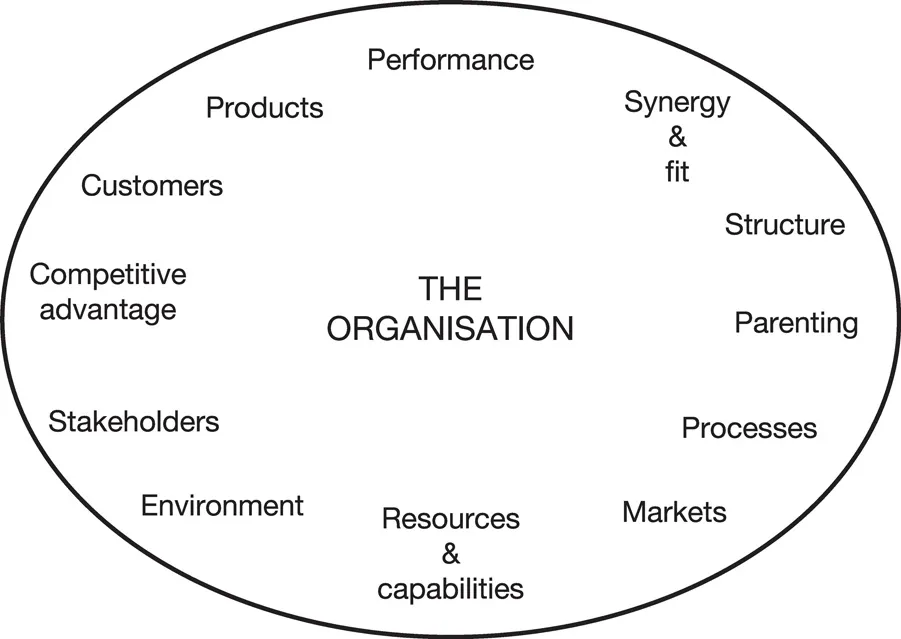
Figure 1.1 outlines the basic corporate model. In multi-business organisations, each business unit can be judged in terms of its own performance, and how that performance contributes to the performance of the total corporate organisation. Within the corporate whole, individual businesses have to be managed and business strategies pursued. The overall corporate strategy and the strategies of sister businesses will influence the strategy of an individual business. Figure 1.2 provides an overview of the major variables that have to be considered when trying to understand the strategies of an organisation.
Figure 1.1 Corporate strategy and business strategies
Figure 1.2 Understanding strategy in organisations

1.2 The analytical process

To understand a complex corporate (multi-divisional) organisation we have to have a process that considers the whole as an entity, and as the sum of its parts. Equally, a business unit or individual company cannot be understood without considering its wider environment and linkages, including linkages arising from its ownership structure because this influences both its management style and its access to resources. Because corporate- and business-level analyses are interwoven we use an algorithm that helps the reader to ask key questions about the businesses being studied in the context of their ownership relationships.
When using the algorithm we recommend that you:
  • Move backwards and forwards within the procedure until the assessment of the data leads to a natural conclusion (see Figure 1.3).
    Figure 1.3 The iterative nature of strategic analysis
  • Recognise that the data you are analysing may be limited.
  • In light of the inherent limitations of the analysis, arrive at your conclusions with care.
  • Be prepared to argue for your conclusions from the available evidence, remembering that managers have to operate in situations of incomplete knowledge.
The analytical process is divided into three related parts:
  1. Preliminary corporate analysis
  2. The analysis of business units
  3. Summative corporate analysis
The complete algorithm is presented in Figure 1.3. The questions posed in each of the three parts of the algorithm are then presented in the remainder of this section to allow the reader to obtain an overview of the analytical process.
Each question in the model is discussed in more detail in Sections 1.3–1.5. In Chapters 5 to 11 the theories and models suggested are evaluated in greater detail.

1.2.1 Preliminary corporate analysis algorithm

  • What products and markets does this organisation supply/serve? What are its business units?
  • What is the formal structure of this organisation?
  • What are the financial and business results of each business? What is the contribution of each business to the overall financial performance of the whole?
  • What is the product market mission of each business? Is the business an industry leader or follower? How do they fit together?
  • Who are the major stakeholders in the organisation? What are the issues that are important to these stakeholders?
Now conduct an analysis of each business.

1.2.2 Individual business analysis algorithm

  • Who are the consumers of the unit’s goods and services?
  • Why do its customers choose this business unit’s products? What need is being met? What are the key success factors in this market? Do the organisation’s managers have a clear idea of these key success factors? What measures are considered important? Why?
  • What are the trends in key results indicators for this business? Are these measures available?
  • What are the characteristics of the organisation’s environment? What are the factors that exist outside the business unit that impact on its ability to provide goods and services? What is likely to change and what is likely to remain the same? Are there new business models that will challenge the now established order?
  • What are the resources (see Guidance note 1.2) within and around the organisation that have allowed the organisation to provide products that customers will buy? To what extent can the business results be explained by an understanding of an organisation’s resources? What is the business model used by the organisation? Does the organisation actively encourage dynamic capability development? Are resources being used to develop future resources?
  • What is the dominant logic/organisation paradigm that guides this business’s decision making and contributes to the way strategy develops? To what extent does the organisation configure its resources and systems that help it prepare for the future? Do the business’s key players have a coherent vision of what they want the business to be in the medium and long term? Are this business’s ambitions a coherent part of the vision for the corporate whole? Does the organisation have systems and a culture that allows it to exploit developments in its environment?
  • What is this business’s articulated view with regard to corporate social responsibility (CSR)? How does the reality of this behaviour reflect this articulation?
  • What are the strengths and weaknesses of the business?
  • What are the opportunities and threats that exist for this business?
  • What is the strategic position of this business from a market-based perspective and a capability perspective? What are its immediate and long-term prospects? Is there evidence that this organisation can sustain...

Table of contents

  1. Cover Page
  2. Half Title Page
  3. Title Page
  4. Copyright Page
  5. Contents
  6. List of illustrations
  7. Introduction
  8. Acknowledgements
  9. PART I The four big questions you need to ask
  10. PART II Helping you answer the four big questions
  11. PART III Case studies
  12. Index