eBook - ePub
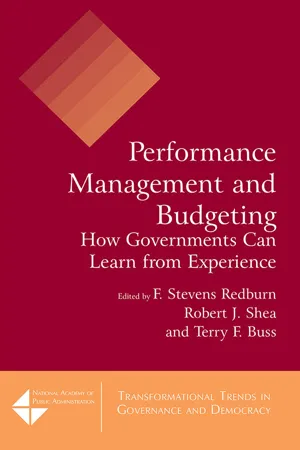
Performance Management and Budgeting
How Governments Can Learn from Experience
- 368 pages
- English
- ePUB (mobile friendly)
- Available on iOS & Android
eBook - ePub
Performance Management and Budgeting
How Governments Can Learn from Experience
About this book
This book provides a fresh look at the process by which governments hold themselves accountable to their citizens for performance. Unlike the plethora of other books in the field, it examines all aspects of the Performance Management and Budgeting issue, not only from the federal, state, and local perspectives, but also internationally in both developing and developed countries.Covering both conceptual and theoretical frameworks in performance management and budget, the book analyzes the effectiveness of different approaches. Featuring insights from a group of distinguished contributors, it ties current performance management approaches into the century-old literature on public sector reform and management, and presents arguments for and against performance management as well as recommendations on how to improve the enterprise.
Information
1
Performance-Based Management
How Governments Can Learn from Experience
F. STEVENS REDBURN, ROBERT J. SHEA, TERRY F. BUSS, AND EDNILSON QUINTANILLA
This volume is about the process by which governments hold themselves accountable to their citizens for performance. Or, it is about the development of institutions that allow governments to learn from experience.
Accountability for Results
From one viewpoint, the effort to plan, budget, and manage government programs based on explicit performance goals and measures is an effort to make government more accountable to its citizens for achieving promised results. In this view, good government—a government responsible to the people—must have as its core purpose the achievement of results for the people, taxpayers, whose money it uses. Taxpayers expect government to offer programs that will provide basic services that improve their lives. They also want their money spent wisely, effectively, and efficiently. They will at some point hold the government accountable for results.
To properly hold governments accountable, however, taxpayers need clear, candid, easily accessible, and up-to-date information about agency and program successes and failures. The Bush administration, for example, has attempted to improve the federal government’s accountability by making more and more budget decisions based on performance. The president’s Budget and Performance Integration (BPI) Initiative1 is an effort to ensure that dollars produce the best results by helping decision-makers and the public identify which programs work well, which are deficient, and what can be done to improve their performance. In some cases, it may be necessary to reallocate funding to more effective programs. This and other decisions about programs are ultimately made jointly by Congress and the president, but the analysis of program performance can help the executive and legislative branches make more informed decisions. To broaden and inform citizen participation in these choices, federal agency and OMB career staff prepare formal assessments of each program’s performance that are made public and accessible.
Similar systems of performance and accountability are becoming the norm in governments at the state and local levels, not to mention in developed and developing countries around the globe. Consider this: A web search on Google for “performance budgeting” yields 340,000 sites, for “performance management,” 31,600,000 sites.
Learning from Experience
From another viewpoint, use of performance goals and information as a basis for public choice and program administration is an effort to enable government to learn from experience. Just as people individually and collectively learn from experience, so—it is argued—governments can improve their performance over time not by simple trial and error, but by systematically analyzing what works and what does not and translating this information into decisions about where to put their resources, how to manage, and how to improve program designs. Unlike people, however, governments do not necessarily possess the capacity to readily learn from their previous successes and failures. This capacity has to be consciously created. Some would argue that the effort to institutionalize government capacity to learn from experience is still in its infancy, and that failures merely highlight the need to get on with building this capacity.
Whether BPI, or its counterparts in other governments, are viewed as efforts to improve accountability or to create a capacity to learn from experience, results of this and other efforts can be measured in two principal ways:
• Improved program performance: Through the use of performance assessments, programs will have the information they need to improve their performance every year. The initiative requires each agency to identify opportunities to improve program management and design, and then to develop and implement clear, aggressive plans to get more for tax dollars every year.
• Greater investment in successful programs: Overall, scarce resources need to be allocated to programs that benefit the nation most effectively and efficiently. Program performance will not be the only factor in decisions about how much funding programs receive. However, policymakers equipped with information about program performance can consider performance to a greater degree in their decision making and invest primarily in programs that provide the greatest return on the investment of taxpayer dollars. If poorly performing programs are unable to demonstrate improved results, then that investment may be reallocated to programs that can demonstrate greater success.
The success of BPI and similar efforts can be judged over time by whether programs are becoming more efficient and more effective through implementation of meaningful improvement plans guided by assessment and evaluation and by whether budgets shift resources from unproductive programs to those that produce results consistent with their goals.
Many programs are demonstrating improved results. For example:
• In FY2005, the Social Security Administration improved the efficiency with which it processed claims by 2.7 percent. The gain in overall agency productivity meant that the SSA needed 2,155 fewer work years to complete its job. With each work year estimated to cost $73,700, this improvement in efficiency represented savings of approximately $159 million.
• In FY2005, the Arizona state legislature was on the verge of eliminating a $10.8-million drug treatment program that supplies psychotropic drugs to the seriously mentally ill. But the drug treatment program demonstrated not only that its 9,000 participants were benefiting from drug therapy, but also that the state was saving money by providing drugs to people who otherwise tended to end up in jail or hospitals. The legislature refunded the program.
• In FY2005, Mayor Michael Bloomberg ordered a review of New York City’s tax incentive programs. Each program had to demonstrate—using outside consultants and researchers—that programs’ results were significant enough to justify continued funding. In addition, programs would have to align themselves with the city’s strategic plan.
How BPI Works
To many, the Bush administration’s performance management and budgeting initiative is among the most sophisticated efforts in the field—although, as chapters 2 through 6 demonstrate, there is no shortage of ways to improve or reengineer it. In 2007, in its fifth year, it was also developing a track record against which to evaluate its effectiveness as a management tool. We focus this book on various aspects of BPI, including:
• Assessing performance with the Program Assessment Rating Tool (PART);
• Publishing a scorecard to hold agencies accountable for managing for results, addressing PART findings, and implementing follow-up actions;
• Communicating results to the public on ExpectMore.gov; and
• Coordinating program improvement through interagency collaboration.
We also include work from U.S. state and local government, and developed and developing countries, many of which have adopted some or all of these BPI techniques, have contributed to their further development and shaped them to their needs through their own efforts, or have taken very different approaches that can inform performance management and budgeting. We turn now to the central feature of BPI, the PART.
Comprehensive Assessment with the PART
How do we ensure that programs are improving every year? First, we assess their current performance. In order to improve program outcomes, it is critical to have a good understanding of how the program is currently performing. By 2007, the Bush administration had assessed the performance of 976 programs with the PART, representing 96 percent of the federal budget, or $2.5 trillion in spending.2 As of March 2007:
• 17 percent of programs were rated effective
• 30 percent of programs were rated moderately effective
• 28 percent of programs were rated adequate
• 3 percent of programs were rated ineffective
• 22 percent of programs were rated results not demonstrated.
Note: in several contributions—chapters 2 to 6—to this volume, PART results from previous rating cycles are cited. A notation in each of those instances refers the reader to these results, the most recent at the time of publication. This information is also updated regularly on www.ExpectMore.gov, a public website designed to make transparent the evidence on which program assessments are based.
History of the PART
The federal government spends 2.7 trillion dollars on programs annually, but until the advent of the PART, no one had a uniform basis for assessing the extent to which these programs actually work. For example, were the taxpayer dollars the federal government spent on adult education actually improving the lives of adults? Were federal efforts to cure or reduce disease successful?
The Bush administration built upon prior efforts by creating the PART, an objective, ideologically neutral, and easy-to-understand questionnaire with which to assess program design, planning, management, and performance. Federal agencies and OMB administer the PART. Objectivity of PART ratings is paramount. When first launched, the test PART asked whether the assessed program served an appropriate federal role. The answer to that question would depend on the perspective of the person answering it, so the question was removed.
Reviews of the PART by public- and private-sector entities have often praised the transparency and objectivity of the process, while at the same time raising concerns that needed to be addressed. For instance, some reviews found the assessment to lack consistency in the answers to the same questions when applied to different programs. So OMB now audits all draft assessments to correct any obvious inconsistencies. Reviews also found that agencies did not always agree with the final assessment of their programs. Agencies can now appeal to a high-level subcommittee of the President’s Management Council (PMC) to dispute answers with which they disagree. To address the conclusion by some reviewers that OMB and agencies were not doing enough to involve Congress in the assessment process, agencies are now required to brief and consult with their congressional appropria-tors, authorizers, and overseers before the annual assessments begin (Posner and Fantone focus on this issue in chapter 5).
Effective programs set clear performance objectives, develop realistic strategies for achieving those objectives, and continually review their progress to improve their performance. This requires an ongoing annual planning and review cycle integrated with the agency’s budgeting cycle and with agency-level strategic planning processes.
OMB assesses strategic planning for individual programs using the PART. In judging the quality of a program’s strategic planning, the PART assesses whether the program has a limited number of performance measures with ambitious and achievable targets to ensure that planning, management, and budgeting are strategic and focused. Sources and evidence for the assessment include strategic planning documents, agency performance plans/performance budgets and reports, reports and submissions from program partners, evaluation plans, and other program documents. While it is recognized that some programs have greater difficulty than others in developing quantitative performance goals, all programs are expected to have meaningful and appropriate methods for assessing their progress and demonstrating results.
In short, OMB judges the quality of a program’s strategic planning effort by whether it produces realistic but ambitious long-term and short-term goals that permit the program’s managers and others to assess whether it is making progress toward important outcomes. The quality of a strategic planning process therefore must be judged by whether it produces agreement and commitment to such goals.
A Short History of Performance Management and Budgeting
The history of performance management is exemplified by at least one new significant proposal advanced almost every decade, the PART being the latest advance. New approaches tend to acknowledge the shortcomings of previous models and address any critical public or political concerns. Federal interest in performance budgeting was initially manifested during the early 1920s, partly as a result of recommendations from the earlier Taft Commission of 1912. Rising government spending, and debt associated with financing World War I, led Congress to pursue a budget system that would also act as a tool for controlling federal spending. The Budget and Accounting Act of 1921 had a twofold approach: it delegated more definitive authority and responsibilities over the budget to the executive and established many basic measurements to facilitate greater congressional oversight. Prior to 1921, the federal government operated without a comprehensive presidential budget process. The earlier budgetin...
Table of contents
- Cover
- Half Title
- Title Page
- Copyright Page
- Table of Contents
- Foreword
- Preface and Acknowledgments
- 1. Performance-Based Management: How Governments Can Learn from Experience
- Part 1. PART, PMA, BPI, and the Quest for Results
- Part 2. State and Local Government and Intergovernmental Contexts
- Part 3. The International Context
- Part 4. Tools for Performance Management and Budgeting
- About the Editors and Contributors
- Index
Trusted by 375,005 students
Access to over 1.5 million titles for a fair monthly price.
Study more efficiently using our study tools.
Frequently asked questions
Yes, you can cancel anytime from the Subscription tab in your account settings on the Perlego website. Your subscription will stay active until the end of your current billing period. Learn how to cancel your subscription
No, books cannot be downloaded as external files, such as PDFs, for use outside of Perlego. However, you can download books within the Perlego app for offline reading on mobile or tablet. Learn how to download books offline
Perlego offers two plans: Essential and Complete
- Essential is ideal for learners and professionals who enjoy exploring a wide range of subjects. Access the Essential Library with 800,000+ trusted titles and best-sellers across business, personal growth, and the humanities. Includes unlimited reading time and Standard Read Aloud voice.
- Complete: Perfect for advanced learners and researchers needing full, unrestricted access. Unlock 1.5M+ books across hundreds of subjects, including academic and specialized titles. The Complete Plan also includes advanced features like Premium Read Aloud and Research Assistant.
We are an online textbook subscription service, where you can get access to an entire online library for less than the price of a single book per month. With over 1.5 million books across 990+ topics, we’ve got you covered! Learn about our mission
Look out for the read-aloud symbol on your next book to see if you can listen to it. The read-aloud tool reads text aloud for you, highlighting the text as it is being read. You can pause it, speed it up and slow it down. Learn more about Read Aloud
Yes! You can use the Perlego app on both iOS and Android devices to read anytime, anywhere — even offline. Perfect for commutes or when you’re on the go.
Please note we cannot support devices running on iOS 13 and Android 7 or earlier. Learn more about using the app
Please note we cannot support devices running on iOS 13 and Android 7 or earlier. Learn more about using the app
Yes, you can access Performance Management and Budgeting by F Stevens Redburn,Robert J. Shea,Terry F. Buss,David M. Walker in PDF and/or ePUB format, as well as other popular books in Politics & International Relations & International Business. We have over 1.5 million books available in our catalogue for you to explore.