![]()
1
What Makes Today Different from Yesterday
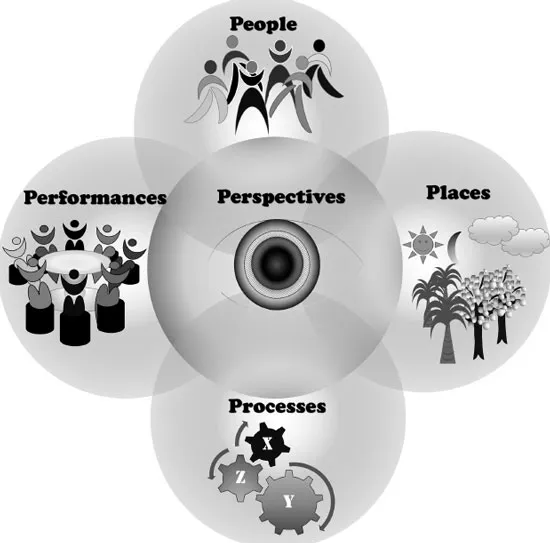
To lay the foundation for a decent understanding of the evolutionary trend we have been experiencing in the past decades, this chapter evaluates the changing parameters of performance and life in general. Change will be explained through five parameters: people, places, processes, performances and perspectives. The 20th and 21st centuries will briefly be reviewed in light of their most influential events and inventions. Critical qualities for leadership in the 20th century, such as charisma, decisiveness, profit focus and assertiveness, will be placed alongside those that are required today, such as emotional intelligence, social sensitivity, openness to diversity and moral responsibility. Some important established and upcoming leadership styles will be reviewed.
The Changes in What Matters
Everything changes. This is a statement we have heard many times before, but only consider in selective contexts. That may be because it’s a rather inconvenient, perhaps even mind-boggling thought. Everything changes: people, places, processes, performances, perspectives, and within those, numerous layers we cannot even begin to fathom. Let us, to get a slight idea, consider change within each of these five categories.
People change. Internally and externally, deliberately and inadvertently: whether they want it or not, people change. We grow older, our circumstances change, which compels us to adapt, and oftentimes reconsider our habits and beliefs. We are exposed to far more influences today than ever before, which means that we are learning lessons of multiple natures, among which physical, psychological and spiritual, far beyond any time before. While not everyone applauds all the changes we face in our times, the overarching message seems positive. The magnitude and speed of change we face these days leads us to higher consciousness, and this, in turn, accelerates the cycle of change even more: we question more trends and behaviors, detect which ones don’t work for us anymore and alternate those as well.1
In the business world, change has been a high-ranked and frequently mentioned trend for quite some time. Business textbooks, and thus business professors, teach us that change is the only constant in the world of professional performance. But change manifests itself in an equally consistent manner in our personal life as well. We change all the time. The person you were five years ago has physically, psychologically and mentally changed altogether. Even on a short notice this is clear: the person who you were when you woke up this morning has changed by the time that you go to bed in the evening. You have been exposed to impressions from meeting people, learning new things through books and media, listening to others, and through those impressions, you have gained insights, were possibly challenged to question something you used to do and changed it.
Day after day, we make decisions, large and small, which lead us into new situations and change us from the person we used to be. When we look at an old photograph of ourselves, we may recall the circumstances we were dealing with in those days of old, and we realize that the person viewing the photograph is different from the one in the past. Understanding and accepting the fact that we are subject to change is important, because it can help us accept the fact that our notions and feelings about things we once liked may have altered.
Places change. Depending on where you live, you may witness the process of change in places at a faster or slower pace: stores close and others open, major building constructions arise where once small homes used to stand, and complex infrastructural systems emerge where once simple, straight streets were situated. If you lived somewhere and left for a few years, you will most likely be amazed to see how much change happened.
Much of the change in places is linked to economic factors: if a country’s or state’s economy booms, people gravitate to it, and new living and working quarters emerge. If things are not so rosy, people move away, and cities erode into ghost towns, with few stores still in business, and only small numbers of people – usually those who lived there for a long time – still hanging on.
Places also change on the basis of needs that arise: if a high-demand product or resource is available somewhere, whether valuable minerals or oil, or inexpensive labor, more and more companies will seek to establish their quarters in that location, bringing along a chain of supporting entities (other companies), and a large scale of radical changes in economic, environmental, cultural, moral and psychological regards.
Processes change. Processes are an extremely comprehensive aspect of change. There are numerous angles on process change, as will be explained briefly in this section. So many things are no longer done the way they first were. People don’t move on horseback or stagecoach if they need to travel from one city to the next. They drive their car, take a fast train, or go by airplane. Many products that were once made by hand are now produced mechanically, enabling thousands of units to be made in the same time span in which only dozens used to be made.
Within the concept of processes, there are so many layers to be distinguished, and each layer has its own foundations. People rarely visit travel agencies anymore to book their plane flights. They go online and compare rates through the many websites available for that purpose. They can print out their boarding passes at home or scan it from their mobile device. The foundation of these changed processes is the internet, as is the case with so many. People use less of the conventional mailing services these days. Only packets are still mailed out from a post office. Most communication is nowadays done by email. Even the fax machine, which seemed like a revolutionary find in the early 1980s, is now practically obsolete, as people scan items or take pictures with their mobile device and email them to others. The processes within data transfer over the internet are also changing in fascinating ways. For quite some time, large-sized files were a problem, but with all the cloud options of today, size is no longer an issue.
Performances change. Change is an interdependent concept, as one may gradually start to realize. Due to the changes in people, places and processes, performance also changes. People of our times perform at an entirely different level than those from, say, 50 years ago. This is not to say that the people from before were not performing well. The issue is not human ability, but more possibility. Today, we have many more options in our performance: we can, for instance, move from one place to another faster with our fast cars, trains and airplanes; we can transfer information faster through our computers, tablets, mobile phones, all supported by the powerful internet; and we can construct more buildings and roads, and make more changes to the environment, due to the powerful machines we now have at our disposal.
With all the advanced methods we know, processes and strategies become obsolete at a faster pace as well, and we have to keep ourselves informed about new needs that may emerge. Many people have experienced the pressure of increased performance in a painful way in recent years, when they learned that their jobs were outsourced to a less expensive country, or taken over by a machine. These people had to either find another source of income in a different industry, or return to school to learn new skills, in order to learn how to perform in a different area.
Perspectives change. As we get confronted with new ways of acting, thinking, working and socializing, our perspectives are also changing. Exposure to people and processes from other areas than the one where we grew up can be a major eye-opener. Today, we are exposed to more new impressions and more alternative ways of thinking and behaving than humanity has since its inception. It is therefore not so strange that people change their perspectives more often today than they did in the past. While such may not be the case with everyone, it is understandable, and even expectable. Workplaces today are highly diverse. Many of us are on one or more social media platform and communicate with people from multiple parts of the world. Many of us travel, and meet more people than our parents and their parents ever met, because traveling is far less expensive today than it was in their time.
And, of course, there is also the process of sharing through media: scientists and explorers are not sitting still. They learn many new things, and share those readily with us. We learn about the universe, and the fact that it is so much vaster than we thought before. We learn about old civilizations and how they lived, thanks to the archeological findings. Based on these findings, we find ourselves placed before the dilemma of clinging to past beliefs that have been proven incorrect, or rewrite history – difficult choices that can only gradually be addressed, due to their huge impact upon everything we stand for. But whether we like it or not, the human race analyzes more today than it ever did, and in that process, new knowledge emerges and perspectives change.
It is the change of perspectives that causes us to mature in insights, as we find out that the things and behaviors that made a difference before no longer matter. In the next section, this will become apparent in leadership aspects: many of the skills and qualities that were revered in the 20th century are now considered inappropriate in relationships of mutual respect. We will start first with an overview of the critical qualities for leadership in the 20th century, and then move to those that are recommended for the 21st century.
The 20th Century
The 20th century was, in many regards, an important one. Sandwiched between the Industrial Revolution and the Internet era, this century brought humanity quantum leaps in opportunities, inventions, productivity, change and leadership.2 It was an aggressive era, where growth and sales were the leading motives in business. One of the underlying factors for the aggressive nature of this century was the fact that everything increased in speed. This was a century where, in its early days, a trip from New York to Chicago with an express passenger train lasted 20 hours. Yet, 30 years later, the same trip could be done in 4.5 hours with the Douglas DC-3, a fixed-wing propeller-driven airliner. Another 30 years further, in the 1960s, it was even possible to travel to another continent in less than five hours with the four-engine DC-8.3 Speed was also a critical performance determinant in production processes. While it took about 12.5 hours to produce a Ford Model T in 1913, the same car could be assembled in two minutes only three years later, thanks to the installation of assembly lines.4 Cross-country mail delivery accelerated from five days in the 1920s to 31.5 hours four years on due to the regular scheduling of air mail. In the latter part of the century, this service ultimately sped up to overnight deliveries with services such as FedEx and UPS.5
Figure 1.1 The Five Ps of Change
The 20th century was one of pretentiousness as well: everyone was out to impress everyone else. Money was the grease for all practices, especially in business. In the early 1900s, the trend was set by J. P. Morgan, who purchased Carnegie’s steel empire for the then unheard-of price of $250 million, and John D. Rockefeller achieved the acclamation of being the world’s first billionaire, with an estimated personal wealth of $1 billion in 1913.6 Excess was the obsession of the day. This could be detected in the mid-century cars, for instance. A 1959 Cadillac convertible had a tail fin that was 3.5 feet long.7
On a more positive note, the 20th century also stood out as one of ingenuity, which was expressed in plentiful ways. One manifestation of this ingenuity was improved efficiency, which happened when Henry Leland, the founder of Cadillac, invented interchangeable parts in the very early...