Do video games cause violent, aggressive behavior? Can online games help us learn? When it comes to video games, these are often the types of questions raised by popular media, policy makers, scholars, and the general public. In this collection, international experts review the latest research findings in the field of digital game studies and weigh in on the actual physical, social, and psychological effects of video games. Taking a broad view of the industry from the moral panic of its early days up to recent controversies surrounding games like Grand Theft Auto, contributors explore the effects of games through a range of topics including health hazards/benefits, education, violence and aggression, addiction, cognitive performance, and gaming communities. Interdisciplinary and accessibly written, The Video Game Debate reveals that the arguments surrounding the game industry are far from black and white, and opens the door to richer conversation and debate amongst students, policy makers, and scholars alike.
eBook - ePub
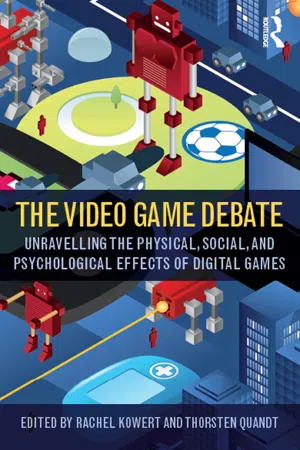
The Video Game Debate
Unravelling the Physical, Social, and Psychological Effects of Video Games
- 196 pages
- English
- ePUB (mobile friendly)
- Available on iOS & Android
eBook - ePub
The Video Game Debate
Unravelling the Physical, Social, and Psychological Effects of Video Games
About this book
Information
1 A BRIEF HISTORY OF VIDEO GAMES
10.4324/9781315736495-1
Evolutionary biologists use a term called “convergent evolution” to explain the existence of similar traits in living organisms that are otherwise markedly different and only distantly related.1 For example, similarities between the body types of fish, marine mammals such as dolphins and whales, and the extinct ichthyosaur may give the impression that these animals share a similar biological class even though other less superficial characteristics of these animals clearly identify them as members of separate animal classes. Similarly, bats may seem more closely related to birds than to other mammals because of their shared wings and ability to fly even though bats have little else in common with birds, including the anatomical location of their wings (bats’ wings are essentially long webbed fingers, while the feathers of birds’ wings are attached to the equivalent of the forearm and wrist). In these and other examples, it is all too easy to misperceive beasts that have little in common as part of one family.
So it is with video games. The social, cultural, and economic presence of video games is so overwhelming in the electronic media milieu, and the term “video game” is so often used as a talismanic catch-all for nearly any form of interactive digital entertainment, that it is easy to assume that the technological and social developments leading to what we now call “video games” are not composed of a single evolutionary pathway. Instead, the video games of today represent a convergence of substantially different trajectories of technological developments providing discrepant forms of entertainment to audiences with different needs. The result is a medium that is very diverse in its functions, content, and audiences – so diverse, in fact, that like birds and bats or dolphins and fish, many shared characteristics among some video games may be only superficial. Just as organisms described as examples of convergent evolution are very different creatures who seem more similar than they are because of a shared functional trait, many video games are actually very different entertainment products with different technological and social histories distinguished from other electronic media only by their shared primary function of providing interactive entertainment to their users. This kludge of technological and social bloodlines and audiences under the loosely defined blanket term “video games” is a challenge for those seeking to understand the impact of the medium. The impact of video games is great, but it is far from uniform because video games are far from uniform.
The Converging Ancestry of Video Games
Nuclear Roots: Action Simulations from Oscilloscopes to Arcades to Consoles
The First Video Games
The most resounding impact William “Willy” Higinbotham had on the world had nothing to do with video games. Higinbotham worked on the team that developed the first atomic bomb at Los Alamos Laboratory (now Los Alamos Research Laboratory), and after that experience he became a leading figure in the nuclear non-proliferation movement as a founder and chair of the Federation of American Scientists.2 As a relative footnote to his role in such pivotal global events, Higinbotham is also known for having arguably developed the first electronic video game. While serving as a senior physicist at Brookhaven National Laboratory, Higinbotham was aware that even though the innovations his facility was producing could be world-changing, they were not necessarily impressive on display to visitors (his work in Los Alamos being a notable exception). To entertain attendees at an annual public visitors’ day in 1958, he spent a few hours developing a rudimentary tennis simulation using analog computer technology designed to track missile trajectories and a pair of 5-inch oscilloscope screens.2 The result, Tennis for Two, was a popular feature for visitors, but appeared only once more at the next annual visitors’ day. Higinbotham couldn’t even be bothered to pursue a patent for his patched-together diversion, which was based in technology that was already on its way to obsolescence; digital computers had already begun to appear, and much larger cathode ray tube displays were in use in household televisions. Only more than a decade later, when the eerily similar Pong burst onto the commercial scene, did the significance of Higinbotham’s Tennis for Two as a milestone in video game history become apparent.3
As with most remembered milestones in the history of communication technology, the actual story of the first video game is not so clear-cut as Higinbotham and Tennis for Two. Just as tales of Alexander Graham Bell’s telephone and Samuel Morse’s telegraph are famous, but oversimplified by the absence of references to earlier prototypes and competing developments,4 there were other prototypes that could be called electronic games that were developed before Higinbotham’s 1958 demonstration. OXO, a simulation of the popular pencil-and-paper game called “Noughts and Crosses” or “Tic Tac Toe,” was developed in 1952 as part of Alexander “Sandy” Douglas’ doctoral work at the University of Cambridge.5 While the program ran on a digital computer (the Electronic Delay Storage Automatic Calculator, or EDSAC) and used a cathode ray tube display, OXO often eludes credit as the first video game because it lacked a moving graphic display. A similar effort was a draughts (checkers) simulation made in 1951 by Christopher Strachey at England’s National Physical Laboratory in London, which was a pioneering artificial intelligence program.6 British engineering firm Ferranti exhibited a computer developed to play the game Nim using a series of lights as an interface at the Festival of Britain in 1951,7 and famed British mathematician Alan Turing worked with Dietrich Prinz on a rudimentary chess simulation that had no visual interface and was programmed by Prinz in 1951.8
Another argument for the earliest origin of the video game can be based on a patent for a “Cathode Ray Tube Amusement Device” filed in 1947 and issued in 1948.9 That device, developed by Thomas T. Goldsmith, Jr. and Estle Ray Mann at Dumont Laboratories in Upper Montclair, New Jersey, allowed users to control a dot on a screen to aim at paper overlay targets, with successful targeting tracked mechanically rather than by computer processing. While sharing some visual display traits with Higinbotham’s Tennis for Two game, Goldsmith and Mann’s device was completely mechanical and used no computer program or memory. There is therefore a good case for Tennis for Two as the first video game prototype because earlier putative “first” video games lacked either a graphical motion display (e.g., Nim, OXO) or computing technology (e.g., the Cathode Ray Tube Amusement Device). Bragging rights regarding which invention might truly be called the first video game notwithstanding, it is notable that all of these early precursors and prototypes simulated a game or sport, and of these the graphical motion display is frequently cited as a necessary criterion for an early prototype to be called a “video game.” Thus, even retrospective glances at video game history place a heavy emphasis on action and simulation as defining characteristics of video games.
Tennis for Two and its various predecessors were never widely played or released commercially; they were either produced only as working prototypes or exhibited to the public at isolated events. The first video game to find a large audience and be available beyond a single exhibition was Spacewar! Initially developed by three students at the Massachusetts Institute of Technology, Stephen R. “Slug” Russell, J. Martin Graetz, and Wayne Witanen (with help from others at later stages), in 1962, Spacewar! allowed two players to control dueling spaceships and attempt to shoot each other with torpedoes while orbiting a black hole.10Spacewar!, played using a cathode ray tube display and custom-built controllers on the Digital Equipment Corporation’s PDP-1 computer, also featured a score display, a player-friendly feature not available on the oscilloscope display used by Tennis for Two. This and other competition-oriented features ensured that Spacewar! was a hit. Within a year of its 1962 demonstration at the Massachusetts Institute of Technology’s annual Science Open House in May, 1962, copies and variations of the Spacewar! program began to emerge at research laboratories across the United States, and the game was being played not only on PDP-1 computers but on other computers that used a cathode ray tube display as well.
A much more polished video game than Tennis for Two, Spacewar! might also be considered the first video game, especially as Spacewar! used digital computing hardware rather than analog technology. More relevant to the video game industry boom to come, Spacewar! was certainly the first video game to be commercialized. While the actual Spacewar! game as originally programmed could not be commercialized because it was played on expensive research computers that were usually inaccessible to the public, the first coin-operated arcade games were both adaptations of Spacewar!: Galaxy Game, a one-of-a-kind arcade unit that debuted on the Stanford University campus in Palo Alto, California in 1971 and was the first coin-operated video game, and Computer Space, a mass-produced coin-operated arcade game released later the same year throughout the United States.11 Therefore, whatever early device is credited as the first video game, there’s no debating that Spacewar! accomplished two milestones important to the scalability of the video game as a mass medium_ it was the first video game to be played on more than one machine, and the first video game to be adapted for commercialization.
While the technologies employed to create the first video game prototypes and their predecessors varied, some conceptual themes are apparent across all of these early games. Each had a basis in simulating competition, either competitive action simulations or simulations of competitive strategy games. While some of the early precursors imitated competitive board games and parlor games (OXO, chess, draughts/checkers, Nim), the prototypes most often referred to as actual video games and the first video game to evidence the medium’s commercial potential featured competitive action simulations of sport or combat (Cathode Ray Tube Amusement Device, Tennis for Two, Spacewar!). Therefore, even in the earliest roots of video games an emphasis is established on conceptual inspiration from simulation of competitive games and other competitive activities, sometimes based only ...
Table of contents
- Cover
- Half Title Page
- Title Page
- Copyright Page
- Contents
- Acknowledgments
- 1 A Brief History of Video Games
- 2 The Rise (and Refinement) of Moral Panic
- 3 Are Electronic Games Health Hazards or Health Promoters?
- 4 The Influence of Digital Games on Aggression and Violent Crime
- 5 Gaming Addiction and Internet Gaming Disorder
- 6 Social Outcomes: Online Game Play, Social Currency, and Social Ability
- 7 Debating How to Learn From Video Games
- 8 Video Games and Cognitive Performance
- 9 Exploring Gaming Communities
- 10 No Black and White in Video Game Land! Why We Need to Move Beyond Simple Explanations in the Video Game Debate
- Contributors
- Index
Trusted by 375,005 students
Access to over 1.5 million titles for a fair monthly price.
Study more efficiently using our study tools.
Frequently asked questions
Yes, you can cancel anytime from the Subscription tab in your account settings on the Perlego website. Your subscription will stay active until the end of your current billing period. Learn how to cancel your subscription
No, books cannot be downloaded as external files, such as PDFs, for use outside of Perlego. However, you can download books within the Perlego app for offline reading on mobile or tablet. Learn how to download books offline
Perlego offers two plans: Essential and Complete
- Essential is ideal for learners and professionals who enjoy exploring a wide range of subjects. Access the Essential Library with 800,000+ trusted titles and best-sellers across business, personal growth, and the humanities. Includes unlimited reading time and Standard Read Aloud voice.
- Complete: Perfect for advanced learners and researchers needing full, unrestricted access. Unlock 1.5M+ books across hundreds of subjects, including academic and specialized titles. The Complete Plan also includes advanced features like Premium Read Aloud and Research Assistant.
We are an online textbook subscription service, where you can get access to an entire online library for less than the price of a single book per month. With over 1.5 million books across 990+ topics, we’ve got you covered! Learn about our mission
Look out for the read-aloud symbol on your next book to see if you can listen to it. The read-aloud tool reads text aloud for you, highlighting the text as it is being read. You can pause it, speed it up and slow it down. Learn more about Read Aloud
Yes! You can use the Perlego app on both iOS and Android devices to read anytime, anywhere — even offline. Perfect for commutes or when you’re on the go.
Please note we cannot support devices running on iOS 13 and Android 7 or earlier. Learn more about using the app
Please note we cannot support devices running on iOS 13 and Android 7 or earlier. Learn more about using the app
Yes, you can access The Video Game Debate by Rachel Kowert, Thorsten Quandt, Rachel Kowert,Thorsten Quandt in PDF and/or ePUB format, as well as other popular books in Social Sciences & Cognitive Psychology & Cognition. We have over 1.5 million books available in our catalogue for you to explore.