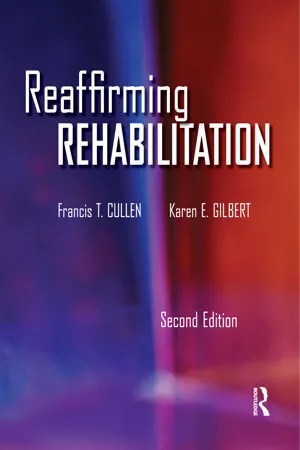
Reaffirming Rehabilitation , 2nd Edition, brings fresh insights to one of the core works of criminal justice literature. This groundbreaking work analyzes the rehabilitative ideal within the American correctional system and discusses its relationship to and conflict with political ideologies. Many researchers and policymakers rejected the value of rehabilitation after Robert Martinson's proclamation that "nothing works." Cullen and Gilbert's book helped stem the tide of negativism that engulfed the U.S. correctional system in the years that followed the popularization of the "nothing works" doctrine. Now Cullen traces the social impact on U.S. corrections policy. This new edition is appropriate as a textbook in corrections courses and as recommended reading in related courses. It also serves as a resource for researchers and policymakers working in the field of corrections.
- 266 pages
- English
- ePUB (mobile friendly)
- Available on iOS & Android
eBook - ePub
Reaffirming Rehabilitation
About this book
Information
CHAPTER 1
Crisis in Criminal Justice Policy
In 1977, C. Ray Jeffrey, soon to be elected president of the American Society of Criminology, declared unhesitantly that “punishment has failed...treatment has failed.”1 This assertion is perhaps overly sweeping and, some might argue, empirically problematic. But whatever its factual merits, Jeffrey’s statement accurately expressed the sentiments of many of his academic peers and, indeed, of much of the general public at this time. Nothing that was being done about the “crime problem” seemed either to prove or promise to be successful—our “war on crime” was in a shambles—and the public agitated for order to be restored. However, the uncertainties as to just what solution would rectify this troubling state of affairs were considerable; a crisis in American criminal justice policy prevailed.2
The Crisis Emerges
There was good reason for people to doubt the wisdom and effectiveness of our policies. City streets became increasingly endangered, and drugs and delinquency were no longer seen to be exclusively confined to distant, disorganized urban slums—they penetrated as well into the communities, homes and lives of the affluent and “respectable.” Indeed, by all accounts, the crime rate had burgeoned in recent years. Criminologists were now writing extensively and often with an air of inevitability about the “growth of crime” and the “relentless upsurge in crime.”3 Few would any longer disagree with Charles Silberman’s conclusion that “since the early 1960s, the United States has been in the grip of a crime wave of epic proportions.”4
One did not have to travel far for the statistics needed to confirm these observations. Data accumulated and published by the FBI in 1977 indicated that during the course of the preceding decade, the amount of serious violent crime rose over 80 percent, serious property crimes over 75 percent. In 1976, eleven million crimes were reported to police; the actual number of offenses (which include both crimes reported and not reported to police officials) perpetrated on the American public in that single year is estimated to have been at least two to three times higher than this eleven million statistic.5 The magnitude of such crime figures is perhaps more understandable if placed in these terms: by the mid-1970s, approximately three Americans in every hundred could expect to be the victim of a violent crime each year and one household in ten to be burglarized.6 Equally disturbing but of even greater drama, James Q. Wilson informed us in 1975 that “a typical baby born and remaining in a large American city is more likely to die of murder than an American soldier in World War II was to die in combat.”7
But a soaring crime rate was not all that people saw. At the same time, the inhumanity and injustice of our correctional process were forced upon the public’s consciousness. Attica accomplished this deed.
Now it has been persuasively argued that it is primarily through unrest that the powerless are able to move the powerful to yield material and political concessions.8 The history of imprisonment has certainly demonstrated the viability of this principle. Countless times, it has taken a wave of inmate insurrections to publicize prison abuses, prick society’s conscience, and prompt correctional officials to institute reforms—however cosmetic. And this lesson has not been lost on our incarcerated. Tom Murton, noted prison critic and former superintendent of Arkansas State Penitentiary, has observed that by failing to improve conditions until a riot occurs, the prison “administration clearly informs inmates that it must be forced to perform its duty. It also indicates that it can be manipulated by intimidation and coercion. From these revelations, the inmates learn the necessity of developing a power base in order to bring about change within the prison.”9 On this topic, a Pennsylvania steel worker has been equally perceptive: “I think that if they didn’t pull off a riot and grab some hostages, they figure nobody would ever pay attention to their problems. And you know, they’re probably right.”10
Yet despite this knowledge that prison reform and protest are intimately intertwined, inmates do not always riot in an effort to secure greater advantages or, more accurately, in an effort to suffer fewer disadvantages. More frequently, they endure their painful environment rather than risk a confrontation with the power—in concrete terms, the guns—held by the agents of the state. At certain junctures in history, however, social circumstances prevail that allow for the inmates’ pent-up frustrations and hostility to break through traditional constraints and to be unleashed in the form of an uprising against the custodial regime. In these unique eras, insurrections sweep across our nation’s prisons.
Significantly, by the late 1960s, the climate was ripe for another rash of inmate disturbances protesting deplorable living conditions. While the walls of our prisons remained as high and as secure as ever and proved sufficient to keep all but the exceptionally ingenious inmates confined, they were no longer able to keep society out.11 On the other side of the penitentiary gates, substantial segments of the populace questioned the fundamental legitimacy of governmental policies (Vietnam) and of social arrangements that resulted in gross disparities of wealth. These attitudes, based in part on radical ideologies, seeped through the cracks in the prison wall and provided inmates with a new vocabulary with which to explain their plight. They now suffered not “prison abuse” but “oppression”; rebellion against the “exploitive” order was called for.12
At the same time, investigative reporters, mobile camera crews, and nightly news were now common features. Inmates knew that more than ever before their uprisings would receive immediate and widespread attention, and that negotiations with administrators over long lists of grievances would appear on the television screens in the living rooms of many American households. Brutalizing practices would be too open to be ignored; at least some changes could be won.13
Not surprisingly, then, beginning in 1968 in Salem, Oregon, a series of inmate uprisings spread throughout our prison system. “The horrifying climax” to this wave of riots came on September 13, 1971, at Attica Correctional Facility, located in the small, upstate New York town of Attica.14
Four days earlier on Thursday, September 9, shortly before 9 a.m., an attempt to direct a company of inmates headed for their daily yard privileges back into their cells precipitated an outbreak. An hour and a half later, 1,281 of Attica’s 2,243 inmate population occupied D-Block Yard in the prison, holding 38 guards hostage. Over the course of the following weekend, the national media went into D-Block Yard and watched as an outside committee of “observers” (including such notables as radical attorney William Kunstler, news reporter Tom Wicker, and Black Panther leader Bobby Seale) was allowed to negotiate with the inmates. A list of demands was procured, and State Correctional Commissioner Russell G. Oswald quickly agreed to nearly all points. However, Oswald refused to grant the inmates’ demand for complete immunity for crimes committed during the uprising. And when a young guard injured in the takeover died, this proved to be a crucial impediment to a negotiated and bloodless settlement.
On Monday morning, September 13, the fateful decision was reached to retake the institution. An armed assault by state troopers and some correctional officers was launched at 9:43 a.m. The firing ceased by 9:52 and by 10:30 the rebellious inmates had been cleared from D-Block Yard. The final toll was the largest in the 150 year history of the American penitentiary. Over 80 inmates were wounded and 29 lay dead or dying. Ten guards were also killed—not by inmates as threatened and as reported initially by prison officials—but by the crossfire of the assaulting troopers.15
Attica was not to be simply another unfortunate, grizzly, yet soon forgotten event in the dark history of American penology.16 Instead, it quickly assumed a national character and joined those other events in our past that have produced deep anguish in the American conscience. Shortly after Attica, a Time correspondent prophetically remarked:
Attica. For some time to come in the U.S., that word will not be primarily identified with the plain upon which ancient Athens nurtured philosophy and democracy. Nor will it simply stand for the bucolic little town that gave its name to a turreted prison, mislabeled a “correctional facility.” Attica will evoke the bloodiest prison rebellion in U.S. history. It will take its place alongside Kent State, Jackson State, My Lai and other traumatic events that have shaken the American conscience and incited searing controversy over the application of force—and the pressure that provokes it.17
Thus, the tragedy of Attica did not remain hidden; it reverberated throughout our nation. In the year following the violent repression of the Attica insurrection, the American public, typically conservative on law and order issues, had become “essentially more sympathetic to the complaints of inmates than to the conduct of penal authorities.”18 In this vein, a Louis Harris survey indicated that 58 percent of the public attributed “recent takeovers of prisons by inmates” to the fact that “authorities don’t understand the needs of prisoners,” while only 23 percent stated that “authorities are too easy on inmates” (19 percent remained undecided).19
Beyond this, Attica revealed another truth to those who had not previously glimpsed into the world of imprisonment: prisons are populated overwhelmingly by racial minorities and the economically disadvantaged. Indeed, few white faces (not counting the all-white custodial force held hostage) and even fewer faces of the rich could be found among the prisoners occupying D-Block Yard.20 With the civil rights movement still in memory, these demographic facts of prison life suggested, if not demanded, the conclusion that racism and class inequality permeated our criminal “justice” system.
But above all, “Attica became a code word for the failure of the entire apparatus of corrections,”21 or in Gresham Sykes’ words, “a symbol for the end of an era in correctional philosophy.”22 A century and a half before, America had forged ahead with a penal innovation: a penitentiary system that promised to reform its charges. This promise for the humane improvement of inmates remained largely unfulfilled, but nevertheless many believed it to be within reach. Attica shattered this hope. The violent encounter between the state and its captives made apparent to the nation that the prison had failed in its original mission. Brutality, not benevolence, seemed the governing principle of our prisons. As never before, the assumptions underlying our correctional policies came under careful scrutiny, and liberal as well as more radical prison reform movements with roots in the previous decade took on added meaning. Few could any longer dispute that changes were clearly in order.
Thus, Americans in the first half of the 1970s were faced with the prospect of an intractable crime rate and confronted with the reality—powerfully symbolized by Attica—that their prisons were both inhumane and grossly ineffective. In this context, a culprit was needed to take the blame, and a candidate was readily found. Rehabilitation would take the rap.
The Failure of Criminal Justice Rehabilitation
Over the course of the past century, the notion that we should rehabilitate lawbreakers had, on the surface, displaced punishment as the philosophy guiding the formulation of criminal justice policy. It had become something of a truth in criminological circles that punishing criminals for their transgressions—whether it was to balance harms inflicted on society (retribution), to teach that crime does not pay (deterrence), or to protect society by keeping the dangerous in secure cages (incapacitation)—had no moral legitimacy, scientific standing, or pragmatic benefit. Thus, writing in 1930, Harry Elmer Barnes, a pioneer in the field of criminology, voiced the opinion that “our entire system of criminal jurisprudence is wrong-headed and unscientific because, in the first place, it rests upon the fundamental assumption of the primary importance of detecting guilt and adjusting the punishment to the crime.”23 Similarly, over 35 years later, Karl Menninger asserted in his acclaimed work The Crime of Punishment that “crime problems have been dealt with too long with only the aid of common sense. Catch criminals and lock them up; if they hit you, hit them back. This is common sense, but it does not work.”24
In practice, the ascendancy of rehabilitation meant that the components of the criminal justice system were now manifestly organized to effect the reformation of offenders. Criminals were supposedly placed on probation to allow for their treatment in the community; they were sent to prison not to pay for their crimes but to be cured of their criminogenic malady; and they were released on parole by a board of “experts” when this benevolent task of reform had been accomplished.
However, close observers of our correctional system would have recognized that the pre-eminence of rehabilitation was more myth than reality. They were well aware that probation was likely the result of an offender receiving a mild sentence in exchange for a guilty plea that would lighten the burden of a prosecutor’s case load. And release from prison, where few rehabilitation programs actually operated according to plan, probably reflected the willingness of an inmate to cooperate with the custodial regime or perhaps the desire of the state to reduce the size of its prison population in order to save money. As historian David Rothman has illustrated, a look to our past clearly reveals that “convenience” far more often than “conscience” has controlled the daily workings of our correctional process.25
Nevertheless, as America entered the decade of the seventies, a substantial seg...
Table of contents
- Cover
- Half Title
- Title
- Copyright
- Dedication
- Contents
- INTRODUCTION TO THE ANNIVERSARY EDITION
- FOREWORD TO THE FIRST EDITION
- CHAPTER 1 Crisis in Criminal Justice Policy
- CHAPTER 2 Criminal Justice Theories and Ideologies
- CHAPTER 3 The Rise of Rehabilitation
- CHAPTER 4 Attacking Rehabilitation
- CHAPTER 5 The Poverty of the Justice Model: The Corruption of Benevolence Revisited?
- CHAPTER 6 Implementing the Justice Model: Problems and Prospects
- CHAPTER 7 Reaffirming Rehabilitation
- CHAPTER 8 The Future of Rehabilitation: From Nothing Works to What Works (An Epilogue)
- NAME INDEX
- SUBJECT INDEX
Trusted by 375,005 students
Access to over 1.5 million titles for a fair monthly price.
Study more efficiently using our study tools.
Frequently asked questions
Yes, you can cancel anytime from the Subscription tab in your account settings on the Perlego website. Your subscription will stay active until the end of your current billing period. Learn how to cancel your subscription
No, books cannot be downloaded as external files, such as PDFs, for use outside of Perlego. However, you can download books within the Perlego app for offline reading on mobile or tablet. Learn how to download books offline
Perlego offers two plans: Essential and Complete
- Essential is ideal for learners and professionals who enjoy exploring a wide range of subjects. Access the Essential Library with 800,000+ trusted titles and best-sellers across business, personal growth, and the humanities. Includes unlimited reading time and Standard Read Aloud voice.
- Complete: Perfect for advanced learners and researchers needing full, unrestricted access. Unlock 1.5M+ books across hundreds of subjects, including academic and specialized titles. The Complete Plan also includes advanced features like Premium Read Aloud and Research Assistant.
We are an online textbook subscription service, where you can get access to an entire online library for less than the price of a single book per month. With over 1.5 million books across 990+ topics, we’ve got you covered! Learn about our mission
Look out for the read-aloud symbol on your next book to see if you can listen to it. The read-aloud tool reads text aloud for you, highlighting the text as it is being read. You can pause it, speed it up and slow it down. Learn more about Read Aloud
Yes! You can use the Perlego app on both iOS and Android devices to read anytime, anywhere — even offline. Perfect for commutes or when you’re on the go.
Please note we cannot support devices running on iOS 13 and Android 7 or earlier. Learn more about using the app
Please note we cannot support devices running on iOS 13 and Android 7 or earlier. Learn more about using the app
Yes, you can access Reaffirming Rehabilitation by Francis Cullen,Karen Gilbert in PDF and/or ePUB format, as well as other popular books in Social Sciences & Criminal Law. We have over 1.5 million books available in our catalogue for you to explore.