This practical guide is essential for anyone new to or intimidated by online instruction. Drawing on the expertise of teachers of the humanities who have deep experiences in the online environment, this work explores a variety of areas within the online teaching experience. It discusses the differences between online and face-to-face learning environments and assesses and evaluates best practices in developing and teaching online courses. This volume is not really about the technology, but instead focuses on the ways in which available technologies can be used to enhance teaching in both synchronous and asynchronous forums, and as such it will still be worth the read many years from now—even in the face of rapid technological change. Contributions from faculty members teaching in art education, communication, English, history, social studies education, and interdisciplinary studies departments, as well as directors of writing centers and online education and distance learning programs are included. Essays in this volume will assist instructors, faculty members, and administrators new to the online experience, but who want to learn more about making the transition to online teaching, in navigating this transition gracefully.
eBook - ePub
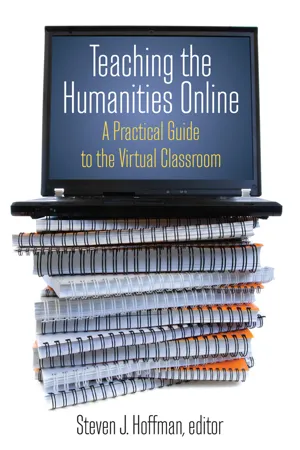
Teaching the Humanities Online: A Practical Guide to the Virtual Classroom
A Practical Guide to the Virtual Classroom
- 224 pages
- English
- ePUB (mobile friendly)
- Available on iOS & Android
eBook - ePub
Teaching the Humanities Online: A Practical Guide to the Virtual Classroom
A Practical Guide to the Virtual Classroom
About this book
Information
1
Before We Begin
Preparing to Teach Online
Online education in the humanities calls for a great deal of preparation before the instructor and students enter the course site. This preparation involves acquisition of basic technical prowess, assessment of student learning styles, pedagogical style selection, content review and adaptation, and implementation. To prepare effectively, it is necessary to consider: Who is the online instructor? Who is the online student? What tools are needed? What time is required? What facilities and resources are available? What skills are needed? What learning styles are addressed (or left out)? Who is served best by online education?
Technical Prowess
To teach online effectively, the instructor cannot simply transfer face-to-face lecture notes into a PowerPoint presentation or a Word document to be downloaded and read. The online instructor first needs to be comfortable with technology—the computer, various software, the course management system, video and audio. The online instructor is not required to be a technology expert. Content is most important, but effective online delivery of the content is the responsibility of the instructor.
What is required of the instructor is some basic knowledge of electronic media and comfort in using various formats. The combined access to media (the Internet, processes, programs, etc.) and technical knowledge (hardware, software programs, formats, etc.) reinforces the shift in the instructor’s role in the learning environment from teacher-directed learning to student-centered learning. The online classroom becomes an online knowledge center where the student and teacher capture, share, store, access, and create knowledge. The online instructor thus serves as a facilitator, assisting in the development and presentation of knowledge media and course content knowledge.
This new role as facilitator may require the instructor to work with technical experts to maximize the effective exchange of knowledge in this delivery mode. Ideally, the online instructor should work with an instructional designer and a course management specialist to create and operate the course management site. This allows the instructor to focus on content and to share implementation ideas. However, in most cases the instructor wears multiple hats—dealing with content, delivery, operation, and maintenance of the course site.
In wearing these multiple hats, the online instructor works to balance the focus on course content with the concern for effective content delivery. In a traditional classroom the instructor lectures, writes notes on the board, pauses for questions, answers questions, engages in dialogues, and involves students in various interactive methods of teaching, learning, and exchanging knowledge. The online environment can offer an instructor these same opportunities, but in a different way and through multiple media. What is most needed, once the instructor decides to commit to teaching online, is technical support. This technical support assists in maximizing the learning experience in the course for the students and the instructor.
The first challenge many instructors face is the unknown: What will happen to my lectures? Where will my work go? Will I still have control, even in cyberspace? What about my intellectual property rights? These valid questions, in addition to the technical challenges posed by online teaching, often cause resistance in faculty considering going online.
Once these concerns are addressed and resolved, another challenge that will surface is the idea that this format could eliminate our worth as instructors: “If everything we teach is on the computer, what are we needed for?” Instructors are needed, as they are pertinent to the facilitation of course content and knowledge. Even in an era of budget restraints and cuts, instructors (aka facilitators) are needed to ensure that learning and engagement occurs. The time, effort, patience, commitment, and study that online media education (aka eLearning) requires of instructors often does not receive the recognition it deserves in academia. Support, promotion, tenure recognition, and appropriate consideration and credit to online instructors and their instruction need to increase in order to decrease the reluctance of instructors to begin this process of teaching online.
Once the instructor is ready to embark upon online teaching, the following questions should be asked:
• Why do I want to teach online? Is it through online education, perhaps, that teaching and learning can be improved? Will it enhance my own knowledge as well as increase student engagement and practice of course content?
• My department is developing an online program and I am obligated to participate. What are the goals of the program? Do I subscribe to them? How many of my colleagues are involved as well? How will the courses I teach fit with the other online courses? Can my course be taught effectively online? Is collaboration with other faculty members possible?
• Am I committed? Do I have or will I make the time to learn, develop, and use the technology and teaching methods required? Are there any resources to assist in this shift?
• What vision do I have for the online course? What aspects of my face-to-face teaching can easily transfer to an online environment? Will this course replace my face-to-face offering? Or will it merely provide a different method for taking the class? Is it possible to offer a hybrid course? Is this course required? What can I do in this learning mode to enhance learning and increase engagement? Transitioning from face-to-face to online teaching requires instructors to revisit and often revise the ways that teaching is approached and delivered.
• What resources are available to assist in this process? Is there technical support available—an instructional designer, a course management system specialist? Does my institution have an office or department of eLearning or technology? If so, what services does it provide?
• Will I get release time? What will be the faculty/student ratio online? What technology is available to me as an instructor and what technology is accessible to students? Are there any incentives for teaching online?
• What do I need to learn? What (new) technology skills are needed? What (new) teaching methods are needed? How can I learn them? Do I have the time to learn these new technology skills and develop new instructional methods?
• What is my plan? What is my timeline for creating the course? How can it be executed effectively and efficiently?
• Will I be recognized and/or rewarded for the time and energies invested to create an online course?
Student Learning Style
The instructor needs to be mindful of the online student. Most online students juggle multiple responsibilities. They usually do not have the physical time to sit in a classroom at a particular time for a specific length of time. They need the flexibility of reading and writing at two o’clock in the morning, or whenever they have allotted or designated time to study. They also need to self-evaluate and assess whether the online learning environment is right for them. Several online student preassessments ask basic questions of the online student regarding technological knowledge and access as well as maturity level and time availability. Many institutions offer these assessments through their eLearning programs.
Although students may have no other practical option, if they are to continue their education online, they still need to ask and answer certain questions:
• What is my learning style? Am I an auditory, visual, or kinesthetic learner?
• Do I want to learn online? Why? Why not?
• Do I own a computer? Do I have access to the necessary equipment (hardware and software) to be successful online?
• Do I have a physical learning space that I can devote to online education?
• How much time can I devote to this online learning experience? Can I manage my time well? What is my online weekly learning schedule?
• Do I have access to and know how to contact technical assistance?
• Am I self-motivated? Am I an aggressive learner? Will I seek assistance and ask questions of my instructor and classmates? Can I initiate conversations and dialogue to maximize this online learning experience?
As instructors approach the online educational environment, it is important for them to be cognizant of what has led students to this mode of learning. Tasks and schedules should be designed to effectively maximize students’ participation and time put into the course.
Pedagogical Style Selection
Pedagogy and the teaching methods for the content are most important. The online pedagogy, the art and study of teaching methods, focusing on the goals of teaching (how they should and can be met) and how the recipient meets or is assisted in meeting those educational goals and objectives, has to be a part of the getting-started phase. There are numerous theories about the ways in which learning takes place, including adult learning theories, constructivist and objectivist paradigms, Bloom’s taxonomy (1956), problem-based learning (Bridges and Hallinger 1992), and the engagement theory (Kearsley and Shneiderman 1998). Chickering and Gamson’s “Seven Principles for Good Practice in Undergraduate Education” (1987) serves as a practical checklist for instructional environments, particularly online.
In The Adult Learner: A Neglected Species (1984), Malcolm Knowles shifted the meaning of “andragogy” to derive a broader definition of a learner-focused education for people of all ages. This model meets multiple needs, including letting learners know why something is important, assisting them to direct themselves through information, and relating the topic to the learner’s experiences. It also recognizes that most people will not learn until they are ready and self-motivated to learn. For instance, when considering this pedagogy with the course content and learning objectives, a thematic history course (e.g., a course about the civil rights movement) would be a good example. Students can make clear-cut connections to the activities, motives, circumstances, people, and places during the civil rights movement that have distinct effects on the life they live today. They can also make a clear statement why these connections are important and relate the history to their own lives and learning experiences.
The objectivist and constructivist approaches or paradigms are seen as two extremes. However, in the context of online learning, all paradigms must be considered for the diverse, broad, and multiple learners in this educational setting. According to objectivists, the learner strives for complete and correct understanding of the multiple structures (entities, properties, etc.) in the world. The constructivist paradigm argues that knowledge is contextual with multiple meanings and perspectives for any and every experience, concept, or event; hence, meaning is derived from that particular experience. Bloom’s taxonomy provides a pedagogical framework that categorizes various levels of content attainment abstraction (listed from lowest to highest level): knowledge, comprehension, application, analysis, synthesis, and evaluation.
When considering the objectivist or constructivist approach, instructors should consider the level of the course. Objectivist pedagogy usually works best in a lower-level sur...
Table of contents
- Cover
- Half Title
- Title Page
- Copyright Page
- Table of Contents
- Acknowledgments
- Introduction: The Future Is Now
- 1. Before We Begin: Preparing to Teach Online
- 2. Reducing Distance in Online Classes
- 3. Using Electronic Courseware: Lessons for Educators
- 4. Making Course Management Systems Work
- 5. Blended Classrooms: Hybridity, Social Capital, and Online Learning
- 6. Facilitating Interaction in the Online Environment
- 7. Using Social Networking Applications in Online Teaching
- 8. Redirecting Discussion: Challenges Related to the Social Aspects of Online Educational Environments
- 9. Easier Than It Looks: Using Web Resources in the Humanities
- 10. Assessing Student Learning Online
- 11. Creating an Environment of Faculty Involvement
- 12. If the Future Is Now, What Is Next? Five Trends Affecting the Future of Online Education
- About the Contributors
- Index
Trusted by 375,005 students
Access to over 1.5 million titles for a fair monthly price.
Study more efficiently using our study tools.
Frequently asked questions
Yes, you can cancel anytime from the Subscription tab in your account settings on the Perlego website. Your subscription will stay active until the end of your current billing period. Learn how to cancel your subscription
No, books cannot be downloaded as external files, such as PDFs, for use outside of Perlego. However, you can download books within the Perlego app for offline reading on mobile or tablet. Learn how to download books offline
Perlego offers two plans: Essential and Complete
- Essential is ideal for learners and professionals who enjoy exploring a wide range of subjects. Access the Essential Library with 800,000+ trusted titles and best-sellers across business, personal growth, and the humanities. Includes unlimited reading time and Standard Read Aloud voice.
- Complete: Perfect for advanced learners and researchers needing full, unrestricted access. Unlock 1.5M+ books across hundreds of subjects, including academic and specialized titles. The Complete Plan also includes advanced features like Premium Read Aloud and Research Assistant.
We are an online textbook subscription service, where you can get access to an entire online library for less than the price of a single book per month. With over 1.5 million books across 990+ topics, we’ve got you covered! Learn about our mission
Look out for the read-aloud symbol on your next book to see if you can listen to it. The read-aloud tool reads text aloud for you, highlighting the text as it is being read. You can pause it, speed it up and slow it down. Learn more about Read Aloud
Yes! You can use the Perlego app on both iOS and Android devices to read anytime, anywhere — even offline. Perfect for commutes or when you’re on the go.
Please note we cannot support devices running on iOS 13 and Android 7 or earlier. Learn more about using the app
Please note we cannot support devices running on iOS 13 and Android 7 or earlier. Learn more about using the app
Yes, you can access Teaching the Humanities Online: A Practical Guide to the Virtual Classroom by Steven J. Hoffman in PDF and/or ePUB format, as well as other popular books in Education & Economic Theory. We have over 1.5 million books available in our catalogue for you to explore.