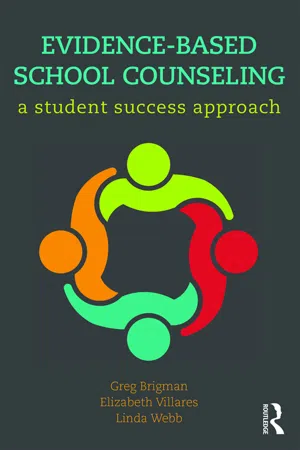
Evidence-Based School Counseling presents a unique method for training graduate students to become effective school counselors that is presented in a "Tell, Show, Do, Coach" approach to instruction and reflective of ASCA, CACREP, and CAEP standards. This method is based on three interrelated components: (a) the ASCA National Model, especially its Mindsets & Behaviors for Student Success and its related student competencies, (b) the extensive research base associated with social/emotional learning (SEL), non-cognitive factors and college/career readiness, and (c) evidence-based programs tied to this research base and suited to school counselor implementation. The text highlights how the new ASCA Mindsets & Behaviors for Student Success have been modeled after this research base and provides resources for school counselors to find evidence-based programs and interventions connected to this research. Evidence-Based School Counseling provides extensive practice and coaching so students can arrive at practicum and internship feeling confident, and they can hit the ground running as they start their careers.
eBook - ePub
Evidence-Based School Counseling
A Student Success Approach
- 312 pages
- English
- ePUB (mobile friendly)
- Available on iOS & Android
eBook - ePub
Evidence-Based School Counseling
A Student Success Approach
About this book
Information
1 | Conceptual Framework for School Counseling |
Topics Covered:
- Brief History of School Counseling
- American School Counselor Association (ASCA) National Model
- The Era of Evidence-Based School Counseling
- Standards in School Counseling Training Programs
- Standards for School Counseling
- Benefits of Evidence-Based School Counseling
- Outcome Research Supporting School Counseling Programs
Introduction
Helping school-aged youth meet their full potential has historically been at the heart of the school counseling profession. Like most professions, the field of school counseling has undergone various stages of growth, primarily in the role of the counselor and the purpose and intention of counseling activities. In part, these transformations were a reaction to societal challenges (Gysbers & Henderson, 1988; Paisley & Borders, 1995; Wingfield, Reese, & West-Olatunji, 2010), a lack of clear school counselor roles and responsibilities (Cinotti, 2014), and the need for empirical evidence documenting the effectiveness of school counseling programs and school counselor interventions (Whiston & Sexton, 1998).
Brief History of School Counseling
Most scholars agree that school counseling developed from the vocational guidance movement. At the turn of the 20th century, the United States was undergoing an enormous economic, social, and political transformation known as the Industrial Revolution. During this time, workers were leaving their farms in pursuit of higher-paying manufacturing and industrial jobs available in the ever-growing urban cities. Consequently, cities grew rapidly to absorb the massive influx of the native and immigrant workforce. Soon, social activists and reformers across the country recognized the need to provide educational and vocational choices to the poor and often exploited workers, giving birth to the vocational guidance movement (Gysbers & Henderson, 2001).
Among these reformers was Frank Parsons, an educator and activist from New England. Parsons, considered the Father of Vocational Guidance, was the director of the Vocation Bureau in Boston (VBB), Massachusetts. As director, Parsons was responsible for providing evening and weekend lectures to local youth on how to choose a vocation. In his book, Choosing a Vocation (1909), Parsons introduced the importance of personal interests and their impact on an individual’s thoughts, emotions, and behaviors. From this frame of reference, Parsons theorized that helping young people explore their personal interests and then matching those interests to a vocation would increase the likelihood of success and occupational satisfaction (Briddick, 2009).
Parsons also created a systematic training program for other educators and reformers to learn how to help youth to find meaningful work. The training program included topics related to the principles and methods of guidance as well as a collection of occupational information. The goal of guidance activities was to help young people successfully navigate the transition from school to work. After Parsons’s death in 1908, Meyer Bloomfield became the director of the VBB and would continue to work in the field for three decades. Bloomfield eventually established the National Career Development Association and the American Management Association, founded the Journal of Counseling and Development, and offered the first university course in counselor education (Savickas, 2009).
In addition to the use of systematic training programs to help men and women find meaningful vocations, reformers such as Jesse B. Davis began infusing vocational information into the existing academic curriculum. For instance, in 1907 Davis, a middle and high school principal from Grand Rapids, Michigan, encouraged his English teachers to integrate career exploration into their curriculum. This integration of classroom and small group meetings laid the foundation for future school counseling programs (Cinotti, 2014; Singh & Salazar, 2010). While vocational guidance gained considerable attention during the early part of the 20th century, most guidance activities were provided by teachers with little training and without additional compensation in terms of time or pay.
The onset of global military conflicts and engagement in World War I and World War II increased the need for effective vocational assessments to appropriately place military personnel and build a strategic and competent fighting force. Therefore, counselors needed more specialized training in administering vocational assessments and interpreting results, as well as guidance in occupational decision making. Meanwhile, as the profession continued to evolve during the 1930s and 40s, most of the school counselor’s roles and responsibilities were determined by school administrators (Gysbers & Henderson, 2006). School counselors began to shift their attention from primarily focusing on vocational needs to supporting students’ academic potential, character development, and behavior management (Paisley & Borders, 1995).
Around the mid-20th century, societal challenges, civil unrest within the United States, and the passage of federal legislation as well as government initiatives forced educators to examine school policies and practices. While vocational guidance was still a central theme, the work of psychologists and theorists (e.g., Carl Rogers and humanistic theory) made a significant impact on the school counseling profession and counselor preparation. For example, Rogers emphasized the importance of individualized personal development. As a result, programs moved away from counselor-centered models towards more one-on-one remedial services needed to address the personal growth and mental health needs of their clients (Galassi & Akos, 2004; Gysbers & Henderson, 2001; Schmidt, 2008). Many of the counseling theories and approaches that influenced the school counseling direct services (i.e., individual counseling, small group, and classroom guidance) emerged in the 1950s. Some of the most common theories included Adlerian Therapy, Reality Therapy, Rational Emotive Behavior Therapy, Person-Centered Counseling, and Multimodal Therapy (Schmidt, 2008).
Conjointly, legislation such as the Vocational Education Act of 1946, the National Defense Education Act (NDEA) in 1958, and the Elementary and Secondary Act (ESA) in 1965 helped provide specialized program development and training opportunities for school counselors (Paisley & Borders, 1995). In 1957, the Soviet Union successfully launched the first unmanned satellite, Sputnik 1. The launch would have a significant influence on the NDEA. To compete with the Soviets, U.S. lawmakers approved the appropriation of funds for education. The newly invested dollars were designed to increase the number of graduate-student fellowships and university professors. Graduate programs began to provide training for guidance counselors who could implement standardized tests in schools. By investing in guidance counselor preparation and standardized testing, the United States stood a better chance of identifying high school students with the strongest aptitude for mathematics, sciences, and foreign languages. Counselors could also encourage student enrollment in postsecondary institutions by helping young people applying for student loan programs. The use of standardized testing to measure student aptitude would eventually lead to the development of (a) gifted and talented programs and (b) the use of assessments in schools to measure student competency. Soon, teachers with limited training were replaced by full-time school counselors who collaborated with school psychologists, nurses, and social workers to deliver services to prekindergarten to grade 12 students under the umbrella of pupil personnel services (Gysbers & Henderson, 2001).
In addition, the ESA and Title VI of the Civil Rights Act of 1964 were designed to ensure equal access to quality education for all students and to close the achievement gap for ethnically and culturally diverse students. The ESA allocated funds to meet the needs of economically disadvantaged students and to improve their readiness for school, eventually becoming the Head Start preschool program. The ESA also provided resources to expand bilingual education and a variety of guidance and counseling programs. These domestic efforts resulted in an increase of remedial services that were primarily delivered through individual and small group services. While many new programs and materials were being introduced to improve personal social development (e.g., decision making, problem-solving methods, character development, and drug abuse education and prevention), school counselors still lacked a consistent and comprehensive model for delivery and accountability. Without a standardized approach for program delivery, school counseling would continue to be viewed as an ancillary service to students’ educational experience (Gysbers & Henderson, 1988, 2001).
By the 1970s, school counselors were advocating to serve all students regardless of gender, ethnic, and cultural background, abilities or disabilities, and socioeconomic status. At the same time, school counselors began shifting away from crisis-oriented, individual models towards a developmental framework that emphasized improving students’ self-concept, the use of positive peer relationships in small groups, and facilitating psychoeducational classroom curriculums. In addition, school counselors served as consultants to teachers, parents, and families to maximize prekindergarten to grade 12 students’ academic, personal, social, and career development. Furthermore, school counselors continued to coordinate student testing, placement in special programs (e.g., gifted and talented and special education), and engagement with community members.
The developmental guidance movement coincided with the accountability movement in education. The need for accountability was intensified after the publication of A Nation at Risk, a 1983 report by the National Commission on Excellence in Education examining the quality of U.S. education (Lambie & Williamson, 2004). The report was made public after an 18-month investigation. The investigation reviewed the U.S. educational curriculum, college admission requirements, high school student achievement, education programs that resulted in postsecondary success, and the impact of social and educational changes affecting student achievement; it defined problems impacting postsecondary transitioning and compared the performance of U.S. schools to those of other advanced nations (Gardner, 1983). Two significant recommendations in the report suggested that education institutions adopt more rigorous and measurable standards and utilize standardized tests of achievement to measure student achievement at major points of transition (e.g., elementary to middle and middle to high school, high school to college or to work). Also, the standardized test scores could be used to identify gaps in learning as well as areas for advanced or accelerated work. Thus, many states began to implement standards-based curriculums and craft future educational legislation (i.e., the No Child Left Behind Act of 2001) making student performance on annual reading and math tests a condition for promotion and high school graduation. Consequently, the increased need for annual testing, college admissions, and career education responsibilities was delegated to school counselors. With such high importance placed on student academic performance, school counseling programs naturally moved towards a student competency-based system. The competency-based system included grade-level expectations of student attitudes, knowledge, and skills in the areas of academic, career, and personal/social development. From this developmental guidance perspective, school counselors began implementing developmental counseling through various direct services such as individual counseling, small group counseling, and classroom guidance. In addition, school counselors served as consultants to teachers and parents to improve the education system and support student success.
By the late 1980s, leaders in the field were coming to an agreement on the core components essential for effective school counseling programs (Gysbers & Henderson, 1988; Myrick, 1987). Borders and Drury (1992) characterized the four principles of a comprehensive school counseling program as independent, integrative, developmental, and equitable. To be considered an independent education program, the school counseling program had a mission statement that complimented the existing district- and state-level mission statements along with well-defined, purposeful, and sequential program goals and objectives. The school counseling curriculum included specific student competencies that were evaluated on a consistent basis. Moreover, effective school counseling programs used an interdisciplinary approach to implementing the counseling curriculum. For instance, career education lessons could be infused into social science classes, and college admission and scholarship essays could be developed and revised with feedback from English teachers. This approach reinforced the team-player mentality of school counselors and educators, and helped ensure that all students had the opportunity to participate in the school counseling program (Borders & Drury, 1992).
In addition to being independent and integrative education programs, effective comprehensive school counseling programs were grounded in theoretical counseling approaches. Approaches such as Adlerian Theory, Brief Counseling, Cognitive Behavioral Therapy, Choice or Reality Therapy, Resiliency and Positive Psychology, and Solution-Focused Theory had implications for comprehensive school counseling programs as well as the interventions delivered by school counselors (Casey & Herman, 1985; Prout & DeMartino, 1986; Littrell, Malia, & Vander Wood, 1995; Littrell, 1998). Given the theoretical orientation of the program, school counselors can identify specific skills for each grade level, and design and deliver lessons to assist students in mastering appropriate developmental skills and tasks. Finally, comprehensive school counseling programs were intended to reach all students. Ideally, students of all ages, backgrounds, and abilities receive direct and indirect services delivered by their professional school counselor and by collaborating with other teachers, administrators, and personnel working in the school.
By the mid to late 1990s, school counselor educators increased calls for school counselors to demonstrate how thei...
Table of contents
- Cover
- Title
- Copyright
- Dedication
- Contents
- Introduction
- Chapter 1 Conceptual Framework for School Counseling
- Chapter 2 Evidence-Based School Counseling
- Chapter 3 School Counselors Are in the Student Success Business
- Chapter 4 Evidence-Based Classroom Core Curriculum
- Chapter 5 Evidence-Based Group Counseling
- Chapter 6 Individual Counseling
- Chapter 7 Consultation and Collaboration
- Chapter 8 Supervision in Practicum and Internship in School Counseling
- Chapter 9 Ethics
- Chapter 10 Building Your Program Tied to ASCA National Standards–RAMP
- Chapter 11 The Role of Technology in School Counseling
- Chapter 12 Competency Assessments
- Appendix A ASCA Ethical Standards for School Counselors
- Appendix B 2016 CACREP Standards
- Index
Trusted by 375,005 students
Access to over 1.5 million titles for a fair monthly price.
Study more efficiently using our study tools.
Frequently asked questions
Yes, you can cancel anytime from the Subscription tab in your account settings on the Perlego website. Your subscription will stay active until the end of your current billing period. Learn how to cancel your subscription
No, books cannot be downloaded as external files, such as PDFs, for use outside of Perlego. However, you can download books within the Perlego app for offline reading on mobile or tablet. Learn how to download books offline
Perlego offers two plans: Essential and Complete
- Essential is ideal for learners and professionals who enjoy exploring a wide range of subjects. Access the Essential Library with 800,000+ trusted titles and best-sellers across business, personal growth, and the humanities. Includes unlimited reading time and Standard Read Aloud voice.
- Complete: Perfect for advanced learners and researchers needing full, unrestricted access. Unlock 1.5M+ books across hundreds of subjects, including academic and specialized titles. The Complete Plan also includes advanced features like Premium Read Aloud and Research Assistant.
We are an online textbook subscription service, where you can get access to an entire online library for less than the price of a single book per month. With over 1.5 million books across 990+ topics, we’ve got you covered! Learn about our mission
Look out for the read-aloud symbol on your next book to see if you can listen to it. The read-aloud tool reads text aloud for you, highlighting the text as it is being read. You can pause it, speed it up and slow it down. Learn more about Read Aloud
Yes! You can use the Perlego app on both iOS and Android devices to read anytime, anywhere — even offline. Perfect for commutes or when you’re on the go.
Please note we cannot support devices running on iOS 13 and Android 7 or earlier. Learn more about using the app
Please note we cannot support devices running on iOS 13 and Android 7 or earlier. Learn more about using the app
Yes, you can access Evidence-Based School Counseling by Greg Brigman,Elizabeth Villares,Linda Webb in PDF and/or ePUB format, as well as other popular books in Psychology & Counseling in Career Development. We have over 1.5 million books available in our catalogue for you to explore.