- 192 pages
- English
- ePUB (mobile friendly)
- Available on iOS & Android
eBook - ePub
About this book
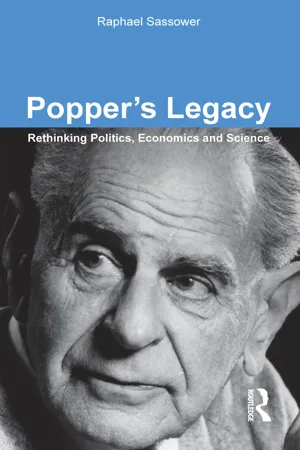
The work of Karl Popper has had extraordinary influence across the fields of scientific and social thought. Widely regarded as one of the greatest philosophers of science of the twentieth century, he was also a highly influential social and political philosopher, a proponent and defender of the "open society". "Popper's Legacy" examines Popper in the round, analysing in particular his moral and psychological insights. Once Popper's scientific legacy is couched in political and moral terms, it becomes apparent that his concern for individual autonomy does not come at the expense of institutional guidelines and social conventions. Instead, these guidelines turn out to be essential sanctions for individual freedom. Popper envisions the conduct of the scientific community as paralleling the conduct of any democratically established community. Critical rationality guides the words and actions of all participants and leadership can be replaced without violence. In presenting a critical overview, "Popper's Legacy" reveals the debt many intellectual movements - such as Marxism, feminism, and postmodernism - still owe to Popper.
Information
CHAPTER 1
The open society as liberty
Four main concerns inform this chapter: first, to provide a brief summary of some of the main ideas attributed to Popper related to social science and politics and their reception over the past century; secondly, to rehearse some of the standard critiques of his work, so as to emphasize how someone from the margins of philosophy, someone commonly associated with the Vienna Circle, was eventually taken seriously by the philosophical establishment and appreciated on all fronts; thirdly, to illustrate the relevance of his ideas about politics and freedom to the increased popularity of his ideas about scientific methodology; and fourthly, to assess his critical rationalism as an ideology and guide for political leadership and institutions.
A brief survey
The Open Society and Its Enemies (Popper [1943] 1966) became an event more than just a book published during World War II. What made this two-volume book such a sensation was its clear line of demarcation, a methodological device Popper has used so effectively in his discussion of the philosophy of science. Epictetus did the same: let us divide the world and life, he said, into those things that are within our control and those which are not; the trick is, of course, figuring out what events and issues fall into either category. In a brilliant move, Epictetus provides us with a road map, a scale and a benchmark, while shifting the responsibility to us to decide which items or events belong to which category. It seems simple at first, every student can understand the line of demarcation, but it becomes a difficult task, as all students realize halfway into the reading, when it is up to them to decide whether being students taking a philosophy course is or is not within their control (so that whatever grade they receive should or should not be within your control, too). Once students wake up in the middle of the process, the tables have turned on them, so to speak, so any climate of victimhood is obviously inappropriate: is this within your control or not? How would you know ahead of time? How do you approach your life's decision within this matrix?
Popper uses the same device: all societies are divided into two kinds - closed and open. Here are the lines of demarcation, here are the criteria according to which one decides which society belongs in which camp, and it is now up to us to apply the criteria and figure out which societies are more open or less, and then expect different things to occur within each one of them. The burden, so to speak, is put squarely on the shoulders of the assessors, so that the self-proclamations of the heads of state or political leaders are discounted from the start. But in order to set up this theoretical framework, Popper offers us the history of philosophy, just as anyone since Hegel has done. The use of history, we all agree, is a tricky undertaking, since one can be selective and thereby manipulative in doing so. Is this necessarily incorrect? Probably yes, if one believes that history provides a uniform and incontestable narrative that is absolutely true; probably no, if one is aware, since the nineteenth century, that narratives are made by people who have agendas and their own perspectives (consciously or subconsciously) so that they might make different choices to support their views.
Where does Popper rest? Surely he is guilty of choosing what fits his theoretical framework. So, now we have a choice to make. Either we can study the framework and appreciate its potential usefulness or we can analyse the examples he uses to bolster or support this framework, and, if found wanting, discard the entire framework. Some scholars have chosen the former strategy, others the latter. Some have argued that since Popper is not an expert in the history of ideas, anything he says about Socrates and Plato, Hegel and Marx should be doubted and ignored. Others have said that even although Popper might be wrong in this or that interpretation of the texts, his overall view is of interest and should be considered for its own merit. Why, then, use the historical record to begin with? There is something about the European upbringing and tradition that compels intellectuals to pay homage to their elders, pay tribute to their forefathers (even if they disagree with them), and acknowledge that one's own ideas have a history and as such rely on the ideas of others. So, there is a difference between gesturing to the icons of the history of ideas, misusing their words to fit one's own, or finding nuggets of wisdom in what they said as illustrations for what is currently problematic and symptomatic of one's culture and its ailments.
Writing, as he did, during World War II, in exile (New Zealand), and outside the machinery that opposed the forces of fascism in Europe, probably was the best Popper could do for the war effort, so to speak. One can raise a sword, a gun, or a pen; obviously the pen seems powerless against the sword and the gun, as Stalin is reputed to have claimed when he challenged the Pope's position in regards to dictating treaties to end the war (how many divisions does he have under his control?). But Popper's pen, in a manner of speaking, turned out to be quite powerful, after all. As he says in the Preface, written in 1950:
Although much of what is contained in this book took shape at an earlier date, the final decision to write it was made in March 1938, on the day I received the news of the invasion of Austria. The writing extended into 1943.
([1943] 1966, viii)
Popper admits that this was an emotional undertaking, one that took on a "harsher" tone and critical approach just because the times were emotional. One had to stand tall and face fascism in the manner it had never been faced before; eventually, one had to face communism of the Soviet kind in a likewise manner, as reports of the gulags were forthcoming, and the massacres of millions of citizens under the Soviet rule were compared to the atrocities of the Nazis. One had to answer the questions, Is your own society "open" or "closed"? How would you know? Under what conditions can you make the assessment? Perhaps a bit of history could help; perhaps historical records could be culled so as to bring about a reassessment of the political conditions of the twentieth century. Socrates was a democrat, Plato was not! Socrates believed in the intrinsic value of an open-ended dialogue, where the truth remained as elusive as the next argumentative move. Plato believed in a blueprint of a state, where everyone knew his or her role and position, where you could prefigure where and why you belonged in what social group or class; all you had to do is know your proper place. It is in this sense, then, that this society is closed. I shall refrain from analysing the details of Popper's scholarship concerning ancient Greek philosophy in general and his textual analysis of Socrates and Plato in particular. Suffice here to say that it's a useful cognitive device to claim a distinction between the two so as to illustrate some concerns Popper has with his contemporary culture.
Popper explains already in his Introduction to The Open Society and Its Enemies that his distinction between the open and closed society is one related to the history of civilization, so that his own contribution
attempts to show that this civilization has not yet fully recovered from the shock of its birth - the transition from the tribal or "closed society", with its submission to magical forces, to the "open society" which sets free the critical powers of man.
(Ibid.: 1)
And in order to illustrate the shift from one to the other, it also answers the question raised above about the conditions under which such a transformation would be possible:
It analyses the principles of democratic social reconstruction, the principles of what I may term "piecemeal social engineering" in opposition to "Utopian social engineering" . . .
(Ibid.)
It is in these opening passages that Popper already alludes to his The Poverty of Historicism (1957) where he argues forcefully about the misapplication of the scientific method to the social sciences in general and to political institutions in particular. As he explains, there is a distinction between scientific prediction and historical prophecy, and when political philosophers or leaders confuse the two, they become guilty of closing the society to any future re-examination or reconstruction.
In The Poverty of Historicism, Popper provides a set of arguments that connect and distinguish between the method used in the natural sciences and the one used in the social sciences. Clearly, one aim of such an exercise is to set a line of demarcation between science and non-science. But in addition, this kind of approach also alerts us to the inapplicability of one method whose effectiveness in physics, for example, remains indisputable (in terms of theoretical breakthroughs illustrated over the historical record as well as useful applications over time) when applied to the social sciences. In going about his survey, Popper terms historicists all those who advocate the view that historical prediction is the principal aim of the social sciences (1957: 3). Obviously, there are differences between the laws of nature, as they are called, because of their absolute uniformities, regardless of geographical and demographic differences, while the "laws of social life" depend to a large extent on historical conditions and the particular situations under which we live (Ibid.: 5).
Popper suggests the criteria according to which one can distinguish or realize the difference between one set of laws and the other, the ones associated with physical as opposed to social laws. They include generalization, experimentation, novelty, complexity, inexactitude of prediction, objectivity and valuation, holism, intuitive understanding, quantitative methods and essentialism versus nominalism (Chapter 1). Instead of following all the details of these features and their related characteristics when applied to either set of laws, let me briefly offer the main line of argument that is threaded through them.
Unlike astrophysicists who can construct a model of celestial movement to explain their observations and then predict, with a great deal of precision, the movement or appearance of a particular planet in the future, social scientists find themselves observing, explaining and predicting future events in a manner that influences their pronouncements: theirs turn out to be self-fulfilling prophecies. Referring to ancient myths and narratives, Popper has this to say:
The idea that a prediction may have influence upon the predicted event is a very old one. Oedipus, in the legend, killed his father whom he had never seen before; and this was the direct result of the prophecy which has caused his father to abandon him. This is why I suggest the name "Oedipus effect" for the influence of the prediction upon the predicted event (or, more generally, for the influence of an item of information upon the situation to which the information refers), whether this influence tends to bring about the predicted event, or whether it tends to prevent it.
(Ibid.: 13)
Sure enough, Popper continues his psychological journey into historical legends so as to remind us not so much about Oedipus's love for his mother, as a son and protector, as a sexual perversity or fantasy, but about the influence that a prediction has on those listening to it. Although there is some "indeterminacy" in the physical sciences (Ibid.: 14), an observer cannot "cause" a physical event to take place, or prevent it from doing so, in the sense that one can and often does interfere in the social sciences when public announcements about war or famine, inflation or food shortage do indeed accelerate or retard these prophecies from taking shape. Moreover, one can compare the social sciences to biological science where mutual influence among the variables necessitates a holistic approach, one that can appreciate evolution, for example, as a process that combines variables not simply reduced to individual, causal relations, so that historicism is akin to an "organic theory" rather than a physical theory (Ibid.: 17-19). When social life is studied under these circumstances and is explained in this manner, one must also appreciate the notion of "tacit knowledge" popularized by Michael Polanyi (1958) that is prevalent in societies, a way to appreciate social trends and behaviour that are not reduced to causal elements and processes one can deconstruct after the events have occurred.
Popper distinguishes between two kinds of predictions, those "about an event which we can do nothing to prevent. I shall call such a prediction a 'prophecy' . . . [T]echnological predictions . . . form a basis of engineering. They are, so to speak, constructive, intimating the steps open to us if we want to achieve certain results" (1957: 43). This distinction is what forms the basis of his distinction between open and closed societies (as we shall see below). But the distinction is not as strict or clear-cut, after all. As Popper admits: "All social engineering, no matter how much it prides itself on its realism and on its scientific character, is doomed to remain a Utopian dream" (Ibid.: 47). As far as he is concerned, social reality as seen historically never complies with a rational construction, a plan or an agenda, Platonic or otherwise. Instead, there are conflicts and specific situations that come about in a manner that disrupts and changes any idea or plan, no matter how rational. In making this argument, Popper criticizes Plato's notion of "a powerful philosopher-king who would put into practice some carefully thought out plans" as a fairy-tale as well as its so-called democratic equivalent fuelled by the "superstition that enough people of good will may be persuaded by rational argument to take planned action" (Ibid.). By contrast, he suggests, "Social midwifery [Socrates' method] is the only perfectly reasonable activity open to us, the only activity that can be based upon scientific foresight" (Ibid.: 49). And the scientific insight and foresight that are relevant to the social sciences, turn out to be the method of trial and error, the method that encourages rational criticism, the kind that exposes mistakes and allows us to make the kind of theoretical and practical changes from which we can learn for future reference (Ibid.: 57).
Popper's recommendation tor the social sciences is to maintain the bare minimum of reference to the natural sciences in methodological terms. Since a methodology that claims explanatory and predictive powers as precise and universal as those found in the history of science is untenable, Popper switches to a technological approach to sociology and the other social sciences. When recommending piecemeal engineering, piecemeal technology and social technology as methods and approaches to the seeming complexity of social phenomena, Popper warns against "scientism", a phrase he attributes to his colleague Hayek, which is a "dogmatic methodological naturalism", so reductive and unrealistic that it undermines the credibility and even beauty found in the natural sciences and the methods they employ (Ibid.: 60). The "misguided effort to copy these methods" (Ibid.: 105), is fundamentally bound to undermine any potential success that could be associated with the social sciences. But even piecemeal engineering as a method is problematic, as Popper confesses in one of his notes. Once again, he attributes to Hayek the insight that even in engineering one must see the entire theoretical framework to make minor changes, and that all the relevant details are interconnected in multiple ways, that simply focusing on one area or one detail is bound to be a mistake (Ibid.: 64). Popper's rejoinder is of interest here: "The piecemeal technologist or engineer recognizes that only a minority of social institutions are consciously designed while the vast majority have just 'grown', as the undersigned results of human actions'' (Ibid.: 65). Obviously, most institutions, even when not formally designed, have some functional purpose that corresponds to human needs and wants, and that thereby can be rationally examined. If they had no function whatsoever, these institutions would wither away in a quasi-Darwinian manner, and not make it into the next evolutionary step of their existence.
Socrates and Plato are never too far from Popper's analysis:
The piecemeal engineer knows, like Socrates, how little he knows. He knows that we can learn only from our mistakes. Accordingly, he will make his way, step by step, carefully comparing the results expected with the results achieved, and always on the look-out for the unavoidable unwanted consequences of any reform; and he will avoid undertaking reforms of a complexity and scope which make it impossible for him to disentangle causes and effects, and to know what he is really doing.
(Ibid.: 67)
Socrates, who was told by Chaerephon that the oracle of Delphi told him that no one was wiser than Socrates, claimed that his unpopularity was not due to this pronouncement alone, but that indeed it was based simply on the fact that he didn't think he knew what he didn't know (a minimalist definition of knowledge and wisdom, rather than an expansive one about the accumulation of facts; see Apology: 21, Plato). And here he is, not the midwife of ideas, but the seeker of truth who has no prefigured set of ideas or planned society. Popper's preferred method of trial and error, of small changes and reforms that themselves are prone to be misguided but easily corrected, is revisited with Socrates in mind. It is in this sense, then, that Popper explains the difference between the historicist Utopian vision and prophecy and his own piecemeal engineering as something that "in practice, [turns out] to be a difference not so much in scale and scope as in caution and preparedness for unavoidable surprises" (1957: 69). This is the same difference one finds between the holist and the piecemeal engineer, "while the piecemeal engineer can attack his problem with an open mind as to the scope of the reform, the holist cannot do this; for he has decided beforehand that a complete reconstruction is possible and necessary" (Ibid.). One can detect here the eventual criticism Popper levels against both Hegel and Marx, albeit in their respective contexts and for different textual and intellectual details. This is how Popper concludes his remarks:
This, we may say, is the ...
Table of contents
- Cover
- Half Title
- Title
- Copyright
- Contents
- Acknowledgements
- Original Title
- Original Copyright
- Introduction
- 1 The open society as liberty
- 2 Capitalism as economic equality and freedom
- 3 Methodology as applied to individualism
- 4 The predicament of applied Popperianism
- Select bibliography
- Index
Trusted by 375,005 students
Access to over 1.5 million titles for a fair monthly price.
Study more efficiently using our study tools.
Frequently asked questions
Yes, you can cancel anytime from the Subscription tab in your account settings on the Perlego website. Your subscription will stay active until the end of your current billing period. Learn how to cancel your subscription
No, books cannot be downloaded as external files, such as PDFs, for use outside of Perlego. However, you can download books within the Perlego app for offline reading on mobile or tablet. Learn how to download books offline
Perlego offers two plans: Essential and Complete
- Essential is ideal for learners and professionals who enjoy exploring a wide range of subjects. Access the Essential Library with 800,000+ trusted titles and best-sellers across business, personal growth, and the humanities. Includes unlimited reading time and Standard Read Aloud voice.
- Complete: Perfect for advanced learners and researchers needing full, unrestricted access. Unlock 1.5M+ books across hundreds of subjects, including academic and specialized titles. The Complete Plan also includes advanced features like Premium Read Aloud and Research Assistant.
We are an online textbook subscription service, where you can get access to an entire online library for less than the price of a single book per month. With over 1.5 million books across 990+ topics, we’ve got you covered! Learn about our mission
Look out for the read-aloud symbol on your next book to see if you can listen to it. The read-aloud tool reads text aloud for you, highlighting the text as it is being read. You can pause it, speed it up and slow it down. Learn more about Read Aloud
Yes! You can use the Perlego app on both iOS and Android devices to read anytime, anywhere — even offline. Perfect for commutes or when you’re on the go.
Please note we cannot support devices running on iOS 13 and Android 7 or earlier. Learn more about using the app
Please note we cannot support devices running on iOS 13 and Android 7 or earlier. Learn more about using the app
Yes, you can access Popper's Legacy by Raphael Sassower in PDF and/or ePUB format, as well as other popular books in Philosophy & Philosophy History & Theory. We have over 1.5 million books available in our catalogue for you to explore.