Throughout history, humans have always indulged in certain irrationalities and held some fairly wrong-headed beliefs. But in his newest book, philosopher Lee McIntyre shows how we've now reached a watershed moment for ignorance in the modern era, due to the volume of misinformation, the speed with which it can be digitally disseminated, and the savvy exploitation of our cognitive weaknesses by those who wish to advance their ideological agendas. In Respecting Truth: Willful Ignorance in the Internet Age, McIntyre issues a call to fight back against this slide into the witless abyss. In the tradition of Galileo, the author champions the importance of using tested scientific methods for arriving at true beliefs, and shows how our future survival is dependent on a more widespread, reasonable world.
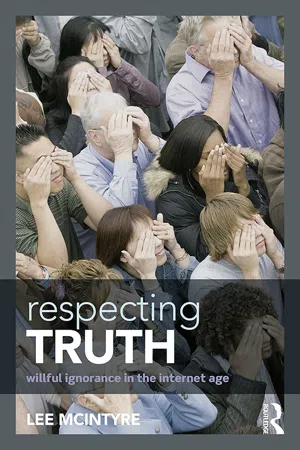
- 150 pages
- English
- ePUB (mobile friendly)
- Available on iOS & Android
eBook - ePub
About this book
Information
1 ATTITUDES TOWARD TRUTH Willful Ignorance and the Last Glimpse of Shoreline Willful Ignorance and the Last Glimpse of Shoreline
DOI: 10.4324/9781315713168-1
All truth passes through three stages. First it is ridiculed. Second, it is violently opposed. Third it is accepted as being self-evident.Schopenhauer
The human relationship with truth is a complex one. On the one hand, most of us believe strongly in the concept of truth and may even grow upset when we feel that it is being withheld from us: when our government lies to us, when a doctor substitutes happy talk for a genuine diagnosis, when despite overwhelming evidence a child abuser pleads “not guilty” at trial. On the other hand, most of us can also be counted on to resist or even actively disbelieve in some truths that we just do not want to accept: that we cannot balance the federal budget unless we raise taxes and cut entitlement programs, that the mole on our back really is cancer, that even the most heinous criminals are entitled to a defense at trial. But what to say, then, about those cases in which—if we are rational beings—such dissonance should be resolved on the spot, because we have the truth right in front of us … yet we resist it anyway? Why is there so much difficulty not only in finding the truth, but in accepting it once it has been discovered? It is the latter sort of problem that I will be concerned with in this book.
One might think that belief in truth—as opposed to its discovery—would be a fairly trivial matter. For despite our reluctance to hear unwanted truths, it seems plausible that the deep-seated countervailing human desire to know the truth would eventually result in acceptance, once things were demonstrated to us. But of course, with humans it is never quite so simple. As the history of science has shown us, the discovery of truth is hard, but the acceptance of truth can be even harder.1
But we have always known this. Even when science (and philosophy) were in their infancy, human nature was already going strong. In Plato’s dialogue Euthyphro, we see the great Socrates admonish a callow young fellow for professing to know something that he is in no position to know: what is “righteousness”?2 Throughout the dialogue, Socrates demonstrates again and again that Euthyphro has no idea what he is talking about, when he argues that it would be righteous for him to prosecute his own father for murder, given some pretty shoddy evidence and the fact that Euthyphro cannot even define the meaning of righteousness. One might think that Socrates is so adept at this kind of questioning and verbal humiliation—which is his standard method throughout the dialogues—because he himself knows the answers to the questions he is asking. But, when challenged in this way, Socrates always demurs and says that he himself has no wisdom, but is only a kind of “midwife” who can help others to seek it. Even though the goal of philosophy is to find the truth, Socrates customarily professes ignorance.
Why is this important? Here Plato is teaching a central lesson about the philosopher’s search for knowledge that will have later ramifications not only for science but also for any subsequent quest for true belief. The real enemy of truth is not ignorance, doubt, or even disbelief. It is false knowledge. When we profess to know something even in the face of absent or contradicting evidence, that is when we stop looking for the truth. Which is more likely to stand in the way of truth, Socrates wonders, ignorance or the conviction that we do not need to learn anything new? It is the hubris of the latter point of view that is the real problem. If we are ignorant, perhaps we will be motivated to learn. If we are skeptical, we can continue to search for answers. If we disbelieve, maybe others can convince us. And perhaps even if we are honestly wrong, and put forward a proposition that is open to refutation, we may learn something when our earlier belief is overthrown. But when we are willfully ignorant—when we refuse to consider new data because nothing could convince us to abandon what we already believe—that is when truth is most in danger. When we choose to insulate ourselves from any new ideas or evidence because we think that we already know what is true, this is when we are most likely to believe a falsehood.
In the search for truth, it is not mere disbelief that explains why truth is so often disrespected. It is one’s attitude.
The Problem of Willful Ignorance
Our problems with truth are many. Not only are we often ignorant of it, or careless in not bothering to use reliable methods to find it, but we also sometimes actively choose not to believe things even when we know full well that they are probably true or have within our reach easily available sources of information that would enable us to find out. In one of the 2008 Republican presidential primary debates, the candidates were asked to raise their hands if they did not believe in evolution; Senator Sam Brownback, Governor Mike Huckabee, and Representative Tom Tancredo did so. In the 2012 political cycle, Sen. Rick Santorum, Rep. Ron Paul, and Gov. Rick Perry became fond of saying that global warming is a “hoax.” When asked to clarify his views Perry said:
I do believe that the issue of global warming has been politicized. I think there are a substantial number of scientists who have manipulated data so that they will have dollars rolling into their projects. I think we’re seeing it almost weekly or even daily, scientists who are coming forward and questioning the original idea that man-made global warming is what is causing the climate to change.3
And while the eventual Republican nominee, Mitt Romney, had this to say in June 2011:
I don’t speak for the scientific community, of course. But I believe the world’s getting warmer. I can’t prove that, but I believe based on what I read that the world is getting warmer. And number two, I believe that humans contribute to that … so I think it’s important for us to reduce our emissions of pollutants and greenhouse gases that may well be significant contributors to the climate change and the global warming that you’re seeing.4
By August 2011, he appeared to have changed his position:
My view is that we don’t know what’s causing climate change on this planet … and the idea of spending trillions and trillions of dollars to try to reduce CO2 emissions is not the right course for us.5
That same month Jon Huntsman, the only Republican candidate who was willing to stand up for science, tweeted “I believe in evolution and trust scientists on global warming. Call me crazy.” After polling in single digits for a few more months, Huntsman dropped out of the race in January 2012.
As if this sort of “head in the sand” approach to scientific evidence by our elected officials was not appalling enough, it is depressing to learn that the level of scientific illiteracy is perhaps even greater among the general public.
In a nationwide telephone survey conducted by the California Academy of Science in 2009, it was found that:
- 47 percent of American adults did not know how long it takes for the Earth to revolve around the Sun.
- 41 percent believed that the earliest humans lived on Earth at the same time as the dinosaurs.6
Add to this the equally depressing results of a 2007 Harris Poll which found that:
- 42 percent of American adults believe in ghosts.
- 32 percent believe in UFOs.
- 23 percent believe in witches.7
And, although it is true to say that Americans tend to be more skeptical of some basic scientific truths (like evolution) than residents of any other nation except Turkey,8 the problem of willful ignorance is far from an American-only problem. In a 2008 British poll it was found that:
- 23 percent of Britons thought that Winston Churchill was a myth, while 58 percent believed that Sherlock Holmes was real.
- 47 percent thought that the twelfth-century English king Richard the Lionheart was a myth.9
But what makes us think that such incredible beliefs have anything to do with the problem of willful ignorance and are not just the result of plain old ignorance? Some of our fellow citizens and politicians, that is, could just be incredibly stupid when it comes to reasoning about scientific (and historical) matters. What is there beyond the falsehood of the views expressed above that leads us to believe that they not only contradict the truth, but show contempt for it?
Ignorance is the lack of true knowledge. Willful ignorance is something more. It is ignorance coupled with the decision to remain ignorant. In saying this, it is tempting to believe that if one is willfully ignorant then one must know that one is ignorant, thereby revealing a bit of savvy whereby, presumably, one knows that there is some truth out there that one wants to be insulated from. A good example of this might be our suspicion that a vast majority of the people who ran for the Republican presidential nomination in 2012 did not actually believe the nonsense that they spouted about global warming, but instead merely pretended to believe it, so that they would appeal to those voters who were actually ignorant.10 But this is not willful ignorance; this is dishonesty. Instead, to be truly willfully ignorant, one could neither disbelieve in the truth (for, after all, one could simply think that one’s mistaken beliefs were correct), nor affect the mere pretense of disbelieving (for that is to look at the truth with one eye and pretend not to see it). Willful ignorance is instead marked by the conviction to shut both eyes against any further investigation, because one is so firm in one’s belief that any other sources of knowledge are not needed. Here one is not only ignorant but (like Euthyphro) prefers to remain so. One does not in any sense “know” the truth (even with one eye), even though one probably does suspect that there are further sources of contravening information out there. Yet these are rejected, because they might conflict with one’s favored beliefs; if there are other sources of information, they must be ignored. This is why the false beliefs cited in the polling results show more than just ignorance. For when there are such easily available sources of accurate information out there, the only excuse for such stunning ignorance is the desire to remain so; one has actively chosen not to investigate. More than mere scientific illiteracy, this sort of obstinacy reflects contempt. But why would someone embrace such a hostile attitude toward the truth?
The answer to this question is complicated and will require the remainder of this book to address it fully. But already, we may settle the matter of whether willful ignorance is a reasonable approach to the problem of trying to form true beliefs, for most certainly it is not. To reject possibly refutatory sources of information—only because they might contradict one’s beliefs—is wrong. Worse, it is irrational.11 It is fundamental to scientific judgment that one could always be wrong. Because scientific judgment (and, one presumes, many other forms of rational judgment) are based on evidence, it is always theoretically possible that some further information will come along that will refute one’s hypothesis. If one’s beliefs are based on evidence in the first place, they should be open to revision or refutation based on further investigation. The problem with willful ignorance is not just that it will likely lead to false beliefs, but that it relies on a standard of reasoning that foregoes the possibility of correcting one’s beliefs in the future. But we should not so easily give up on the search for truth. Instead, we should embrace the methods of critical reasoning that are used by science to make our beliefs better (and truer) over time. Even where we may not be able to find the truth, we can at least approach it.
To reject this method in favor of dogmatism is not just ignorant, nor even dishonest. It is instead to show contempt for the standards by which true beliefs are formed. Truth is not discovered by happenstance, nor merely by having the right theory. It is a result of openness to new data, whereby one is constantly correcting one’s opinion over time, because this is a method that has proven itself in the past to lead to true beliefs. To shut oneself off from new sources of information is to be hostile to the truth. Even if one happened to be right about some matter of opinion (like the proverbial stopped clock that is right twice a day), one’s opinions arguably still would not be “true” if they were arrived at by accident, rather than produced by a procedure that could be justified as reliable.
The problem with willful ignorance, therefore, is not mere ignorance of any particular facts about astronomy or biology, but rather a pervasive hostility to searching out reliable methods of gaining true beliefs, which demonstrates a lack of respect for the concept of truth in the first place. It reflects a willingness to cling to falsehood even when good sources of information are easily within our reach. Beyond being wrong, one’s beliefs will likely end up being irrational. The problem with willful ignorance isn’t mere ignorance of the truth; it is the “willfulness” that is troubling.
The Human Relationship to Truth
As we have seen, our relationship to truth is complicated. We can actively search for it, accept it when we see it, doubt it, reject it, disbelieve it, spin it, outright lie about it, keep it a secret, remain indifferent to it, choose to remain ignorant of it, or pretend that it isn’t there. The interestin...
Table of contents
- Cover Page
- Half Title Page
- Title Page
- Copyright Page
- Dedication
- Contents
- Preface
- Acknowledgements
- 1 Attitudes Toward Truth: Willful Ignorance and the Last Glimpse of Shoreline
- 2 The Value of Truth: Should My Genes Care Whether I Can Justify My Belief That a Tiger is Coming Toward Me?
- 3 The Roots of Human Irrationality: Behavioral Economics, Self-Deception, and Lawn Chair Larry
- 4 The Assault on Truth and the Triumph of Ideology: The Flying Spaghetti Monster, Climate Change, and the “Myth” of Race
- 5 Sources of (Mis)information: Why the Media Worship Objectivity but the Ivory Tower Rejects Truth
- 6 Sources of Hope: The Wisdom of Crowds, Group Benefits, and Why Wikipedia is More Reliable than You Think
- 7 A More Reasonable World: Better Living Through Empirical Social Science
- Selected Bibliography
- Index
Trusted by 375,005 students
Access to over 1.5 million titles for a fair monthly price.
Study more efficiently using our study tools.
Frequently asked questions
Yes, you can cancel anytime from the Subscription tab in your account settings on the Perlego website. Your subscription will stay active until the end of your current billing period. Learn how to cancel your subscription
No, books cannot be downloaded as external files, such as PDFs, for use outside of Perlego. However, you can download books within the Perlego app for offline reading on mobile or tablet. Learn how to download books offline
Perlego offers two plans: Essential and Complete
- Essential is ideal for learners and professionals who enjoy exploring a wide range of subjects. Access the Essential Library with 800,000+ trusted titles and best-sellers across business, personal growth, and the humanities. Includes unlimited reading time and Standard Read Aloud voice.
- Complete: Perfect for advanced learners and researchers needing full, unrestricted access. Unlock 1.5M+ books across hundreds of subjects, including academic and specialized titles. The Complete Plan also includes advanced features like Premium Read Aloud and Research Assistant.
We are an online textbook subscription service, where you can get access to an entire online library for less than the price of a single book per month. With over 1.5 million books across 990+ topics, we’ve got you covered! Learn about our mission
Look out for the read-aloud symbol on your next book to see if you can listen to it. The read-aloud tool reads text aloud for you, highlighting the text as it is being read. You can pause it, speed it up and slow it down. Learn more about Read Aloud
Yes! You can use the Perlego app on both iOS and Android devices to read anytime, anywhere — even offline. Perfect for commutes or when you’re on the go.
Please note we cannot support devices running on iOS 13 and Android 7 or earlier. Learn more about using the app
Please note we cannot support devices running on iOS 13 and Android 7 or earlier. Learn more about using the app
Yes, you can access Respecting Truth by Lee McIntyre in PDF and/or ePUB format, as well as other popular books in Philosophy & Epistemology in Philosophy. We have over 1.5 million books available in our catalogue for you to explore.