![]()
1
Intimate entanglements: new media in Asia
Larissa Hjorth and Olivia Khoo
When we think of new media today, an image of the ubiquitous smartphone user comes to mind. New media, entangled with gestures of intimacy, are increasingly becoming mainstream as mobile devices further embed within our everyday spaces. In each location, new media is shaping, and being shaped by, place in different ways. Haunted with traces of older media, what constitutes new media today is changing as mobile devices afford new access to multimedia tools and networks once unimagined. This is especially the case in Asia, the world’s largest and most populous continent, where the consumption and production of new media has been the most palpable.
The undulating growth of ICTs (Information and Communication Technologies) has accompanied the uneven, multiple and contested “soft power” of the region. ICTs have played a key role in the rise of the region as well as its transnational collaborations and reframing of national boundaries (Berry et al. 2009; Otmazgin 2013). In India, one can find the third biggest group of users of Facebook with over 57 million users. In Indonesia, there are nearly 43 million Facebook users in a nation that has been dubbed “Twitter Nation.” In China, where Facebook is banned everywhere except in Shanghai’s newly demarcated free-trade zone (FTZ), a healthy diet of QQ, Weibo, WeChat and Jiepang dominate, highlighting the diversity of media-rich social networks and the significance of mobile media. For many of the older Chinese users, the mobile phone has been their only portal for the online, especially through QQ, which for many is synonymous not just with the social media but also the Internet. With a strong shanzhai (copy) phone culture that keeps smartphone prices down, we see over 420 million of China’s total of 564 million online users accessing the Internet from their mobile. Chinese artist Ai Weiwei has deployed the power of Twitter (with over 220,000 followers) to fuse art and politics with new media. In Vietnam, art space Sán Art questions the governmental regulations of the online while the media-savvy strategies of “The Propeller Group” challenge governmental historical “truths.”
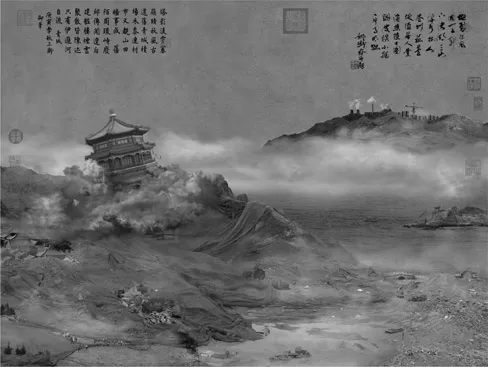
Against the backdrop of Asia’s high consumption and innovative uses of new media, the region is also home to much of the world’s production of online and mobile technologies, as witnessed in the exposé of Foxconn’s inhumane working conditions in Chinese factories producing the world’s Apple products. The impact of ICT e-waste has brought about new narratives concerning media and the environment. In recent years a visual culture of environmental deterioration has emerged intertwined with the accelerated rate of ICTs. Artists such as China’s Yao Lu have intercepted the new media visualizations of accelerated climate change by overlaying the traditional with the contemporary. At first glance, Yao Lu’s photographs of landfill look like traditional Chinese paintings. But instead they are the reality of post-industrial new media consumption where the impact of material and immaterial waste and storage is yet to be fully acknowledged.
Figure 1.1 Yao Lu, The Beauty of Kunming (2010), from the “New Landscapes Part III” series
(Courtesy of the artist)
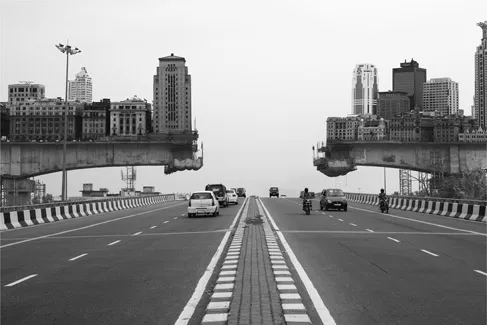
While a decade ago much of the discussion of new media in Asia was couched in Occidental notions of Asia as a “default setting” for technology in the future (Morley and Robins 1995), today we are seeing a much more complex picture of contesting new media practices and production. Asia is home to the world’s first example of mainstream mobile Internet in Japan over 15 years ago. With strong production and consumption patterns the region’s various and contesting social and mobile media cultures play a pivotal role in everyday life. As “new media” becomes increasingly an everyday reality for young and old across Asia through smartphones and their copies, boundaries between art, new media, and the everyday are transformed. From divergent gaming cultures in China, South Korea and Japan (Hjorth and Chan 2009) to new media artists like China’s Cao Fei and India’s Gigi Scaria, Asia’s diverse new media practices are as uneven as they are dynamic.
This Handbook seeks to address the historical, social, cultural, political, philosophical, artistic and economic dimensions of the region’s new media. Through an interdisciplinary revision of both “new media” and “Asia” the Handbook seeks to provide new insights into the complex and contesting terrains of both notions.
Figure 1.2 Gigi Scaria, Face to Face (2010), inkjet print on archival paper, 63 x 44 inches
(Courtesy of the artist)
New media in Asia
Chapters in the Handbook explore new media politics, practices and paradigms across South, Southeast and East Asia. We do not define Asia according to strict geographical demarcations or boundaries but follow the flows and circuits of new media production and consumption between and across the region considered expansively. While often referred to as a geographic reality, Asia is a discursively constructed entity with a “historically invented geography” (Ching 2000, 238). Taking cognizance of longstanding as well as newly emergent regional dynamics, we seek to explore and problematize theories around place and locality, especially through notions such as diaspora and transnationalism, which continue to impact on how “Asia” has been and is today conceptualized.
From the Asian financial crisis of the late 1990s to the rise of China and India, the last two decades have seen increased trade and cultural connections between Southeast Asian nations (ASEAN) and China, India, Hong Kong, Japan, Korea and Taiwan. Prasenjit Duara notes that while Asia was historically linked terrestrially, and later by maritime silk routes, the new trade and cultural linkages across contemporary Asia “represent a kind of networked region” (2015, 15). Duara’s description of Asia as a networked region made up of “overlapping, intersecting networks, hubs and hinterlands” (2015, 15), is especially appropriate for encapsulating the forms of digital connectivity we are interested in exploring in this volume, together with their attendant political, economic, and socio-cultural implications. This network model is not underpinned by a notion of territorial homogenization—economic, political or cultural—in the way that Europe as a region is conceived, for instance. Rather, it enables a rethinking of various connected nodes within a wider system of global capitalism.
The pitfalls of regionalist thinking have been well noted by a range of scholars. Leo T.S. Ching (2000), for example, cautioned against a reflexive tendency towards regionalist thinking regarding Asia, suggesting that regionalism “represents a mediatory attempt to come to terms with the immanent transnationalization of capital and the historical territorialization of national economies,” on the one hand, while it also underscores “deeper structural and historical changes in the ways Asia is perceived as both a mode of production and a regime of discursive practice in the Japanese imaginary” (236). Regionalist thinking can distort or even eradicate internal differences and conflicts, including ongoing conditions of internal colonizing practices between various Asian nations.
As a contemporary networked region in Duara’s description, however, Asia represents an intermediate stage between the global and the national that might enable forms of collective engagement with a range of issues tied to the development of global capitalism, including the environmental concerns we earlier noted. It also provides a useful framework for considering the interlinked struggles between the various Occupy Movements across Asia (and the rest of the world), and other political and social protests taking place throughout the region, including the Umbrella Revolution in Hong Kong and Taiwan’s Sunflower Movement. Considering Asia as “networked,” then, is one way to confront the problems of what Ulrich Beck calls “methodological nationalism” (2005, 43), which has stymied collaborative efforts across parts of the social sciences and the humanities.
In this Handbook, the particularity of Asia, for otherwise ubiquitous or “global” new media, is that far from homogenizing the region, we acknowledge the specificity of local contexts and communities as they exist within wider flows of globalization. Attention is paid to how local sites, and the flows between them, are impacted upon by censorship, varying levels of political control, alternative formations of kinship, tradition and culture, and divergent technological capabilities and capacities.
China assumes prominence in several chapters as an important node within a networked Asia due to its sheer size and influence. In China, the Internet is run on hardware controlled by state-owned entities, which gives the Chinese government a larger degree of control over and access to Internet data than anywhere else. The rise of China as a new media production center highlights the sometimes significant level of state control over the media in Asia, as well as the dichotomy between what is considered “public” or “private” in relation to new media practices, consumption and use. Related to issues of censorship, surveillance and privacy, are rapid changes in technology that afford users of new media in Asia the ability to participate more inclusively in what might otherwise be a more constrained political environment.
When Rey Chow wrote her seminal essay on the Sony Walkman in China, “Listening Otherwise, Music Miniaturized: A Different Type of Question about Revolution,” she called for a “history of listening”—“a history of how listening and how the emotions that are involved in listening change with the apparatuses that make listening possible” (1990–1991, 143). Chow notes that while listening is traditionally public, with the portability of music wrought by devices such as the Walkman and the invention of headphones, “privacy” becomes possible as listening is interiorized. As a new technological device of the time, Chow argued that the Walkman provided a decisive break from the forms of listening in the past:
If music is a kind of storage place for the emotions generated by cultural conflicts and struggles, then we can, with the new listening technology, talk about the production of such conflicts and struggles on the human body at the press of a button. … In the age of the Walkman … the emotions have become portable.
(Chow 1990–1991, 144)
It is the ability to listen privately that
leads to a certain freedom. This is the freedom to be deaf to the loudspeakers of history. We do not return to individualized or privatized emotions when we use the Walkman: rather the Walkman’s artificiality makes us aware of the impending presence of the collective, which summons us with the infallibility of a sleepwalker.
(Chow 1990–1991, 145)
Beijing-based new media artist Liu Ding encapsulates Chow’s discussion of the Walkman as part of a new epoch in different approaches to listening. In the work 1999 (2014), 1990s popular culture music and quotes in China can be listened to from public phones.
In 1999 audiences can pick up a landline phone (pre mobile phone) to listen to music and quotes. A hybrid between headphones and mobile phone they are instead stationary receptors that transport the listener to another time. The work embodies Chow’s discussion of rendering personal and private the act of listening which had been historically always public. 1999 inverts this history of listening by deploying a non-mobile media (the landline) to blur the public with the private, and the intimate with the social, in ways that are both culturally specific and also cross-cultural. Rather than listening being mobile and private as with the Walkman, audiences are frozen in space and also in time (stuck in the nineties). The play with old and new media also evokes the importance of co-presence (especially across time) while being both mobile and still.
Figure 1.3 Liu Ding, 1999 (2014), installation view, Shanghai Biennale
(Courtesy of the artist)
Chow’s essay on the Walkman provides for us a lynchpin for how we hope the chapters in the Handbook can collectively be viewed as an attempt to historicize a field, new media in Asia, which, precisely because of its newness, is often left unhistoricized. We invited key thinkers including Chow and Leo T.S. Ching to provide reconsiderations of their earlier work, at the same time as we present a new generation of scholars and thinkers who bring their own voices and methods of “listening” to the histories and practices of new media in Asia.
The Handbook does not only provide surveys of different national contexts, although there are focused essays on national perspectives and case studies. Chapters also offer overviews of regional and sub-regional formations, as well as examinations of the interconnections and flows between local and national boundaries that have intensified with the advent and development of digital technologies, in particular the Internet since the late 1990s. Media content from throughout Asia and the rest of the world is now readily accessible through mobile phones, computers and gaming devices, which means that neither a regional nor a national approach alone are adequate in providing a picture of the rich and complex terrain that has developed across the region in the last three decades. New media in Asia, as it is conceived in this Handbook, is therefore primarily concerned with inter-Asian flows, networks and connections, rather than in perceiving how “Asia” has been constructed by and is connected to other formations outside it.
Organization
The Handbook seeks to be the definitive publication for readers interested in comprehending all the various aspects of new media in Asia. We hope it will provide a crucial reference text to inform students and scholars interested in this quickly expanding, far-reaching field of new media within the context of Asia. In this authoritative collection we seek to not only provide new insights into understanding “Asia” as a geographically, philosophically, and culturally divergent term but also the changing role of new media within the everyday lives of those who live in the region.
The Handbook is organized into six parts pertinent to the on-going theoretical and methodological development of new media in Asia. These are: “New media in Asia”; “New media cultures, politics and literacies”; “Intimate publics, screen and haptic cultures”; “Mapping mobile, diasporic and queer Asia”; “Creative industries: new producers, performativity and production paradigms”; and “Mobile, play and game ecologies in Asia.” There is slippage between the sections and they are not meant to be silos but rather more like different paralleling playgrounds for conceptual meandering. Through these six parts we seek to not only consolidate the multiple and interdisciplinary ways for understanding the region but also new media. In addition to this broad, inclusive approach, we include as comprehensive as possible authors from various locations globally including the Asia-Pacific and Europe alongside Britain and the United States—this is crucial to an understanding of new media in Asia as constituted through local, situated practices and as global technology.
Part I asks key scholars in the area to reflect upon “New media in Asia” drawing from their various disciplinary backgrounds. The first chapter in Part I, by Ani Maitra and Rey Chow, reflects on the productive epistemic contradiction that shapes the title of this anthology: “New Media in Asia.” By teasing out the tensions around new media as placeless or ubiquitous, this chapter questions the relationship between “Asia” and “new media” constructs. Underscoring their chapter are queries such as: What does the putative “Asian-ness” of new media and new media practices—if there could be such a thing—have to contribute to contemporary scholarship on new media? And when does the phrase “in Asia” stop being an adequate description for new media practices in Asia? As they argue, cultural readings of media practices can fall into another form of essentialism.
Probing cultural and situated definitions of new media is further extended by Lina Tao and Stephanie Hemelryk Donald’s “Migrant youth and new media in Asia” in which they discuss the use of new media amongst migrant youth in the Asia-Pacific region. Drawing upon extensive fieldwork conducted in China, Tao and Hemelryk Donald question who the “migrant” is and how this figure is being defined in contemporary Asian media politics. The next chapter is Leo T.S. Ching’s “Neo-regionalism and neoliberal Asia,” in which he argues that regionalism in Asia (Asianism) has been historically constructed by and associated with Japanese colonial design and postwar economic and cultural imperialism. Ching argues that such a Japan-centric regionalism is no longer feasible in describing the changing geopolitical and economic dynamism under post-Cold War neoliberal capitalism. Instead, neo-regionalist formations, characterized less by “imagined geographies” as configured through “virtual geographies,” have emerged as the new structure of feelings, especially among the digital youth.
We then turn to the role of new media during crisis through a case study of Japan in Love Kindstrand, Keiko Nishimura and David H. Slater’s “Mobilizing discontent: social media and networked activism since the Great East Japan Earth...