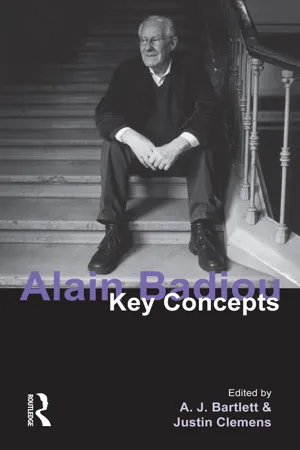
Alain Badiou is one of the world's most influential living philosophers. Few contemporary thinkers display his breadth of argument and reference, or his ability to intervene in debates critical to both analytic and continental philosophy. Alain Badiou: Key Concepts presents an overview of and introduction to the full range of Badiou's thinking. Essays focus on the foundations of Badiou's thought, his "key concepts" - truth, being, ontology, the subject, and conditions - and on his engagement with a range of thinkers central to his philosophy, including Plato, Descartes, Spinoza, Heidegger and Deleuze.
- 207 pages
- English
- ePUB (mobile friendly)
- Available on iOS & Android
eBook - ePub
About this book
Information
ONE
Biography and early works
Oliver Feltham
How can a life correspond to a proper name when that life is incomplete, its vicissitudes not exhausted, its past forever open before it? How does a mortal’s life correspond to a proper name when the name itself marks the desire for immortality? And if a mortal life has intersected more than one subject – in the Badiouean sense of the term – and if each subject is properly infinite, then what possible correspondence can be written out between one name and a life? Only a correspondence of personae, of heteronyms.
First persona: the teacher, the master. A graduate student spends a year researching his doctorate in Paris, sits in on three notorious seminars. To distinguish the lecturers he disposes of three variables, each with two values: starts late or not, dresses up or down, audience rich or poor. One starts late, dresses up and the audience is rich; another starts late, dresses up, and the audience is rich; the other starts late, dresses down and the audience is poor – which one was Miller, which Derrida, and which Badiou? Badiou avows having encountered three masters in his youth: Sartre, Althusser and Lacan, but in each text he engages in a progressive multiplication of masters: Mao and Mallarmé, Hegel and Pascal, Canguilhem, Cavaillès and Lautman, Cantor and Cohen, not to mention the seven poets of the Manifesto for Philosophy’s “Age of Poetry”. What kind of filiation is possible amidst such a multiple matrix? How many voices? How many teachings? How many proper names to integrate? Is a philosophy solely systematic to the degree that it integrates its proper names or to the degree that it makes them resonate?
Second persona: the tragic voice. The preface to Théorie du sujetannounces an “I” who stands alone in a philosophical desert. In his Deleuze Badiou speaks of the reception of that very book; “Deleuze sent me a favourable note which was very touching given the public solitude in which I found myself … the silence, the absolute disdain for what I was trying to do in philosophy” (D 9). In the introduction to Beingand Event Badiou confesses “I groped around for several years among the impasses of logic – developing close exegeses of the theorems of Gödel, Tarski and Löwenheim-Skolem – without surpassing the frame of Théorie du sujet save in technical subtlety. Without noticing it I had been caught in the grips of a logicist thesis … I had mistaken the route” (BE 5). So not only had Badiou been alone, deprived of recognition, but he had lost the way, perhaps more than once. What wilderness had he been through? And who had accompanied him – Lazarus, Mao, Gödel? Is this what led him to write: “the only definition of courage is exile without return, loss of name” (Badiou 1982: 185, my trans.)?
Third persona: the world-famous philosopher. Badiou is invited everywhere; almost as ubiquitous as Žižek, the floodgate of translations and commentary is finally opened. Rival bibliographies are published and disciples compete to publish their translations of the same article first. Badiou’s disciples get jobs, teach his texts, his interlocutors are well placed and even the BBC interviews him on Hardtalk, hamfistedly trying to pin him down as an apologist for communism. What is themeaning of Sarkozy? is a bestseller in France and the UK, and his second magnum opus, Logics of Worlds, is translated into English only three years after its French appearance, whereas the first, Being and Event,took seventeen years to arrive. In one of the early English commentaries the authors say recognition of Badiou has been slow to come in the English-speaking world. What is it for a philosopher to come to fame, or recognition, late?
Fourth persona: the brilliant radical student, the Normalien. Badiou was also famous when he was young. Well placed in the École Normale Supérieure, member of a closed seminar of students around Althusser including Rancière, Balibar, Regnault and Macherey, he published three magisterial articles in the most avant-garde journal of the day, Cahierspour l’analyse, completed television interviews with many of the major intellectuals of the day, Foucault, Aron, Hyppolite, Serres; wrote two novels before the age of twenty-eight; and his first book of philosophy, The Concept of Model, was a bestseller. What happened between that moment and his late fame? We know that May ‘68 was an event that signed a rupture with Althusser under the name of Mao, that years of activism and splintering groups followed: but for the philosopher who thinks life under the emblem of moments of intense and exceptional existence, what can this long period in between be called if its objective name is restoration? A calvary? A sustained period of self-critique – the Maoist activist’s exercise par excellence? Or a fidelity, an exile without return?
Fifth persona: Scapin. Or rather, Ahmed, the 1984 Scapin. Badiou played Molière’s Scapin in a high-school production, and sees his character, Ahmed, as Scapin’s avatar. But Scapin is a troubleshooter, a fix-it man, a mischief-making middleman, a hatcher of farcical imbroglios whose harlequin habitat is the thick of things, an interrogator and ventriloquist of each and everybody. How could he be one of Badiou’s heteronyms if the latter wrote “I practically boycott every instance of the department and the university, except my course”? (D3) What can you fix by boycotting? What milieu is Badiou in the middle of? One day, on the edge of a protest march for the s ans-papiers, I see Badiou a block away negotiating with the police, on the fly, to guarantee right of passage for the thin winding ribbon of protestors, all too vulnerable to instant arrest and expulsion from the territory. And I hear the slogan echoing between the peeling fagades of Rue Faubourg du Temple, “I am here. I am from here. I’m not moving!”, and I think this slogan, in the end, is a mediating troubleshooting middleman’s slogan, a slogan that creates its own milieu.
Teacher, solitary thinker, famous philosopher, student, middleman – in the end it is Scapin, the middleman, the fix-it man, who can make the most sense of the passage between these personae – Badiou is Scapin, that exemplary mortal, who creates as he finds his own milieu.
PART I
The foundations of Badiou’s thought
TWO
Philosophy
Oliver Feltham
Badiou is a fellow traveller – not of communism, being a Maoist, but of poststructuralism. He sympathized with its critique of philosophy’s ubiquitous presupposition of unity and identity; he sympathized with its attempt to think multiplicity. One can detect thousands of tiny post-structuralist influences in every one of his texts. For this reason it was all the more surprising – especially for the anglophone practitioners of theory and the permanent blurring of disciplinary boundaries – when Badiou suddenly called for a return to philosophy, for an end to the end of philosophy and its endless deconstruction, when he called for a restart. We were not ready. It sounded reactionary.
To understand Badiou’s call it is not enough to realize that many poststructuralists, such as Jean-Luc Nancy, never gave up on the name. The very concept and position of philosophy must be investigated in each period of Badiou’s œuvre. It is only in the third and apparently final period of his work, opened in 1985 by the text Can Politics be Thought?, that a full doctrine on the nature of philosophy is developed and promulgated, the doctrine of conditions. This chapter will briefly examine the place of philosophy in Badiou’s early work and then his Maoist period before investigating the nature of philosophy under its conditions.
Althusserian epistemology
It is possible to distinguish a short period of Althusserian epistemo-logical enquiry before Badiou’s Maoist commitment takes over in the 1970s. This period – the only one that really deserves the term “early work” – runs from 1965 to 1969, the year of publication of The Concept of Model, a text whose preface is Maoist but whose body is largely Althusserian. During this period Badiou practises a recognized form of French philosophy, epistemology in the tradition of Georges Can-guilhem and Gaston Bachelard, albeit with a Lacanian twist and a rare focus on mathematics. Philosophy itself as the name of Badiou’s discipline is not explicitly thematized. This is not to say that it was a tacit institutional background for Badiou: not only did he practise other disciplines, or rather the art of the novel, and mathematics; but the status of philosophy had become a serious problem in a seminar that he attended. The seminar was run by his early master, Louis Althusser, whose major teachings included a fundamental distinction between science and ideology. Althusser’s students – Jacques Rancière, Etienne Balibar, Pierre Macherey, Badiou, Frangois Regnault and others – were not happy about the status of philosophy with regard to this distinction.
Althusser argues that the field of theoretical practice is divided by a contradiction between science and ideology, defined in the following manner:
Science is the productive practice of knowledges, whose means of production are concepts; whilst ideology is a system of representations, whose function is pratico-social, and which auto-designates itself in a set of notions. The proper effect of science – “effect of knowledge” – is obtained by the regulated production of an object essentially distinct from the given object. Ideology on the other hand articulates lived experience (le vécu); that is, not the real relation men have to their conditions of existence, but “the manner in which men live their relation to their conditions of existence”.
(Althusser 2005b: 40; see also 239)
Philosophy is then defined as the theoretical practice that draws a line of demarcation between science and ideology. This line is not simply to be drawn between, say, the news on state television and Marxist science of history, but rather within scientific and theoretical texts themselves in so far as the latter spontaneously generate ideologies (see Althusser 1974). In his early review of Althusser’s work, Badiou cites another definition of philosophy: it is the “theory of the history of production of knowledges” (1967: 448; see Althusser 1996: vol. I, 70). These two definitions are consistent thanks to Althusser’s appropriation of Bachelard’s notion of an epistemological break. For Bachelard a science constitutes its objects of knowledge by continually separating its results from the illusions of immediate knowledge and ideological representations of its field. This process of separation is called an epistemological break or cut. Unlike Kuhn’s paradigm shift or even the shift between epistemes in the early Foucault, an epistemological cut is not chronologically situated between two stable structures of knowledge, but takes place continually as part of the very production of scientific knowledge. Indeed, Althusser appropriates it as a concept of both change and novelty. Philosophy’s central task for Althusser is thus to trace an epistemological cut in a particular scientific field; in doing so it doubles the work of science itself, recalling the Platonic definition of philosophy as the thought of thought. This should already sound uncannily familiar to adepts of Badiou’s doctrine of conditions, but the similarities do not stop here. For Althusser there is no proper object of philosophy, such as the limits of reason, or the epistemological foundations of science.1 Kant’s project, for instance, is problematic in so far as it situates philosophy as “the juridical guarantee of the rights of science, as well as its limits” (Althusser 1974: 92; see also LW 535–6). Rather, philosophy’s task is to think what exactly emerges via an epistemological cut in a particular ideological field, such as Marx’s science of history from humanist philosophy.
Badiou’s early article “Subversion infinitésimale” and his book The Concept of Model both practise philosophy in this Althusserian acceptation, carefully delimiting ideological notions of infinity and mathematical models from their properly scientific concepts (CM 5–9). However, at one point in The Concept of Model Badiou ranges philosophy under the heading of ideology and later on he claims that philosophy must practise an “an impossible relation between science and ideology” (CM 9, 50). Evidently the Althusserian conception of philosophy is unstable: philosophy is supposed to trace the division between science and ideology, but the status of philosophy itself continually falls back into either side of that division: philosophy either pretends to be a science or to be an ideology. This is the first problem Badiou encounters in his work with regard to philosophy: the problem of the status of philosophy. Perhaps this instability, this oscillation between two stable types of discourse, is due to philosophy having been defined in a dynamic manner, as a process, or rather, as the double of a process. In any case, any suspicions about the stability of Althusser’s initial conception of philosophy are immediately confirmed by the original 1969 preface to Badiou’s work that denounces the text as a “theoreticist deviation”! This self-critique clearly marks the opening of Badiou’s Maoist period. Note, however, that the charge of “theoreticism” also mirrors a turn in Althusser’s own work. In the mid-1960s Althusser positions philosophy in the field of science, fights against the French Communist Party’s silence on theoretical issues and critiques Marx’s “practicism” in Reading Capital (1996: 47–8). In 1967–8 the auto-critique of “theoreticism” as another possible deviation emerges and Althusser redefines philosophy as “the class struggle in theory” (1967: postface; see also Althusser 1974: 115; CM 50; Badiou 1992b: 42).
Ironically, it is this very definition that Badiou adopts in his departure from Althusser. Nevertheless he manages to demarcate himself from his former master by offering a far stricter Maoist interpretation of such class strugg...
Table of contents
- Cover
- Half Title
- Key Concepts
- Title Page
- Copyright Page
- Table of Contents
- Contributors
- Acknowledgements
- Abbreviations
- Excerpts
- Introduction: Badiou's form
- 1. Biography and early works
- Part I: The Foundations Of Badiou's Thought
- Part II: Badiou'S Key Concepts or "Conditions"
- Part III: Badiou's Engagement With Key Philosophers
- Afterword: Badiou's futures
- Bibliography
- Index
Trusted by 375,005 students
Access to over 1.5 million titles for a fair monthly price.
Study more efficiently using our study tools.
Frequently asked questions
Yes, you can cancel anytime from the Subscription tab in your account settings on the Perlego website. Your subscription will stay active until the end of your current billing period. Learn how to cancel your subscription
No, books cannot be downloaded as external files, such as PDFs, for use outside of Perlego. However, you can download books within the Perlego app for offline reading on mobile or tablet. Learn how to download books offline
Perlego offers two plans: Essential and Complete
- Essential is ideal for learners and professionals who enjoy exploring a wide range of subjects. Access the Essential Library with 800,000+ trusted titles and best-sellers across business, personal growth, and the humanities. Includes unlimited reading time and Standard Read Aloud voice.
- Complete: Perfect for advanced learners and researchers needing full, unrestricted access. Unlock 1.5M+ books across hundreds of subjects, including academic and specialized titles. The Complete Plan also includes advanced features like Premium Read Aloud and Research Assistant.
We are an online textbook subscription service, where you can get access to an entire online library for less than the price of a single book per month. With over 1.5 million books across 990+ topics, we’ve got you covered! Learn about our mission
Look out for the read-aloud symbol on your next book to see if you can listen to it. The read-aloud tool reads text aloud for you, highlighting the text as it is being read. You can pause it, speed it up and slow it down. Learn more about Read Aloud
Yes! You can use the Perlego app on both iOS and Android devices to read anytime, anywhere — even offline. Perfect for commutes or when you’re on the go.
Please note we cannot support devices running on iOS 13 and Android 7 or earlier. Learn more about using the app
Please note we cannot support devices running on iOS 13 and Android 7 or earlier. Learn more about using the app
Yes, you can access Alain Badiou by A. J. Bartlett,Justin Clemens in PDF and/or ePUB format, as well as other popular books in Philosophy & Philosophers. We have over 1.5 million books available in our catalogue for you to explore.