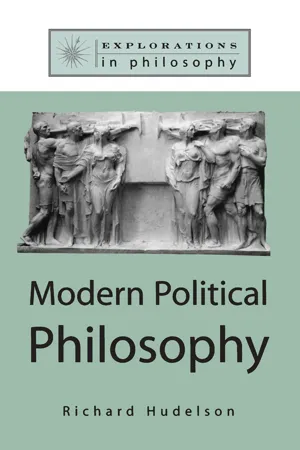
- 192 pages
- English
- ePUB (mobile friendly)
- Available on iOS & Android
eBook - ePub
Modern Political Philosophy
About this book
An introduction to the topics and issues in political philosophy, from the Enlightenment to Postmodernism. The author presents both the historical background of, and a systematic discussion of contemporary issues relating to the major traditions within political philosophy.
Information
— Chapter 1 —
Natural Rights
At ten o’clock on the night of April 18, 1775, seven hundred British soldiers under the command of Lieutenant Colonel Francis Smith began moving out of Boston. General Thomas Gage, commander in chief of British forces in North America, had commanded Colonel Smith to march “with the utmost expedition and secrecy to Concord, where you will seize and destroy all the artillery and ammunition you can find.”1 Marching at night, the soldiers could hear signal shots and the ringing of church bells as they made their way along the road toward Concord, the local residents having been warned of the coming of the British force by two dispatch riders, William Dawes and Paul Revere. Realizing that the element of surprise had been lost, Colonel Smith ordered Major John Pitcairn to go ahead with six companies of lightly armed fast infantry to try to prevent the aroused colonials from removing the military supplies from Concord.
At dawn on the morning of the nineteenth, Pitcairn’s British forces encountered a group of some seventy or eighty minutemen, local colonial militia, under the command of Captain John Parker. The men were spread in a line across the village green in Lexington, a town lying along the road between Boston and Concord. The Americans, greatly outnumbered by the British, did not attempt to block the road and had begun an orderly withdrawal when, from one side or the other, a shot was fired. At the sound of the musket, British soldiers opened fire on the Americans. Before Pitcairn’s shout to cease fire was obeyed, eight Americans had been killed and ten others had been wounded. There were no casualties on the British side.
The British force resumed its march to Concord. There the British entered the town without resistance and destroyed the few military supplies that had not been removed. After a brief exchange of fire between British and American forces at North Bridge, on the edge of Concord, with light casualties on both sides, Colonel Smith, considering his mission accomplished, ordered British troops to begin the march back to Boston. By now, however, enraged colonials from nearby towns and farms had taken up positions behind the trees and stone walls that lined the road. From these protected positions they fired at the red-coated British troops marching along the road. By dusk, when the British troops reached the safety of Charleston, more than 70 soldiers had been killed and 175 had been wounded.
What could possibly lead peaceful farmers and tradesmen to inflict deadly fire on a line of marching soldiers? To be sure, the killing of Americans at Lexington and Concord must have provoked great anger. But why did the Americans resist in the first place? Why were arms stored at Concord? Why did the local militia take up arms and line up across the green at Lexington?
The Lexington militia did not act in haste. Warned that the British were coming, they met in a tavern near the village green for several hours before the British arrived, where they discussed what to do.2 Clearly the minutemen of Lexington believed that resistance to the British was right and that the issues involved were sufficiently important to kill or be killed for their sake.
In fact, the town of Lexington had been discussing these matters for some time. In 1765, when the British government passed the Stamp Act to raise revenues in the colonies, the town of Lexington voted to instruct its representative in the General Court of the colony to protest the act. The actual instruction sent by the town, setting out reasons why the act was unjust, was written by Jonas Clarke, a clergyman and prominent leader in Lexington. It was at Clarke’s home where the colonial leaders Samuel Adams and John Hancock were staying on the night of the British expeditionary force’s move against Lexington and Concord.
In the instruction that he had written for the people of Lexington, Clarke advanced a number of different reasons for thinking the Stamp Act was unjust. He claimed that it violated the ancient right of British subjects to be taxed only with their own consent. He also maintained that the act violated the agreement between British kings and their subjects enshrined in the Magna Carta. Finally, Clarke also held that the Stamp Act violated the rights and liberties of men who were “beings naturally free.”3 Clarke’s appeal to the ancient rights of British subjects and his appeal to the Magna Carta justified resistance to the Stamp Act on historical and legal grounds. These reasons appealed to rights belonging to British subjects in virtue of their being British. Neither the ancient rights of British subjects nor the Magna Carta had anything to say about the rights of human beings who were not British subjects. By contrast, Clarke’s third argument left behind the particular claims to rights that belonged to the American colonists in virtue of their being British subjects. It claimed rights as belonging to the Americans in virtue of their status as “beings naturally free.” Here the justification of the claim to rights lies not in legal precedents established in the past but in the very nature of men as beings of a certain kind. Such rights are natural rights. They belong to men as men. (Clarke and his contemporaries did not even consider the rights of women.) They apply to Americans, to all other British subjects, to Frenchmen, to Chinese—to all men. Agreements such as the Magna Carta can create special rights, but natural rights are not created by any human agreement. They belong to men as beings having a certain nature.
In the years leading up to the American Revolution, the American colonists often appealed to the ancient rights of Englishmen embedded in the unwritten constitution that had supposedly governed English life from time immemorial. They appealed to the Magna Carta. They appealed to the specific rights guaranteed to the colonists in the charters granted by British kings in founding the American colonies. They also appealed to natural rights possessed by Americans simply in virtue of their nature as men. For example, a resolution adopted by the town of Lexington maintained that the keeping of a standing British army in the colonies to enforce the acts of Parliament was an infringement of the “natural, constitutional and chartered rights” of the colonists.4 These different arguments were mutually supporting, but the natural-rights argument was fundamentally different in scope and kind. Appealing to neither history nor legal precedent, it raised directly philosophical reasons for resisting the authority of the British government, reasons that implied rights that were universal in scope, applying to all men everywhere. It was this directly philosophical claim to universal natural rights that made the shot on Lexington green, in the words of Ralph Waldo Emerson, “the shot heard ‘round the world.”
Not only for Americans, but also for people in all comers of the world, the Declaration of Independence, adopted by the Second Continental Congress in 1776, provides an inspiring and powerful formulation of the philosophy of natural rights:
We hold these truths to be self-evident, that all men are created equal, that they are endowed by their Creator with certain unalienable Rights, that among these are Life, Liberty and the pursuit of Happiness. That to secure these rights, Governments are instituted among Men, deriving their just powers from the consent of the governed, that whenever any Form of Government becomes destructive of these ends, it is the Right of the People to alter or to abolish it, and to institute new Government.
In these words the American colonists appealed directly to rights endowed upon all men by their creator, to rights held by all men in virtue of their God-given nature as men. The American colonists did not invent this idea. The theory of natural rights has a long history running back to the works of the ancient Greek and Roman philosophers. Particularly influential on the thinking of the American colonists was the English philosopher John Locke, whose Second Treatise on government used a theory of natural rights to defend the English revolution of 1688. Indeed, the phrases of the Declaration so closely parallel passages from Locke that a fellow Virginian accused Thomas Jefferson, the principle author of the Declaration, of copying directly from Locke’s Second Treatise.5 In the discussion that follows we will sometimes turn to Locke and other philosophers in an attempt to make sense of some of the basic concepts of the philosophy of natural rights found in the Declaration.6
Rights
The Declaration of Independence claims that men have certain rights. This idea of rights is clearly one of the basic ideas of the philosophy of natural rights. We Americans often argue about what rights there are. Is there, for example, a right to die? We also argue about who has certain rights. Does the fetus in the womb have a right to life? However, despite these differences, we tend to take the idea of rights for granted. We rarely stop to ask just what a right is or what it is for a person to have a right. Now, in fact, contemporary philosophy recognizes several different kinds of rights. We will consider some of these different kinds of rights in later chapters of this book. Here, though, we will focus on a particular conception of rights that is central to the philosophy of the Declaration and to the historical core of the philosophy of natural rights.
According to this conception, a right is a moral claim belonging to an individual that prohibits all other persons from acting in certain ways toward that individual. For example, your right to life prohibits all other persons from killing you. Similarly, your right to liberty prohibits all other persons from enslaving you, kidnapping you, or holding you prisoner against your will. Such rights are often said to be moral fences: They surround people and protect them from outside interference. They are said to be “negative rights” in that they stipulate things that other people may not do in their interactions with some individual. Your right to life says that I may not kill you. My right to liberty says that you may not enslave me.
Rights protect people from outside interference. But, of course, the protection afforded by rights is not always effective. People have been murdered. People have been enslaved. The natural-rights theory does not deny these unfortunate facts of life. What it does say is that murder and slavery are serious moral infractions. This is what is meant by saying that rights are moral claims or moral fences. They stipulate things that other people should not do to you. They specify limits on how we may rightly or justly interact with one another. They also provide the basis for complaints of unjust treatment, as when the American colonists in the Declaration of Independence pointed to a series of actions by the king of England as transgressions of their rights, transgressions that justified resistance to English rule.
Natural Rights
The rights to life and liberty claimed by the Declaration prohibit people from killing or enslaving one another. In this respect these rights are like rights created by human beings. Human laws often prohibit certain kinds of actions. Murder and kidnapping are illegal. Human law forbids them, though of course this does not prevent their happening from time to time. Like the rights proclaimed in the Declaration, legal rights say how we should behave, which is not always how we do behave. Legal rights, like the rights of the Declaration, are prescriptive, not descriptive. Both prescribe certain behaviors. But since we humans sometimes fail to live up to these prescriptions, neither accurately describes how we invariably will behave. In these ways the rights claimed by the philosophy of natural rights are like legal rights. Nonetheless, there are some important differences. These differences are central to the idea of certain rights as natural rights.
The fundamental difference between natural rights and legal rights is that legal rights are created by human beings and natural rights are not. Human law may give me certain rights. For example, human law gives me the right to drive a car provided I meet certain requirements. Supposing I have met those requirements, no one may interfere with me in the lawful driving of my car. However, the legislature might decide to restrict nighttime driving for people with poor night vision, or it might, because of life-threatening problems of pollution, decide to ban automobile driving for all but emergency purposes. My right to drive a car is created by human law and may be modified or abolished by the action of a legislature composed of human beings. My natural rights are not like this.
Consider, for example, my natural right to life, a right I have independent of any human action. The Declaration says that I am endowed with this right by my creator. It belongs to me simply in virtue of my being a human being who, like all human beings, is created equally with a certain nature. It belongs to me by nature, not by human artifice. My natural right to life does not depend upon any human act of creation and cannot be taken away by any human action. Legal rights are created by human action and can be taken away by human action. An evil legislative body might pass a law denying me a legal right to life. The legislature might, correctly following the rules of parliamentary procedure, amend the human law to permit the killing of human beings of a certain kind. Something like this happened in Germany in the 1930s, when the law was changed to deny civil rights to Jews. In America, of course, any such action would violate the written constitution that governs what our legislators may do. Such an action would be illegal because it violated my constitutional rights. But suppose a constitutional amendment is passed excluding human beings with my ethnic background from the protections of the Constitution. It would then be within the power of a human legislature to take away my right to life and the right to life of all people like me. However, according to natural-rights theory, while the legislature may have stripped me of my legal right to life, it would be wrong for it to do so.
The idea of a natural right to life can be easily grasped by reflecting on the debate over abortion that has divided Americans for the last quarter century. On one side, the state legislatures and the courts have said that abortion, subject to some restrictions, is legal. The law does not recognize a fetal right to life. On the other side, opponents of abortion argue that abortion is a great moral evil because it involves the violation of a natural right to life that belongs to every human fetus. Now, not all natural-rights theorists would agree that human fetuses do have a natural right to life. Here there is important disagreement about who is included among the class of beings that have a right to life. However, thinking about the abortion controversy can help us see what is involved in claiming such a right. The fetal right to life is supposed to be a natural right. Such rights do not depend upon human creation, and while they may be violated, they cannot be destroyed by any human action.
Natural Law
We have already seen that natural rights are in some ways like legal rights. Both prohibit other people from interfering with us in certain ways. Both involve a complex network of responsibilities corresponding to the rights they claim. My natural right to life imposes a duty on you and all others to refrain from killing me. My right to drive a car imposes a duty on you and all others to refrain from interfering with my lawful exercise of that right. Legal rights exist as part of a system of laws. My legal right to drive a car and the corresponding duties of other persons are precisely spelled out by the laws governing the use of motor vehicles. In a similar way, natural-rights theorists conceive of natural rights as existing within a system of natural laws. The Declaration of Independence itself mentions “the laws of nature and nature’s god” as the basis for those rights to life, liberty, and the pursuit of happiness it goes on to claim.
These laws of nature are moral laws. They are not like the laws of nature discovered by physics and chemistry, which tell us how things invariably do act but say nothing about how things should act. Unlike the laws of chemistry and physics, but like human-created legal laws, moral laws of nature are prescriptive rather than descriptive. They tell us how we ought to behave, not how we invariably do behave.
Like many natural-rights theorists, the authors of the Declaration of Independence saw the laws of nature as God’s laws. The Declaration conceives of natural rights as part of a larger system of natural law, a body of moral law coming from God rather than from any human legislators. It is important, however, to distinguish this “natural law” from what philosophers and theologians have traditionally called “revealed law.” The biblical text known as the Ten Commandments serves as an excellent example of revealed law. According to the biblical story, these commandments were given directly to Moses by God in an encounter on the top of Mount Sinai. In this story God reveals the commandments of the moral law to Moses and through him to all of God’s chosen people. Preserved in the holy scriptures of the Jews, Christians, and Moslems, these commandments are then revealed to all who read them. The appearance of God before Moses on Mount Sinai is an example of a special revelation, an instance of God’s speaking to a particular individual or group of individuals at a particular point in time. The revelation of God’s message in the scriptures, available to all who can read them or hear them read, is an example of general revelation. Revealed law is based upon the general or special revelations of God’s commandments that have appeared in the course of human history. In revealed law God’s moral law ap...
Table of contents
- Cover
- Half Title
- Title Page
- Copyright Page
- Table of Contents
- Series Foreword
- Preface
- Acknowledgments
- 1. Natural Rights
- 2. Utilitarianism
- 3. Liberals and Conservatives
- 4. Anarchists and Socialists
- 5. The New Liberalism and the Foundations of the Welfare State
- 6. Justice
- 7. The Libertarian Challenge
- 8. Answering the Libertarian Challenge
- 9. A Deeper Sense of Politics
- 10. Global Politics
- 11. Some Concluding Thoughts
- Notes
- Bibliography
- Index
- About the author
Trusted by 375,005 students
Access to over 1.5 million titles for a fair monthly price.
Study more efficiently using our study tools.
Frequently asked questions
Yes, you can cancel anytime from the Subscription tab in your account settings on the Perlego website. Your subscription will stay active until the end of your current billing period. Learn how to cancel your subscription
No, books cannot be downloaded as external files, such as PDFs, for use outside of Perlego. However, you can download books within the Perlego app for offline reading on mobile or tablet. Learn how to download books offline
Perlego offers two plans: Essential and Complete
- Essential is ideal for learners and professionals who enjoy exploring a wide range of subjects. Access the Essential Library with 800,000+ trusted titles and best-sellers across business, personal growth, and the humanities. Includes unlimited reading time and Standard Read Aloud voice.
- Complete: Perfect for advanced learners and researchers needing full, unrestricted access. Unlock 1.5M+ books across hundreds of subjects, including academic and specialized titles. The Complete Plan also includes advanced features like Premium Read Aloud and Research Assistant.
We are an online textbook subscription service, where you can get access to an entire online library for less than the price of a single book per month. With over 1.5 million books across 990+ topics, we’ve got you covered! Learn about our mission
Look out for the read-aloud symbol on your next book to see if you can listen to it. The read-aloud tool reads text aloud for you, highlighting the text as it is being read. You can pause it, speed it up and slow it down. Learn more about Read Aloud
Yes! You can use the Perlego app on both iOS and Android devices to read anytime, anywhere — even offline. Perfect for commutes or when you’re on the go.
Please note we cannot support devices running on iOS 13 and Android 7 or earlier. Learn more about using the app
Please note we cannot support devices running on iOS 13 and Android 7 or earlier. Learn more about using the app
Yes, you can access Modern Political Philosophy by Richard Hudelson in PDF and/or ePUB format, as well as other popular books in Filosofia & Filosofia moderna. We have over 1.5 million books available in our catalogue for you to explore.