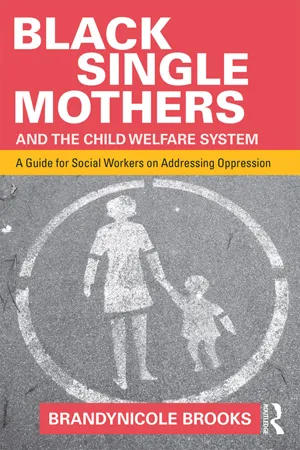
Black Single Mothers and the Child Welfare System examines the pressures, hardships, and oppression women of color face in the child welfare system, and how this affects social workers who investigate childhood abuse and neglect. Author Brandynicole Brooks addresses intersectionality and ideological, institutional, interpersonal, and internalized oppression and how it affects the safety, permanence, and well-being of children. Through research and real-life examples, the reader will be immersed in a historical perspective of oppression faced by black single mothers involved with social service systems, understand the definition of oppression and its four interrelated facets, examine ways oppression plays out in child welfare supports and services, and discover new integrated methods of addressing oppression. The last chapter discusses theory, generalist social work practice, and transformational leadership styles, which can be used by social workers to advocate on behalf of their clients and inspire self-advocacy, thus transforming child welfare.
eBook - ePub
Black Single Mothers and the Child Welfare System
A Guide for Social Workers on Addressing Oppression
- 104 pages
- English
- ePUB (mobile friendly)
- Available on iOS & Android
eBook - ePub
Black Single Mothers and the Child Welfare System
A Guide for Social Workers on Addressing Oppression
About this book
Information
1
Historical Perspectives of Child Welfare and Intersectionality
Child Welfare Historically
The mission of child welfare across the United States is focused on the safety, permanence, and well-being of the most vulnerable population—children. This mission has been addressed from every angle throughout child welfare’s history—protecting children from abuse, educating parents, developing familial support systems, and addressing parents’ mental health needs. Currently, child welfare seeks to ensure children’s safety from abuse and neglect by implementing permanency planning. Permanency planning is a theoretical social work perspective promoting a permanent living arrangement for children that seeks to meet the child’s physical, emotional, and developmental needs (North Carolina Department of Health and Human Services, 2014). Permanency planning means focusing on long-term care arrangements for a child beginning the first day the child enters into the foster care system. These arrangements can involve placing the child with the biological parents, kinship providers, fictive kin, or in adoptive homes. However, prior to the adoption and implementation of this theory, child welfare services turned to practices of infanticide, warehousing, orphanages, and fostering to address the concern of parents’ inability to provide appropriate care and support to their children (McGowan, 2005).
According to McGowan (2005), there was no child welfare system in the “early days, however, two groups of children were presumed to require attention from public authorities: orphans and the children of paupers” (p. 11). As a result of this focus, during the 17th and 18th centuries, children were treated like dependent adults and faced one of four different outcomes:
1 Outdoor relief: Public assistance programs for the poor provided minimal funds/food.
2 Farming-out: Children and dependent adults were auctioned off to provide contracted services in exchange for room and board.
3 Almshouses: Institutions were set up by public authorities in rural areas for the care of orphaned children and dependent adults.
4 Indenture: Orphans were given to households to learn a trade and were required to continue working for that household until the debt of their apprenticeship was paid (McGowan, 2005, p. 12).
By the 19th century, changes began to be made to address the welfare and poor treatment of children. With the influx of slave importation, the growing size of the bourgeois class, increased immigration, and hazardous labor conditions, there was an eventual rise in the number of orphanages and institutions during the 1830s. These institutions were set up to provide for the care for children whose parents could not provide for them, as well as for true orphans, whose parents were deceased or could not be found. The 1821 Report of the Massachusetts Committee on Pauper Laws found that “outdoor relief was the worst and almshouse care the most economical and best method of relief” (McGowan, 2005, p. 13). In 1824, the Yates Report suggested further support for the increase in almshouses/orphanages in rural areas of the country. However, by 1856 investigations of these almshouses revealed “such a record of filth, nakedness, licentiousness, general bad morals, and disregard of religion and the most common religious observances, as well as of gross neglect of the most ordinary comforts and decencies of life” (New York State Senate, 1857, cited in McGowan, 2005, p. 13) that there was a shift, however gradual, to reforms, beginning with the establishment of the Children’s Aid Society in 1853.
The Children’s Aid Society was founded by Charles Loring Brace and other social reformers as a way of addressing the poor conditions of the only social services available to orphaned and destitute children. The Society brought the beginnings of a “foster care” system by placing children in “Christian homes in the country, where they would receive solid moral training and learn good work habits” (McGowan, 2005, p. 14). From 1853 to 1929, the Society was responsible for moving more than 150,000 children from New York City to farms across the country to uphold this mission. Also during this time, the Children’s Home Society (CHS) was established as a child-placing agency to provide free foster homes for dependent children. However, negative reports regarding child labor, poor hygiene, poor treatment, and abuse plagued the Children’s Home Society, and more reforms were seen as necessary.
Towards the latter part of the 19th century, authorities began to “recognize families had an obligation to provide for their children’s basic needs” (McGowan, 2005, p. 16) and that if the families did not provide for their children, society then had the obligation to intervene on the children’s behalf. Thus, child protection came into play. Child protection was first formally addressed with the establishment of the New York Society for the Prevention of Cruelty to Children (NYSPCC) in 1875. This society was founded following the rescue of Mary Ellen Wilson, which was supported by a leader of what is now known as the American Society for the Prevention of Cruelty to Animals or the ASPCA.
The ASPCA and Child Welfare
A child by the name of Mary Ellen Wilson was born to parents Francis and Thomas Wilson in 1864 in New York City. Shortly after Mary Ellen’s birth, her father passed and her mother was left with no source of income. Due to her inability to care for her infant daughter with no income, Francis Wilson sent her daughter to a boarding home with a woman by the name of Mary Score. With the stresses of maintaining her household, and an inability to keep up with boarding payments, Francis stopped visiting her daughter at the boarding home, and Mary Ellen was soon turned over to the city’s Department of Charities by Mary Score. At the age of 2, Mary Ellen was then illegally placed by the Department, without proper documentation and little to no oversight, in the home of Mary and Thomas McCormack. Mr. McCormack claimed to be Mary Ellen’s biological father. Shortly after this placement, Mary Ellen’s second father, Thomas McCormack, passed. Mary McCormack married Francis Connolly, and the new family moved to a tenement known as Hell’s Kitchen on West 41st Street in New York.
Mary Ellen was severely abused and neglected at the hands of Mary McCormack Connolly to the point that neighbors became involved and the family moved to another tenement, but not before a missionary, Ms. Etta Angell Wheeler, took notice of Mary Ellen’s plight in 1847. Upon seeing the bruised and malnourished 10-year-old Mary Ellen, Ms. Wheeler began to seek ways to legally protect the child. However, there were no local laws that prohibited the excessive discipline of children, and New York City authorities were hesitant to intervene on behalf of the child due to a misinterpretation of the city’s early child neglect laws.
Not wanting to leave Mary Ellen in her current state, Ms. Wheeler remained diligent and sought the assistance of Henry Baugh, a leader of the animal humane movement later known as the American Society for the Prevention of Cruelty to Animals (ASPCA). Mr. Baugh’s involvement proved to be substantial to getting Mary Ellen’s case before legal authorities. Based on Mary Ellen’s own testimony and the statements of her neighbors regarding her experience of abuse and neglect, Mary Ellen was placed under the control of the state, and Mary McCormack Connolly was sentenced to 1 year of hard labor. Mary Ellen was then placed in an institutional shelter for adolescent girls.
(Adapted from the American Humane Society, 2013)
Slowly, over the next several decades, the United States would see an increase in the number of societies developed to prevent cruelty to children. However, not until the creation of the federal Children’s Bureau in 1912 were there governmental protections for children. The Children’s Bureau was not authorized to work at the state and local level until the passing of the New Deal in 1935 under the presidency of Franklin D. Roosevelt. Beginning with the Social Security Act of 1935, the federal government began to focus on child welfare and putting funding and policies in place to address child protection.
Table 1.1 provides a brief overview of some of the more important federal child protection laws.
Title IV-B of the Social Security Act of 1935 | States were provided funding to support both preventative and protective services to children and families identified as vulnerable. |
Child Abuse Prevention and Treatment Act of 1974 | States were provided funding to prevent, identify, and address child abuse and neglect. |
Title XX of the Social Security Act of 1975 | States were granted funds to support social services (child protection, prevention, and treatment programs, foster care and adoption services) to low-income families. |
Indian Child Welfare Act of 1978 | Allowed tribal governments to determine the custody of Native American children and emphasized the significance of placement with extended family. |
Adoption Assistance and Child Welfare Act of 1980 | Set up mandatory guidelines for states to offer child protection and prevention services to children in their homes, prevent foster care placements, and focus on family reunification; also supported states in paying adoption expenses for children with special needs. |
Adoption and Safe Families Act of 1997 | Increased funding to states for promoting safe and stable families; required states to move children into permanent homes by terminating parental rights more quickly and pushing for adoption. |
Child Abuse Prevention and Enforcement Act of 2000 | Established the use of federal funds to enforce child abuse and neglect laws, promote programs designed to prevent child abuse and neglect, and establish or support cooperation between law enforcement and media to support the identification of suspected criminal offenders. |
Keeping Children and Families Safe Act of 2003 | Emphasized enhanced connections between child protective services agencies and public health, mental health, and developmental disabilities agencies. |
Child and Family Services Improvement Act of 2006 | Reauthorization of the Keeping Families Safe Act of 2003 |
Fostering Connections to Success and Increasing Adoptions Act of 2008 | Amended the Social Security Act to connect and support relative caregivers, improve outcomes for children in foster care, and provide tribal foster care and adoption services. |
Child and Family Services and Improvement and Innovation Act of 2011 | Called for improvements in the response of state child welfare agencies to children’s healthcare services, length of time in foster care, court involvement, and caseworker visits to children. |
As seen in the historical overview and Table 1.1, child protection grew from protecting children from harsh labor conditions to understanding childhood development, which moved the perspective away from treating children as little adults. Today, we see child protection from a child welfare lens focused on ensuring that children’s basic physical needs, as well as their psychological, medical, and emotional needs, are met by their parents or guardians. Even with changes in parental expectations, the evolution of child protection laws, and the injection of strengths-based and solution-focused practice within child welfare, today’s approaches to prevention and protection still are focused on the shortcomings of the parents as individuals who are unable to meet society’s expectations of what it means to raise children. Oftentimes, services and supports ignore the hardships faced by these parents at the hands of a discriminatory society.
The Women’s Movement
The women’s movement and three waves of feminism are often presented along identical timelines. The first wave of feminism focused on women gaining legal equality with men. The focus of the 19th and 20th centuries was on women gaining the right to vote. The first step in this process began in 1848 with the Declaration of Sentiments, which was loosely based on the Declaration of Independence. In the Declaration, leaders of the women’s movement outlined the ways in which “the history of mankind is a history of repeated injuries and usurpations on the part of man toward woman, having in direct object the establishment of an absolute tyranny over her” (Eisenberg & Ruthsdotter, 1998). It then went listed the following to support this statement:
- Married women were legally dead in the eyes of the law.
- Women were not allowed to vote.
- Women had to submit to laws when they had no voice in their formation.
- Married women had no property rights.
- Husbands had legal power over and responsibility for their wives to the extent that they could imprison or beat them with impunity.
- Divorce and child custody laws favored men, giving no rights to women.
- Women had to pay property taxes although they had no representation in the levying of these taxes.
- Most occupations were closed to women and when women did work they were paid only a fraction of what men earned.
- Women were not allowed to enter professions such as medicine or law.
- Women had no means to gain an education since no college or university would accept women students.
- With only a few exceptions, women were not allowed to participate in the affairs of the church.
- Women were robbed of their self-confidence and self-respect, and were made totally dependent on men (Eisenberg & Ruthsdotter, 1998).
Even a brief understanding of women’s history finds these outlined complaints as valid. These 12 sentiments were presented and endorsed at the First Women’s Rights Convention. In the following years, the woman’s movement expanded, and conventions for women were held across the country to increase the voice of the women’s movement. The right to vote in 1920 was seen as the first major victory of the women’s movement.
The second wave of feminism of the 1960s to the 1980s focused the debate on...
Table of contents
- Cover
- Title
- Copyright
- Dedication
- Contents
- Preface
- Acknowledgments
- Introduction
- 1 Historical Perspectives of Child Welfare and Intersectionality
- 2 Oppression in Child Welfare
- 3 The Four Layers of Oppression and Child Welfare Practice
- 4 Transforming Child Welfare
- Index
Trusted by 375,005 students
Access to over 1.5 million titles for a fair monthly price.
Study more efficiently using our study tools.
Frequently asked questions
Yes, you can cancel anytime from the Subscription tab in your account settings on the Perlego website. Your subscription will stay active until the end of your current billing period. Learn how to cancel your subscription
No, books cannot be downloaded as external files, such as PDFs, for use outside of Perlego. However, you can download books within the Perlego app for offline reading on mobile or tablet. Learn how to download books offline
Perlego offers two plans: Essential and Complete
- Essential is ideal for learners and professionals who enjoy exploring a wide range of subjects. Access the Essential Library with 800,000+ trusted titles and best-sellers across business, personal growth, and the humanities. Includes unlimited reading time and Standard Read Aloud voice.
- Complete: Perfect for advanced learners and researchers needing full, unrestricted access. Unlock 1.5M+ books across hundreds of subjects, including academic and specialized titles. The Complete Plan also includes advanced features like Premium Read Aloud and Research Assistant.
We are an online textbook subscription service, where you can get access to an entire online library for less than the price of a single book per month. With over 1.5 million books across 990+ topics, we’ve got you covered! Learn about our mission
Look out for the read-aloud symbol on your next book to see if you can listen to it. The read-aloud tool reads text aloud for you, highlighting the text as it is being read. You can pause it, speed it up and slow it down. Learn more about Read Aloud
Yes! You can use the Perlego app on both iOS and Android devices to read anytime, anywhere — even offline. Perfect for commutes or when you’re on the go.
Please note we cannot support devices running on iOS 13 and Android 7 or earlier. Learn more about using the app
Please note we cannot support devices running on iOS 13 and Android 7 or earlier. Learn more about using the app
Yes, you can access Black Single Mothers and the Child Welfare System by Brandynicole Brooks in PDF and/or ePUB format, as well as other popular books in Social Sciences & Mental Health in Psychology. We have over 1.5 million books available in our catalogue for you to explore.