![]()
Part I
Principles
![]()
chapter 1
Basic concepts
SOUND IS A PRESSURE DISTURBANCE in the form of a longitudinal wave that produces an auditory sensation. Because of this there are always two important parts of the analysis of sound: the source and the receiver. To understand the behavior of sound in buildings, we need to understand the basic physics of sound. In this section we will begin by defining the main characteristics of the sound wave. First, imagine sound as a dominoes effect. Each molecule is excited and triggers the one next to it, but the molecules remain in almost the same position they started. However, the effect has been carried along and you can say something is “traveling.” In architectural acoustics we usually talk about sound traveling through air. This means that a small vibration has created a variation in the air pressure and molecules are beginning to move back and forth, carrying the energy. This energy is spent along the way and thus the level decreases with distance.
The simplest sound is a pure tone. This means that it is composed by only one frequency (tone) and it is represented as a sine wave. The peaks of the sine wave are the points of highest pressure.
SOUND NEEDS A MEDIUM TO PROPAGATE and it travels at different speeds depending on the medium. The more dense the medium, the faster sound will travel. For example, in steel, sound travels at 20,000 ft/s (6,100 m/s), while in air sound travels at approximately 1,125 ft/s (343 m/s). Did you ever wonder why someone would get down and put their ears to the railroad track instead of pointing their ears up toward the train? Well, they would detect the incoming train earlier through the steel than through the air. Sound speed varies depending on the temperature, density, and elasticity of the medium.
SOUND PRESSURE IS THE DIFFERENCE between the pressure of the sound wave and the pressure of the medium (usually air). It is very small compared to the atmospheric pressure and measured in Pascals [Pa].
Amplitude is the difference between the maximum and minimum sound pressures of the wave.
FREQUENCY IS THE NUMBER OF OSCILLATIONS per second of the sound wave. It is measured in Hertz [Hz] or cycles per second. This frequency corresponds directly with the mechanical vibration frequency of the sound source.
We have already mentioned that a sound can be composed of only one frequency: the pure tone. But most sounds we hear every day are a lot more complex than that. Sounds produced by musical instruments, for example, are not pure tones. They are composed by a number of tones (or harmonics) that are related to the main tone. Other sounds are more randomly composed of a multitude of frequencies. Sounds such as speech, the sound of a lawnmower, the static of a radio, are very hard to describe in terms of each frequency that is part of them. Because of this, frequencies are usually grouped for analysis and measurement. These groups are called frequency bands.
1.3.1 Bandwidth
The term “bandwidth” refers to how much of the frequency range is included in a specific sound or the analysis of a sound. “Broadband” usually refers to the entire audible frequency range, or most of it. “Narrow band,” on the other hand, is commonly used to refer to single or very small groups of frequencies.
1.3.2 Frequency band
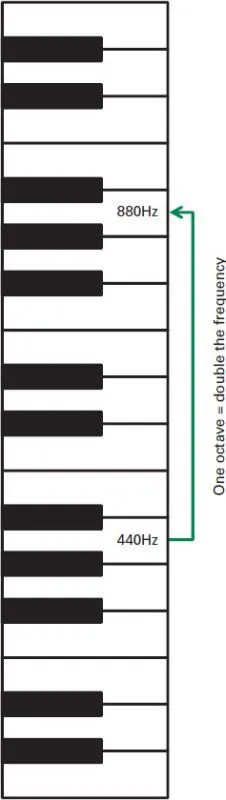
As mentioned above, frequencies are clustered in bands in order to make them easier to study and represent. The most common band is the octave. The term “octave” is borrowed from the music field, where it means the interval between one note in the scale and the same note in the next scale (Figure 1.1).
1.1 One octave in music and acoustics
In acoustics, an octave is the distance or interval between a tone at any specific frequency and the tone which is twice that frequency; however, there are some internationally accepted octave bands for the study of acoustics. They begin at 31.5 Hz and go up by doubling the frequency: 63 Hz, 125 Hz, 250 Hz and so on. These numbers correspond to the center of the frequency range covered by each band (e.g., the 1K octave band contains the frequencies between 707 and 1414 Hz). It is common to use smaller divisions of an octave for the study of acoustics, such as 1/3 or 1/12 of an octave (Figure 1.2).
1.2 Octave and 1/3 octave bands
1.3.3 Sound spectrum
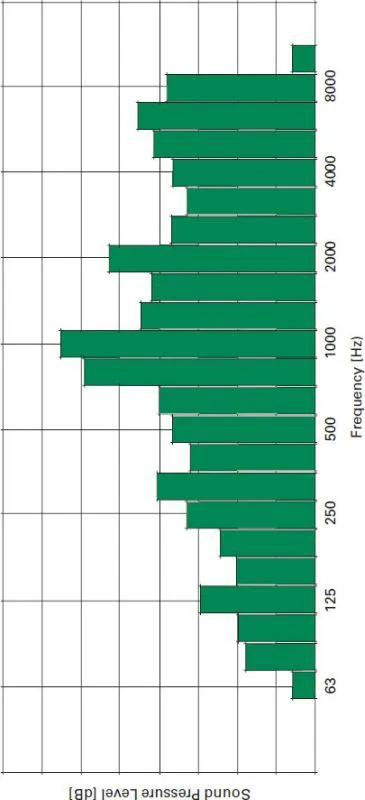
Sound is commonly represented as a wave in time with amplitude in the Y axis; however, with the exception of the simplest sounds (composed by only one or two frequencies), this representation does not tell us much about how they “sound.” We know from an energy-time chart how loud it was at different points of time, but we can’t tell the pitch by looking at it, the way we could with a sine wave. In those cases we represent sound in terms of its amplitude and frequency. This is called a sound spectrum. In Figure 1.3, we have a spectrum by 1/3 octave bands.
A spectrum will give us a very good idea of how the sound was in terms of both its loudness and its pitch, but not how it varied in time. This is usually not necessary for short impulsive noise, or for long but steady noises. In some cases, though, we would need to use both graphical representations, because we need to understand amplitude and frequency as well as the changes over time (i.e., when measuring community ambient noise).
1.4 Period [T] and wavelength [λ]
PERIOD IS THE DURATION IN SECONDS [S] of one full cycle or oscillation on the wave.
Wavelength is the length of one full cycle. It is measured in distance units (meters, feet, inches, etc.). Wavelength, frequency, and the speed of sound are related by Eq. A.1. Higher frequencies have smaller wavelengths, and when we talk of architectural acoustics it is very important to understand the wavelength of sound. In the range of frequencies that are audible for the human ear, wavelengths are comparable in size to architectural elements – that is, they go from about 5/64 in (2 mm) to 65 ft (20 m) long. So, to be able to affect the way sound behaves in a room we have to understand its frequency content.
1.3 Sound spectrum (produced using measuring software SysTune)
Further reading
Egan, M. D. (1988). Architectural acoustics. New York: McGraw-Hill.
Jaramillo, A. M. (2007). Acústica: La ciencia del sonido. Medellín: Fondo Editorial ITM.
2323__perlego__chapter_di...