- 256 pages
- English
- ePUB (mobile friendly)
- Available on iOS & Android
eBook - ePub
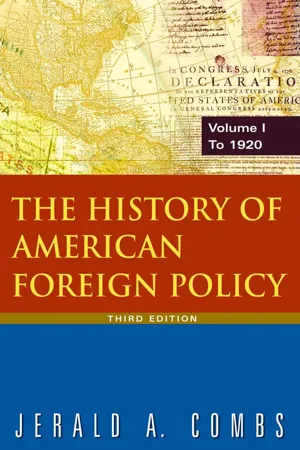
The History of American Foreign Policy: v.1: To 1920
About this book
Now thoroughly updated, this respected text provides a clear, concise, and affordable narrative and analytical history of American foreign policy from the revolutionary period to the present. This edition includes an all-new chapter on the George W. Bush presidency, 9/11, and the war in Iraq. The historiographical essays at the end of each chapter have been revised to reflect the most recent scholarship."The History of American Foreign Policy" chronicles events and policies with emphasis on the international setting and constraints within which American policy-makers had to operate; the domestic pressures on those policy-makers; and the ideologies, preferences, and personal idiosyncrasies of the leaders themselves. The new edition also provides expanded coverage of the role of cultural and intellectuual factors in setting up the problems faced by U.S. policy-makers, as well as new materials on globalization and the War on Terror.
Information
CHAPTER 1
The American Revolution and the Origins of American Diplomacy
Early American Foreign Policy: Neutrality and Expansion
One of America’s leading diplomatic historians, Ernest May, has characterized early American foreign policy as “pacifist and isolationist.” There is much truth in this label. Americans did try to avoid entanglement in the wars and alliances of the great powers of Europe, just as George Washington had advised them to do in his famous Farewell Address. President Martin Van Buren said in the 1840s that Americans still regarded nonintervention and neutrality “with a degree of reverence and submission but little, if anything, short of that entertained for the Constitution itself.” With its neutralist stance and its tiny army and navy, the United States seemed a peaceful haven to many Europeans who immigrated to escape the continuous wars and burdensome military obligations of their homelands.
Yet the image of early America as “pacifist and isolationist” is misleading. Americans did not want total isolation from Europe: They avoided political entanglements as best they could, and some even sought cultural isolation to prevent contamination by Europe’s supposedly corrupt, anti-Republican society, but Americans did not want commercial isolation. Trade with Europe was vital to the American economy, and if Americans designed their neutrality to avoid entanglements in Europe’s wars, they also designed it to increase their foreign trade. Under international law, neutral nations could trade unmolested with nations at war, and the United States intended to benefit from this protection. Americans also hoped to reinforce the protection of international law by making their trade so valuable that no nation would risk interfering with it. So early American policy toward Europe is far better characterized as neutralist than isolationist.
Nor was early American diplomacy truly pacifist. Even though Americans wanted neutrality to keep them out of European wars, they were ready to fight for their right to remain neutral, as they proved in 1812. In addition, although the American people may have revered nonintervention as Martin Van Buren claimed in the quotation above, the United States nevertheless joined the major powers of Europe in claiming and exercising the right to intervene in other nations to protect the lives and property of its citizens abroad. The United States considered this “nonpolitical” intervention and therefore a legitimate function of diplomacy. America conducted over one hundred such interventions before 1900, ranging from forced debt collection to the bombardment of towns that had imprisoned American sailors.
It was not only the belligerent pursuit of the rights of neutrality and “nonpolitical” interventions that belied the image of early American foreign policy as pacifist and isolationist; on the North American continent and in the Caribbean, the United States was aggressively expansionist. It conquered the Indians, purchased Louisiana from France, extorted Florida from Spain, and took the Far West from Mexico. There were even profound expansionist aspects to episodes that were essentially defensive efforts to secure independence and neutrality, such as the American Revolution and the War of 1812.
The twin themes that dominated American foreign policy before the twentieth century were neutrality and expansion, rather than pacifism and isolationism. Of the two themes, neutrality was at first the more important. Until after the War of 1812, the nation’s diplomacy was essentially defensive rather than offensive. The desire to expand American trade and territory always hovered in the background, but it remained secondary to the desire of the United States simply to survive and preserve what it already had. After the War of 1812, however, Americans felt secure from destruction at the hands of hostile European powers for the first time in their history and could turn their attention with confidence to westward expansion. Neutrality toward Europe remained a cornerstone of American diplomacy for the rest of the nineteenth century and occasionally, as during the Civil War, reemerged as the dominant concern. But for the most part, territorial expansion became the primary theme.
The Origins of Early American Foreign Policy
“These United Colonies are, and of a right ought to be free and independent States” and as such should seek “foreign alliances.” So proclaimed Richard Henry Lee of Virginia to the Continental Congress in June 1776. After vigorous debate, Congress agreed. This famous resolution embodied the contradictory impulses that would compete for dominance in America’s foreign policy during much of the new nation’s early existence—the desire for independence from Europe and the need for foreign connections. Nonentanglement was the eventual victor. Washington’s Farewell Address, warning against foreign influences and permanent alliances, became almost an eleventh commandment for Americans of the nineteenth century. But it was neither an easy nor a permanent victory.
The American Revolution probably did more than anything to turn Americans against European entanglements. Behind the primary grievance of the colonists against England—taxation without representation—was the conviction of many Americans that the connection with Great Britain had impeded expansion of their trade and territory. The British mercantile system had monopolized American commerce and limited the growth of manufactures. Parliament had frustrated the territorial ambitions of the Americans. Acting on the assumption that they would gain access to vast tracts of land, the colonists had cooperated with the British to eliminate French control of Canada and Louisiana during the French and Indian War. Yet with the Proclamation of 1763, the British had temporarily halted settlements beyond the Appalachians. Then the Quebec Act had given administration over much of the Ohio Valley to Canada rather than to claimants in the original thirteen colonies. In their disappointment, many Americans recalled still another instance of British betrayal. In the 1740s, during the War of the Austrian Succession, New Englanders had captured the strategic French fortress of Louisbourg, guardian of the mouth of the St. Lawrence River. In the final peace treaty, however, the British had returned it to the French in exchange for concessions in Asia of no value to the colonists. Such incidents convinced many Americans that their ties to Europe through Great Britain had involved them in wars so little related to American interests that the United States would be well advised to avoid such bonds in the future.
American attitudes toward Britain’s European rivals reinforced this disposition to shun alliances. Most potential allies had long been enemies of the colonists. Spain had made the initial claim to the Western Hemisphere and viewed the British as trespassers. A long period of desultory warfare on America’s southern frontier resulted, stimulating hatred between the Spanish and the settlers. The French in Canada and Louisiana also had been bitter antagonists of the Americans, and these colonists murdered each other enthusiastically during the century of warfare between their mother countries. Americans regarded France and Spain as corrupt and effete Catholic regimes whose superstitious subjects were willing victims of perpetual inquisition and enslavement. The American image of the French was summed up in a line from a popular song of the time—“When Gallick hosts, ungrateful men, our race meant to extermine….” To most Americans, an alliance with such powers was no improvement on their old colonial relationship with Great Britain.
America’s geographical situation reinforced the colonists’ inclination to keep the Europeans at arm’s length. All the great powers were 3,000 miles across the Atlantic. The United States was surrounded by the colonies of these nations, but such thinly populated neighbors posed no threat without the long-distance backing of the mother countries. As America’s population grew, military invasion from any source would become even more difficult. Benjamin Franklin calculated that the nation’s population was doubling every twenty-three years. John Adams figured that this growth guaranteed the addition of 20,000 fighting men each year. He thought the physical size of America might protect against invasion as well. To conquer and garrison even a few of America’s state, and enemy would require “multitude of posts” and an army 100,000 strong, Adams argued. Intellectual tradition also supported separation of the two hemispheres. More than two centuries before the American Revolution, Pope Alexander VI had drawn a line of demarcation down the Atlantic to separate the colonial spheres of Portugal to the east and Spain to the west. The British and French disregarded the papal proclamation to plant their own colonies, but the line still had some influence. European leaders came to disregard many conflicts “beyond the line” as somehow outside the realm of civilization and not necessarily cause for war between the mother countries.
British Whig reform tradition, the same philosophy that so influenced American resistance to taxation without representation, confirmed the revolutionaries’ inclination for nonentanglement. The British Whigs had long sought to avoid excessive entanglements with European powers. They urged concentration on overseas trade and empire rather than on continental politics. Such trade would promote a strong navy that could defend the moat of the British Isles, the English Channel, and thus prevent an invasion of the homeland. This would make a large standing army, the traditional enemy of internal liberty, unnecessary.
The Americans, already disposed to agree with the Whig outlook on domestic affairs, readily adopted much of Whig foreign policy as well. Like the British Whigs, Americans would avoid foreign entanglements. They would rely on an even larger moat than the English Channel, the Atlantic Ocean, to protect the homeland. They too would avoid the large standing army that might threaten internal liberty. Even for the frontier, no large army would be necessary, because Americans were certain that the country’s rapid population growth, the local militias, and a few regular troops at strategic frontier forts would be adequate for the purpose of westward expansion.
The British Whig emphasis on a navy, however, was more debatable in America. Many Americans thought a navy essential to defend their commercial shipping and coastline, and they echoed the British Whigs in pointing out that a navy did not threaten internal liberty in the same manner as an army. Ships could not be used so easily to disrupt legislatures or coerce farmers. Opponents, however, warned that naval building and maintenance would require heavy taxation that would strengthen a potentially despotic central government. They argued that the Atlantic moat supplemented by coastal defenses would suffice to protect America against a major invasion from the sea and that America’s neutral policy toward Europe combined with Europe’s need for American commerce would deter interference with American shipping.
The belief that Europe desperately needed American trade undergirded much of America’s early attitudes toward foreign affairs. It allowed Americans to rationalize their desire for nonentanglement and peace with their equal desire for the profits of overseas commerce. Like the eminent French philosophes who wrote at the time of the American Revolution, many Americans hoped that free and extensive commerce would render balance of power politics and warfare obsolete. If each nation’s prosperity depended upon a network of international trade, no country would risk attacking another. Militarism, which the philosophes believed to be a dangerous prejudice, a carry-over from barbarism, and a remnant of former chaos, would be replaced by free commerce that pacified and unified the peoples of the world. So Americans urged that colonialism be ended and other artificial barriers to world trade abandoned. Free governments responsive to the will of their people should be established. These governments would be more peaceful than monarchies, many Americans believed, since only monarchs stood to gain by war while their people supplied the deaths and taxes.
Free trade and anticolonialism gratified America’s interests as well as its ideological proclivities. America could afford to support free trade because it needed access to foreign markets. In the absence of large-scale domestic manufactures, it had little need to protect its home markets against foreign competition. America could oppose colonialism because it had no colonies of its own and was surrounded by the colonies of European powers, which severely restricted foreign commerce. Foreigners were expected to trade with colonies only through the mother countries. This policy worked little hardship on European nations, since they were neighbors. But these mother countries were thousands of miles away from the United States.
In its desire for freer trade, America naturally championed such doctrines as neutral rights and freedom of the seas. The United States saw these doctrines as both morally correct and helpful to American interests. Since the United States expected to be a neutral and to have a navy inferior to those of the major powers, it was to America’s interest to promote an international law that protected the trade and shipping of neutrals against the desire of powerful warring nations to interfere with them.
While all Americans hoped that extensive commerce might help the United States protect its neutrality, a good many recognized that this neat package of ideals and interests might not always hold together. Thomas Jefferson, for instance, warned that America’s determination to share in the world’s commerce and shipping meant “frequent wars without a doubt,” as America’s ships, property, and sailors might be insulted or captured. Occasionally Jefferson saw this danger as a reason to abandon commerce and navigation entirely, but most of the time he was confident that America’s trade itself could be a powerful enough weapon to deter war. Jefferson and other Americans had had considerable experience in wielding trade as a weapon. Before the Revolution, their boycotts of British goods helped to force repeal of the Stamp Act of 1765 and the Townshend Duties of 1767. Most Americans were quite prepared to follow the same policy again if it became necessary. They would use commerce to manipulate the balance of power system if the Europeans refused to accept free trade as a substitute for outmoded military competition.
The Franco-American Alliance: Challenge to Nonentanglement
In his 1776 tract Common Sense, which circulated in America almost as widely as the Bible and crystallized opinion in favor of independence, Thomas Paine spelled out America’s developing attitude toward foreign policy. He denounced the British connection because it tended “directly to involve this continent in European wars and quarrels…. As Europe is our market for trade, we ought to form no partial connection with any part of it. It is the true interest of America to steer clear of European connections.” Commerce, “if well attended to, will secure us the peace and friendship of all Europe; because it is the interest of all Europe to have America a free port.”
Despite this inclination to avoid European connections, Americans desperately needed foreign help to win their revolution against Great Britain. The Continental Congress therefore tried to secure French aid without violating Paine’s philosophy of nonentanglement. This contradiction appeared graphically in the model treaty Congress adopted to serve as a guide for all its ministers abroad. John Adams, its primary author, was so determined to avoid military or political ties with France that he was prepared to refuse French troops and naval support. The United States was to make only a “marine treaty.”
America would exchange its commerce for supplies and economic aid. When the inevitable war between Britain and France resulted, the United States would promise only to refrain from suppo...
Table of contents
- Cover
- Half Title
- Title Page
- Copyright Page
- Dedication
- Table of Contents
- Maps
- Preface
- Acknowledgments
- 1. The American Revolution and the Origins of American Diplomacy
- 2. The Diplomacy of a New Nation: 1783–1800
- 3. Republican Diplomacy: The Louisiana Purchase and the War of 1812
- 4. The Diplomacy of Expansion: Florida and the Monroe Doctrine
- 5. Territorial Expansion: Texas, Oregon, California, and the Mexican War
- 6. The Civil War and Its Diplomatic Aftermath
- 7. Looking Abroad: Overseas Expansion in Mid-Century
- 8. The Spanish-American War and the Decision for Empire
- 9. The Surge Into Asia: Empire in the Philippines and the Open Door in China
- 10. The Surge Into Latin America: Varieties of American Empire
- 11. Europe, America, and World War I
- Index
- About the Author
Trusted by 375,005 students
Access to over 1.5 million titles for a fair monthly price.
Study more efficiently using our study tools.
Frequently asked questions
Yes, you can cancel anytime from the Subscription tab in your account settings on the Perlego website. Your subscription will stay active until the end of your current billing period. Learn how to cancel your subscription
No, books cannot be downloaded as external files, such as PDFs, for use outside of Perlego. However, you can download books within the Perlego app for offline reading on mobile or tablet. Learn how to download books offline
Perlego offers two plans: Essential and Complete
- Essential is ideal for learners and professionals who enjoy exploring a wide range of subjects. Access the Essential Library with 800,000+ trusted titles and best-sellers across business, personal growth, and the humanities. Includes unlimited reading time and Standard Read Aloud voice.
- Complete: Perfect for advanced learners and researchers needing full, unrestricted access. Unlock 1.5M+ books across hundreds of subjects, including academic and specialized titles. The Complete Plan also includes advanced features like Premium Read Aloud and Research Assistant.
We are an online textbook subscription service, where you can get access to an entire online library for less than the price of a single book per month. With over 1.5 million books across 990+ topics, we’ve got you covered! Learn about our mission
Look out for the read-aloud symbol on your next book to see if you can listen to it. The read-aloud tool reads text aloud for you, highlighting the text as it is being read. You can pause it, speed it up and slow it down. Learn more about Read Aloud
Yes! You can use the Perlego app on both iOS and Android devices to read anytime, anywhere — even offline. Perfect for commutes or when you’re on the go.
Please note we cannot support devices running on iOS 13 and Android 7 or earlier. Learn more about using the app
Please note we cannot support devices running on iOS 13 and Android 7 or earlier. Learn more about using the app
Yes, you can access The History of American Foreign Policy: v.1: To 1920 by Jerald A Combs in PDF and/or ePUB format, as well as other popular books in Politics & International Relations & International Business. We have over 1.5 million books available in our catalogue for you to explore.