eBook - ePub
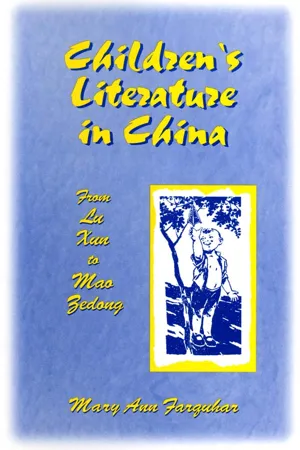
Children's Literature in China: From Lu Xun to Mao Zedong
From Lu Xun to Mao Zedong
- 352 pages
- English
- ePUB (mobile friendly)
- Available on iOS & Android
eBook - ePub
Children's Literature in China: From Lu Xun to Mao Zedong
From Lu Xun to Mao Zedong
About this book
This book introduces the major works and debates in Chinese children's literature within the framework of China's revolution and modernization. It demonstrates that the guiding rationale in children's literature was the political importance of children as the nation's future.
Information
1
The Historical Background
In China, modern children’s literature began in the early twentieth century. It was written by the first generation of great modern writers such as Lu Xun, Ye Shengtao and Mao Dun. There were, of course, books for children long before this. But these were elementary primers within the Confucian education system, rejected by modern reformers.
This chapter considers the historical background of Confucian children’s books up to the end of the early May Fourth period (1926). It outlines the growing challenge in the nineteenth century to the legitimacy of the Confucian canon. This challenge became direct confrontation in the May Fourth period. May Fourth writers for children borrowed ideas and forms from Western literature to attack the dominance of Confucianism which they regarded as inimical to the modernization of China. They believed that only the introduction of modern science and democracy could ensure China’s survival as a nation.
At the core of this confrontation lay two very different views on education. Writers such as Lu Xun claimed that Confucian children’s texts were rooted in the past and were retrogressive; Confucian texts directed children towards mindless obedience. Advocates of a modern children’s literature, on the other hand, sought to inculcate a sense of individual worth and a spirit of scientific enquiry. Progressive thinkers in the early twentieth century considered that the lack of these two qualities explained, in part, the decline of China. These thinkers stressed that education through children’s literature should develop the personal capacities of the young.
In this context, it can be said that the Chinese ‘discovered’ childhood in the early twentieth century. There was widespread interest in Western theories on child psychology and the nature of childhood. The discussions focussed in particular on an evolutionary concept of childhood development and pre-Freudian notions of childhood innocence. These theories served a dual function. First, they undermined Confucian educational practices as ‘unscientific’. Second, they underpinned current arguments for new developments in children’s education which included the production of ‘a garden’ of children’s literature. Pastoral images of hope and delight reinforced arguments for the emancipation of children from the dark night of Confucian orthodoxy.
Despite the obvious incompatibility between Confucian and May Fourth views on education, they share one striking feature: recognition of the social importance of the educative role of children’s books. Confucian children’s books clearly sought to perpetuate a living tradition. The success of these texts within the education system offered a partial explanation for the longevity and dominance of Confucian ideology. Twentieth century reformers, therefore, sought to displace them. But the reformist conception of children’s literature was still socially determinist in that its stated end was to transform and enrich future Chinese society. Reformists’ interest in childhood, albeit genuine, was ultimately shaped more by the emerging forces of nationalism than by disinterested scientific curiosity. Indeed, for a short period the child was the political symbol of China’s future.
Traditional Children’s Books
Children’s books in traditional China were primarily educational. The best known, The Three Character Classic (Sanzi Jing),1 was a language primer which introduced children to characters, an outline of Chinese history and the social tenets of Confucianism through easily memorized three-character phrases. This book, together with The One Hundred Family Names (Baijia Xing),2 and The Thousand Character Classic (Qianzi Wenf)3 formed a set of elementary Confucian texts for children. They were familiarly known as the san bai qian (‘three, hundred and thousand’) and were learned by heart.
When children had mastered the basics—counting and reading—they continued to follow an approved reading schedule. According to The Three Character Classic:
Those who are learners
Must have a beginning.
When Education for the Young is finished
Proceed to the Four Books…
When the Classic of Filial Piety is mastered
And the Four Books are known by heart,
The next step is to the Six Classics
Which may now be studied.4
Children’s traditional education directed them as early as possible to the Four Books which, as the first portion of the Confucian canon, were memorized by all candidates who hoped for success in the public examinations. In meritocratic China, success in these examinations was the gateway to official position, wealth and prestige. In one sense, children’s texts were merely necessary stepping stones to the Confucian classics rather than reading matter or ‘literature’ as we now understand it; indeed, twentieth century critics claimed that children did not understand the texts they recited and were bored to death by them. Nevertheless, these texts were spectacularly successful. They remained within the Confucian canon for centuries because they were well suited to their purpose: the san bai qian introduced children to about two thousand characters, the basic number for beginners, and the short, rhythmic lines of The Three Character Classic trip off the tongue as easily as nursery rhymes.
Children also had elementary reading material: poetry texts such as The Thousand Family Poems (Qianjia Shi)5 and prose story books such as Daily Stories (Riji Gushi).6 While books such as these could be called ‘children’s literature’, the Chinese saw them as properly belonging to education; they were texts for ‘enlightening the ignorance’ (qimeng) of the very young. Zhu Xi makes this clear in his comments on Daily Stories in Education for the Young (Xiaoxue):
Education for the young is not just learning by heart. We must begin with language as the basis in nurturing both deep knowledge and a fine application (of that knowledge). Daily Stories, whether old or new, must first teach such qualities as filial piety, fraternal love, loyalty, truth, propriety, duty, honour and honesty through stories like Huang Xiang warming his parent’s be… Only when these (stories) are well known will the basic principles be clear and through long familiarity (the habit of) virtue will become natural.7
China produced the world’s earliest picture book for children, one century earlier than production of the first picture book for children in the West, Orbus Pictus by Comenius (1592–1670). The Chinese book, written in 1542, was an illustrated version of Daily Stories, a staple in the Confucian children’s canon. Pictorialization was common in both traditional and modern children’s books. It enhanced the pleasure of reading and reinforced the educative meaning of the texts.
Approved children’s books such as these had three aims: to introduce characters and sentence structure, to impart general knowledge and to transmit traditional Chinese cultural values. The transmission of culture involved more than exposure to literature or factual accounts of Chinese history and philosophy, for the Chinese did not separate knowledge from its application; as Zhu Xi suggests, these books sought to internalize as second nature certain moral attitudes that would produce patterns of behavior which formed the basis of Confucian society. Their acceptance by the child guaranteed survival and continuity of Confucian mores within Chinese culture.
Mastery of the Confucian classics was, however, the prerogative and the hallmark of the educated elite: the literati from whom the mandarins or official class were chosen by examination. The vast majority of Chinese people remained illiterate. They lacked the leisure and wealth required to support the acquisition of a traditional education. Even within the wealthier families, education was principally the domain of the sons. When it existed for daughters, it was directed towards preparing them for marriage, not for public office. Texts for girls, such as Precepts for Women (Nu Jie) and Classic for Girls (Nu ‘er Jing), set standards for female conduct. Essentially, these texts reiterated and expanded on the maxim contained in the Confucian classic, The Book of Rites (Liji): ‘to be a woman meant to submit’.8 As Croll claims, books such as these embodied the ideological mechanisms of subordination of women in traditional China. The works rationalized female’s acquiescence in their own inferiority and domestic seclusion. The works interacted with other mechanisms of subordination to reduce women to a state of economic dependence, physical subservience and sexual servitude.9 In short, the Confucian classics which include books for children were the educational pillars of a patriarchal and elite social system.
Children also had access to a vast amount of material which, while not intended specifically for them, seems to have reached them by one means or another. In Chinese Popular Literature and the Child, Hayward Scott gives a full account of traditional popular literature available to Chinese children. This includes oral literature such as songs and stories, and popular written literature such as novels.
An historical example of the influence of popular literature on children is found in China’s most famous novel, the Qing Dynasty masterpiece called The Dream of the Red Chamber. Baoyu, the boy hero, is bored with reading Confucius and Mencius, but enraptured with a pile of books bought for him by his young servant, Tealeaf. His purchases include:
Old Inklubber’s Stories Old and New
The Secret History of Flying Swallow
Sister of Flying Swallow
The Infamous Loves of Empress Wu
The Jade Ring Concubine, or
Peeps in the Inner Palace
and a heap of playbooks—mostly romantic comedies and the like…
Tealeaf uttered a warning: ‘Don’t take these into the garden. If you do and anyone finds out about them I’ll be in real trouble— more than just a bellyful’.10
Baoyu ignores the warning and takes a few of the more chaste volumes into the gard...
Table of contents
- Cover
- Half Title
- Title Page
- Copyright Page
- Dedication
- Table of Contents
- List of Figures
- List of Tables
- List of Illustrations
- Acknowledgments
- Introduction
- 1 The Historical Background
- 2 Lu Xun and the World of Children
- 3 A New Children's Literature
- 4 Revolutionary Children's Literature
- 5 Comic Books and Popularization
- 6 Children's Literature in the People's Republic of China
- 7 The Post-Mao Canon
- Bibliography
- Index
Trusted by 375,005 students
Access to over 1.5 million titles for a fair monthly price.
Study more efficiently using our study tools.
Frequently asked questions
Yes, you can cancel anytime from the Subscription tab in your account settings on the Perlego website. Your subscription will stay active until the end of your current billing period. Learn how to cancel your subscription
No, books cannot be downloaded as external files, such as PDFs, for use outside of Perlego. However, you can download books within the Perlego app for offline reading on mobile or tablet. Learn how to download books offline
Perlego offers two plans: Essential and Complete
- Essential is ideal for learners and professionals who enjoy exploring a wide range of subjects. Access the Essential Library with 800,000+ trusted titles and best-sellers across business, personal growth, and the humanities. Includes unlimited reading time and Standard Read Aloud voice.
- Complete: Perfect for advanced learners and researchers needing full, unrestricted access. Unlock 1.5M+ books across hundreds of subjects, including academic and specialized titles. The Complete Plan also includes advanced features like Premium Read Aloud and Research Assistant.
We are an online textbook subscription service, where you can get access to an entire online library for less than the price of a single book per month. With over 1.5 million books across 990+ topics, we’ve got you covered! Learn about our mission
Look out for the read-aloud symbol on your next book to see if you can listen to it. The read-aloud tool reads text aloud for you, highlighting the text as it is being read. You can pause it, speed it up and slow it down. Learn more about Read Aloud
Yes! You can use the Perlego app on both iOS and Android devices to read anytime, anywhere — even offline. Perfect for commutes or when you’re on the go.
Please note we cannot support devices running on iOS 13 and Android 7 or earlier. Learn more about using the app
Please note we cannot support devices running on iOS 13 and Android 7 or earlier. Learn more about using the app
Yes, you can access Children's Literature in China: From Lu Xun to Mao Zedong by Mary Ann Farquhar in PDF and/or ePUB format, as well as other popular books in Literature & Chinese History. We have over 1.5 million books available in our catalogue for you to explore.