eBook - ePub
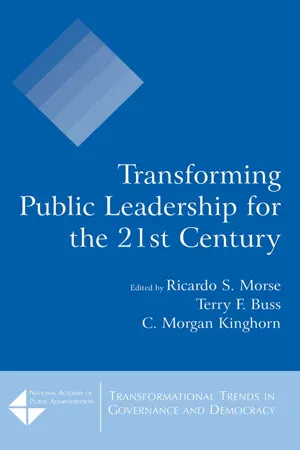
Transforming Public Leadership for the 21st Century
- 392 pages
- English
- ePUB (mobile friendly)
- Available on iOS & Android
eBook - ePub
Transforming Public Leadership for the 21st Century
About this book
The forces of globalization are shifting our world, including the public sector, away from hierarchy and command and control toward one of collaboration and networks. The way public leadership is thought about and practiced must be, and is being, transformed. This volume in the "Transformational Trends in Governance & Democracy" series explores what the shift looks like and also offers guidance on what it should look like. Specifically, the book focuses on the role of "career leaders" - those in public service - who are agents of change not only in their own organizations, but also in their communities and policy domains. These leaders work in network settings, making connections and collaborating to create public value and advance the common good. Featuring the insights of an authoritative group of contributors, the volume offers a mix of scholarship, from philosophical discussions to conceptual models to empirical studies that, taken together, will help inform the transformation of public leadership that is already underway.
Information
1
The Transformation of Public Leadership
RICARDO S. MORSE AND TERRY F. BUSS
Public leadership—the way it is practiced and how it is conceived—is undergoing a transformation, corresponding with changes in the public sector generally that some have termed the new governance (Salamon 2002). What exactly is public leadership? Is it really changing? If so, how? Further, how should public leadership change? What does this mean for the theory and practice of public administration? These are the questions taken up in this book.
Patricia Ingraham recently commented that “it is impossible to overlook the limited extent of systematic analysis of public leadership issues” (2006, 361). Larry Terry notes the “neglect,” in terms of scholarly attention, of what he called “bureaucratic leadership” (2003, 4). Matthew Fairholm also observes that “in the face of technicism, strict policy implementation, and a fear of administrative discretion, it has often been a significant struggle to discuss the philosophy of leadership in public administration” (2004, 577).
We concur with these assessments, particularly when speaking of public leadership by non-politicians. For some reason, the body of literature on public leadership, that is, the study of leadership from a public-sector perspective, is very small, especially in comparison to the enormous offerings from business schools and management gurus.1 And a great majority of what is called public leadership is focused on what might be better termed political leadership; that of presidents, governors, and other high-level government executives (elected and political appointments). We argue that public leadership is, more than anything, the domain of those in the public service; in other words, public administration. Certainly “political leadership” is part of the public leadership landscape, but we leave that discussion, for the most part, to others.
This book focuses on public leadership from an unabashed public administration point of view. The contributors to this volume, though representing a variety of perspectives, bring into focus the work of public servants in different venues. We believe that public leadership is distinctive and that generic treatments of leadership are not sufficient for the public leaders navigating the “transformation of governance” (Kettl 2002).
In this introduction, we first clarify what we mean by the terms leadership, public leadership, and transformation and otherwise define the scope of this book. We then outline some of the trends transforming governance and, by extension, public leadership, and we offer an overview of the main dimensions of the transformation. Finally, we provide an introduction and overview of the chapters in this book.
Public Leadership and Transformation
It is important that we clarify terms. First, we should speak about what we mean by leadership. Most scholarship on leadership defines it (in one way or another) as a process of influence where a person or group influences others to work toward a common goal (e.g., Northouse 2004, 2–4; Gardner 1990, 1). Thus a dynamic is set up with leaders influencing followers to do something. However, the leader-follower construct takes us only so far. In a “shared-power” world (Crosby and Bryson 2005) where “nobody [is] in charge” (Cleveland 2002), the leadership-as-motivating-followers notion often breaks down. Thus, Harlan Cleveland’s more simple definition of leadership as “bringing people together to make something different happen” may be the more appropriate definition for today and into the future (2002, xv). The distinction is subtle yet important. The former, more conventional understanding assumes a leader-follower dynamic whereas the latter does not.
With that simple definition of leadership in place, we now turn to what public leadership means. It is difficult to characterize the public leadership literature, much less the leadership literature in general, in any definitive way. What is apparent to any analyst is that use of public leadership varies greatly. We find it useful to sort the literature into three perspectives.
First, policy elite, or political leadership, focuses on political leaders, either elected or high appointees. Leader, in this sense, refers to people in government with positional authority who are legislators or senior executives. Much of the so-called public leadership literature represents this perspective, examining the behavior of top government leaders (Kellerman and Webster 2001). More specifically, these studies examine what these powerful, very visible, leaders do to create and sustain change. Burns’s Leadership (1978), for example, really focuses on political leadership. The many studies of U.S. presidents exemplify this branch of scholarship (e.g., Greenstein 2004).
Second, public organizational leadership focuses on formal leadership within public organizations: on “leadership” positions in public organizations—from line supervisor on up—and how those “leaders” lead organizational change and produce results. Van Wart’s (2005) textbook, Dynamics of Leadership in Public Service, is an example of scholarship aimed squarely at organizational leaders in the public sector. Another example of public leadership research from this perspective is Behn’s (1991) study of organizational leaders in the Massachusetts Department of Public Welfare.
Finally, what many generically call public leadership—and what others have labeled “collaborative leadership” (Chrislip 2002), “catalytic leadership” (Luke 1998), and “leadership for the common good” (Crosby and Bryson 2005)—focuses not on public “leaders” (people in formal leadership positions in government) so much as on the process of creating public value inside and outside government and at all levels of organization. Here we think of public leadership as a process that extends beyond public organizations and beyond formal leaders. It reflects the realities of a “shared power world” where governance is the product of many organizations—not just government. While formal leaders still play a prominent role, there is more of an emphasis on those—with and without formal leadership positions—that lead from “the middle” as opposed to “the top.” Whereas public organizational leadership focuses squarely on intraorganizational context, this broad notion of public leadership emphasizes inter organizational context. This broad, process-focused view of public leadership is captured by the Center for Public Leadership’s interpretation of “acts, large and small, of individuals and groups as they tackle challenges facing a community or society” (Pittinsky et al. 2006, 17).
Certainly considerable overlap exists among these three variants of public leadership; it is really a matter of focus. One perspective looks at political success, another at organizational, and the other on solving public problems. Crosby and Bryson argue that public leadership as “leadership for the common good” includes political and organizational leadership (2005). It is not so important to draw hard distinctions as it is to understand that some treatments of public leadership look broadly at processes among a wide variety of actors, in and out of government, that produce public value, while others look more narrowly at the workings of political elites or organizational leaders. The majority of attention to “public leadership” tends to be of this latter variety. However, more attention ought to be paid to public leadership that is non-big-P politics. Effective leadership within and across public organizations is just as crucial to resolving America’s “leadership crisis” (Pittinsky et al. 2006) as is reforming Congress.
The contributors to this volume, for the most part, bring into focus organizational and public (or collaborative) leadership, though important aspects of political leadership are touched upon in several of the chapters. We feel that the transformative forces on public administration lead to a greater emphasis on public—as in interorganizational—leadership, though steady intraorganizational leadership remains essential. While political leadership more often makes the headlines, it is the more pervasive, on-the-ground leadership that is changing communities and policy domains in exciting and innovative ways. And as Dwight Ink points out in this volume, more global, political success is highly dependent on alignment with the non-political leadership that is the public administration.
We also need to be very clear about what we mean in selecting this book’s title. We are not referring to the specific idea of “transforming leadership” as articulated by James McGregor Burns (1978). Rather, we are thinking more broadly about how the public leadership landscape is changing or transforming. The context in which public leadership occurs is transforming. The practice of public leadership is transforming. And the way we think about public leadership is transforming. Of course, these three transformations are intertwined and linked. The changing context leads to changes in practice. Changes in practice lead to changes in how we think about leadership. The changes in how we conceptualize leadership also shape practice, which in turn shapes or alters the context.
For at least a decade now, public administration scholars have been making the case that changing circumstances have altered the field from a study of government to one of “governance.” In this sense, governance is more than what governments do; rather, it is collective actions taken to solve public problems. This “new governance” thus shifts emphasis away from the agency toward a broad array of “tools” that might include contracting out, interagency or intersectoral collaborations, and so on (Salamon 2002). The transformation toward the new governance coincides with a transformation of leadership in the public sector.
Oftentimes we speak of transformational change in the sense of something new that replaces something outmoded. This is perhaps the wrong connotation here. In saying that public leadership is being transformed, we do not mean to imply that it is being replaced by something entirely new. Rather, consider the biological synonym for transformation: metamorphosis. The change from a caterpillar to a butterfly is remarkable and dramatic, yet the organism itself has not been replaced; rather, it has changed from one state to another. The change we speak of is the result of significant changes in context (discussed in the next section). These environmental changes require leadership to evolve, to transform; to go through a metamorphosis of sorts. The change keeps (hopefully) the lessons from the past, the elements of good management and leadership, of high-performing organizations, and so on. Essential components of good public administration remain. Yet, radical changes in context mean we must go beyond these conceptions of leadership and reach for something more.
The title of the book can thus be interpreted in a variety of ways. On the one hand, we could argue that leadership is going through a transformation—it is being transformed—and this book reports on that transformation. On the other hand, we could argue that, given our circumstances in the dawn of the new millennium, we need to transform present conceptions of leadership. In other words, this book could be about how we should go about transforming leadership. We see this book as taking both positions simultaneously. In certain respects, leadership is already being transformed. Discussions of the “new governance” provide ample evidence that the practice of public leadership is changing. Further, conceptions of public leadership are beginning to include broader ideas going well beyond specifically leading public organizations (e.g., Crosby and Bryson 2005; Luke 1998).
Yet, there is too little scholarship, in our view, on the leadership dimensions of the new governance. We still find that there is much to do in transforming how public leadership is thought about, practiced, and taught. The language of leadership is still by and large dominated by a hierarchical, organizational, positional paradigm and has not caught up with new notions of governance, networks, and collaboration.
The chapters here fill some of these gaps. The entries in this volume present various perspectives on public leadership, offering insights into both how public leadership is changing and how it should be changed. Before discussing the chapters, we first highlight some of the trends transforming governance and outline the main themes of transforming public leadership.
Transformational Trends
What contextual changes are so significant as to require a transformation in how we think about and practice public leadership? In a word, globalization. Incredible advances in transportation, communication, and information technologies have shrunk the world, or rather, made it “flat” to use Thomas Friedman’s analogy (2005). The major changes in the public sector we are seeing today are very much connected to the broader societal, economic, and political changes brought about by globalization.
As we have entered into a new millennium, we have also entered a new phase of globalization—what Friedman labels “Globalization 3.0”—that has profound social, economic, and political repercussions. Friedman explains that “Globalization 1.0” (1492–1800) was about nation-states “breaking down walls and knitting the world together, driving global integration” (2005, 9). The world shrunk from “large” to “medium” size. “Globalization 2.0” (1800–2000) was about the expansion of multinational corporations. Advances in “hardware” such as railroads in the early years and telecommunications in the latter years drove increased global integration, shrinking the world further to a size “small” (2005, 8–9). Around the time of the new millennium, Friedman argues, “Globalization 3.0” began to emerge with the convergence of several forces, most prominently advances in software and IT infrastructure. The world is now size “tiny” and the playing field for individuals is getting flatter and flatter (2005, 8–9).
The flattening described by Friedman is leading to a global capitalism that is not only turning China and India into economic superpowers but also making borders and other “boundaries” less meaningful. Globalization means that cities can no longer afford to think in terms of competing with their neighbors because now the competition is among regions on a global scale. Friedman argues that the emerging global market is “making some very new politics” (2005, 201). The world is moving from a “primarily vertical (command and control) value-creation model to an increasingly horizontal (connect and collaborate)” model that “affects everything” from how “communities and companies define themselves, where companies and communities stop and start, how individuals balance their different identities as consumers, employees, shareholders, and citizens, and what role government has to play.” All of this, according to Friedman, requires a “sorting out” on a global scale (2005, 201–205).
The unanswered questions in Friedman’s analysis—all of the “sorting out” that is to occur—is very much the domain of public leadership. How the redefinitions work out, who wins and who loses, and what it all means for communities, st...
Table of contents
- Cover
- Title Page
- Copyright Page
- Dedication
- Table of Contents
- Foreword
- Preface and Acknowledgments
- 1. The Transformation of Public Leadership
- Part I. Politics, Administration, and Public Leadership
- Part II. Leadership Frames
- Part III. Leadership and Collaboration
- Part IV. Leading Change in Different Contexts
- About the Editors and Contributors
- Index
Trusted by 375,005 students
Access to over 1.5 million titles for a fair monthly price.
Study more efficiently using our study tools.
Frequently asked questions
Yes, you can cancel anytime from the Subscription tab in your account settings on the Perlego website. Your subscription will stay active until the end of your current billing period. Learn how to cancel your subscription
No, books cannot be downloaded as external files, such as PDFs, for use outside of Perlego. However, you can download books within the Perlego app for offline reading on mobile or tablet. Learn how to download books offline
Perlego offers two plans: Essential and Complete
- Essential is ideal for learners and professionals who enjoy exploring a wide range of subjects. Access the Essential Library with 800,000+ trusted titles and best-sellers across business, personal growth, and the humanities. Includes unlimited reading time and Standard Read Aloud voice.
- Complete: Perfect for advanced learners and researchers needing full, unrestricted access. Unlock 1.5M+ books across hundreds of subjects, including academic and specialized titles. The Complete Plan also includes advanced features like Premium Read Aloud and Research Assistant.
We are an online textbook subscription service, where you can get access to an entire online library for less than the price of a single book per month. With over 1.5 million books across 990+ topics, we’ve got you covered! Learn about our mission
Look out for the read-aloud symbol on your next book to see if you can listen to it. The read-aloud tool reads text aloud for you, highlighting the text as it is being read. You can pause it, speed it up and slow it down. Learn more about Read Aloud
Yes! You can use the Perlego app on both iOS and Android devices to read anytime, anywhere — even offline. Perfect for commutes or when you’re on the go.
Please note we cannot support devices running on iOS 13 and Android 7 or earlier. Learn more about using the app
Please note we cannot support devices running on iOS 13 and Android 7 or earlier. Learn more about using the app
Yes, you can access Transforming Public Leadership for the 21st Century by Ricardo S. Morse,Terry F. Buss,C. Morgan Kinghorn in PDF and/or ePUB format, as well as other popular books in Política y relaciones internacionales & Liderazgo. We have over 1.5 million books available in our catalogue for you to explore.