Social media is becoming an increasingly important—and controversial—investigative source for law enforcement. Social Media Investigation for Law Enforcement provides an overview of the current state of digital forensic investigation of Facebook and other social media networks and the state of the law, touches on hacktivism, and discusses the implications for privacy and other controversial areas. The authors also point to future trends.

- 112 pages
- English
- ePUB (mobile friendly)
- Available on iOS & Android
eBook - ePub
Social Media Investigation for Law Enforcement
Chapter 1
Introduction to Social Media
When we think about social media, a few things immediately come to mind: Facebook, friends, games, Twitter, Internet, iPhone. We are all familiar with social media in one form or another. Television shows advertise their Facebook page containing games and program information. News stations broadcast opinionated Tweets from Twitter regarding current events. Businesses connect with customers through foursquare so that fans can receive deals and companies may advertise to a specific audience. There are many popular social media sites today which vary in their uses, all the way from fundraising for charities to creating a centralized database of information, from CouchSurfing.org, which lets members find places to stay while traveling, to partyflock.nl, a Dutch community for people interested in house music. Although we are all familiar with what is considered social media, many are unfamiliar with the definition of social media and what exactly differentiates social media from other forms of media.
1.1 Definition of Social Media
According to Boyd and Ellison (2007), social networking sites are “web-based services that allow individuals to (1) construct a public or semi-public profile within a bounded system, (2) articulate a list of other users with whom they share a connection and (3) view and traverse their list of connections and those made by others within the system” (p. 211).
By breaking down this definition and building on it, we can define what exactly constitutes social media. A social medium allows the user to create a profile within the site; this may consist of a personal picture, screen name, e-mail address, avatar, symbol or other depiction. The profile gives users a specific and unique identification so that other members may identify him from all other members on the system. Once users have created a unique profile, they may find and connect with other members on the site. This includes friends or acquaintances from the real world, and may extend to users met through the site itself. Once the user has connected with others on the site, it may be possible to see not only his own connections made through the site but connections that other members have also made within the system. Viewing of other member’s connections depends on how the social site is designed and what privacy settings users have enabled.
Building on Boyd and Ellison’s definition, we can further define social media. A social medium (4) encourages its users to communicate with other users who are a part of that network and/or the site creators themselves, and (5) creates an environment for users to share content and/or connect through their similar interests. Many social media sites offer different ways for users to communicate with one other: instant messaging, e-mailing, real-time video or voice chatting. One of the goals and thus a characteristic of a social medium is a sense of community among users. Members of a site are able to distribute and share their content with one another, or may be able to unite through similar interests and hobbies.
1.2 A Very Brief History of Social Networking
Ever played the game “Six Degrees of Kevin Bacon?” A random individual is chosen and the players try to make a connection from the selected person to actor Kevin Bacon in six links or less. As arbitrary as the number six seems for this game, it actually comes from a scientific theory. An Italian inventor, Guglielmo Marconi, through his research and experiments of wireless telegraphy, postulated that any two people throughout the world should be linked by a chain of 5.83 intermediaries or less (Hayes, 2000).
According to Boyd and Ellison’s definition along with our own additions, the first social network was SixDegrees.com, originally launched in 1997. The idea behind SixDegrees was to promote social associations and business contacts. A user became part of the network by filling out the information form and listing ten e-mail addresses of associates. Contacts were ordered by degrees, so one was able to see his first-degree contacts, second-degree contacts, eventually leading to the sixth degree, which included the entire SixDegrees.com network. It consisted of electronic bulletin boards, e-mailing and online messaging. There was also an internal search engine which allowed users to search and find others with similar interests (Bedell, 1998). It was the first web site to combine successful features from other popular sites to create a social network. It also included profiles, which were normal on dating or community sites, buddy lists from chat programs and networks that high schools and colleges commonly used, such as Classmates.com (Boyd and Ellison, 2007) (Fig. 1.1).
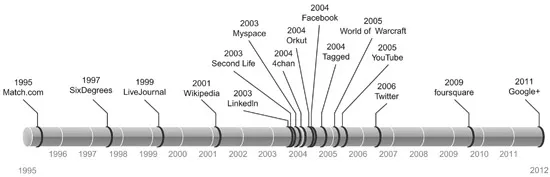
Fig. 1.1 . Social media timeline.
As the Internet continues to expand and improve, social media sites develop and grow as well, attempting to reach high popularity among users and attract more participants. This growth continues in the present, where social media sites are an everyday part of our lives.
1.3 Types of Social Media
There is currently a wide variety of social media available on the Internet, each designed for different purposes. Some sites promote an environment for all users, while others create a place for people with specific and/or similar interests. Social media sites have been categorized to explain their uses and purposes in a descriptive manner. These categories include collaborative projects, blogs and microblogs, location-based, content communities, social networking sites, virtual game worlds, virtual social worlds and dating sites (Kaplan and Haenlein, 2010). Many of the different types of social media sites will synchronize with one another so users can interact through multiple social media interfaces simultaneously.
1.3.1 Collaborative Projects
Collaborative projects encourage users to contribute to the content of the site. All users are essentially writers, editors and proofreaders; any member can be involved in the project to help assist in the final outcome of the collaboration.
1.3.1.1 Wikipedia
Wikipedia is a free-content online encyclopedia project, where any user may add information to subject pages in order to increase the knowledge database. Articles are continually created and updated, allowing users to have up-to-date written and stored information about events in a matter of minutes rather than weeks or years. Each article contains links which cross-reference additional articles about an associated subject. These connected articles allow users to quickly find related information regarding a specific subject. Since any user may update an article, there are concerns regarding accuracy; many errors may be found in the encyclopedia. Wikipedia states that “the ideal Wikipedia article is well-written, balanced, neutral and encyclopedic, containing comprehensive, notable, verifiable knowledge.” Pages and articles are actually edited, discussed and debated among users, eventually taking on a neutral point of view reached through a general consensus (“Wikipedia: About,” n.d.).
1.3.2 Blogs and Microblogs
The term “blog” comes from Jorn Barger who, in 1997, published a series of links in reverse chronological order, naming it Robot Wisdom WebLog. Users started referring to other sites containing posts in reverse chronological order as WebLogs as well. An online journalist then split the word “WebLog” into “We Blog,” coining the use of the common term “blog.” Microblogging developed a few years later, consisting of smaller and shorter blog posts (Carvin, 2007).
Blogs and microblogs give users a chance to express their personal thoughts and opinions on a wide variety of subject matters. The textual content varies from both nonfictional and fictional articles to journal entries and short stories; content often includes streaming video, audio and photographs. A very popular microblog these days is Twitter.
1.3.2.1 Twitter
Twitter is a web site which allows users to post on a real-time information network. The community is open to everyone from all demographics, and is often used by celebrities; it is a place where members connect to the latest stories, ideas, opinions, and news. Each post is known as a Tweet, which is 140 characters long at the most (“About Twitter,” n.d.). By March 2012, Twitter’s sixth birthday, more than 340 million tweets were posted each day – that is more than one billion tweets every three days (@twitter, 2012).
1.3.3 Location-Based
Location-based social media sites and applications allow users to tag their geographical location. Members can check into specific stores, helping businesses advertise, distribute coupons and attract more customers.
1.3.3.1 Foursquare
Foursquare is a popular example of a location-based social medium. Users “check in” at a location, which lets them discover what specials are offered along with other possible attractions nearby. Businesses commonly place coupons and deals on foursquare, giving members the opportunity to save money and hopefully inspire their friends to join them. A certain competitive aspect exists on the site, making the user who checks in the most at a single location the “mayor” of the check-in point. If another user checks in more times than the current mayor, he can be ousted from office and a new mayor is then declared (“About foursquare,” n.d.).
1.3.4 Content Communities
Content communities are social media sites that allow users to share all different types of content with one another. This may include photographs, articles, short stories, videos, games and presentations.
1.3.4.1 YouTube
YouTube was founded in February 2005 and lets users watch and share videos (“About YouTube,” n.d.). YouTube’s vision is to give every member a voice and support the evolution of video. As of June 2012, forty-eight hours’, or two days’, worth of video is uploaded each minute, resulting in nearly eight years of content uploaded every day (“Frequently,” n.d.). The following site automatically displays the most popular videos (n.d.) from different categories on YouTube: http://www.youtube.com/topic/4qRk91tndwg/most-popular.
1.3.4.2 4chan
4chan originally started as a project founded by the administrator “moot.” It is an image-based bulletin board where users post comments and share images about all different topics, which has been growing ever since its development. The site wants users to contribute by adding images and posting comments to the boards which are substantial, helpful, friendly and humorous (“4chan,” n.d.).
1.3.5 Social Networking Sites
Social networking sites are probably the most well-known type of social media. Facebook is a household name that is now anywhere and everywhere. Social ...
Table of contents
- Cover
- Half Title
- Title
- Copyright
- CONTENTS
- Preface
- Acknowledgements
- Chapter 1 Introduction to Social Media
- Chapter 2 How Social Media Is Used
- Chapter 3 Investigative Uses of Social Media
- Chapter 4 Social Media and the Law: Legal Considerations
- Chapter 5 Moving Forward
- Appendix 1: Sample Social Media Preservation Letter Request
- Appendix 2: Sample Social Media Subpoena Request
- Appendix 3: Sample Social Media Court Order
- Appendix 4: Media Emergency Disclosure Request Form
Frequently asked questions
Yes, you can cancel anytime from the Subscription tab in your account settings on the Perlego website. Your subscription will stay active until the end of your current billing period. Learn how to cancel your subscription
No, books cannot be downloaded as external files, such as PDFs, for use outside of Perlego. However, you can download books within the Perlego app for offline reading on mobile or tablet. Learn how to download books offline
Perlego offers two plans: Essential and Complete
- Essential is ideal for learners and professionals who enjoy exploring a wide range of subjects. Access the Essential Library with 800,000+ trusted titles and best-sellers across business, personal growth, and the humanities. Includes unlimited reading time and Standard Read Aloud voice.
- Complete: Perfect for advanced learners and researchers needing full, unrestricted access. Unlock 1.5M+ books across hundreds of subjects, including academic and specialized titles. The Complete Plan also includes advanced features like Premium Read Aloud and Research Assistant.
We are an online textbook subscription service, where you can get access to an entire online library for less than the price of a single book per month. With over 1.5 million books across 990+ topics, we’ve got you covered! Learn about our mission
Look out for the read-aloud symbol on your next book to see if you can listen to it. The read-aloud tool reads text aloud for you, highlighting the text as it is being read. You can pause it, speed it up and slow it down. Learn more about Read Aloud
Yes! You can use the Perlego app on both iOS and Android devices to read anytime, anywhere — even offline. Perfect for commutes or when you’re on the go.
Please note we cannot support devices running on iOS 13 and Android 7 or earlier. Learn more about using the app
Please note we cannot support devices running on iOS 13 and Android 7 or earlier. Learn more about using the app
Yes, you can access Social Media Investigation for Law Enforcement by Joshua Brunty,Katherine Helenek in PDF and/or ePUB format, as well as other popular books in Law & Cyber Security. We have over 1.5 million books available in our catalogue for you to explore.