- 192 pages
- English
- ePUB (mobile friendly)
- Available on iOS & Android
eBook - ePub
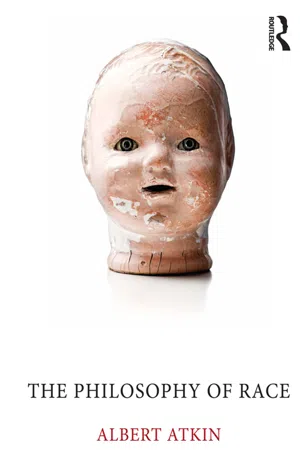
The Philosophy of Race
About this book
"Race" is so highly charged and loaded a concept it often hampers critical thinking about racial practice and policy. A philosophical approach allows us to isolate and analyse the key questions: What is race? Can we do without race? What is racism and why is it wrong? What should our policies on race and racism be? The Philosophy of Race presents a concise and up-to-date overview of the central philosophical debates about race. It then builds on this philosophical foundation to analyse the sociopolitical questions of racism and race-relevant policy. Throughout, the discussion is illustrated with a wide range of examples: Afro-American 'blackness'; British-Asian racial formation; Aboriginal identity in Australia; the racial grouping of Romany-Gypsies and Jews in Europe; categories of race in Brazil; and the concept of model minorities in the US and UK.
Information
CHAPTER ONE
Is race real?
Is race real? At first blush, this may seem like an odd question. After all, race seems to be all around us. We have no difficulty ascertaining its presence in our daily interactions with others – if you ask me, I can tell you the race of the woman who drove the bus I caught to work this morning, or the race of the man who sold me a newspaper on my way home. And of course, race looms large in how we consider the world to be – it seems significant that the USA elected its first black president in 2008; it seems right that Australia’s “Stolen Generation” should seek compensation for injustices inflicted upon them on account of their race; it seems contentious that the commissioner of the Metropolitan Police in London thinks young black men should be the focus of anti-crime initiatives in Britain’s capital; it seems to be an advance that in the 2011 UK census, the racial category of “Romany” has been added for the first time. In light of what looks like the ubiquity and mundanity of race talk and thought in our daily lives, then, the oddness of the question “Is race real?” becomes apparent. Are we really supposed to question the reality of something that is so obviously a part of our everyday lives, and the subject of everyday talk everywhere? If we are, it looks as though it will simply be one of those esoteric philosophical questions that raise unlikely doubts about what is blindingly obvious to anyone who doesn’t want to play the philosopher’s game. But, as it happens, questions about the reality of race are not quite like that. They are the foundation of serious enquiry with significant import and ramifications for our everyday thought and talk.
In asking if race is real, we are trying to do some serious philosophical work, and one of the first things we must learn to do in such work is question what seems to be obvious. But questions, philosophical or otherwise, about the reality of race arguably have deeper consequences than questions of merely esoteric philosophical concern – those questions we ask simply because we can. After all, the first black American to take office in the USA is an event of no small moment, just as the compensatory entitlements of Australia’s indigenous people or the possibility of raceled policing in London are hardly issues without practical friction in the world. And these things are premised on the notion that there really is such a thing as race. So, odd as the question may seem, to ask whether race is real is to take a serious question about our behaviours, beliefs and ways of thinking and talking, and to look for the assumptions that lie beneath. That’s the philosophical project of this chapter.
The first thing to note is that we do seem to assume that race is real. After all, that’s what our observations about the ubiquity and mundanity of race talk are meant to show. In our non-philosophical garb, in our role as ordinary folk with pre-theoretical ideas, we talk, think and behave as though there really is such a thing as race in the world. But what are we really assuming here? What are our pre-theoretical, ordinary-folk assumptions about race? What do we think that word picks out in the world? And by assuming or even boldly asserting that race is real, even if only pre-theoretically, what do we honestly mean? That we behave as though there are races, or that there really are races? That it is a fact about our behaviour, or that it is a fact about the world? In short, what do we ordinary thinkers mean when we talk about race, and is that thing, the thing we take ourselves to be talking about, real?
In this chapter we will begin to answer these questions about our pre-theoretical ideas of race and its reality. Indeed, we shall deal with these questions in two separate sections, first examining what our ordinary race talk purports to be about, and then examining whether that thing really exists. However, for the sake of clarity it is worth saying here and now that among the key themes underlying our ordinary talk and thought about race are the following ideas: that the key markers of race are bodily or somatic traits; that race involves genealogy or inheritance; that race is crucially tied to geographical origins; that race indicates, generates or constrains certain physical or mental abilities and capacities; that race indicates, generates or constrains certain cultural and attitudinal behaviours; that race involves notions of purity. As for the question of reality, we seem to assume that race is real and that its reality is underpinned by biological and genetic facts made readily available by our best scientific theories. We shall of course examine and elaborate on all of these points in the rest of this chapter.
We’ll start by spending some time looking at our ordinary ideas about race by introducing and making sense of the common themes, assertions and ideas that seem prevalent in our ordinary notions and talk of race. We shall also spend some time trying to make that “ordinary notion” a little more robust – we want to find a concept that can do justice to the ordinary pre-theoretical idea of race, while at the same time being coherent and well-formed enough to do some philosophical work. We’ll then move on to examine what our ordinary assumptions about the reality of race are, and see if there is any clear way in which those assumptions are borne out by scientific fact. In particular, we shall see that our assumptions about the scientific underpinnings of race are not supported by science at all and that if our ordinary thinking about the reality of race assumes that there are solid scientific facts that bear it out, then we are wrong.
WHAT DO WE MEAN BY “RACE”?
Part of the problem of asking what we mean by “race” is that because our use of the term is often unreflective, we seldom stop to ask exactly what it is we take ourselves to be referring to when we talk about it. However, some time spent reflecting on the ways we talk about and use the concept of race in our day-to-day interactions with the world can allow us to recover an awful lot of the features that we seem to assume are bound to race. The following is a list of notions that seem to be more or less implicit on our ordinary race talk:
1. Race and racial difference is marked by certain somatic markers and bodily differences (e.g. skin colour, facial features, hair texture).
2. Race is something that we inherit from our parents, grandparents, etc.
3. Racial differences are tied to geographical origins (e.g. black people originate from Africa).
4. Different races have different physical and mental capabilities.
5. Different races have different cultural and attitudinal behaviours.
6. Races are more or less pure.
We will examine the elements on this list in a little more detail very shortly, but it is worth noting a few things before we begin. First of all this is not an exhaustive list of the assumptions that are implicit in our race talk. Second, this is not meant to be a simple list of necessary and sufficient conditions, just a cluster of ideas that seem to circulate around our ordinary uses of the term “race”. And third, confronted with this list, it is unlikely that everyone will agree that this captures what they mean when they talk and think of race. Indeed, they may think all of these ideas should be included in a clarification of the term “race”, but they might just as easily think this list too extensive, or even totally inadequate. Nonetheless, I think this list forms a good working core of ordinary pre-theoretical assumptions about race,1 and it certainly includes what are arguably non-negotiable features of our race thinking – we shall return to this when we try to make our ordinary concept of race more robust. But before we do that, let’s examine the elements of the list above more closely and see just what reasons we might have for thinking these are the assumptions that underpin ordinary talk about race.
Racial difference as bodily difference
What reason do we have for claiming that in our ordinary thinking race and racial difference is supposedly marked by bodily difference? In fact, I take this to be a relatively non-contentious claim – it simply attempts to capture the fact that we think people of different races look different, and people of the same races look similar. And the features we most often tend to think of when talking of race are skin colour (black skin, brown skin, white skin, yellow skin, etc.), facial features (thin noses, broad noses, thick lips, round heads, etc.) and hair type and colour (thick and frizzy, thin and straight, etc.). We can support such a claim by pointing to a number of facts.
First, our everyday practices of noting race and racial difference tend to rely on physical descriptions, and in particular on skin colour. Had you asked me the race of the woman who drove the bus I caught to work, or the race of man who sold me a newspaper on the way home, I would probably have answered by making reference to skin colour – “she was white” or “he was black”. Indeed, in a variety of contexts, our names and descriptions (including pejoratives) for the different races are meant to reference perceived differences in skin colour: “blacks”, “whites”, “red-skins”, and so on. Physical difference, then, is readily used in ordinary discourse as a marker of race and racial difference.
Second, the assumption of racial difference as bodily difference is made explicit in official contexts too. Skin-based racial markers are often included in our census categories, with the USA, UK and Australia frequently including black and white among their classifications, and countries such as Brazil on occasion including as many as twenty-eight colour-related census classifications for race.2 There are even examples of police training manuals that demarcate races in wholly physical terms – South Carolina’s Gypsies, Tramps and Thieves describes “European Gypsies” thus: “Average height – 5’9” (tend to be stocky); average weight – medium to heavy; hair – dark; eyes – dark; complexion – olive to dark”. Physical difference, then, plays a role in our more official attempts to organize and demarcate members of our broader social groups.
And finally, we often use perceived bodily differences between races as the explanatory basis of other perceived racial differences. So, for example, in the USA, swimming is not taken to be a recreational activity much pursued by black people or black families. There are absurd explanations for why this is so, including claims that “black bones” are denser, or that black people are naturally less buoyant. But even among the better explanations of why this kind of apparent behavioural difference between the races should exist, we still find recourse to somatic or bodily difference. One good candidate explanation is that black parents have not learned to swim and so cannot teach their children, hence there are lower numbers of black participants in recreational swimming. Further pressing on why this should be so sees “hair” or “black hair” as a frequently cited factor. While the allusion to racial differences in hair type (and the related difference in required maintenance of that hair) will be familiar to most people, the point here is merely that in such a case we can only cite such simple bodily differences as explanations of complex social differences because there is an underlying assumption that these bodily differences are key to marking racial differences.
Race is something that we inherit from our parents, grandparents, and so on
Our ordinary concept of race also seems to rely on the notion of inheritance – we assume that an individual’s race is dependent upon the race of that individual’s biological parents and ancestors. Again, this is a fairly non-contentious claim about our uses of the concept of race. And again, there are plenty of obvious instances showing just why, in our ordinary talk and thought, we assume that heritability and/or genealogy is crucial to race.
The most obvious evidence for our ordinary assumption of racial inheritance comes from examining our likely responses to questions about the respective races of parents and children – asked about the possible race of a black person’s parents, we are unlikely to entertain seriously any answer other than “black”. However, we can see the assumption of racial inheritance in other ways too. For example, our consternation and surprise at, and explanations for, atavism – instances where, for example, black parents give birth to white children, or white parents give birth to black children – all highlight our assumption of racial inheritance. First of all, we simply do not expect to see parents give birth to children who appear to be racially different to them, and so we find such cases fascinating. Second, we often assume that a more likely explanation is that we are not really seeing racial difference between parents and children, but instances of cuckoldry and concealed infidelity. In such instances, our assumption of racial inheritance is preserved of course – the absent or concealed parent explains the apparent anomaly and race is inherited just as we suspect. And finally, even where our assumption of racial inheritance cannot be maintained by suspicion of concealment (because cuckoldry is ruled out, say), the whole notion of atavism, the “evolutionary throw-back”, relies upon the idea that some ancestor buried deep in the genealogy has the racial trait which the child has now manifested. Inheritance lies at the heart of this.
A further example worth mentioning is the use of genealogy and family trees by Nazi researchers for finding workable definitions for classifying individuals as “Gypsies”. The problem faced by those charged with the task of giving a ready definition of “Roma”, “Sinti” and “Gypsies” that would enable the easy classification and removal of these racial groups was that, unlike other racial groups, the somatic and bodily markers of racial difference were not so clear or prominent. The next best thing, it was decided, was to make use of long and elaborately researched family trees, genealogies, and ancestral histories – a key marker of being racially Roma was being the offspring of someone who was racially Roma. This, of course, is an extreme case, but nonetheless, it shows that in circumstances where readily useable markers of racial difference are needed, among the first to be called upon are racial inheritance and ancestry.
Racial differences are tied to geographical origins
The claim that our ordinary race talk and thought takes race and racial differences to be tied to differences in geographical origins is the familiar idea that races are somehow linked to particular areas of the Earth – white people tend to originate in Europe, black people in Africa, and so on. Of course, such a claim is mostly interconnected with the first two markers mentioned – contemporary black people and white people in the USA, for instance, need never have set foot outside North America, but we perceive the somatic markers of their race to be inherited from their forebears who did originate in other geographical locations.
Again, we can see this underlying assumption about race in our everyday talk and behaviours. We talk of African-Americans, British-Asians or Anglo-Australians for instance, and such categorizations, which explicitly draw race and geographical location together, even find themselves included on official census forms in many countries. And there are, of course, less pleasant examples which illustrate just how we tie racial differences and geographical origins in our ordinary thought and talk – an oftcited (but ludicrous) sentiment arising fro...
Table of contents
- Cover
- Half Title
- Title Page
- Copyright Page
- Table of Contents
- Acknowledgements
- Introduction
- 1 Is race real?
- 2 Is race social?
- 3 What should we do with race?
- 4 Racism
- 5 The everyday impact of race and racism
- Further reading
- Bibliography
- Index
Trusted by 375,005 students
Access to over 1.5 million titles for a fair monthly price.
Study more efficiently using our study tools.
Frequently asked questions
Yes, you can cancel anytime from the Subscription tab in your account settings on the Perlego website. Your subscription will stay active until the end of your current billing period. Learn how to cancel your subscription
No, books cannot be downloaded as external files, such as PDFs, for use outside of Perlego. However, you can download books within the Perlego app for offline reading on mobile or tablet. Learn how to download books offline
We are an online textbook subscription service, where you can get access to an entire online library for less than the price of a single book per month. With over 1.5 million books across 990+ topics, we’ve got you covered! Learn about our mission
Look out for the read-aloud symbol on your next book to see if you can listen to it. The read-aloud tool reads text aloud for you, highlighting the text as it is being read. You can pause it, speed it up and slow it down. Learn more about Read Aloud
Yes! You can use the Perlego app on both iOS and Android devices to read anytime, anywhere — even offline. Perfect for commutes or when you’re on the go.
Please note we cannot support devices running on iOS 13 and Android 7 or earlier. Learn more about using the app
Please note we cannot support devices running on iOS 13 and Android 7 or earlier. Learn more about using the app
Yes, you can access The Philosophy of Race by Albert Atkin in PDF and/or ePUB format, as well as other popular books in Filosofía & Historia y teoría filosóficas. We have over 1.5 million books available in our catalogue for you to explore.