- 176 pages
- English
- ePUB (mobile friendly)
- Available on iOS & Android
eBook - ePub
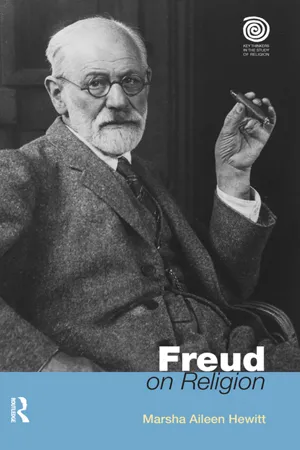
Freud on Religion
About this book
Freud argued that religions originate in the unconscious needs, longings and fantasies of human minds. His work has served to highlight how any analysis of religion must explore mental life, both the cognitive and the unconscious. 'Freud on Religion' examines Freud's complex understanding of religious belief and practice. The book brings together contemporary psychoanalytic theory and case material from Freud's clinical practice to illustrate how the operations of the unconscious mind support various forms of religious belief, from mainstream to occult. 'Freud on Religion' offers a new way of understanding Freud's thinking and demonstrates how valuable psychoanalysis is for the study of religion.
Information
ONE
Psychoanalysis as a critical theory of religion
Religion is the record of the wishes, desires, and accusations of countless generations.
(Horkheimer 1972: 129)
Sigmund Freud’s theory of religion “has evoked more controversy and condemnation than any of his other writings”, writes Ernest Jones (1957: 349). This observation remains as true today as it was more than fifty years ago. The irony is that Freud does not write about religion as such. Rather, the real object of inquiry in his work on religion is the human mind and those psychological processes that result in and support the diverse cultural phenomena that many commentators and scholars of religion associate with or identify as religion. As a psychoanalytic theorist and clinician, Freud’s interest in religion is explanatory and scientific, not theological. As far as he is concerned, a “scientific investigation of religious belief” necessarily presupposes “unbelief” (cited in Gay 1988: 637). In this respect Freud’s psychoanalytic and differentiated theory of religion is best situated within the intellectual tradition of psychological and anthropological explanations of religion represented by figures such as Ludwig Feuerbach (1804–72) and Karl Marx (1818–83). The shared goal of all three theorists is to demystify religion and the sacred (Ricoeur 1970: 153) in order to show that the basis of religion – its true “secret” – is anthropology. As far as Feuerbach, Marx and Freud are concerned, gods are the non-conscious or unconscious products of culturally mediated human minds. “Now God is the nature of man regarded as absolute truth – the truth of man … for the qualities of God are nothing else than the essential qualities of man himself”, writes Feuerbach (1957: 19–20).
Religion is the psychological and cultural expression of the relation of humanity to its own nature, emerging out of and filling the “gap” that lies between the individual and the human species (Harvey 1997: 28, 39). Feuerbach, whose philosophy Freud “revered” (Grubrich-Simitis 1986: 287), was Freud’s “favorite thinker” (Gay 1988: 28). His influence reverberates throughout Freud’s thinking on religion (Stepansky 1986; Grunbaum 1987: 157; Wallace 1983; Gay 1987: 53) and is especially evident in Feuerbach’s explanation of God as a psychological projection of humanity’s own ideal qualities that become objectified in the image of an external, transcendent deity. “God”, writes Feuerbach, “is only the nature of man regarded objectively” (1957: 270), the result of an alienation of the human spirit from its own true essence. He describes the psychological nature of human self-alienation that characterizes religion as a process where “[m]an denies as to himself only what he attributes to God … Religion further denies goodness as a quality of human nature; man is wicked … God is only good” (ibid.: 27–8). Feuerbach hopes that humanity will eventually become conscious of this truth, thereby restoring and reclaiming its own spiritual nature as fully human.
Marx, also inspired by Feuerbach’s anthropological methodology, sharpens and summarizes his central thesis with the succinct statement, “Man makes religion, religion does not make man” (1975a: 175). Marx also emphasizes the psychological, spiritual and material enslavement of human beings by religion in his argument that its self-interested, political purpose is to mystify and conceal the truth that human suffering is largely self-inflicted. If the myriad forms of injustice in the world are human creations, they can be changed by human action. As far as Marx is concerned, religion keeps this truth of the human condition hidden from consciousness, thereby supporting and reproducing the exploitative and oppressive forces that result in misery and suffering for the vast majority of human beings. The false consolations and promises of religion manufacture little more than an “illusory happiness” that preserves and maintains the interests of an inhuman capitalist hegemony whose power and wealth are the direct products of exploitative practices it inflicts on the labouring classes. For Marx, it follows that the abolition of religion, along with its false promises of eschatological rewards, opens the way for the “real” (ibid.: 176) material happiness of actual living human beings. As far as Marx was concerned, people turn to religion for assurance that they will be compensated in eternity for what is lacking in their present lives. Religion’s promise of salvation and eternal life draws its emotional power and psychological credibility from the contrasting conditions of miserable human earthly experience. Marx writes, “The demand to give up illusions about the existing state of affairs is the demand to give up a state of affairs which needs illusions. The criticism of religion is therefore in embryo the criticism of the vale of tears, the halo of which is religion” (ibid.: 176). Feuerbach and Freud would concur with Marx that a theocentric world is indeed an “inverted world” where religious narratives and myths are but “the general theory of that world” for which “the human essence has no true reality” (ibid.: 175). Freud reiterates this last point in particular with the assertion that religious myths were “projected on to the heavens after having arisen elsewhere under purely human conditions” (1913a: 292). Freud agrees with Marx and Feuerbach that mythologies are cultural products, man-made explanations of the human condition. “It is in this human content that our interest lies”, he writes (ibid., emphasis added). This last statement may be read as summing up Freud’s entire approach to the psychoanalytic study of religion. Marx writes, in a remarkably prescient insight that could also describe most of Freud’s naturalistic psychoanalytic methodology:
The phantoms formed in the brains of men are also, necessarily, sublimates of their material life-processes, which is empirically verifiable and bound to material premises. Morality, religion, metaphysics, and all the rest of ideology as well as the forms of consciousness corresponding to these, thus no longer retain the semblance of independence.
(Marx 1976: 36–7)
The demystifying explanations by Feuerbach, Marx and Freud of religion share another concern: to liberate the human potential for existential autonomy from what they see as the debilitating grip of both external and internal heteronomous authorities that alienate individuals from their capacities for moral agency and intellectual creativity. In this respect, their theories share a strongly implicit ethical interest. In so far as their critiques of religion aim to expose the ways in which the demands of this cultural and social phenomenon restrict and impoverish the human mind, the work of all three thinkers can be understood as further sharing an emancipatory interest. While Feuerbach and Marx express a less developed understanding of the complex interconnections between internal and external forms of oppression, it was Freud who mounted a full depth-psychological account of the unconscious complexities of the psychodynamics of domination and submission within the individual mind. While Freud does not engage with Marx’s critique of capitalism, he is critically appreciative of some aspects of Marx’s thought (1933a: 176–82) with which his own thinking at times bears striking similarity (Ellenberger 1970: 239–40). For example, Freud believed that a transformation in the relationship of human beings to property and possessions could be more effective in alleviating destructive social tensions than obedience to the dictates of religion or ethics (Freud 1930a: 143; Gay 1988: 548). Freud’s work expands and deepens the explanatory range of both Marx and Feuerbach with respect to the psychodynamics of religious experiences, beliefs and actions, and their intersection with external material forces. In a theoretical move that is conceptually parallel to the anthropological philosophy of Feuerbach and Marx, Freud replaces metaphysics with a metapsychology that identifies and interrogates the multiple affective components of the human being’s need for a god that organizes the underlying internal dynamics of religious belief.1
In his examination of the cross-currents and intersections of psyche and society, and internal fantasy and external forms, Freud’s critique of religion is best understood in terms of a psychoanalytic critical social theory. Furthermore, it is important to bear in mind that his efforts to explain the psychological forces underlying religious belief derive in significant measure from knowledge gained from his clinical work with patients. There is a strong connection that runs throughout Freud’s work between theory and practice, where theoretical insights arise not only from observations made during clinical work, but also where the theory itself is directed to bringing about change. As both a theory and clinical practice, psychoanalysis hopes to effect new and different modes of thought and action in an individual life. This accounts for the often overlooked or forgotten fact that Freud did not conceptualize the individual mind as separate or isolated from its relationships with the external world. Individuals are social and relational beings for Freud. His longstanding preoccupation with cultural issues betrays a particular interest in the nature of the relationship between individual minds and society, which he broadened to include individual human (ontogeny) and species psychological development (phylogeny):
My interest, after making a lifelong detour through the natural sciences, medicine and psychotherapy, returned to the cultural problems which had fascinated me long before, when I was a youth scarcely old enough for thinking … I perceived ever more clearly that the events of human history, the interactions between human nature, cultural development and the precipitates of primaeval experiences (the most prominent example of which is religion) are no more than a reflection of the dynamic conflicts between the ego, the id and the super-ego, which psychoanalysis studies in the individual – are the very same processes repeated upon a wider stage.
(Freud 1935: 72)
While Freud’s studies of culture and religion “originate in psychoanalysis”, their scope extends “far beyond it” (ibid.), as will be seen in subsequent chapters. Virtually all his so-called cultural works address religion, probing the psychic intersections of the individual and society in a psychoanalytic theory of the world within the mind, and the mind writ large upon the world. Freud remained consistent in his view that individual psychology is at the same time a social psychology. “In the individual’s mental life”, he writes, “someone else is invariably involved, as a model, as an object, as a helper, as an opponent; and so from the very first individual psychology, in this extended but entirely justifiable sense of the words, is at the same time social psychology as well” (1921a: 68). As Russell Jacoby observes, “psychoanalysis rediscovers society in the individual” (1975: 79). As works of critical social theory, Freud’s writings on religion illustrate how psychoanalysis “sink[s] into subjectivity till it hits bottom: society. It is here where subjectivity devolves into objectivity; subjectivity is pursued till it issues into the social and historical events that preformed and deformed the subject” (ibid.). The unconscious does not escape culture (Gay 1988: 338). What follows is a detailed analysis of those texts that most clearly demonstrate Freud’s psychoanalytic critical theory of religion.
Religion: individual and mass neurosis
In one of his earliest sustained treatments of the psychology of religion, Freud formulates an analogical relationship between religious belief and practice on the one hand and obsessional neurosis on the other by comparing and exploring their shared unconscious psychodynamics (Freud 1907a: 117). In a later work, he clarified that although religion functions like a “universal obsessional neurosis”, the analogy does not “exhaust the essential nature of religion” (Freud 1927: 43). Moreover, he was well aware of the dangers involved in transplanting ideas that are “far from the soil in which they grew up”. Nonetheless, and while bearing these cautions in mind, Freud insisted that there exists something of a resonance, or a “conformity”, between religion and neurosis that bears investigation (ibid.: 42). What he means by this will be more fully elaborated in the next chapter; for now it is more important to consider Freud’s view that the ritual actions of both religious believers and compulsive obsessional neurotics suggest the existence of a deeper and narrower range of universally shared internal psychological processes whose hidden or latent meanings are manifest in the diverse range of cultural forms. Freud argues that since the compulsive actions of neurotics and the ritual ceremonies of religious practitioners involve analogous “psychological processes” (1907a: 117), they should not be regarded as too sharply distinct (ibid.: 118). Although he does not elaborate the point further in the 1907 essay, Freud intriguingly postulates that “as a rule obsessive actions have grown out of ceremonials” (ibid.), suggesting that ritual action may be a more ancient substrate of the later psychic phenomenon of neurotic compulsion. The idea that internal, psychic conflicts and fantasies that pertain especially to religious feelings and desires have their origins in external events runs throughout Freud’s work.
The surface dissimilarities between obsessive acts and religious rituals are attenuated or removed by psychoanalytic investigation, which demonstrates that both are “perfectly significant in every detail” and “serve important interests of the personality” (1907a: 120). It should be remembered in this context that for Freud (1915a), everything relating to human psychology has meaning and significance, including the most trivial bungled actions of daily life like slips of the tongue. This is especially true with regard to obsessive actions, where “everything has its meaning and can be interpreted” (Freud 1907a: 122). Religious ritual and the obsessional acts that are part of the neurotic’s private idiosyncratic “religion” express features of the unconscious conflicts within human desire that are often experienced as dangerous to, and therefore forbidden by, the (largely unconscious) conscious mind. Neither the religious practitioner nor the obsessive neurotic are aware of the older layers of their minds that anchor their underlying motives and shape their unconscious fantasies, compelling them to perform their rituals no matter what their conscious beliefs about what they do may be (ibid.: 123). It is the compulsive nature of the practices that particularly interests Freud, the fact that they are not freely chosen but are felt to be necessary, and which seem to afford the believer a sense of protection and absolution. For Freud this is what betrays the presence of unconscious forces at work. These unconscious forces include the pressures exerted by a “guilty conscience” that stretch back to the early stages of psychological development. The persistence of primitive desires at odds with cultural standards perpetually arouses burdensome feelings of guilt that both resist and yet long for consolation and relief. Those guilty desires are often strongly rebuffed by culture’s psychic representative and emissary, the “I” or “ego” (das Ich), as dangerous or forbidden, and are subject to the work of repression by religious believers and neurotics alike. With every impulse to transgression that is aroused “with each contemporary provocation”, repressions must be reinforced or constantly renewed (ibid.).
However, the energy exerted by the repressed impulse finds expression in the form of manifest symptoms2 that are present in the ritual practices of both religion and obsessional neurosis. The symptoms of regressive infantile wishful impulses that are encoded in ritual practice allow believers and neurotics alike a measure of self-regulation and reduction in the anxiety generated by unconscious conflict. However, this process is at best a compromise and therefore partial. In the effort to thwart unacceptable desire through its transformation in ritual or compulsive action, desire, not entirely repressed, finds expression in distorted form (Freud 1907a: 124–5). Religious and secular compulsive actions “fulfil the condition of being a compromise between the warring forces of the mind. They thus always reproduce something of the pleasure which they are designed to prevent; they serve the repressed instinct no less than the agencies which are repressing it” (ibid.). The psychodynamics common to religious ritual and neurotic obsession require the “renunciation of certain instinctual impulses” (ibid.: 125). Both obsessional neurotics and religious practitioners are plagued with a guilt that is connected both to persistent temptation and the “fear of divine punishment” that is its inevitable result (ibid.). The source of the guilty conscience common to both the neurotic and the believer lies in the biological substrate that undergirds and motivates desires that may be either sexual or “anti-social” and thus unacceptable to the moral demands of society and religion. “A progressive renunciation of constitutional instincts” belongs to “the foundations of the development of human civilization”. The conclusion to this brief meditation on religion and neurosis blends Feuerbachian and Nietzschean elements, as Freud observes that “it is surely no accident that all the attributes of man, along with the misdeeds that follow from them, were to an unlimited amount ascribed to the ancient gods. Nor is it a contradiction of this that nevertheless man was not permitted to justify his own iniquities by appealing to divine example” (ibid.: 127).
The Future of an Illusion: religion against independent thought and moral freedom
Although Freud provides a number of concrete examples in his 1907 essay of compulsive and ritual actions, he uses them as illustrations to support his analysis of the psychological processes that underlie and give rise to both sets of behaviour. In a later work, The Future of an Illusion (1927), Freud offers a more extended and detailed account of the psychodynamics of religious beliefs. Unfortunately, and ironically, this text is one of Freud’s most widely cited and least understood – or most misunderstood – works on religion. There is a common tendency in the secondary literature to treat this work as emblematic of Freud’s entire theoretical critique of religion, which for many of his commentators amounts to little more than proof of his dismissive and personal hostility to religion. An excessively psychologizing concern with Freud’s so-called atheism (Rizutto 1998) that seeks to rescue religion from what is seen as Freud’s “reductive” and “pathologizing” analysis (Meissner 1984)3 not only misses the point of what Freud is really addressing in this text; it also obscures some of the finer complexities of his thinking and the range of his critique. If one is to do proper justice to The Future of an Illusion, one ought not to read it as an atheist manifesto nor as exclusively representative of Freud’s thinking about religion. The Future of an Illusion is one among several important works by Freud that deal with the subject of religion. Many of the commentators who focus so strongly on Freud’s atheism and/or his personal biases towards religion are somewhat confused and unclear as to what Freud was mainly addressing in this particular text and the psychological phenomena he was attempting to illuminate. Granted, Freud makes no effort to conceal his evaluation that religion is on balance more harmful than beneficial for psychological well-being. However, his purpose in The Future of an Illusion lies in psychoanalytic investigation rather than in advocating for atheism. Freud is too well aware that efforts to “do away with religion” would be “senseless”, “hopeless” and “cruel” (1927: 49). He also understood that religious beliefs are impervious to either “argument” or “prohibition” (ibid.). In the context of these statements, it is misleading to conclude that Freud would have any interest in replacing one set of beliefs with another.
This fact seems to have had little impact on Freud’s more theologically or religiously minded commentators, who tend to be disturbed by what they see as Freud’s efforts to discredit religion. This at times leads them to try to discredit Freud by defending religion. Jonathan Lear, for example, claims that Freud’s work on religion is one of the “least valuable aspects” (2005: 192) of his corpus. Somewhat surprisingly, he goes on to assure his readers that Freud’s views “need not give us a reason to abandon religious belief” (ibid.: 206). He appears concerned that merely by reading Freud, people will abandon their faith. For Lear, it is important to establish that Freud’s approach to religion is mistaken so that new possibilities may open up for “...
Table of contents
- Cover
- Half Title
- Title Page
- Copyright Page
- Table of Contents
- Preface
- Acknowledgements
- Introduction: Freud and the psychoanalytic study of religion
- 1. Psychoanalysis as a critical theory of religion
- 2. “The mind is its own place, and in itself/Can make a Heaven of Hell, a Hell of Heaven”
- 3. Crime, punishment and the return of the repressed: the triumph of the intellectual and the moral mind
- 4. Telepathy and the “occult” unconscious
- 5. What’s love got to do with it? New psycho-mythologies
- Epilogue
- Notes
- Bibliography
- Index
Trusted by 375,005 students
Access to over 1.5 million titles for a fair monthly price.
Study more efficiently using our study tools.
Frequently asked questions
Yes, you can cancel anytime from the Subscription tab in your account settings on the Perlego website. Your subscription will stay active until the end of your current billing period. Learn how to cancel your subscription
No, books cannot be downloaded as external files, such as PDFs, for use outside of Perlego. However, you can download books within the Perlego app for offline reading on mobile or tablet. Learn how to download books offline
Perlego offers two plans: Essential and Complete
- Essential is ideal for learners and professionals who enjoy exploring a wide range of subjects. Access the Essential Library with 800,000+ trusted titles and best-sellers across business, personal growth, and the humanities. Includes unlimited reading time and Standard Read Aloud voice.
- Complete: Perfect for advanced learners and researchers needing full, unrestricted access. Unlock 1.5M+ books across hundreds of subjects, including academic and specialized titles. The Complete Plan also includes advanced features like Premium Read Aloud and Research Assistant.
We are an online textbook subscription service, where you can get access to an entire online library for less than the price of a single book per month. With over 1.5 million books across 990+ topics, we’ve got you covered! Learn about our mission
Look out for the read-aloud symbol on your next book to see if you can listen to it. The read-aloud tool reads text aloud for you, highlighting the text as it is being read. You can pause it, speed it up and slow it down. Learn more about Read Aloud
Yes! You can use the Perlego app on both iOS and Android devices to read anytime, anywhere — even offline. Perfect for commutes or when you’re on the go.
Please note we cannot support devices running on iOS 13 and Android 7 or earlier. Learn more about using the app
Please note we cannot support devices running on iOS 13 and Android 7 or earlier. Learn more about using the app
Yes, you can access Freud on Religion by Marsha Aileen Hewitt in PDF and/or ePUB format, as well as other popular books in Theology & Religion & Psychoanalysis. We have over 1.5 million books available in our catalogue for you to explore.